Perio II, Lecture 2 - Periodontium & Restorative Dentistry (Dr. Chuang)
 Call Kai
 Learn
 Practice Test
 Spaced Repetition
 Match
 Flashcards
 Knowt Play
1/77

There's no tags or description
Looks like no tags are added yet.
78 Terms
What defines if a patient is a periodontitis patient or not?
Interproximal attachment loss on 2+ teeth
All of the following are restorative benefits for periodontal therapy EXCEPT:
A) Ability to see teeth and assess restorability
B) Tissues will bleed during restorative work
C) Gingival margin stabilized
D) Improved OH increase longevity of restorations
E) Esthetics
B - Tissues will NOT bleed during restorative work
T/F: Restorative work / Orthodontic Tx does NOT begin until periodontal health / stability achieved
True (periodontium is the foundation)
Phase ____ periodontal therapy is like an instant make-over for the mouth: it shows the maximum potential of the dentition.
Phase I
Periodontal prognosis is re-evaluated and finalized AFTER which phases?
Phase I & II
Periodontal prognosis may answer what two questions?
- Can the tooth be kept? (yes, anything other than 'hopeless' / periodontally maintainable)
- Can it be part of a comprehensive prosthetic restoration? (e.x: abutment for a bridge or RPD: prognosis must be fair/ good /favorable/ poor/ questionable teeth are typically too risky to include in extensive restorative work)
ID the McGuire and Nunn Classification prognosis:
- Control of the etiological factor and enough clinical and radiographic periodontal support to enable the tooth to be maintained by the patient and clinician with proper maintenance
Good
ID the McGuire and Nunn Classification prognosis:
- Approximately 25% attachment loss, measured clinically and radiographically.
- Class I furcation involvement, but would allow adequate maintenance
Fair
ID the McGuire and Nunn Classification prognosis:
- 50% attachment loss
- Class II furcation: location and degree of furcations would accommodate proper maintenance, although difficult
- Class I mobility
Poor
ID the McGuire and Nunn Classification prognosis:
- Greater than 50% attachment loss
- Poor crown/root ratio
- Class II or Class III furcation
- Class II mobility or more
- Significant root proximity
Questionable
ID the McGuire and Nunn Classification prognosis:
- Severe attachment loss, extraction suggested
Hopeless
ID the Kwok and Caton Classification System:
- Can be stabilized with comprehensive periodontal treatment/maintenance and with less chance of future breakdown
Favorable
ID the Kwok and Caton Classification System:
- Influenced by local and/or systemic factors that may or may not be controlled; the periodontium can be maintained with proper care
Questionable
ID the Kwok and Caton Classification System:
- Influenced by local and/or systemic factors that cannot be controlled
Unfavorable
ID the Kwok and Caton Classification System:
- Must be extracted
Hopeless
If periodontitis is not eliminated or stabilized, what additional periodontal procedures may be performed to treat periodontal disease? (4)
- Open flap debridement
- Osseous surgery
- Periodontal regeneration
- Extraction and ridge preservation
What are all of the following?
- Mucogingival deformities around teeth (Gingival recession, Mucogingival defect)
- Ridge preservation after extraction
- Crown lengthening
- Ridge reconstruction
Pre-prosthetic periodontal surgery
What has the following characteristics?
- Exposure of root surface
- The apical migration of the gingival margin resulting in exposure of the root surface
gingival recession
Gingival recession is typically observed on _________ surfaces
Mid-buccal
Gingival recession may result in... (3)
- Root sensitivity
- Root caries
- Esthetic problems
Gingival recession is caused by inflammation that is related to all of the following EXCEPT:
A) Anatomy such as bony dehiscence and thick phenotype
B) Mechanical trauma such as brushing and oral habits
C) Defective restorations and dentures
A - Should say THIN phenotype
What is gingival recession repaired with?
Connective tissue graft
A minimum of __ mm keratinized gingiva (with 1mm attached) is recommended around teeth for resistance to mastication, brushing and dental restorations
2 mm

ID the condition:
Gingival recession

ID the condition:
Lack of attached gingiva
Mucogingival Defect
Mucogingival deformities may result in... (4)
- Inflammation
- Pain or sensitivity
- Plaque accumulation due to sensitivity
- Further gingival recession
What are three defective dental restorations that may aggravate mucogingival deformities?
- Filling overhang
- Crown margin more than 0.5-1mm subgingival
- RPD in contact with gingival margin
What are mucogingival deformities repaired with?
Free gingival graft
What are three reasons we preserve the alveolar ridge after extraction?
- Future implant placement
- Enhance denture retention
- Esthetic reasons (preserve gingival contour)
What are the steps for alveolar ridge preservation? (4)
1. Atraumatic extraction
2. Bone grafting
3. Membrane or collagen plug
4. Suturing

What are the indications for crown lengthening?
- Not enough tooth structure left to support a crown
- Caries or fracture has spread subgingivally
- Altered passive eruption
What are some consequences if crown lengthening is NOT done? (3)
- Crown may fall off
- Iatrogenic inflammation at deep restoration
- Esthetic concerns

Why is it a problem to place restorations too far subgingivally?
The supracrestal attached tissues are damaged ('violation of the biologic width') resulting in chronic inflammation and bone loss
Contraindications for crown lengthening are related to what?
How far apically the damage (caries, fracture) is extended
What are contraindications to crown lengthening?
- Poor crown-to-root ratio
- Excessive damage to the periodontium of neighboring teeth
- Furcation exposure
- Unesthetic outcome
Relative contraindications:
- Shallow vestibule
- Lack of gingiva
- Difficult surgical access
What is the workflow for crown-lengthening?
1. Restorative dentist:
- Caries control, crown preparation and temporization (re-evaluate restorability, establish margin as a reference point for surgery_
- Periodontal / Endodontic consultation
2. Periodontist:
- Crown lengthening surgery
3. Restorative dentist:
- Finalizing tooth preparation, adjusting temp
- Final impression after 6-8 weeks (posterior teeth / functional crown lengthening) after 6 months (anterior teeth / esthetic crown lengthening)
How long after functional crown lengthening of posterior teeth, can the restorative dentist take final impressions?
6-8 weeks
How long after esthetic crown lengthening of anterior teeth, can the restorative dentist take final impressions?
6 months
What is a hard tissue surgery that can be used to rebuild lost bone?
Ridge augmentation with guided bone regeneration (bone graft and membrane)
What is performed in ridge reconstruction to release bone marrow stem cells?
Corticotomy (drilling multiple small holes into the recipient site with ¼ round carbide bur)
How long does it take for new bone to grow into the graft and create a solid bone structure after a ridge augmentation with guided bone regeneration?
6 months
What are five ways to prevent iatrogenic damage to the periodontium?
- Cervical restorations and gingival margin
- Crown margin in sulcus
- Impression taking: use of the retraction cord
- Temporary crowns
- Pontic design
What type of lesion?
Caries


What type of lesion?
Non-carious cervical lesions (NCCLs)
What is the treatment for carious cervical lesions?
Restorative treatment
What is the treatment for a non-carious cervical lesion on the enamel?
Composite resin filing
What is the treatment for a non-carious cervical lesion on the root surface?
Gingival grafting
What is the treatment for a non-carious cervical lesion both on enamel & the root surface?
Combined gingival grafting and filling
What can sensitivity be treated with?
Densensitizers
What are most NCCL caused by?
Toothbrush trauma (not by occlusal trauma)
What are four things the crown margin placement depends on?
- The need for mechanical retention (minimum of 4mm preparation height)
- The need for removing all carious tissue (varies from tooth to tooth)
- The need to preserve the periodontium (the more supragingival the better)
- Esthetic demands (at or just below the gingival margin)
What are four ways to preserve the periodontium when prepping for a crown?
- Use supragingival margin placement wherever possible (non-esthetic areas)
- Use equigingival margins for tooth-colored restorations
- If subgingival margin is necessary, measure sulcus depth and extend crown margin no more than half the sulcus depth (typically 0.5mm)
- If restoration must be placed deeper, perform crown lengthening first
If you MUST prep a tooth for a crown subgingivally, what is the maximum you can go?
0.5mm
How many cords should be placed during final margin preparation for access and for protection of the free gingival margin?
1
How many cords should be placed before impression taking?
2 (2nd removed just before impression)
What are some ways you can protect the periodontium when taking impressions? (4)
- Use thinner cord for thin phenotype
- Do not use excessive force
- Remove all cords when finished!
- Digital impression
What are three considerations when making a temporary crown?
-Marginal fit: essential in minimizing bacterial accumulation
- Crown contour: overcontouring can cause gingival inflammation whereas lack of contact point causes food impaction
- Debris left behind: impression material, temp crown material, excess temporary cement will cause gingival inflammation
Which pontic design is the easiest to clean but NOT esthetic?
Hygienic
Which pontic design is the hardest to clean but esthetic (we don't use this)?
Ridge lap
Which pontic design is possible to clean and is esthetic ?
Modified ridge-lap
Which pontic design is possible to clean and has the BEST esthetics?
Ovate
What are two factors influencing cleansibility of a pontic?
- Distance (gap/no gap)
- Shape (concave/convex)
Why is the periodontium more vulnerable around implants than around natural teeth?
- Lower bone levels due to prior tooth extraction
- Lack of connective tissue attachment
- Less vascularized due to lack of blood supply
from PDL
- Lack of natural mobility (cushioning by PDL), resulting in stress concentration at crestal bone
T/F: Probing around implants is difficult due to emergence profile. Radiographic bone loss often used for diagnosis instead
True
What is the normal probing depth range for implants?
1-5mm
What factor is used for diagnosis of implants?
Radiographic bone loss
What are the signs of inflammation around implants? (4)
- Bleeding on probing
- Erythema
- Sponginess
- Suppuration
When placing and restoring an implant crown, a _____ transition from implant to crown will avoid undercuts
Smooth

When placing and restoring an implant crown, it is better to use a ________ crown
Screw-retained (avoids cement use)

When placing and restoring an implant crown, it is better to use _______ crowns because they are easier to clean and repair
Individual (vs. splinted crowns)

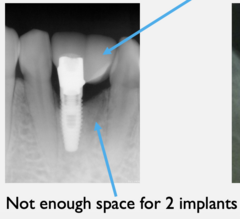
When placing and restoring an implant crown with a narrow space, it is better to place ______ than to have two implants close together
1 implant w/ cantilever 2nd crown
Which is better: a tissue level implant or a bone level implant on posterior teeth?
Tissue level
Why do we prefer tissue level implant over bone level implant for posterior teeth? (2)
- Only one microgap
- Better stability
The prevalence of peri-implantitis was significantly greater in the bone-level group when the emergence angle (EA) was > __ degrees
>30°
When a _____ profile was combined with an angle of >30 degrees, the prevalence of peri-implantitis was higher
Convex
What is the ideal implant morphology (3)
- Tissue level implant
- Less than 30 degrees emergence profile
- Concave profile
What problems may arise if restorative work is done with an inflamed periodontium?
A) Excessive gingival bleeding
B) Restored tooth is lost to complications of periodontal disease
C) Final crown margin exposed
D) All of the answers
D) All of the answers
Which of the following implant-supported crown design has the best prognosis and implant stability?
A) Cement-retained, splinted crowns
B) Cement-retained, single crowns
C) Screw-retained, splinted crowns
D) Screw-retained, single crowns
D) Screw-retained, single crowns