4.1.5 Perfect competition, imperfectly competitive markets and monopoly
 Call Kai
 Learn
 Practice Test
 Spaced Repetition
 Match
 Flashcards
 Knowt Play
1/71

There's no tags or description
Looks like no tags are added yet.
72 Terms
Important features of market structure
- Number of firms
- Market share of the largest firms
- Nature of costs (EoS + sunk costs)
- Degree to which an industry is vertically integrated
- Extent of product differentiation (affects XED)
- Structure of buyers in the industry (monopsony?)
-Turnover of customers (market churn) -> rate of loss of customers over a given period of time
Perfect Competition characteristics
HALFPPP
- Homogenous Products (all perfect substitutes)
- All firms have access to factors of production
- Large number of buyers & sellers
- Free entry and exit to/from the market
- Perfectly elastic demand curve
- Perfect knowledge / information
- Profit maximization assumed as key objective
- Supernormal profits in the short run but not in the long run
- Price taker
- High allocative efficiency
- Individuals cannot affect market price
Perfect Competition
A hypothetical market where competition is at its greatest possible level. Neo-classical economists argued that perfect competition would produce the best possible outcomes for consumers, and society.
Firms are passive price takers
MR=D=AR=P
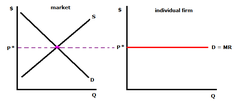
How does the market price change in a perfectly competitive market?
- In the short run, large profits attract new firms
- New firms enter market due to low barriers of entry
- Lower market price as supply increases
Oligopoly
A market dominated by a few producers. There is a high level of market concentration. E.g. petrol in the UK, soft drinks producers and the major high street banks.
Oligopoly characteristics
- Few dominant firms
- Product differentiation
- High Barriers to entry
- Supernormal profits in the short + long run
- Price maker but interdependent behaviour
- Non price competition important
- Low allocative efficiency
Duopoly
An oligopoly with only two firms e.g. Coca-Cola and Pepsi (soft drinks).
- High barriers to entry -> brand loyalty, product differentiation and huge research economies of scale.
Pure Monopoly
A market in which there are many buyers but only one seller. In the UK, to be considered a monopoly, you need to have 25% of more of the market share (proportion of sales)
- No close substitutes + no competition
- E.g. Utility companies, professional sports teams in an area
Monopoly power
Where a seller has enough power to act as a price maker in the market
Monopoly characteristics
- 1 firm
- Limited product differentiation
- High barriers to entry
- Supernormal profits in the short + long run (incentive to overcome barriers to entry)
- Price maker
- Low allocative efficiency
Geographical monopoly
A type of monopoly that exists where, for instance, a commodity is only found in 1 country e.g. precious metals/minerals + rural areas with only 1 shop
Natural monpoly
Where there is only room in the market for 1 firm benefitting from economies of scale to the full
E.g. Royal Mail, electricity and water -> network grip of cables and pipes
Competition is wasteful as it creates an unnecessary fixed cost to build new pipers and cables
Governement created monopoly
Government interference with markets that they consider too important to be left to competition
E.g. UK in 1940's nationalised coal, rail and steel as they thought it was key for the future economy
Constable market
- Perfectly contestable market = entry into and exit out must be costless
- Market with no barriers to entry and exit such as sunk costs
- E.g. hotel, room sharing industry, fast food, bookselling
Constable market characteristics
- Many firms
- Product differentiation
- Low entry and exit costs (lower risk of entering market)
- Low customer loyalty
- Any profit possible
- Supernormal profits in the short run invite hit an run entry
- Price maker (but actual and potential competition limits pricing power)
- Non price competition important
- Perfect information and the ability and/or the right of all suppliers to make use of the best available production technology in the market
Price taker
A firm that has no power to influence price in market -> they must accept the price set by the market
Competitive market
Any market in which firms strive to out do their rivals
Concentrated market
Only a very small number of firms operate
Price maker
a firm that has the power to set its price, rather than taking the price set by the market
Artificial barriers to entry
Barriers that an economic agent has put there by design
Natural barriers to entry
Those that simply exist, not anyone's fault that a big company gets to buy in bulk at a lower price.
Examples of natural barriers to entry
- Economies of scale -> larger firms get a lower average cost
- Indivisibilities ->make entry to some industries extremely challenging (e.g. power generation)
- Sunk Costs -> Costs that cannot be recovered on exit
Examples of artificial barriers to entry
- Patents for certain products
- Limit pricing
-Predatory pricing
- First mover advantage -> customer loyalty to the first into a market
- Bigger market spending by bigger companies
CMA
Competition and Markets Authority
- Responsible for weighing up whether a merger is in the public interest
they look at:
- Market share
- Local monopolies created
- R&D importance e.g. pharmaceutical firms
- Economies of scale in industry
Predatory pricing
- Strategy of driving competitors out of the market by setting very low prices or selling below AVC
- Once existing firms have been driven out and entry of new firms deterred it can raise price
- Key evaluation: Predatory pricing is illegal under the competition laws of most countries but is very difficult to prove.
Limit pricing
- Limit pricing is pricing by the incumbent firm(s) to deter entry or the expansion of fringe firms.
- The limit price is below the short run profit maximising price but above the competitive level
Limit pricing means a short run departure from profit maximisation.
- If successful, businesses can maintain their market power and make higher profits in the long term.
Profit maximisation
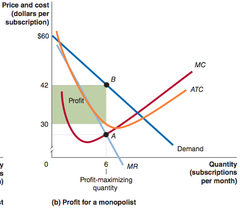
MR = MC
As long as MR > MC, it is worth producing and selling the extra unit, because there is profit in doing so.
Once MR < MC, for each extra item sold, the firm is losing money e.g. products become obsolete or out of date. therefore, they need to stop producing.
Marginal revnue
Extra money brought in by selling 1 more unit. This is also the price charged for the items (remains the same regardless of quantity)
Marginal cost
the cost of producing one more unit of a good.This changes as quantity changes. It first falls due to increasing returns to scale, then decreases due to diminishing returns.

Limitations of profit maximisation
- Managers think about long term profit maximisation which could include giving up profits in the short term to reinvest.
- Divorce of ownership in larger companies -> conflict on interest (favour status + power + expansion over profits)
- Asymmetry of information -> shareholders may not fully understand operation of the business like managers do -> harder to know if their ideas benefit the company
Principle / Agent problem
Principle = Shareholder
Agent = Manager
Problem -> agent doesn't always act in the best interest of principle
- Agent acts on behalf of principle but doesn't receive the full benefit or cost of their actions
- So agent's incentives aren't the same as the principal's
Reasons for avoiding profit maximisation
- Business may be profit seeking but not profit maximising
- Non profit organisations / charities
- Increasing market share by cutting prices
- Main aim could be profit maximisation in the long run (giving up in the short run)
Sales Maximisation
AR = AC
- Normal profits are made here (break even)
- At sales max -> Profit max should be achieved unless you have low efficiency + diseconomies of scale, causing AC to increase

Revenue Maximisation
MR = 0
- As you are selling more, the gain of selling falls (lowering MR)
- At the start there is a high price due to higher demand
Pink shows profit

Growth Maximisation
E.g. Amazon (Revenue is higher than profits as they reinvest to increase profits in the long term)
- Deciding to prioritise increasing size over other objectives
- Difficult to achieve growth + profit max at the same time -> conflicting interests
- Those directly involved in the business e.g. managers would favour growth to make them look good and get higher salaries
Market Share Maximisation
- A firm tries to become the biggest in a particular market + squeeze out competitors
- Secure role of oligopoly / monopoly
- MS max and growth max go hand in hand
Survival
- A firm's most basic objective
- This is the main aim of most firms in a highly competitive market or when their is a downturn in economic activity
Satisficing
- Achieving a satisfactory outcome rather than the best possible outcome
- e.g. Managers keep wages low but not so low to discourage workers
- A firm that is satisficing, is not operating as efficiently as it could
- In a competitive market, a firm must remain close to profit max to stay competitive but in a monopoly, firms can get away with satisficing
Profit satisficing
Where AR is above AC, this can be a possible satisficing price
Green shows the amount profit made at this price
SP cannot be above profit max price as that is unrealistic

Maximisers
Behave in a traditional economic way and always try to make best possible choice from the available alternatives.
Predatory + limit pricing
LTDs or PLCs
Satisficers
They focus on surviving but not maximising efficiency. This is okay in the short term but in the long term its not durable or profitable.
Sole Traders or managers who prefer increasing revenue and marker share
Rule of thumb
Use prior sales and communication activities to determine the present communication prices.
Used by satisficers
Cost Plus approach
Pricing method used by satisficers where the % of profit desired is added onto the cost
Used when demand is price inelastic
Long term and Short term objectives conflicts
Short term -> profit or growth
Long term -> higher profits
Firms taking a long term approach invest in R&D
Reasons for different objectives
- Managerial objectives
- Managerial utility (return for shareholders)
Business Objectives
- Profit
- Revenue
- Growth
- Market Share
- Share Price
- Social aims
- Reputation
- Survival
- Cashflow
- Managerial Aims
Why do businesses depart from profit maximisation?
- Imperfect Information
- Multi-product business
Why does imperfect info cause firms to depart from profit max?
- Hard to pinpoint precise profit maximising output as they can't accurately calculate marginal revenue and marginal cost
- Day-to-Day pricing decisions are taken on the basis of estimated demand / rule of thumb
- Cost plus pricing may be used when demand is price inelastic, increasing profits (hard to know exact elasticity of demand for a product)
Importance of self interest
Self interest of firms causes them to find a way to reduce production costs and gain a competitive advantage.
In a perfectly competitive market, all firms eventually have access to these methods and also reduce costs.
This benefits consumers overall.
Consumer sovereignty
Through exercising their spending power, consumers collectively determine what is produced in a market. Consumer sovereignty is strongest in a perfectly competitive market.
E.g. online petitions and campaigns on social networking websites has encouraged Cadbury to bring back Wispa bar.
Producer sovereignty
Producers or firms in a market determine what is produced and what prices are charged.
E.g. Re-launch using a joint venture with McDonald's to sell a Wispa McFlurry + 'For the love of Wispa' marketing campaign + memorable TV advert featuring BBC comedy shows.
Pros of monopoly
- Use supernormal profits for R&D -> improves dynamic efficiency -> lowers LRAC
- Economies of scale -> falling LRAC -> although they may not be productively efficient (on the lowest point of PPF) -> their average costs may be smaller than smaller firms
- Rarely global monopolies -> consumers still have choice
- If there was no monopoly, there would be a missing market -> market failiure
- Natural monopolies (necessary) -> huge sunk costs means competition is unnecessary
- 1 firm in a market doesn't always mean a monopoly -> constable market has low barriers to entry and exit -> firms act competitively to possible threats -> benefits consumers
- CMA and OFOM (regulation of telecommunications industry) ensure monopolies don't exploit consumers
- Some monopolies increase efficiency -> E.g. Google allows people globally to search better and smarter, Microsoft provide transferable IT skills, Network Rail provide train system all across UK to aid consumers
Cons of monopoly
- Raise prices and restrict output more than in a competitive market -> consumer surplus reduced -> deadweight loss
- No incentive to produce at a higher quality or better efficiency due to lack of competition
Factors influencing monopoly power
- Number of competitors in the area
- Advertising
- Product differentiation (the higher the PD, the higher the price in-elasticity of demand)
Advertising
- Informative Advertising -> informing consumers of rival products
- Persuasive Advertising -> sell lifestyle factors + increase brand loyalty
- Saturation Advertising -> something only large firms can afford to do + gain a competitive advantage
n-firm concentration ratio
A ratio indicating the combined market share of the leading n firms in a market (or the output of the leading n firms as a % of the total market output)
Monopoly and Market Demand
- Pure monopoly - demand curve = output curve
- Price maker - demand curve dictates max output which can be sold
- Quantity setter - demand curve dictates max price
Demand curve is downward sloping so monopolists can't set price and quantity independent of each other
Businesses avoid changing price and quantity by trying to shift demand curve right through advertising
Monopolies are examples of market failure + misallocation of resources
- Market is not doing its job
- Too little is being produced at a too little price. Economic welfare is less than it should be
- Effect greatest where demand for a good is relatively price inelastic
Collusion
Secret agreement or cooperation.
Occurs when firms try to reduce competition in a market illegally.
Can be good ->
Collaborating on research or common standard to benefit consumers
Cartel
A price ring is where firms agree to fix the price at a level above which the market would determine.
The price will be set at a level which will keep the least efficient members of the cartel in business and more efficient members can enjoy higher profits.
Resource inefficient.
Invention
The creation of new ideas for products or processes.
Innovation
Where inventions are turned into marketable goods or services.
Non-price factors that help businesses to compete
- Marketing and Advertising -> reputation
- Product differentiation
- Quality of product or service
- Good customer service
- Maintaining a loyal customer base
Price factors that help businesses to compete
- Promotion or offers
- Increased efficiency to lower average costs
- Premium Pricing
- Penetration Pricing
- Price Skimming
- Limit pricing
- Predatory pricing
Pentration Pricing
A pricing policy that sets the initial price for a new product very low.
Price skimming
A pricing strategy that involves setting prices higher before other competitors come into the market., then lowering it over time
E.g. Technology products
Limit Pricing
Reducing the price of a good to just above average cost to deter the entry of new firms into the market.
Prices are set at levels which are likely to make it unprofitable for potential entrants who might consider coming into the market
Firms sacrifice short term profits to maintain long term profits
Predatory Pricing
A strategy used to drive competitors out of the market by temporarily setting very low prices or selling below AVC (making a loss on each extra unit)
Price floors prevent this as this reduces competition
E.g. Shell and Esso allegations of predatory pricing over fuel costs
How do price wars occur?
- Firm cuts price
- Gain customers from more expensive substitute goods + high XED
- Gain customers from rivals -> more competitive
- Firms try to undercut eachother to increase revenue in the short term or increase market share in the long term
Why is price competition more important in a competitive market?
- Persuades customers to choose you over competitors
- Customers experience price before the quality of the good/service
Creative destruction
The process of industrial transformation from a competitive market to a monopolistic market and then back to competitive market.
E.g. CDs --> digital music downloads
TVs --> Internet
Truck drivers --> self driving (in future)
Books --> E books (Book industry is a dynamic
market)
Benefits of creative destruction
Firms become more productive + profitable -> citizens benefit from better products and living standards