Bio Unit Exam 1 and 2
 Call Kai
 Learn
Learn Practice Test
 Spaced Repetition
 Match
Match Flashcards
 Knowt Play
1/94

Earn XP
Description and Tags
Quiz 1, 2, and 3 and notes
Name | Mastery | Learn | Test | Matching | Spaced | Call with Kai | Chat |
|---|
No analytics yet
Send a link to your students to track their progress
95 Terms
4 Kingdoms in Eukarya
Animalia
Plantae
Fungi
Protista
3 Domains of Life
Bacteria and Archaea ← Prokaryotic
Eukarya ← Eukaryotic, Unicellular/Multicellular, Microscopic
Characteristics of Life
All living things:
Have structure, order
process energy → convert to different forms
Grow and Mature
React to stimuli
Reproduce
Maintain homeostasis (Stable internal condition)
Adapt, evolve over time
Eukaryotic Cells
Have Nucleus 2. Larger 3. Multicellular/Unicellular 4. More Complex
DNA
Stores genetic information within living organisms and cells
3 Domains of Life
Archaea, Bacteria, and Eukarya

Which of the following is true for helium?
Mass number = 4; atomic number = 2; charge = 0 (neutral)
Which part of the atom determines how the atom behaves chemically and its reactivity?
Electrons in the valence shell.
The atomic number of neon is 10. Therefore, which of the following is correct about an atom of neon?
It has 8 electrons in its outermost electron shell
Nitrogen-14 and nitrogen-15 are isotopes found naturally on Earth. Nitrogen-14 has a mass number of 14. Nitrogen-15 has a mass number of 15.
Based on this information, one can conclude that nitrogen-15 has more neutrons than nitrogen-14?
More neutrons
The atomic number of oxygen is 8. Based on its electron distribution, an atom of lithium will have a total of [ Select ] [2, 6 ] electron(s) in its valence shell. It will also have [ Select ] [2, 6] unpaired electron(s) in its valence shell.
6, 2
Molecule
Grouping of two atoms bonded together or more
Compound
Grouping of greater than or equal to 2 atoms bonded together and greater than or equal to 2 different elements.

Intramolecular
bonds between atoms that make up one molecule compound

Intermolecular
bonds/interactions between two different molecules/compounds
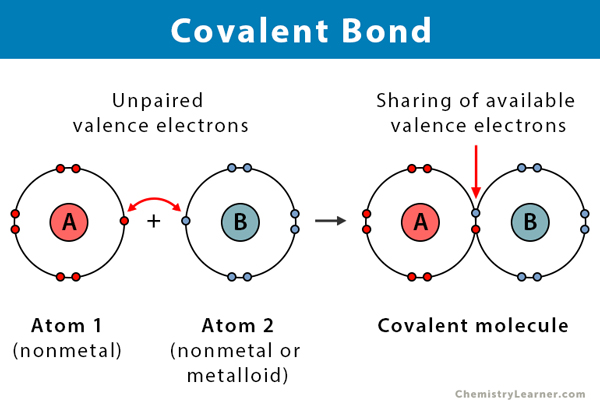
Covalent Bond
Sharing of electrons ( e-) between atoms
STRONGEST chemical bond ( in biology)
# of covalent bonds possible = # of unpaired electrons
1 line = 1 pair e- 2 line = 2 pair e- 3 line = 3 pairs e
Non-polar covalent bonds
Atoms have similar / sameEN
Electrons share equally
EN difference < 0.5
(SUBTRACT element EN and see if the sum is less than 0.5)
NO CHARGE ON ATOMS
Polar covalent bonds
Atoms have different EN
Electrons shared unequally
EN difference >_ 0.5 (and <1.7)
ATOMS have PARTIAL CHARGE
Higher EN = ( - ) Partial Charge NEGATIVE
Lower EN = ( + ) Partial Charge POSITIVE
If one atom is more electronegative than the other atom in a covalent bond, then there is unequal sharing of electrons and the electrons are pulled closer to the more electronegative atom’s nucleus.
What is the chemical bond that is formed by this unequal sharing of electrons?
Polar covalent bond
Electronegativity
Atoms tendency to attract electrons towards itself
Molecular Polarity
Polar or non-polar covalent bonds
Geometry or Symmetry
Polar Molecule / Compound must have:
Polar covelant bonds.
Asymmetrical Geometry on all sides
Ionic Bonds (Intramolecular) bond between 2 compounds
Attraction between oppositely charged ions
atoms give/take electrons → ions
WEAK BOND
2 types of Ions
Cation ( + ) POSITIVE
Arion ( - ) NEGATIVE
Atom can become Cation if it loses an electron
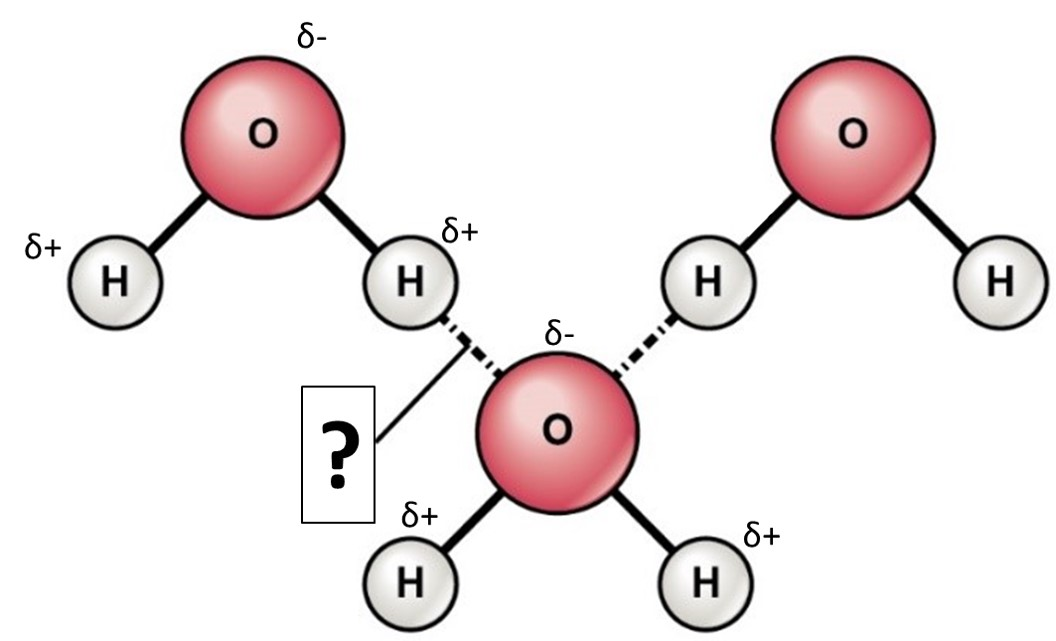
What bond is the question Mark?
Hydrogen Bond
Hydrogen Bond - Intermolecular
WEAK Attraction between PARTIAL + hydrogen ( of one molecule) and electronegative atom ( of a different molecule)
Based On → PARTIAL CHARGE of DIFF MOLECULE
Van der Walls Interaction
Based on TEMPORARY PARTIAL charges on DIFFERENT molecules
WEAK ATTRACTION
between NONPOLAR MOLECULes
because of TEMP or UNEQUAL Electron Distribution and partial charge changing
MOST common interaction between non polar molecule
TEMP UNEQUAL ELECTRON DISTRIBUTION
Water is essential to Life. Which of the following is NOT a property of water
Water is a non polar molecule
Why is ice (solid water) less dense than liquid water?
When water freezes, the water molecules move farther apart from each other to form more stable hydrogen bonds to become solid.
Given the information below, determine if ammonia (NH3) is a polar or nonpolar molecule.
Ammonia (NH3) has asymmetrical geometry.
Electronegativity of nitrogen is 3.0. Electronegativity of hydrogen is 2.1.
Ammonia is a polar molecule
emergent properties
When smaller combine → form larger/complex things
Base (Basic, Alkaline) 7 - 14 pH
Hydrogen Ion acceptor
Absorbs / Binds to H+ in Solution
[ H+ ] DECREASES
[Hydroxide OH-] INCREASES
pH INCREASES
[OH - > [H+]
Acid
H+ Donor
(Gives away / add hydrogen ions to solution)
[H+] Increases
[OH-] Decreases
pH DECREASES
[H+] > [OH-]
Cohesion and Adhesion
Cohesion → 1 group United (water molecules STICK to OTHER WATER MOLECULES)
Adhesion → water molecules STICK to OTHER MOLECULES
Polar Molecules, surfaces interact with water → become wet
Solute
Substance that is being dissolved
Solvent
the dissolving agent of a solution
Solution
Liquid that is completely homogenous mixture of substances (Solute and Solvent)
Molarity
Unit of Concentration
Hydrophobic
Avoid Water
NON POLAR SUBSTANCE → ______
If the hydrogen ion (H+) concentration of a solution is 1 x 10-12 M, then what is the pH of this solution?
Asking for pH ( 0 - 14 )
pH = - log [ 1 × 10 > -12 M]
pH = - ( -12)
pH = 12
If the solution has a H+ concentration of 1 x 10⁻⁴ M, then the OH- concentration is __ and the pH is 10 _ .
[H +] x [OH -] = 1 × 10>-14 M
We know H+, input it in
1 × 10> -4 M x. [OH -]. = 1 × 10 >-14 M
Subtract the Exponents
-14 - (-4) = -10
1 × 10 >-10 M
After finding [OH -] find the pH
pH = -log [1 × 10 >-10 M]
ph = -( - 10)
ph = 10
Carbon
Foundation of organic molecules
Backbone of biologically relevant molecules/compounds. → Carbon is teravalent (form up to 4 bonds with diff. atoms) Caternation → Carbon bond to itself in long series ( chains and rings
Organic
Must have Carbon and Hydrogen. (Can have other elements)
Which statement correctly describes organic compounds?
Organic compounds must be made up of carbon and hydrogen and may have other elements.
Inorganic
Contains no hydrogen and no carbon. Must have both H + C to be organic.
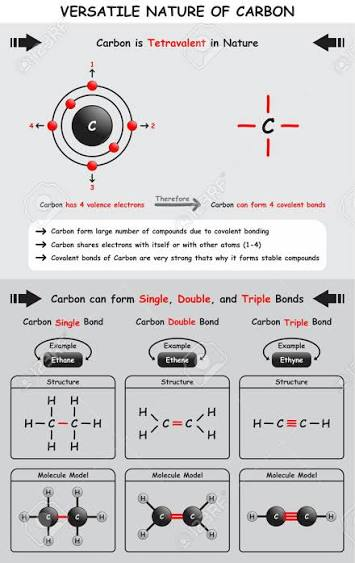
Carbon is tetravalent
Can form up to 4 bonds with different atoms. ( 4 valence elections)
Catenation
Carbon can bond to itself in long series (chains and rings)
Hydrocarbon (Simplest Organic Compound)
ONLY made of Carbon and Hydrogen (C + H)
Simplest
Non-polar / Hydrophobic
Isomers
Same chemical formula BUT diff. arrangement of atoms (different SHAPE)

Macromolecules
Large complex molecules formed from smaller molecules joined together
Multiple small molecules form to make large molecule
Macromolecules contain
functional groups
Functional Groups
Hydroxyl Group (H and O)
O- H or OH
Carbonyl Group (C and O)
O=C (Ketone
H - C = O (Aldehyde)
Carboxyl Group (Carbonyl + Hydroxyl)
OH - C = OH
Amino (Fats)
H - N - H or R - NH2
Sulfhydral
S - H or. SH
Methyl
H - C - H
H
R - CH3
Phosphae
H
O - P - O
O
R - OPO23
Hydroxyl Group
Made up of Hydrogen and Oxygen
(R is the rest of the molecule)
R - O - H
R - OH
HO = OH (Still the same)
Polar
Hydrophillic
Carbonyl Group
Made up of Carbon and Oxygen
O
II Ketone ( C = O )
R - C - R
R - C = O
I Aldehyde ( H - C = O )
H
Polar
Hydrophillic
Carboxyl Group
Made up of Carbonyl and Hydroxyl
R - C = O
I ( R - COOH )
OH
Polar
Hydrophilic
Acidic ( Donates Hydrogen ions (H+)
Amino
Made up of 1 Nitrogen and 2 hydrogen
R - N - H
I R - NH2
H
Polar
Hydrophilic
Basic / BASE ( Takes away Hydrogen Ions )
Sulfhydral
Group made of Sulfide and Hydrogen
R - S - H
R - SH
Polar
Hydrophililc
Methyl
Group made of 1 Carbon and 3 Hydrogen
H
I
R - C - H R - CH3
I
H
Non-polar (UNIQUE)
Hydrophobic
Phosphate
Group made up of Oxygen with negative partial charges, Phosphate, and Hydrogen.
H
I
R - O - P - O(-) R - OPO2 3
I
O(-)
Polar
Hydrophilic
Negatively Charged

What function group is shown in this image below?
Sulfhydryl group
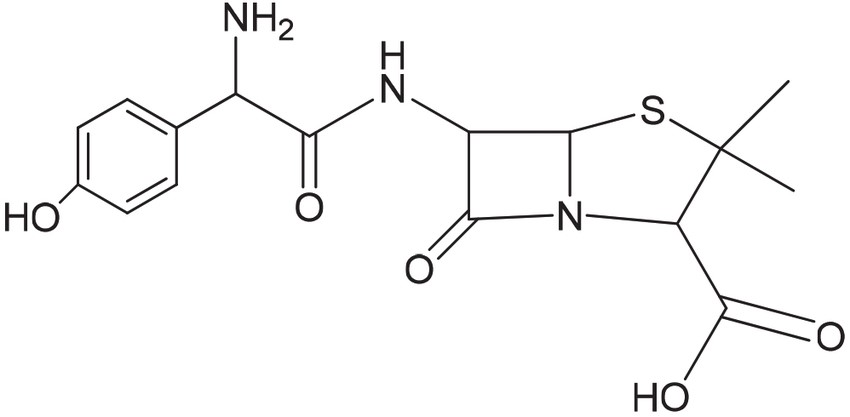
Antibiotics are commonly used in medicine to treat bacterial infections. One common antibiotic is amoxicillin (similar to penicillin). The (short-hand) chemical structure of amoxicillin is shown below.
Which functional group is NOT present in amoxicillin?
Sulfhydryl group
Polymer
Group / Chain of linked monomers
→ O - O - O - O - O - O
Monomer
Small molecule, Building blocks for larger complex molecules called polymers.
→ O
O - O - O - O - O
Lipids are…
Not Polymers
How are Polymers Formed?
Dehydration Synthesis → “remove” + “hydrate” (Remove Water)
Put monomers together to make polymers
Make new bond
O - O - O - ( H HO) - O ( H2O Removed)
O - O - O - O ( New Covalent Bond)
How are Polymers broken down?
Hydrolysis ( Hydro → water + lysis → splitting)
Breaking apart monomers
Break bonds
(Opposite of Dehydration Synthesis)
O - O - O - O
O - O -O - H HO - O (Bond Broken)
Carbohydrates
( “carbon” + “hydrates” “contain water” )
Macros made of C, H, O (Carbon, Hydrogen, and Oxygen)
Function
Energy source
Short - term energy storage
Structural Support
Monomer → Monosaccharide (“mono” one + saccharide “sugar”)
One Sugar
Polymer → Polysaccharides (“poly” many + saccharide “sugar”)
Many Sugar
What are the functions of Carbonhydrates
Function
Energy source
Short - term energy storage
Structural Support
What is the monomer and polymer of Carbonhydrates?
Monomer → Monosaccharides Polymers → Polysaccharides
Carbohydrate Simple Sugars
Simple Sugar - C n H2 nOn.
Ex: C n H 2 O n *5 = C5 H10 O5
Ex: C n H 2 O n. *6 = C6 H10 O5
Aldose = Aldehyde (Carbonyl Group) | C5 H10 O5 → Pentose: 5 - Carbon Sugar
Ketose = Ketone (carbonyl group) | C6 H12 O6 → Hexose: 6 - Carbon Sugar
Simple Sugar Pentose → 5 CARBON
Simple Sugar Hexose → 6 CARBON
What is the Simple Sugar Format?
C n H 2 O n
Pentose
Aldose = Aldehyde (Carbonyl Group) | C5 H10 O5

Which statement is false about the monosaccharide (carbohydrate) below?
This monosaccharide is a ketose sugar.
Hexose
Ketose = Ketone (carbonyl group) | C6 H12 O6
How are monosaccharides joined?
Joined by Glycosidic Linkage
Glycosidic Linkage
Covalent Bond between two monosaccharides formed by dehydration synthesis
O - O - O - ( H HO) - O ( H2O Removed, 2 Hydrogen and 1 oxygen removed)
O - O - O - O ( New Covalent Bond)

Disaccharide monomer count
2 monomers
Oligosaccharide monomer count
3 - 10 monomers
Are carbohydrates made of several monosaccharides

What type of carbohydrate is shown in the image below?
Oligosaccharide
Polysaccharide monomer count
10 or more monomers
Polysaccharide Functions
Short - term energy storage
Starch → Plants
Glycogen → Animals
Structural Support
Cellulose → Plants (Cell Wall)
Chitin → Some animals and Fungi (cell walls)
Starch and glycogen, which are both polysaccharides, differ in that starch is used for _______ whereas glycogen is used for ________ .
energy storage in plants
energy storage in animals
Lipids
Lipids (fats)
Hydrophobic macromolecules (hate water)
NOT Polymers
Mostly C + H (Carbon + Hydrogen). ( C-C , C-H) ← Non-polar Covalent Bonds
Carboxyl → Acidic → Fatty (Acid) Carboxyl put the acid in fatty acid
NO Monomers and Polymers
Building Blocks: Fatty Acid, Glycerol
Complex Lipids: Triglycerides and Phospholipids

Lipid Functions
Long - term Energy Storage
Insulation / Cushoning
Insulation → Fat keeps in heat
Cushioning - Fat adds cushion to butt (ass)
Signaling (as hormones)
Triglycerides
Most common type of fat
(Tri “three” + glyceride “contains glycerol”)
3 fatty acids joined to 1 glycerol molecule via glycosidic linkage

Saturated Fats
No double bonds ( C = C ) in chain
Max # of hydrogen
Linear Shape → they pack well together (lots of van der waals)
Solid at room temp
Unsaturated Fats
At least one double bond ( C = C ) in chain
Not max # of hydrogen
Bent / Kinked shape -> they DO NOT Pack well together (not many van der walls)
Hydrogenation
Adding hydrogens to an unsaturated fat to create saturated fats (eliminate double bonds)
You look at the label on a container of shortening and see the words “hydrogenated vegetable oil.” This means that during processing, the number of carbon–carbon double bonds in the oil was decreased. What is the result of decreasing the number of double bonds?
The oil is more likely to become solid at room temperature after this processing.

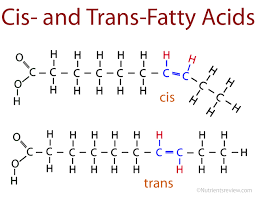
Trans - fats
Isomer (Double bonded)
Unsaturated = Cis (Hydrogen atoms same side)
H - C = C - H
I I
H. H
Trans = Hydrogen atoms on different sides
C - C = C - H
I I
H C
Phospholipid
Phospholipid = Phosphate Group
O
II
R - O - P - O(-)
I
O(-)

What is the function of the lipid molecule shown below?
Form membrane bilayers when a group of these molecules are together.
Lipids are an interesting group of macromolecules. Lipids are generally nonpolar and [ Select ] ["hydrophilic", "hydrophobic"] macromolecules that do not form polymers.
One major type of lipid is called the triglycerides, which are structurally characterized as one [ Select ] ["glycerol", "steroid", "fatty acid", "hydrocarbon"] molecule bonded to three [ Select ] ["hydrocarbon", "steroid", "glycerol", "fatty acid"] molecules. Triglycerides serve a variety of roles within living organisms such as storing energy (for long-term use).
hydrophobic, glycerol, fatty acids
Amphipathic
Have hydrophilic and hydrophobic parts
Love and hate water
Steroids
Signaling molecules (hormones)
4 fused ring chemical structure

What are compounds that have the same numbers of atoms (of the same elements) but different structures and arrangements of those atoms?
Isomers
Which statement(s) correctly describe why carbon is the "backbone" of organic compounds?
(Note: this is a "multiple answers" type of question in which you must select all correct answers for full credit. Selection of incorrect answer choices will result in penalties and loss of partial credit.)
Carbon is tetravalent and has four unpaired valence electrons
Carbon atoms can bond together in series to form long linked chains, rings, and branched structures.
Which of the following statements about amino groups is true?
They can act as bases