NCSU Organic Chemistry Exam 3 Review (Kramer)
 Call Kai
 Learn
 Practice Test
 Spaced Repetition
 Match
 Flashcards
 Knowt Play
1/76

There's no tags or description
Looks like no tags are added yet.
77 Terms
What is the general chemical formula for an alkyne?
CnH2n-2
When naming a molecule containing both an alkene and an alkyne, how are they numbered?
Give the lowest numbering to the first functional group encountered; if there is a tie, the alkene takes priority.

What is the hybridization and bond angle of an alkyne carbon?
sp hybridization with a linear shape and 180° bond angles.
How does the strength and length of an alkyne bond compare to an alkene bond?
The alkyne bond is shorter and stronger than an alkene bond.
What is the approximate pKa of a terminal alkyne?
Approximately 26.
Why can terminal alkynes be deprotonated by strong bases like NaNH2?
Because the terminal alkyne proton is significantly more acidic (pKa ~26) than alkanes (pKa ~60) or alkenes (pKa ~45).

What is the main limitation of alkylating a terminal alkyne using an alkyl halide?
The reaction fails with 3° alkyl halides because E2 elimination occurs instead of SN2 substitution.

How can an internal alkyne be prepared from a geminal dihalide?
By double dehydrohalogenation using 2 equivalents of NaNH2 in NH3.

How can an internal alkyne be prepared from a vicinal dihalide?
By double dehydrohalogenation using 3 equivalents of NaNH2 in NH3 and then H2O.
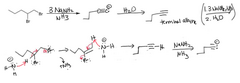
What is the product of catalytic hydrogenation of an alkyne using H2 and Pd/C?
An alkane.

Which reagent is used to reduce an alkyne to a cis-alkene?
H2 with Lindlar Pd catalyst.

Which reagents are used to reduce an alkyne to a trans-alkene?
Dissolving metal reduction using Na or Li in NH3.

Example of use: multistep synthesis
If trans alkane: Na/NH3; If cis alkane: H2/Lindlar Catalyst Then mCPBA to form the epoxide with either both R groups on solid/dashed if cis, or R group on differing wedges if trans.

What is the product of the addition of 2 equivalents of HBr to a terminal alkyne?
A geminal dihalide, following Markovnikov's rule.

What is the product of the addition of 2 equivalents of HBr to an internal alkyne?
A geminal dihalide 50/50 mixture with both Br on one of the carbons in the triple bond, following Markovnikov's rule.
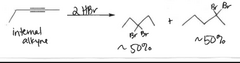
What is the result of adding 2 equivalents of Br2 to an internal alkyne vs 1 equivalents ?
A tetrahalide (addition of two bromines to each carbon of the original triple bond) for 2 equivalents (alkane formation). A vicinal dihalide across an alkene, not an alkane.

What reagents are required for the hydration of an alkyne to a ketone?
H2O in solvent of H2SO4 with an Hg2+ catalyst.

What is tautomerization in the context of alkyne hydration?
The process where an enol (formed by hydration) rapidly converts into a more stable keto form (ketone).

What are the products of the ozonolysis (1. O3 2. H2O/H3O+) of an internal alkyne?
Two carboxylic acids (RC=OOH).

What are the products of the ozonolysis (1. O3 2. H2O/H3O+) of a terminal alkyne?
A carboxylic acid (RC=OOH) and carbonic acid (H2CO3).

How can you synthesize a cis-alkene from an alkyne in a multi-step synthesis?
Use Lindlar Pd and H2.
How can you synthesize a trans-alkene from an alkyne in a multi-step synthesis?
Use Na or Li in NH3.
What is the physical solubility of alkynes in water?
They have low water solubility, similar to alkanes and alkenes.
What is the result of the reaction between a terminal alkyne and NaNH2 followed by an alkyl halide?
An internal alkyne (carbon-carbon bond formation via SN2 alkylation).
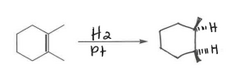
What is the stereochemistry of catalytic hydrogenation of alkenes?
It is a stereospecific syn addition, where both hydrogen atoms add to the same face of the double bond.
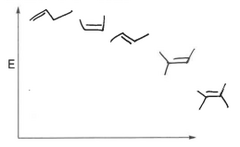
How does alkene substitution affect the heat of hydrogenation?
The heat of hydrogenation decreases as the alkene becomes more substituted, indicating higher stability.
What is the regioselectivity of electrophilic addition of hydrogen halides (HX) to alkenes?
It follows Markovnikov addition, where the hydrogen adds to the less substituted carbon and the halogen adds to the more substituted carbon.

What is the relative reactivity of hydrogen halides in electrophilic addition to alkenes?
HF << HCl < HBr < HI (HI is the fastest).
What phenomenon can occur during hydrogen halide addition to alkenes that results in a different major product than expected?
Carbocation rearrangement.

What are the conditions for acid-catalyzed hydration of alkenes to favor alcohol formation?
Use of dilute H2SO4 (high concentration of water).

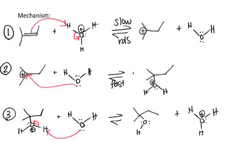
Mechanism for acid-catalyzed hydration of alkenes?
Pi bond steals H+ from H3)=P+O, H2O attaches to carbocation, another H2O steals H from H2O on carbocation.
What are the conditions for acid-catalyzed dehydration of alcohols to favor alkene formation?
Use of concentrated H2SO4 with heat (low concentration of water).

What is the regioselectivity and stereochemistry of hydroboration-oxidation?
It is anti-Markovnikov and a syn addition (OH and H add to the same side).

What is the stereochemistry of halogen (Br2 or Cl2) addition to alkenes?
It is a stereospecific anti addition.
What intermediate is formed during the addition of Br2 to an alkene?
A cyclic bromonium ion.
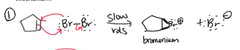
What is the product of the reaction of an alkene with Br2 in the presence of water?
A vicinal halohydrin.

What reagents are typically used for the epoxidation of an alkene?
A peroxyacid such as mCPBA.

What is the stereochemistry of epoxidation of alkenes?
Syn addition.
What is the mechanism of epoxidation of alkenes?
Pi bond attacks lone pair on Br2 whilst the same Br attacks a carbon (forming bromonium), H2O comes in and attacks more substituted carbon, breaking one bond to bromonium, another H2O steals H and major product of vicinal halohydrin is formed.

How can a vicinal halohydrin be converted into an epoxide?
By treatment with a base (e.g., NaOH or NaOCH3).

In the nucleophilic ring-opening of an epoxide, where does the nucleophile attack?
It attacks the less hindered carbon (SN2-like mechanism).

In the acid-catalyzed ring-opening of an epoxide, where does the nucleophile attack?
It attacks the more hindered carbon.

What are the products of the reductive ozonolysis of an alkene?
Aldehydes(RHC=O) and/or ketones, depending on the substitution of the alkene.
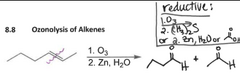
What are the products of the oxidative ozonolysis of an alkene?
Carboxylic acids and/or ketones.

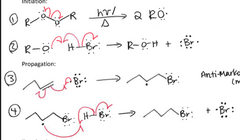
What is the regioselectivity of the free-radical addition of HBr to alkenes?
Anti-Markovnikov addition.
What reagents are required to initiate the free-radical addition of HBr?
Peroxides (ROOR) and heat or light.

Why does free-radical addition of HBr result in anti-Markovnikov products?
Because the reaction proceeds through the more substituted, and therefore more stable, radical intermediate.
What is the trend of carbocation stability?
Carbocation stability increases with substitution: methyl < primary < secondary < tertiary, further stabilized by resonance and hyperconjugation.
What are carbocation rearrangements?
Processes where a carbocation shifts via hydride or alkyl shifts to form a more stable carbocation intermediate.
What is the trend of heats of hydrogenation?
The heat of hydrogenation is inversely proportional to the stability of the alkene; more substituted alkenes release less heat upon hydrogenation.
How does substitution pattern affect reaction rate in electrophilic addition?
Increased substitution on the alkene increases the rate of reaction by stabilizing the transition state leading to the carbocation intermediate.
What components are found on a reaction coordinate diagram?
Reactants, products, intermediates, transition states, activation energy (Ea), and the overall enthalpy change (delta H).
What is the regioselectivity of the addition of hydrogen halides to alkenes?
It follows Markovnikov's rule, where the hydrogen adds to the carbon with more hydrogens, and the halide adds to the more substituted carbon.
What is the product of acid-catalyzed hydration of an alkene?
An alcohol, formed by the addition of water across the double bond following Markovnikov regioselectivity.
What is the outcome of hydroboration-oxidation of an alkene?
An alcohol formed via anti-Markovnikov addition with syn-stereochemistry.
What is the stereochemical outcome of halogen addition (X2) to an alkene?
Anti-addition, resulting in a vicinal dihalide where the two halogens are on opposite faces of the molecule.
What is a halohydrin?
A compound containing both a halogen and a hydroxyl group on adjacent carbons, formed by reacting an alkene with X2 in the presence of water.
What are the products of ozonolysis with reductive vs. oxidative workup?
Reductive workup (e.g., DMS) yields aldehydes or ketones; oxidative workup (e.g., H2O2) yields carboxylic acids or ketones.
What is the result of catalytic hydrogenation of an alkene?
The reduction of an alkene to an alkane using H2 and a metal catalyst (e.g., Pd/C, Pt, or Ni) with syn-addition.
How does radical addition of HBr differ from ionic addition?
Radical addition (in the presence of peroxides) follows anti-Markovnikov regioselectivity.
What is the regioselectivity of nucleophilic ring opening of epoxides?
In basic conditions, the nucleophile attacks the less sterically hindered carbon; in acidic conditions, it attacks the more substituted carbon.
What is the hybridization of alkyne carbons?
Alkyne carbons are sp hybridized, resulting in a linear geometry with a bond angle of 180 degrees.
How does the acidity of terminal alkynes compare to alkenes and alkanes?
Terminal alkynes are significantly more acidic (pKa ~25) than alkenes (pKa ~44) or alkanes (pKa ~50) due to the higher s-character of the sp-hybridized carbon.
What is the difference between geminal and vicinal dihalides?
Geminal dihalides have both halogens on the same carbon; vicinal dihalides have halogens on adjacent carbons.
What is the role of the Lindlar catalyst in alkyne hydrogenation?
It is a poisoned catalyst that stops the hydrogenation of an alkyne at the alkene stage, specifically yielding a cis-alkene.
What does sodium ammonia (Na/NH3) reduction do to an alkyne?
It reduces an internal alkyne to a trans-alkene.
What is tautomerization?
The rapid interconversion between an enol and a ketone (or aldehyde) via proton transfer, typically catalyzed by acid or base.
How are acetylides used in synthesis?
Terminal alkynes are deprotonated with a strong base (like NaNH2) to form a nucleophilic acetylide ion, which can then perform SN2 reactions on alkyl halides to extend the carbon chain.

In the retrosynthetic analysis of the cis-alkene example (using ethyl bromide and acetylene), what intermediate is identified?
An epoxide intermediate which is then converted to the cis-alkene.
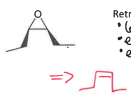
What is the key retrosynthetic step for creating the trans-alkene example from acetylene and ethyl bromide?
The formation of a vicinal dihalide intermediate, which is then reduced.

In the synthesis of the cis-alkene example, why is Lindlar's catalyst used?
To perform a selective partial hydrogenation of the alkyne to the cis-alkene.

What is the purpose of using NaNH2/NH3 followed by an alkyl halide in the synthesis examples?
To perform carbon-carbon bond formation (alkylation) to extend the carbon chain.

What is the role of Br2 in the synthesis of the trans-alkene example?
It is used to form a vicinal dihalide, which serves as a precursor to the final alkane structure.

What is the primary difference in the retrosynthetic approach between the cis-alkene and trans-alkene examples provided?
The cis-alkene synthesis utilizes an epoxide/Lindlar pathway, while the trans-alkene synthesis utilizes a vicinal dihalide/reduction pathway.

How many alkylation steps are required to build the 6-carbon chain in the provided synthesis examples?
Two alkylation steps are required to add the necessary carbon groups to the acetylene core.

In the first retrosynthetic analysis example provided, how is the azide group introduced?
Via an SN2 reaction using NaN3 on a bromide intermediate formed from HBr addition.

In the second retrosynthetic analysis example, what is the key step to convert the alkene to a nitrile?
The use of KCN to displace a leaving group (like a bromide) after functional group interconversion.
