Humas Phys Exam 3 (Menstual, birth control, harmones, nephrin)
 Call Kai
 Learn
 Practice Test
 Spaced Repetition
 Match
 Flashcards
 Knowt Play
1/57

There's no tags or description
Looks like no tags are added yet.
58 Terms

What is A and what is its function?
Afferent arteriole: Brings blood into the glomerulus for filtration.

What is B and what is its function?
Efferent arteriole: Carries blood out of the glomerulus and helps maintain filtration pressure.
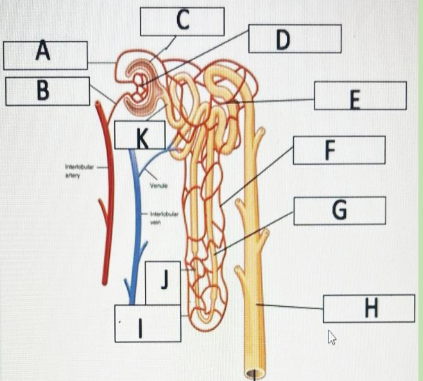
What is C and what is its function?
Bowman's capsule: Surrounds the glomerulus and collects filtered fluid (filtrate).

What is D and what is its function?
Proximal convoluted tubule: Reabsorbs most water, glucose, amino acids, and ions; secretes wastes.

What is E and what is its function?
Distal convoluted tubule: Fine-tunes ion, water, and pH balance under hormone control.

What is F and what is its function?
Peritubular capillaries: Reabsorb water/solutes from tubules and aid in secretion.

What is G and what is its function?
Ascending loop of Henle: Pumps out salts (Na+ and Cl-) while blocking water to dilute filtrate and build the medullary gradient.

What is H and what is its function?
Collecting duct: Adjusts final water reabsorption (via ADH) and drains urine to the renal pelvis.

What is I and what is its function?
Vasa recta: Parallel capillaries around the loop of Henle that preserve the medullary gradient while reabsorbing water and solutes.

What is J and what is its function?
Descending loop of Henle: Lets water exit into the medulla to concentrate filtrate.
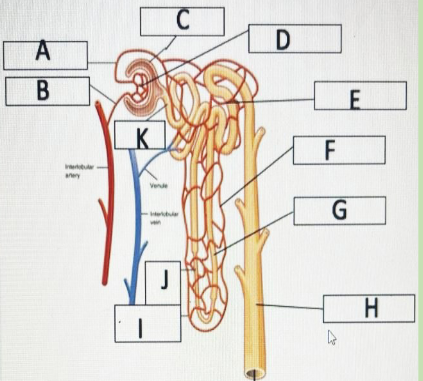
What is K and what is its function?
Glomerulus: Capillary tuft that filters water and small solutes from blood.
What harmones are made in the Hypothalamus
Prolactin releasing hormone, Prolactin inhibiting hormone, Thyrotropin releasing hormone, Corticotropin releasing hormone, Growth Hormone releasing hormone, Growth hormone inhibiting hormone (aka somatostatin), Gonadotropin releasing hormone, Oxytocin, Anti-diuretic hormone (ADH) / Vasopressin
What harmones are made in the Posterior Pituitary
Oxytocin, Anti-diuretic hormone (ADH) / Vasopressin (secreted here by neurons originating in the hypothalamus)
What harmones are made in the Anterior Pituitary
Prolactin, Thyroid stimulating hormone, Adrenocorticotropic hormone (ACTH), Growth hormone, Follicle stimulating hormone, Luteinizing hormone
What harmones are made in the Thyroid
T3 and T4, Calcitonin
What harmones are made in the Parathyroid
Parathyroid hormone
What harmones are made in the Adrenal Glands
Adrenaline (epinephrine), Cortisol, Aldosterone
What harmones are made in the Ovaries
Estradiol and Progesterone
What harmones are made in the Testes
Testosterone
What harmones are made in the Kidney
Erythropoietin
What harmones are made in the Pineal Gland
Melatonin
What harmones are made in the Liver
Insulin-like growth factor-1
what function does Prolactin releasing hormone have and where is it located
Stimulates release of prolactin; made in the hypothalamus
what function does Prolactin inhibiting hormone have and where is it located
Inhibits release of prolactin; made in the hypothalamus
what function does Thyrotropin releasing hormone have and where is it located
Stimulates release of thyroid stimulating hormone; made in the hypothalamus
what function does Corticotropin releasing hormone have and where is it located
Stimulates the release of adrenocorticotropic hormone (ACTH); made in the hypothalamus
what function does Growth Hormone releasing hormone have and where is it located
Stimulates release of growth hormone; made in the hypothalamus
what function does Growth hormone inhibiting hormone (aka somatostatin) have and where is it located
Inhibits growth hormone secretion and therefore IGF secretion; made in the hypothalamus
what function does Gonadotropin releasing hormone have and where is it located
Stimulates release of gonadotropins (follicle stimulating hormone and luteinizing hormone); made in the hypothalamus
what function does Oxytocin have and where is it located
Secreted into systemic circulation in the posterior pituitary by neurons originating in the hypothalamus
what function does Anti-diuretic hormone (ADH) / Vasopressin have and where is it located
Secreted into systemic circulation in the posterior pituitary by neurons originating in the hypothalamus
what function does Prolactin have and where is it located
Stimulates mammary gland development and milk secretion; secreted from anterior pituitary (made by hypothalamus neurons into H-P portal system)
what function does Thyroid stimulating hormone have and where is it located
Stimulates release of thyroid hormones in thyroid; secreted from anterior pituitary (made by hypothalamus neurons into H-P portal system)
what function does Adrenocorticotropic hormone (ACTH) have and where is it located
Stimulates release of glucocorticoids (including cortisol) in adrenal gland; secreted from anterior pituitary (made by hypothalamus neurons into H-P portal system)
what function does Growth hormone have and where is it located
Stimulates growth and regulates energy metabolism including stimulation of insulin-like growth hormone (IGF) in liver; secreted from anterior pituitary (made by hypothalamus neurons into H-P portal system)
what function does Follicle stimulating hormone have and where is it located
Stimulates development of eggs and production of estrogens in the ovary and sperm in testes, and stimulates inhibin in both sexes; secreted from anterior pituitary (made by hypothalamus neurons into H-P portal system)
what function does Luteinizing hormone have and where is it located
Stimulates ovulation and secretion of estrogens and progesterone in females and stimulates secretion of androgens in males; secreted from anterior pituitary (made by hypothalamus neurons into H-P portal system)
what function does T3 and T4 have and where is it located
Two forms of thyroid hormone inducing metabolic changes; located in the thyroid
what function does Calcitonin have and where is it located
Lowers plasma levels of calcium; located in the thyroid
what function does Parathyroid hormone have and where is it located
Regulates blood calcium; located in the parathyroid
what function does Adrenaline (epinephrine) have and where is it located
Triggers fight or flight responses; located in the adrenal glands
what function does Cortisol have and where is it located
Long term stress hormone; located in the adrenal glands
what function does Aldosterone have and where is it located
Regulates plasma levels of salt in the kidney; located in the adrenal glands
what function does Estradiol and Progesterone have and where is it located
Secondary sex characteristics at puberty, propagation of menstrual cycle, continuation of oogenesis, etc.; located in the ovaries
what function does Testosterone have and where is it located
Secondary sex characteristics at puberty, spermatogenesis, etc.; located in the testes
what function does Erythropoietin have and where is it located
Increased RBC development; located in the kidney
What happens during week 1 of the menstrual cycle
Hypothalamus and pituitary release baseline GnRH, FSH, and LH; ovaries begin maturing follicles with low rising estradiol; uterus sheds its lining (menstrual flow) then starts rebuilding.
What happens during week 2 of the menstrual cycle
Hypothalamus and pituitary produce an LH surge and FSH peak around ovulation; ovaries mature a dominant follicle with peak estradiol then release an oocyte; uterus thickens and vascularizes its lining.
What happens during week 3 of the menstrual cycle
Hypothalamus and pituitary keep LH and FSH low; ovaries form the corpus luteum releasing high progesterone and moderate estradiol; uterus maintains a thick, glandular lining for potential implantation.
What happens during week 4 of the menstrual cycle
Hypothalamus and pituitary stay at low baseline activity without pregnancy hormones; ovaries see corpus luteum degeneration and falling progesterone and estradiol; uterus loses hormonal support and begins lining breakdown toward menstruation.
Hormonal Contraception (Ovulation Suppression)
Uses exogenous estrogen and progestins (pill, patch, ring, shot, implant, hormonal IUD) to prevent the LH surge and stop the release of an egg (ovulation), while thinning the uterine lining.
Emergency Contraception (Plan B / ulipristal acetate)
Taken after unprotected sex to delay ovulation and create a buildup of cervical mucus that impairs fertilization; does not disrupt an already implanted pregnancy.
Physical / Mechanical Barriers
Devices (external/internal condoms, diaphragm, cervical cap, vaginal sponge) that physically block sperm from entering the uterus; condoms also prevent STIs.
Surgical / Anatomical Sterilization
Permanent procedures that block gamete transport—vasectomy (tying/removing the vas deferens to block sperm) or tubal ligation / hysterectomy (blocking fallopian tubes or removing the uterus).
Chemical / Local Microenvironment Alteration
Non-hormonal methods—spermicides and vaginal gel (Phexxi) immobilize sperm or alter vaginal pH, while the copper IUD creates a localized uterine environment toxic to sperm to prevent fertilization.