Statistics ECN120 semester 1
 Call Kai
 Learn
 Practice Test
 Spaced Repetition
 Match
 Flashcards
 Knowt Play
1/48

There's no tags or description
Looks like no tags are added yet.
49 Terms
What does ‘Σ’ mean and its name?
The uppercase sigma symbol, meaning the summation operator (add all values)
What does ‘σ’ mean and its name?
The lowercase sigma symbol, showing the population standard deviation, it measures how far values in a dataset spread across the mean.
What does ‘σ²’ mean?
Symbol for population variance
What does ‘s’ mean?
Symbol used for when you have sample data, you use s (not σ) for standard deviation
What is the formula to measure population variance?

What is the formula for standard deviation?

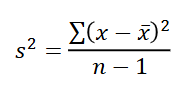
What is the formula for sample variance?
What is standard deviation?
Square root of variance
What are the two most common measures of dispersion?
Standard deviation and variance
What is the formula for the arithmetic mean?

What does ‘μ’ mean and its name?
Mu symbol, meaning the population mean (the average of every individual in a population
What does ‘x̄’ mean and its name?
Named x-bar, the sample mean (a subset of the population)
What is dispersion?
Refers to the extent to which data points in a dataset are spread out or scattered around a central value
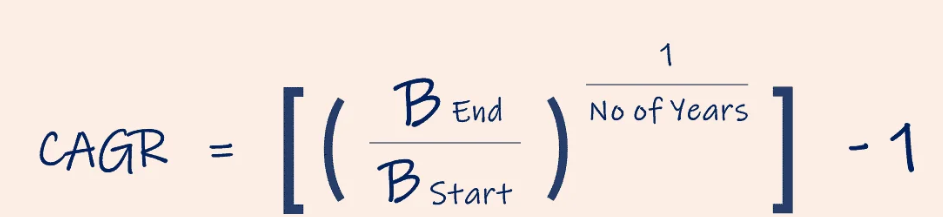
What is the formula for compound annual growth rate?
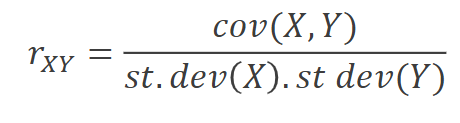
What is the formula for sample correlation coefficient?

What is the formula for sample correlation coefficient if you already have covariance?
What are the interpretations of answer of sample correlation coefficient?

If Pr(A)= 0 what does that mean?
The event will never happen
If Pr(A)= 1 what does that mean?
The event is certain to happen
What do correlation techniques help with?
examine relationship between variables
What is a limitation in interpreting correlation?
spurious correlation
non linearity
causation fallacy (correlation is not causality)
Reasons for non-zero (some connection) correlation coefficient?

What does it mean if two events are mutually exclusive?
events cannot occur at same time
What does A n B mean?
the intersection of two non-mutually exclusive events, A and B
What does A u B mean?
the union of two non-mutually exclusive events, A or B
When events are mutually exclusive, how to work out probability of both events happening at one?

When events are non-mutually exclusive, how to work out the possibility of both events occurring?

What does it mean if two events are independent?
The out come of one event does not effect the outcome of another event
What is the new notation to show the probability of even B happening given that event A has happened?

What is the general addition rule?
The general addition rule is used to find the probability that either event A or event B occurs. It is expressed as: P(A or B) = P(A) + P(B) − P(A and B)
What is the complement rule?
The complement rule states that the probability of an event A equals 1 minus the probability of its complement A′
P(A) = 1 − P(A′)
What does A’ mean?
The complement of event A (written A′ or Aᶜ) includes all outcomes not in A.
Example: If A = “rolling a 4,” then A′ = {1, 2, 3, 5, 6}.
Mutually exclusive with A
How can you prove whether two events are independent?
Check whether probability of both events happening is equal to the product of individual probabilities Pr (AnB)= Pr(A) x Pr(B)
If events are not mutually exclusive, what is the addition rule?

If events are mutually exclusive, what is the addition rule?

What is the combinational formula?

What is Bayes Theorem?
if we observe that B has occurred, what is the chance that A happened?
Formula for Bayes Theorem?

What is the opposite if a random variable?
constant
What is a discrete random variable?
variable that only takes a finite number of variables (eg. shoe sizes)
What is the opposite of a discrete random variable?
continuous random variable (eg. exact height)
What is the expected value?
mean of a probability distribution
What is formula for variance of discrete probability distribution?

What is binomial distribution?
when underlying probability experiment has only two possible outcomes, used for repeated trials of experiments
How can binomial probability be identified to use in probability question?
Binary- only two possible outcomes per trial
Independent- outcome of one trial doesn’t affect the other
Number fixed- fixed number of trials
Same probability- probabilty of success remains constant across every trial
what is binomial distribution formula?

For binomial distribution, how to calculate mean?
n x P
n- number of trials
P- probability of success in single trial
For binomial distribution what is formula for variance?
n x P x (1-P)
n- number of trials
P- probability of success in single trial
1-P - probability of failure in single trial