Genetics Exam 3 Terms
 Call Kai
 Learn
 Practice Test
 Spaced Repetition
 Match
 Flashcards
 Knowt Play
1/63

There's no tags or description
Looks like no tags are added yet.
64 Terms
Euploid
A chromosome number that is multiple of the basic monoploid number (=x)
Monoploid Number
the number of chromosomes in a basic chromosome set containing one copy of each chromosome (x)
Haploid
the number of chromosomes present in gametes (n)
Hexaploid wheat
contains 6 sets of 7 chromosomes per set
Homeologous chromosomes
pairs of chromosomes that were once completely homologous but became partially different after being separated into distinct species over evolutionary time
Haploid chromosome number in hexaploid wheat
n=21
Monoploid chromosome number in hexaploid wheat
x=7
Diploid
2 complete sets of chromosomes
Polyploid
more than 2 complete sets
triploid
3 complete sets
tetraploid
4 complete sets of chromosomes
pentaploid
5 complete sets of chromosomes
Hexaploid
6 complete sets of chromosomes
Monoploidy
only one complete set of chromosomes is present (usually lethal in higher organisms) due to ½ the normal amount of all gene products is produced
Monoploid
Male ants, wasps, and bees/ develop unfertilized eggs (parthenogenesis)/ produce gametes via mitosis
Diploid
Female ants, wasps, and bees/ form fertilized eggs/ produce gametes by meiosis
Plant monoploids
useful in the development on new plant varieties
Challenges of plant monoploids
mutagenesis to produce new plant mutants was traditionally performed in diploid plants
new recessive, mutant alleles must be homozygous in order to be expressed in phenotype
alternative: monoploid plants
Producing monoploid plants
isolate products of meiosis (monoploid)
Cold treatment
transplant onto media that stimulates root and shoot growth
Fertile Monoploids
monoploids are sterile (can’t go through meiosis)
Solution:
treat with colchicine
Colchicine
blocks formation of the mitotic spindle apparatus (complete mitotic failure = doubling of chromosome number)
Alternative method of creating monoploid plants in barley
Domestic barley (2n1) → ovum (n1) + Pollen (n2) ← Wild barley (2n2)
sterile hybrid (n1 n2)
selective loss of chromosomes from wild barley; retains chromosomes from domestic barley
monoploid domestic barley (n1)
select for desired trait
treat with colchicine = diploid domestic barley with desired trait
Polyploid Types
Autoployploids
Allopolyploids
Autopolyploids
contain multiple sets of chromosomes derived from one species
Allopolyploids
contain multiple sets of chromosomes derived from two or more different species
Triploids
often autopolyploids and may arise naturally (two sperm fertilize one egg)
Crossing a tetraploid (4x) and a diploid (2x) results in
a triploid
Triploid characteristics
one chromosome lacks a pairing partner during meiosis
result: unbalanced gametes (2 copies of some chromosome, one copy of others)
Examples of triploids
seedless watermelon, seedless grapes, and seedless bananas
Triploidy in humans
lethal (most are miscarried)
2 sperm fertilize 1 egg
major abnormalities of all organ systems
Autotetraploids
contains 4 sets of chromosomes from a single species
Origins of autotetraploids
chromosomes separate but cytokinesis fails to occur
can occur during meiosis or in mitosis prior to entering meiosis
complete failure of chromosome to separate
can be induced by colchicine treatment
Characteristics of autotetraploids
are fertile
all chromosomes have paring partners
larger cells
larger fruit
larger flowers
Allotetraploids
contain four sets of chromosomes, derived from different but related species
Origins of allotetraploids
diploid species #1 (2n1) → n1 gametes + n2 gametes ← diploid species #2 (2n2)
sterile hybrid (n1n2)
spontaneous doubling of chromosome number
fertile allotetraploid (2n1 2n2) fertile !
Karpechenko’s Experiments
Hybrid between radish and cabbage
radish 2n =18 → gametes n=9 + gametes n=9 ← cabbage 2n=18
sterile hybrid
spontaneous doubling of chromosome number
fertile allotetraploid (had the leaves of a radish and the roots of a cabbage plant)
Commercially grown wheat is what
allohexaploid 2n = 6x = 42 chromosomes
Polyploidy in Animals
seen in flatworms, brine shrimp, and leeches
lizards
reproduce via parthenogenesis (unfertilized eggs)
Frogs and toads
reproduction involves both male and female
Certain fish
tetraploid salmon contain twice as much DNA as diploids
Sterility of triploids (has been exploited for commercial oyster fishing)
diploid oysters are unpalatable during spawning season
triploid oysters can be harvested all year round
Changes in chromosome structure
chromosome is broken
the break is not repaired
unequal crossing-over
What factors cause changes in chromosome structure and breakage
spontaneous and agents
Spontaneous factors
errors in DNA replication
errors in recombination between chromosomes during meiosis
Agents that cause chromosome breakage
ionizing radiation (x-rays, gamma rays)
certain chemicals
certain viruses
exposure to heat
mutations in genes involved in DNA repair or recombination
Deletions
loss of a chromosome segment
Duplications
extra copies of a chromosome segment
Inversions
a chromosomal segment is rotated 180 degrees from its normal orientation
Translocations
a chromosome segment is transferred from one chromosome to another, non-homologous chromosome
Terminal deletion
deletion at the end of the chromosome
Interstitial deletion
internal fragment of chromosome is lost
Cytological consequences 1
if the individual is heterozygous for the deletion, abnormal chromosome pairing occurs meiosis and a deletion loop forms in the area of the deletion

Cytological consequences 2
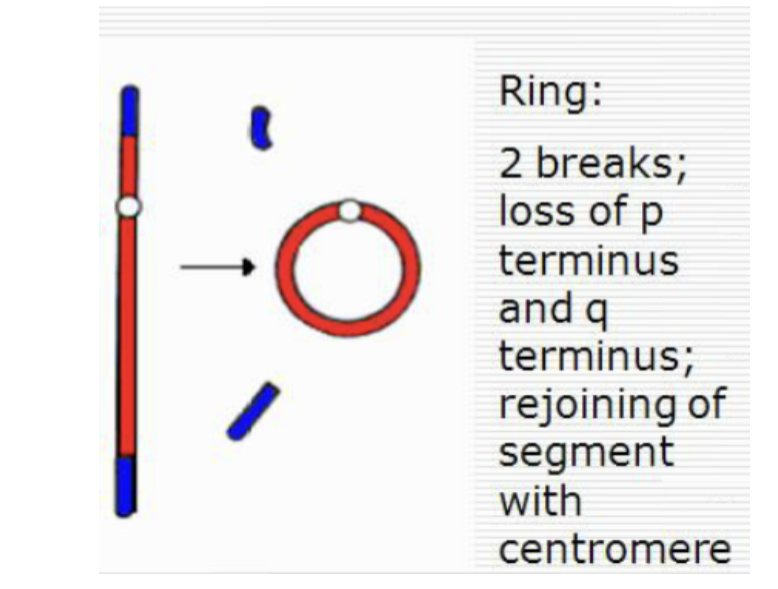
if breakage and deletion occurs at both ends of a chromosome, the two ends may fuse together and form a ring chromosome
Phenotypic consequences
in a heterozygous individual, if the region containing a dominant allele is deleted, the recessive allele will now be expressed
Pseudodominance
expression of a recessive allele when present in a single “dose”
Genetic consequences of deletions
loss of variability
mutant phenotype
suppression of crossing over in the region containing the deletion
Cir-du-chat syndrome
deletion of 5p- infants have a cat-like cry; malformed larynx, facial abnormalities, intellectual impairment
Wilms tumor
deletion of 11q- kidney tumors, genital and urinary anomalies
Retinoblastoma
deletion of 13q- tumors of the eye, increased risk of other tumors
Prader-Willi syndrome
deletion of 15q- infants: weak, slow growth/ children and adults: obesity, severe compulsive overeating
Prader-Willi syndrome Treatment
healthy diet
control access to food
behavioral modification
sex hormone therapy
growth hormone therapy if growth is impaired in childhood
Prader-Willi vs. Angelman Syndrome
normal genets from BOTH mother and father are necessary for normal development
normal chromosome 15 from mom - deletion of 15q from dad = prayer-willi syndrome
normal chromosome 15 from dad - deletion of 15q from mom = Angelman syndrome
Angelman syndrome phenotype
delayed development
intellectual impairment
problems with movement and balance
severe speech impairment
seizures
Microephaly
Hyperactivity
difficulty sleeping
happy, excited demeanor
Deletions are found in many tumors in humans
neuroblastoma (brain tumor)
retinoblastoma (tumor of retina of eye)
wilms tumor (kidney tumor)
melanoma (malignant skin cancer)
small cell carcinoma of the lung
Williams Syndrome
deletion of part of the long arm of chromosome 7 (15q)
Phenotype of Williams Syndrome
intellectual impairment
heart defects
characteristic facial features
kidney abnormalities
low muscle tone
low birth weight
failure to gain weight
hypersensitivity to loud noises
outgoing personality
How can we detect deletions
karyotyping
FISH: fluorescent in situ hybridization