Art History Exam #2 Rome
 Call Kai
 Learn
 Practice Test
 Spaced Repetition
 Match
 Flashcards
 Knowt Play
1/15

There's no tags or description
Looks like no tags are added yet.
16 Terms
Arcade
A covered walkway made of a series of walkways covered by piers
Forum
An open area at the center of a Roman town where people shopped, worshipped and participated in civil discussions
Basilica
Long rectangular building with a central aisle, side aisles and apse rounded area at one end Christian worship
Continuous Narrative
Multiple events are shown in a single pictorial across one continuous background
Oculus
A round, eye like opening in the ceiling, dome or roof
Iconoclasm
Intentional destruction of images on religious or political grounds
Triumphal Arch
A freestanding archway, often marking an entrance or spanning a road decorated with reliefs commemorating a military victory
Stylized
Treated in a mannered or non naturalistic way
Exterior of the Colosseum (Flavian Amphitheater)
Flavian Dynasty Rome, c. 70–80 CE. Tufa and concrete faced with travertine. Massive amphitheater built for public entertainment, gladiatorial contests, and animal hunts. Doric/tuscan on the first level, Ionic on the second level, and Corinthian on the third level. Constructed under Titus and Vespasian and built on Emperor Nero’s private palace, which was remarkable since it was the turning point returning this place to the Roman people. Power and wealth of the emerging Roman Empire.

Arch of Titus, Early Empire
Rome, c. 81 CE. Marble Honored emperor Titus after his victories especially in the Jewish war; relief sculptures depicting Titus triumph procession. Famous relief shoes roman soldiers carrying spoils from the Temple of Jerusalem including the menorah. Propaganda used to promote political power or ideas.

The Spoils of Jerusalem, from Arch of Titus (detail), Early Empire
Depicts Roman Soldiers carrying treasure taken from the Second Temple in Jerusalem after the Roman victory in the Jewish war. Celebratory of imperialism emperors titus conquest of Jerusalem and displayed romes power and dominance or conqered peoples.

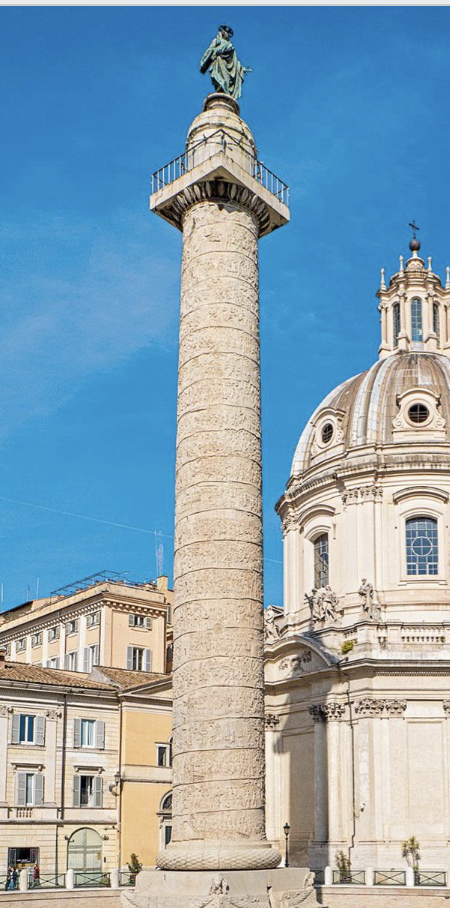
Column of Trajan
Rome, dedicated c. 110 CE, marble column built to commemorate Emperor Trajan’s victories in the Dacian wars. features a narrative frieze that wraps around the column. Celebrates Rome’s military success and expansion, is located in Trajan's Forum, and functions as a historical record and a piece of imperial propaganda.
Pantheon (looking south), Rome, Italy
Interior of the Pantheon, Middle Empire, Rome, c. 110–28 CE. A temple dedicated to all Roman gods. Rebuilt by Emperor Hadrian after the original temple commissioned by Agrippa was destroyed. Demonstrates Roman engineering in the use of concrete. First served as a religious Christian church and later became a church, helping preserve it. Influenced many buildings and monuments: the Oculus, dome coffers, portico and Corinthian order

Interior of the Pantheon
Middle Empire, Rome, c. 110–28 CE. Built during the rule of emepror hadrian, dedicated to all the Roman gods. Unlike Greek temples, which emphasized exterior appearance, the Pantheon creates dramatic interior spaces that showcase the Romans’ mastery of engineering and spatial design.

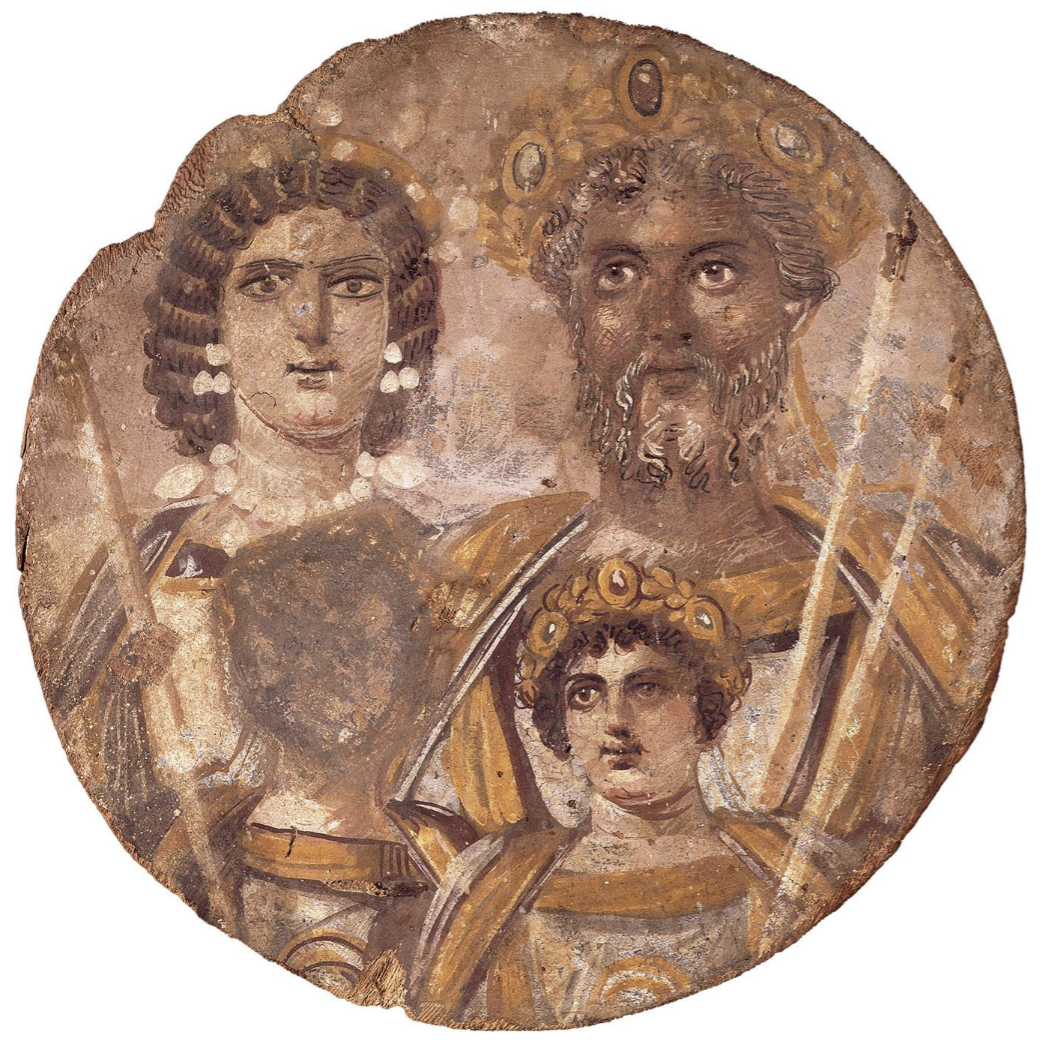
Septimius Severus, Julia Domna, Caracalla, with Geta
Roman, Severan, Egypt, c. 200. Tempera on wood, diameter. Septimius Severus emperor, Julia Domna empress, Caracal their son, Geta second son whose face was erased. Frontally with large eyes a characteristic of roman art, tondo circular picture. “Condemnation of memory” deliberately removed a person from public monuments because carcallas ordered the murder of Geta.
Portraits of the Tetrarchs
Formerly in Constantinople (Istanbul, Turkey), Roman, Tetrarchy, c. 305. Porphyry,
height 51 in. (1.29 m). Currently in the facade of the Cathedral of St. Mark, Venice, Italy. Four tetrarchs, four co rulers of the roman empire under emperor diocletian, arranged in two pairs to symbolize unity and cooperation nearly identical. large eyes, stiff bodies shifting away from classical naturalism. Porphyry, a rare purple stone associated with imperial power and authority emphasized stability and strength.
