muscle exam
 Call Kai
 Learn
 Practice Test
 Spaced Repetition
 Match
 Flashcards
 Knowt Play
1/86

There's no tags or description
Looks like no tags are added yet.
87 Terms
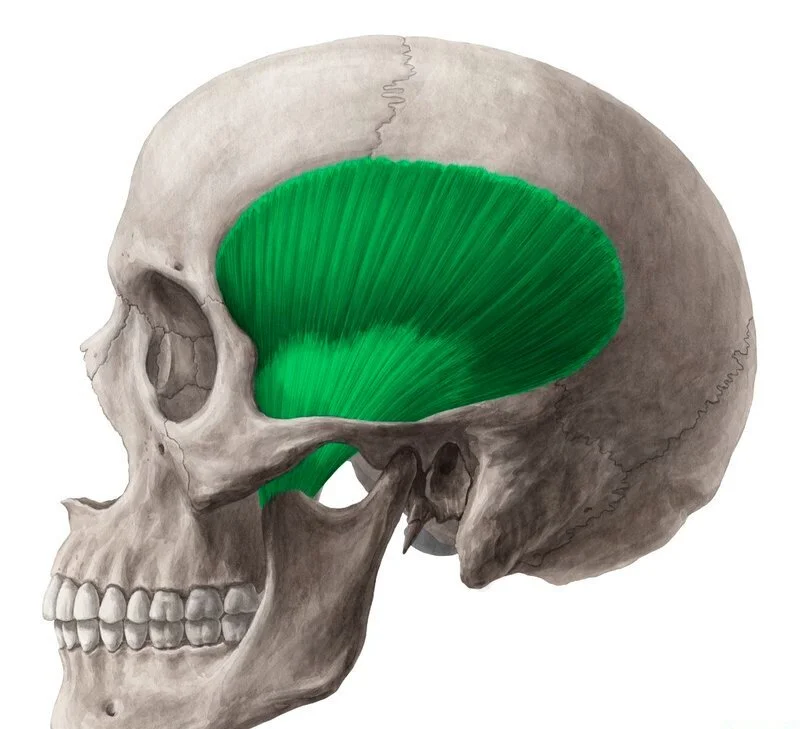
Temporalis
Origin: temporal bone Insertion: mandible Action: closes jaw, raises mandible

Masseter
Origin: zygomatic Insertion: mandible Action: elevates mandible, closes jaw

Sternocleidomastoid
origin: sternum and clavicle insertion: mastoid action: neck flex, head rotation

Pectoralis major
origin: clavicle, sternum insertion: humerus action: shoulder flexes, extends, adducts; moving arm / shoulder

latissimus dorsi
origin: vertebrae T7-L5 Insertion: humerus action: shoulder extends, adducts, rotates

biceps brachii
origin: scapula, shoulder joint insertion: radius action: elbow flexes, forearm turning (supinates)
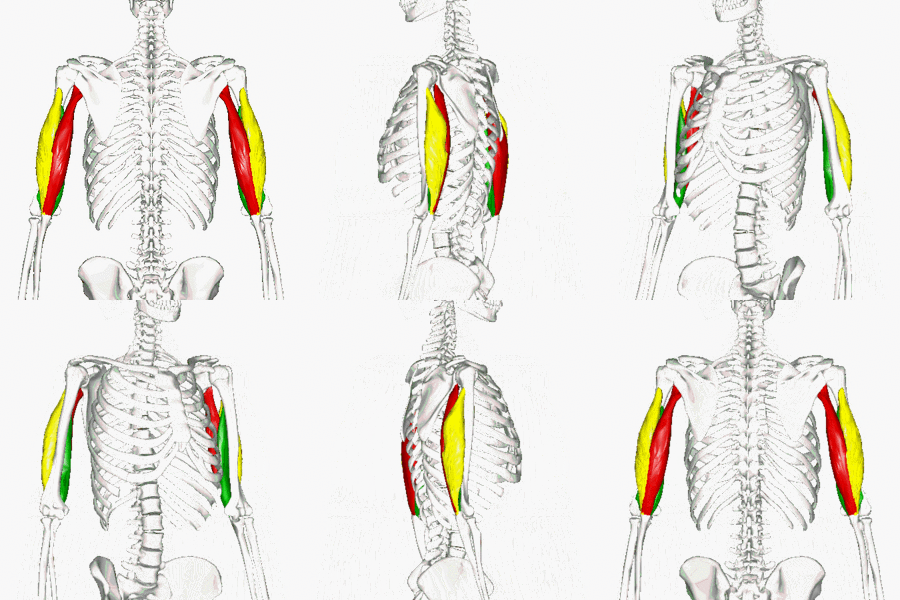
triceps brachii
origin: scapula and humerus insertion: ulna action: elbow extends, arm adducts

brachialis
Origin: humerus Insertion: ulna Action: flexes elbow
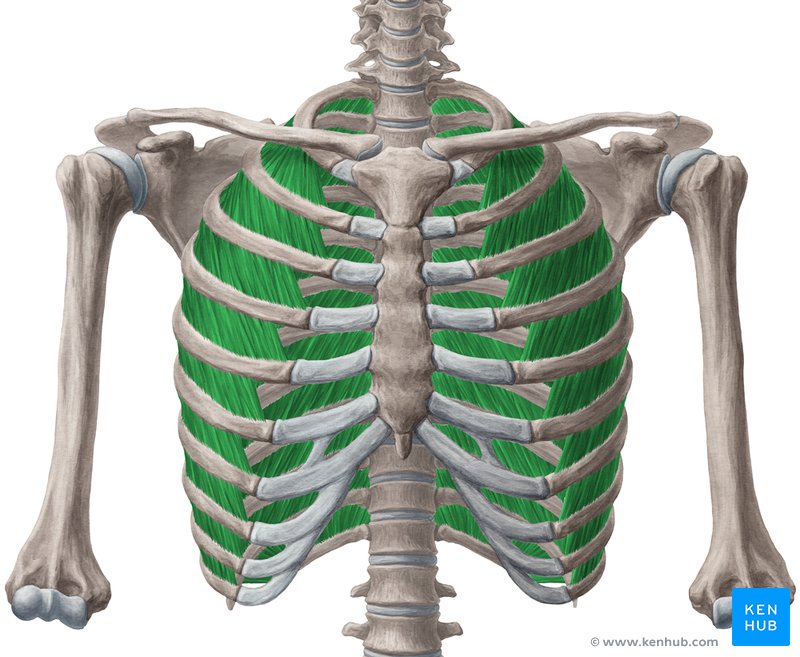
external intercoastals
origin: ribs; inferior edge insertion: next rib; superior edge action: elevate ribs; inspiration

gluteus maximus
origin: ilium, sacrum, coccyx insertion: femur action: extend hip, abducts, rotates

vastus lateralis
origin: femur insertion: tibia, via patella action: extends knee

vastus medialis
origin: femur insertion: tibia, via patella action: extends knee

tibialis anterior
Origin: tibia Insertion: metatarsals Action: foot dorsiflexes and inverts

Gasteocnemius
origin: femur insertion: calcaneis action: foot plantar flexes, leg flexes
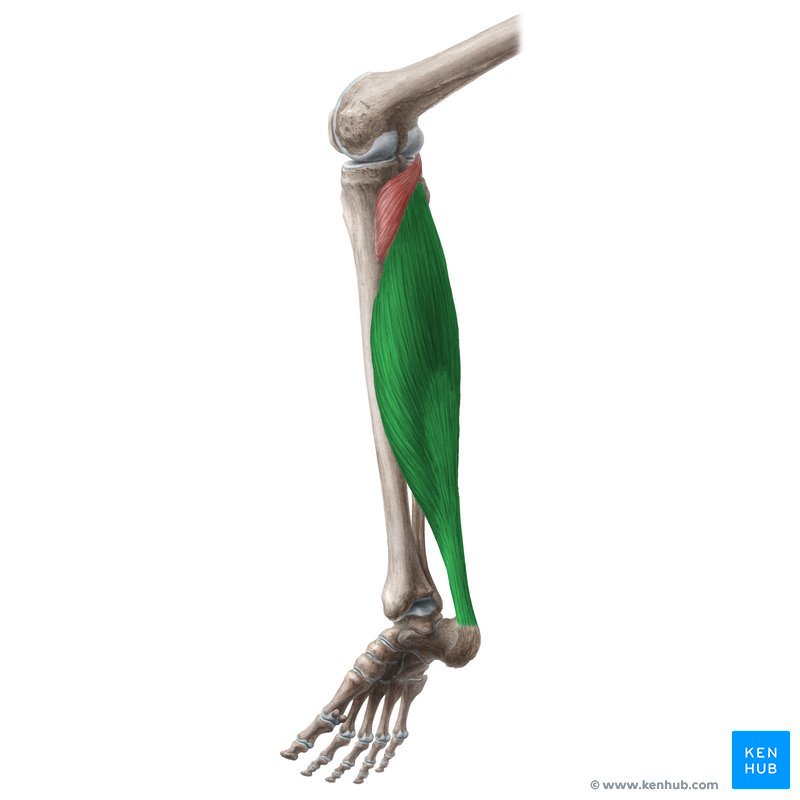
Soleus
origin: tibia and fibula insertion: calcaneus action: foot plantar flexes
six main functions of muscular system
movement
protection
stabilization
producing heat
posture
moving substances internally
abduction
movement away from midline
adduction
movement toward midline
flexion
bending ; decreasing angle of a joint
extension
straightening ; increasing angle of a joint
elevation
raising a body part
depression
lowering a body part
inversion
turning sole inward
eversion
turning sole outward
dorsiflexion
raising sole upward
plantar flexion
lowering sole downward
pronation
rotating hand palm down
supination
rotating hand palm up
medial rotation
rotating toward midline
lateral rotation
rotating away from midline
Agonist
muscle that provides the MOVING force by CONTRACTING
Antagonist
muscle that acts in opposition to the agonist by RELAXING; EXTENDS
Origin
attachment to a STABLE bone that DOESNT MOVE during muscle contraction
Insertion
attachment to a MOVING bone that MOVES during muscle contraction
What do striations on a muscle tell us?
the direction of movement on the muscle
where the muscle’s attachment points are
epimysium
outer sheath of dense, irregular connective tissue that encloses the entire muscle

fascicle

muscle fiber

myofibrils

endomysium
inner sheath of thin areolar connective tissue that wraps each muscle fiber

perimysium
a middle sheath of fibrous connective tissue that wraps each fascicle.

H zone
consists of MYOSIN ONLY; no actin is present

M-line
proteins that hold the two opposing sets of myosin filaments together

A-band
composed of overlapping myosin and actin filaments

I-band
consists of ACTIN filaments ONLY; NO myosin is present (None. Bad Boy)

Z-Line
where actin filaments from adjacent sarcomeres interweave
marks the border of each sarcomere.


What kind of muscle is this?
Skeletal Muscle

What kind of muscle is this?
Cardiac Muscle

What kind of muscle is this?
Smooth Muscle
ball & socket joint
Ball-shaped surface that fits into a concave socket

How does a ball & socket joint move?
Complete range of motion; widest range of all joints

condyloid joint
Oval shaped surface that fits into an elliptical surface

How does a condyloid joint move?
in two directions (back-and-forth and side-to-side), as well as in a circle, without spinning

gliding joint
Articulating surfaces, usually flat

How does a gliding joint move?
Gliding; nonaxial movement

hinge joint
Spool-shaped surface that fits into a concave surface

How does a hinge joint move?
One plane about a single axis, like door

pivot joint
Arch-shaped surface that rotates around a rounded pivot

How does a pivot joint move?
Rotation

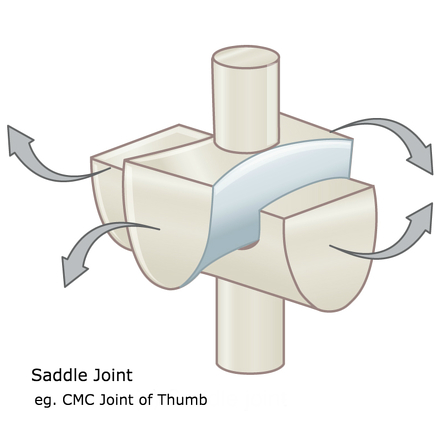
saddle joint
Saddle-shaped surface that fits into a socket curved in opposite direction

How does a saddle joint move?
Like condyloid, similar to a rider in a saddle

B?
Articular cartilage: Smooth, white tissue; allows bones to glide over each other

C?
Synovial cavity: Soft tissue that lines the synovial cavity, secretes synovial fluid
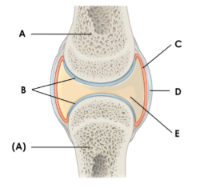
D?
Joint capsule: Connective tissue capsule that encases bones within the joint

E?
Joint Cavity / Synovial Fluid:
- joint cavity: Connective tissue capsule that encases bones within the joint
- synovial fluid: Clear, thick, lubricating fluid; reduces friction during movement
Ligaments
Bands of connective tissue that support and strengthen the joint

Bursa
A closed sac of synovial fluid; found in most synovial joints

Skeletal Muscle function + location
F - Moves skeletal bones to produce body movement
L - Attached to skeletal bone
Cardiac Muscle function + location
F - Contracts heart to move blood through vessels
L - Found only in the heart
Smooth Muscle function + location
F - Moves substances through internal passages
L - Surrounding internal organs