Chem Unit 11: The Periodic Table & Bonding
0.0(0)
Studied by 2 people Call Kai
 Learn
 Practice Test
 Spaced Repetition
 Match
 Flashcards
 Knowt Play
Card Sorting
1/116

Earn XP
117 Terms
1
New cards
Atomic Radius Definition
½ of the distance between the nuclei of 2 atoms of the same element when the ats are joined
2
New cards
Atomic Radius group trend
Atomic size ^^increases^^ from top to bottom within a group
3
New cards
Why (AR group trend)
%%As atomic # increases within a group, charge on nucleus increases(more p+ and more e-), # occupied energy levels increase.%% Shielding effect greater than the effect of the increase in nuclear charge, therefore atomic size decreases.
4
New cards
AR Period trend
Atomic size ^^decreases^^ left to right across a period
5
New cards
Why? (AR Period trend)
Atomic size decreases across Period left to right. Each element has 1 more e- than preceding. e- added to same principal energy level, shielding effect constant for all elements in a period. Increasenuclearchargepullse−inhighestenergyleveltonucleus,atomicsizedecreases.
6
New cards
Period
Left to right
7
New cards
Group
Top to bottom
8
New cards
Largest element (atomic radius) located
Bottom left
9
New cards
Smallest element (atomic radius) located
Top right
10
New cards
Ionization energy definition
The energy required to remove an e- from an atom
11
New cards
When is it the hardest to remove e- (ionization energy)
Full energy level, therefore ==easier to take from metals==
12
New cards
Group trend (IE)
1st ionization energy ^^decrease^^ from top to bottom
13
New cards
1st ionization energy def
Energy required to remove 1st e- from an atom
14
New cards
Why?( group trend IE)
The atomiz size increases as atomic # increases within a group. As size of atom increase, nuclear charge has a small effect on the e- in highest occupied E.L., less energy required remove e- from this energy level
15
New cards
Period trend (IE)
^^Increases^^ left to right
16
New cards
Why?(period trend IE)
As nuclear charge increases, shielding effect stays constant. Nuclear charge increases across a period, increase attraction of nucleus for an e-, it takes more energy to remove an e- from an atom
17
New cards
Electronegativity def
%%Ability of an atom of an element to attract e-%% (when the atom is in a compound)
Nonmetallicbetterat
Nonmetallicbetterat
18
New cards
Group trend (EN)
Top to bottom ^^decreases^^
19
New cards
Dmitri Mendeleev & PT
\-invented PT (1869)
\-arrangedelementsbyatomicmass
\-predicted existence unknown elements
\-element Md
\-arrangedelementsbyatomicmass
\-predicted existence unknown elements
\-element Md
20
New cards
Henry Moseley & PT
\-determined atomic # of elements from theirnX-ray spectra (1914, worked with Rutherford)
@@-arranged elements by increasing atomic #@@
@@-arranged elements by increasing atomic #@@
21
New cards
Periodic Law
When elements are arranged in order of increasing atomic #, there is a periodic pattern in their chemical and physical properties
22
New cards
Physical properties (examples)
Color, luster, malleability, density, MP, BP, FP, conductivity
23
New cards
Chemical properties (examples)
Chemical reactivity, flammability, reactivity w/ acids, oxidation
24
New cards
Metals
80%, good conductors, solid @ RT (except Hg)
25
New cards
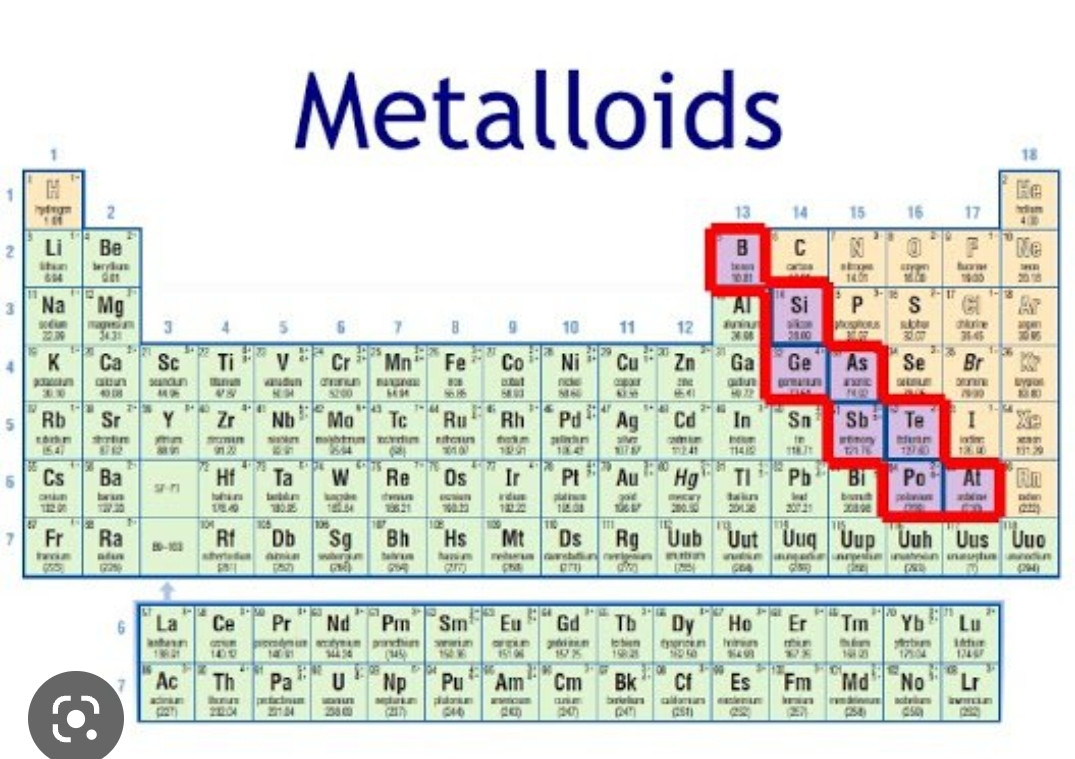
Metalloids (semi-metals)
“Steps”, depends on conditions
26
New cards
Non-metals
Top right, most gas @ RT, more variation, poor conductors (except C)
27
New cards
Representative elements (regional/group name)
Groups 1, 2 , 13-17 or “A”
28
New cards
Transition elements
Group 3-12 or “B”
29
New cards
Inner transition elements
“Rare-earth” elements
30
New cards
Halogens
Group 17, non-metal
31
New cards
Noble gases
Group 18, “inert" gases- not very reactive
32
New cards
Why?(group trend EN)
Metals far left of PR have low values, nonmetallic far right have high values
33
New cards
Period trend EN
Left to right %%increases%%
34
New cards
Purpose of bonding
To fill the valence shell of an atom
35
New cards
Most elements are stable when
They have the same # of valence e- as a noble gas (8)
36
New cards
Atoms will__electrons in order to become stable
Lose, gain, or share
37
New cards
Chemical bond
Mutual attraction of 2 molecules on an e-
38
New cards
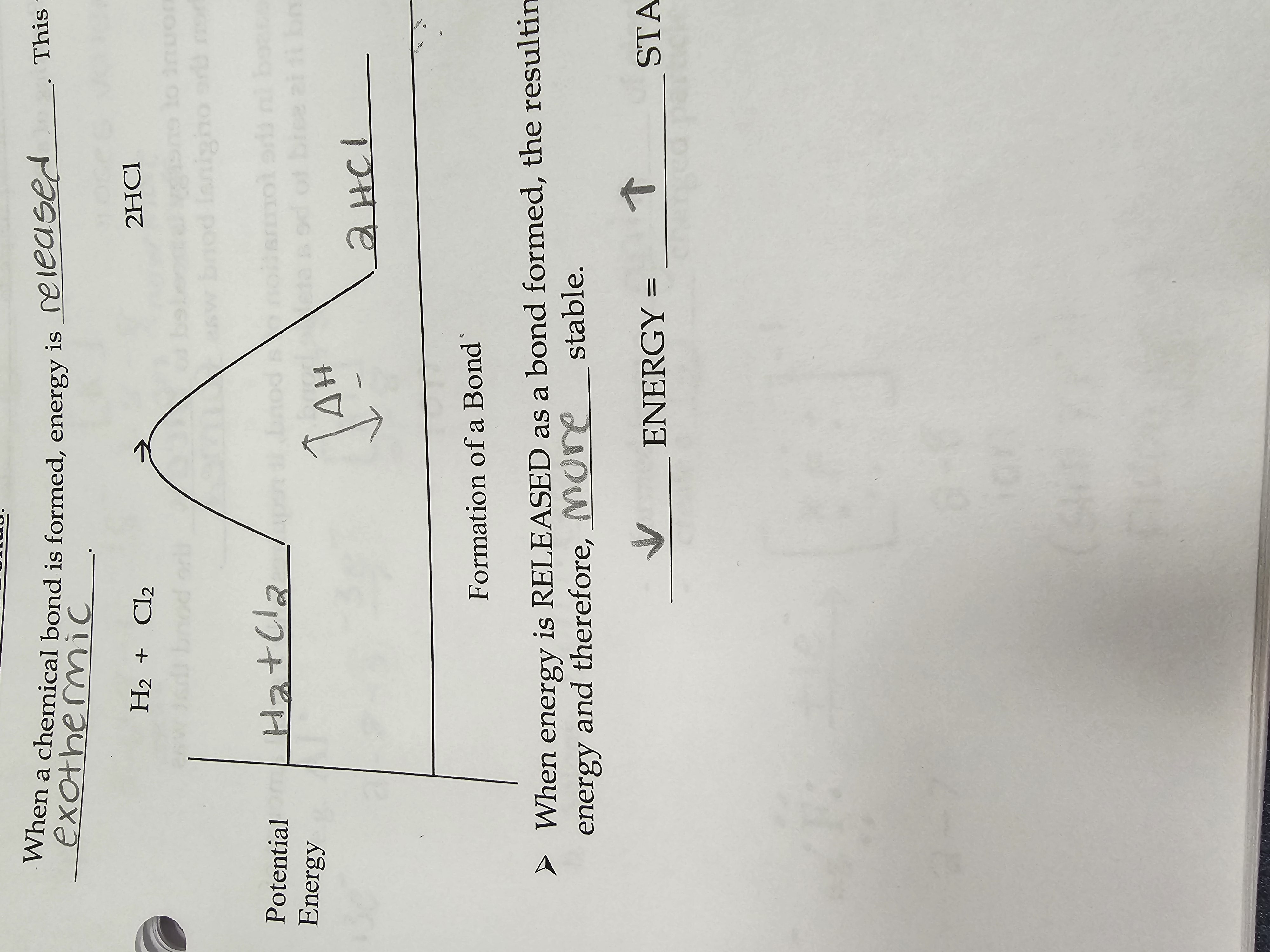
When a chemical bond is formed, energy is
Released, exothermic
39
New cards
When energy released as a bond formed, the resulting system is
At lower energy, more stable
40
New cards
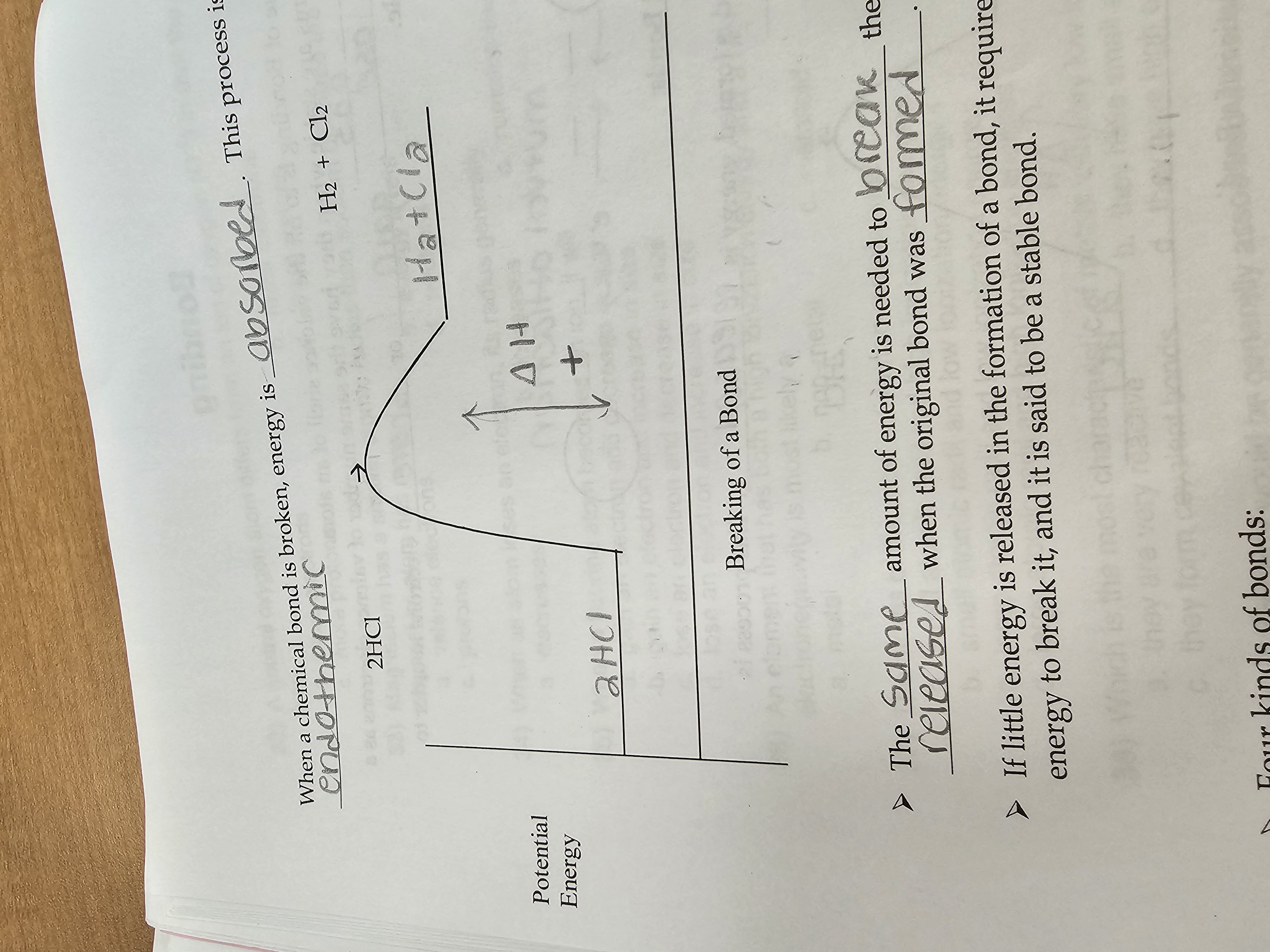
When chemical bond is broken, energy is
Absorbed, endothermic
41
New cards
How much energy is needed to break the bond that was released when the original body was formed
Same amount
42
New cards
If little energy is released in the formation of a bond, it requires only
A small amount of energy to break it, said to be a stable bond
43
New cards
Four kinds of bonds:
Ionic, metallic, network, covalent
44
New cards
Ionic bonds
A bondbetweenametalandanon−metal made by the creation of ions that are %%electrically opposite and therefore attracted to each other%%
45
New cards
Cation + anion =
Ionic crystal (neutral)
46
New cards
Ionic bonds energetically favorable to get __ e-
8
47
New cards
Atoms react in order to achieve
The stable electeon configuration of a noble gas
48
New cards
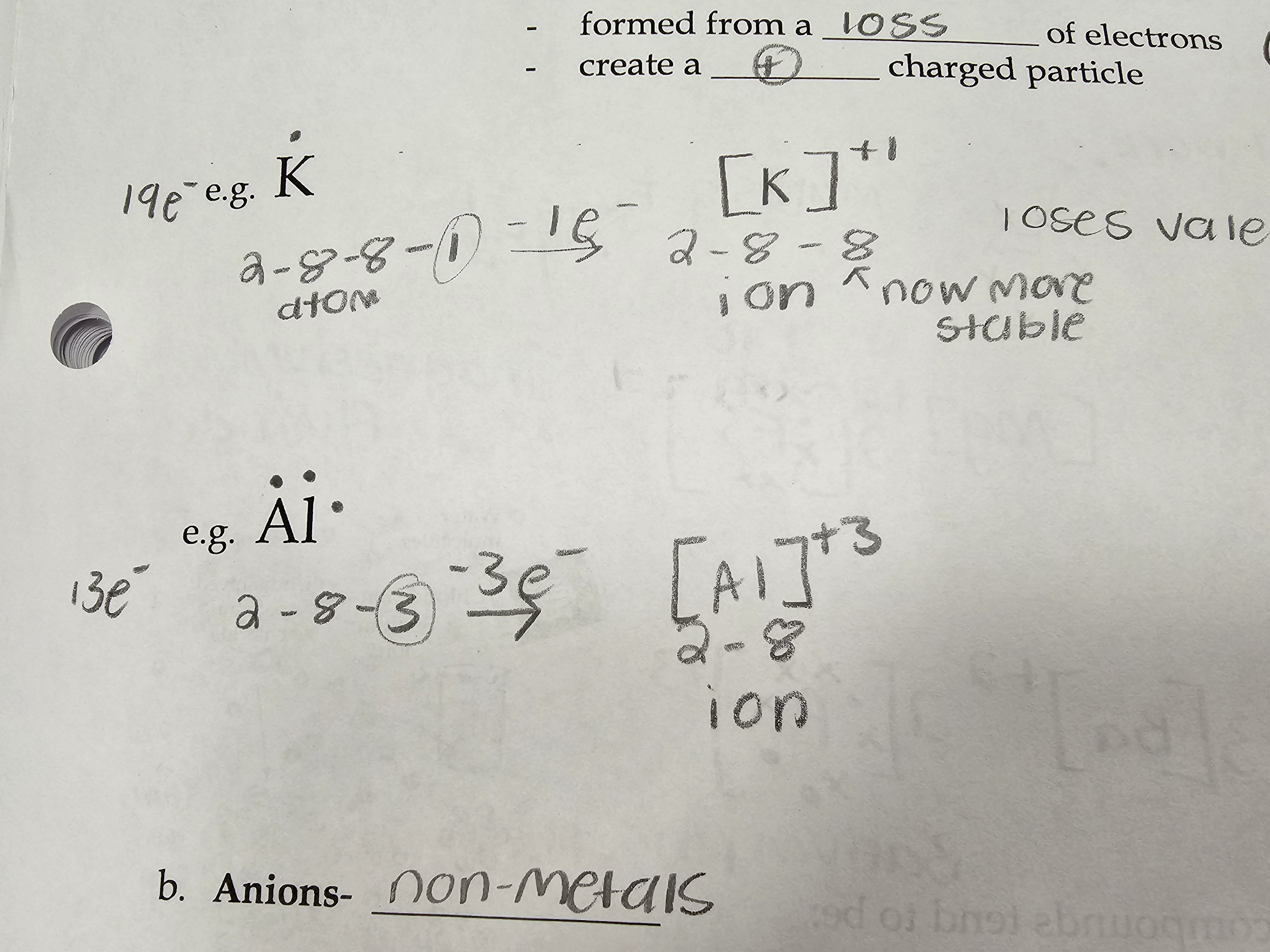
Cations =
* Metals
* Formed from loss of e- (oxidation)
* Creates a + charged particl
* Formed from loss of e- (oxidation)
* Creates a + charged particl
49
New cards
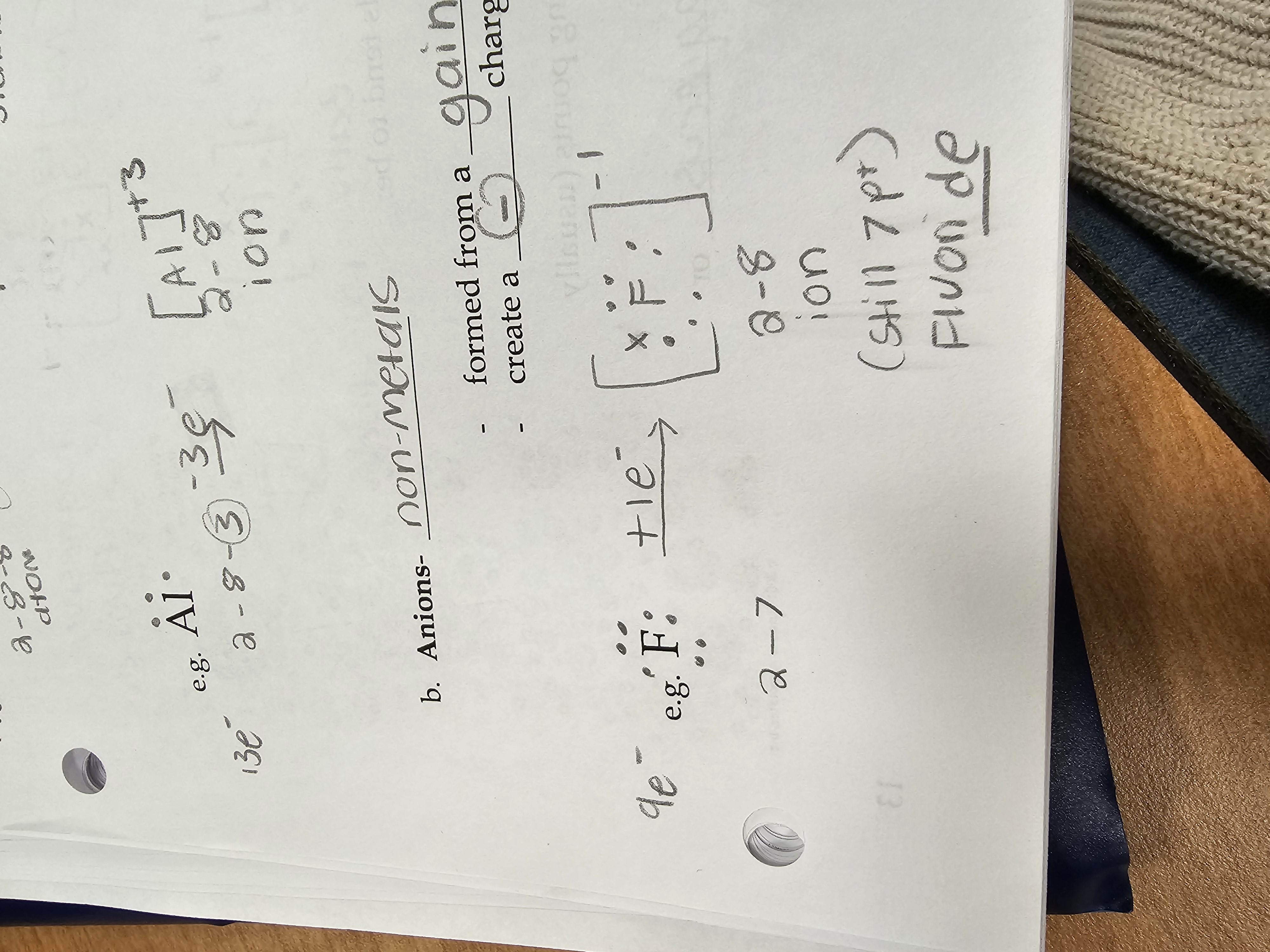
Anions=
* Non-metals
* Formed from gain of e- (reduction)
* Creates - charged particle
* Formed from gain of e- (reduction)
* Creates - charged particle
50
New cards
Ionic bond formation
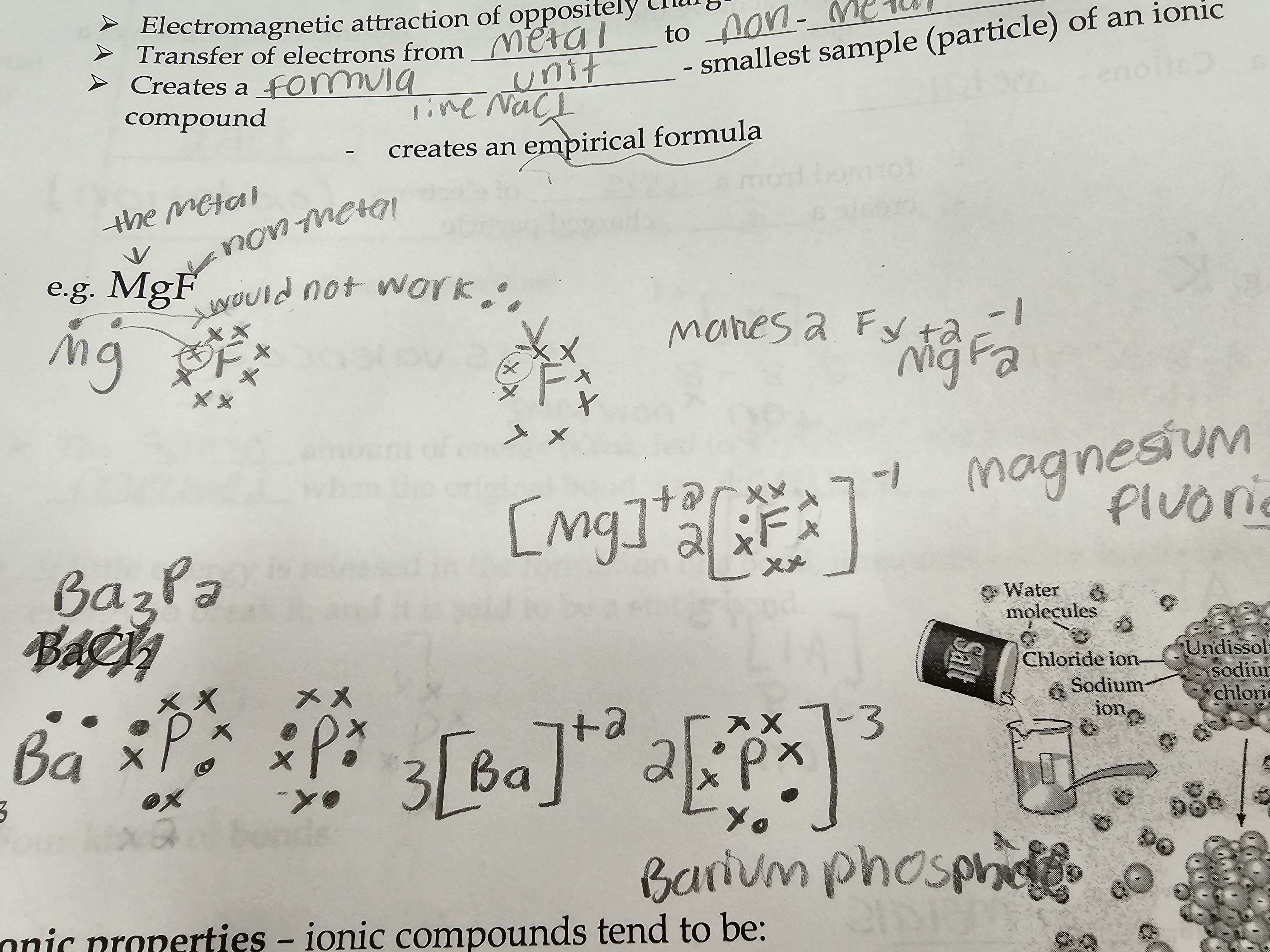
* Electromagnetic attraction of oppositely charged ions
* Transfer e- from metal to non-metal
* Creates a formula unit (empirical formula)
* Transfer e- from metal to non-metal
* Creates a formula unit (empirical formula)
51
New cards
Formula unit definition
Smallest sample (particle) of an ionic compound (like NaCl)
52
New cards
Ionic properties- ionic compounds tend to be:
* Crystalline
* Solid at room temp
* Have high melting and boiling points (usually >300°C)
* @@Conduct electricity when in the aqueous or liquid state(or gas)@@
* Solid at room temp
* Have high melting and boiling points (usually >300°C)
* @@Conduct electricity when in the aqueous or liquid state(or gas)@@
53
New cards
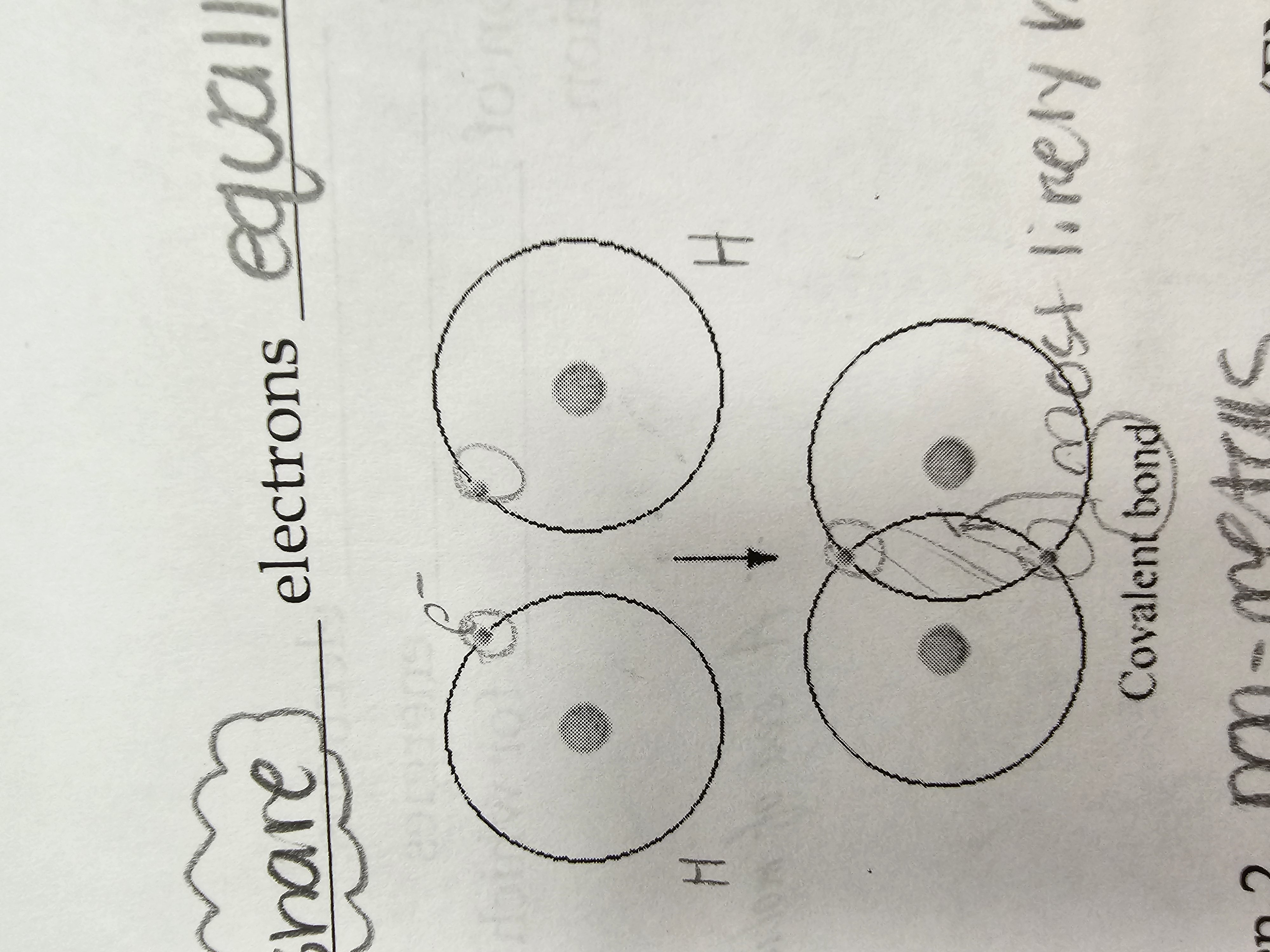
Covalent bonds formed
When 2 nuclei ==share== e- equally or unequally
54
New cards
Covalent bons generally occur
Between 2 non-metals (EN's are so high neither atom would want to lose e-s)
55
New cards
Covalent bonds can form
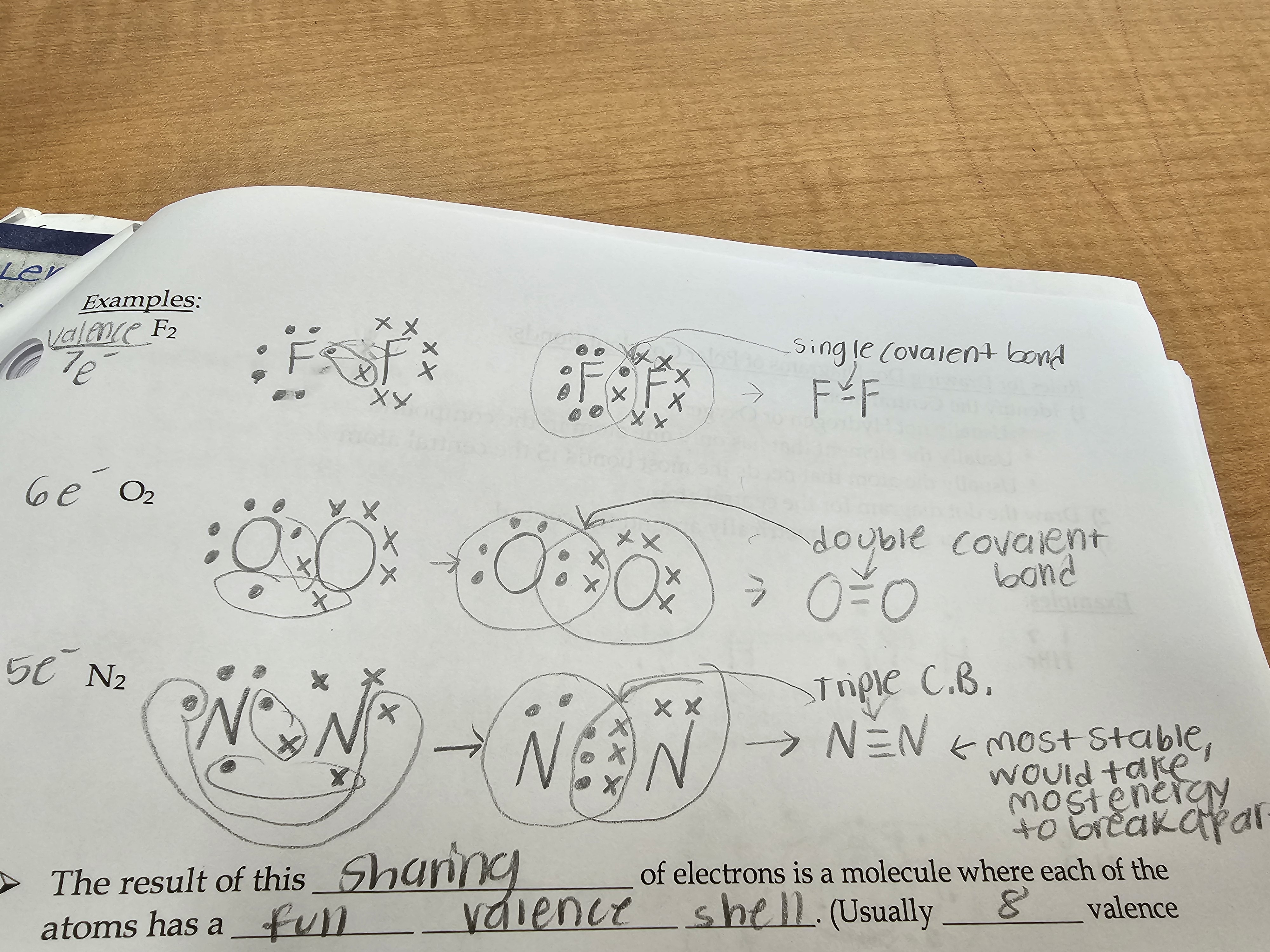
* Single bonds (sharing 1 pair of e-)
* Double bonds (share 2 pairs)
* Triple bonds (share 3 pairs)
* Double bonds (share 2 pairs)
* Triple bonds (share 3 pairs)
56
New cards
Types of covalent bonds
* Non-polar (non-dif) covalent bonds
* Polar covalent bonds
* Polar covalent bonds
57
New cards
Non-polar covalent bonds formed
When 2 or more of th%%e same kind of atom%% are bonded together by sharing electrons, ex diatomics
58
New cards
Non-polar covalent bonds, since all atoms have the same attraction for electrons
(Same EN), the electrons are shared equally
59
New cards
Non-polar covalent bonds EN difference
0
60
New cards
N-P result of sharing e-
Is a molecule where each of the atoms has a full valence shell (usually 8 valence e-)
61
New cards
Polar covalent bonds- EN values
Unequal (EN difference does not = 0; usually >.4)
62
New cards
Polar covalent bonds- sharing of electrons
Unequal
63
New cards
EN difference of Polar covalent bonds
>.4
64
New cards
Partial charges Polar covalent bonds
(δ-) charge = \~ -
(δ+) charge = \~ +
(δ+) charge = \~ +
65
New cards
Rules for drawing dor diagrams of Polar covalent bonds
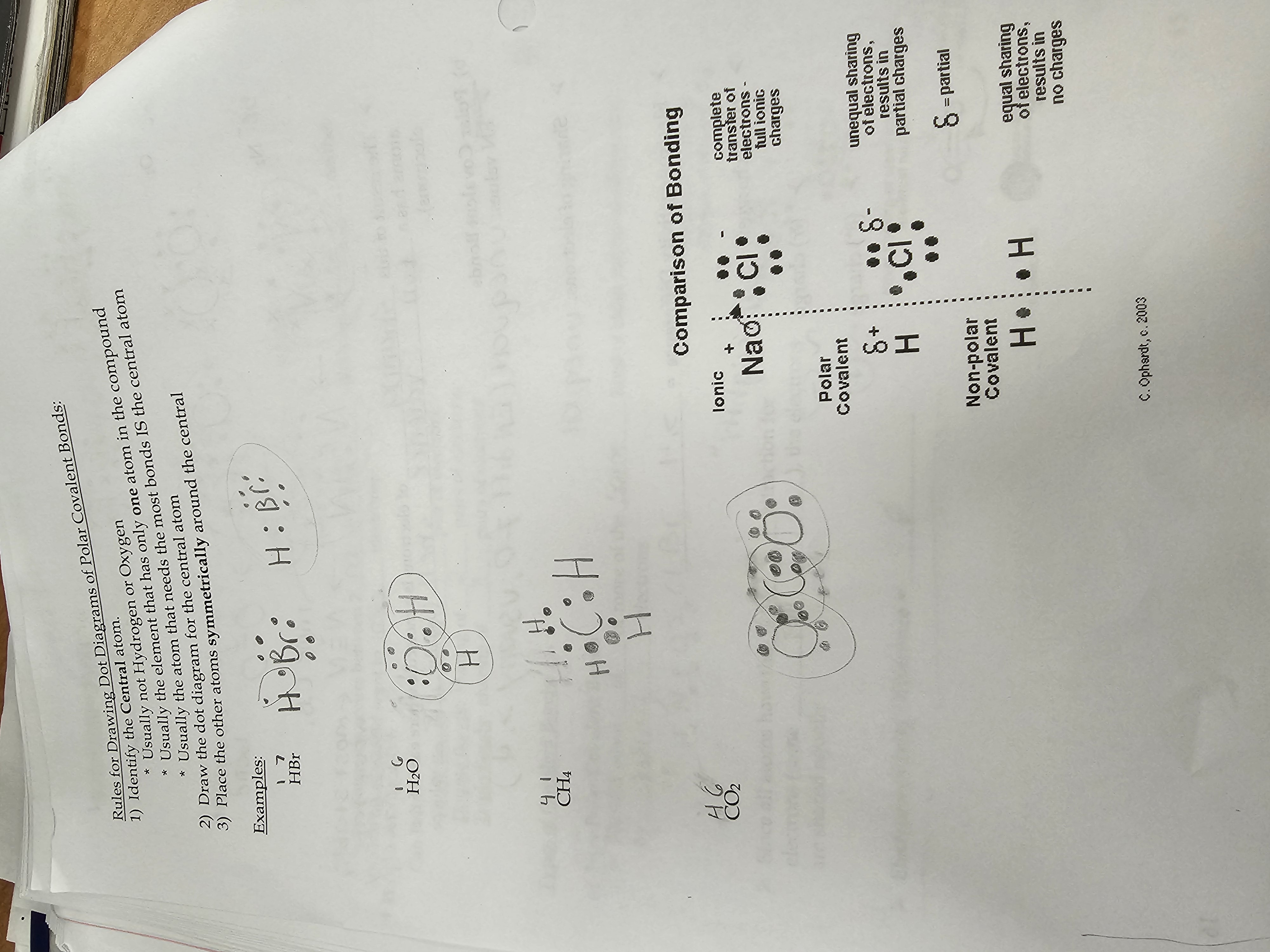
66
New cards
Lewis dot diagrams do not indicate
67
New cards
68
New cards
Valence-Shell Electron-Pair Repulsion Theory (VSEPR)
* One method used to predict the geometry of specific molecules
* Atoms are bonded together in molecules by the shared pairs of e-
* Best arrangement of a molecule is one which minimizes repulsion of electron pairs
* Atoms are bonded together in molecules by the shared pairs of e-
* Best arrangement of a molecule is one which minimizes repulsion of electron pairs
69
New cards
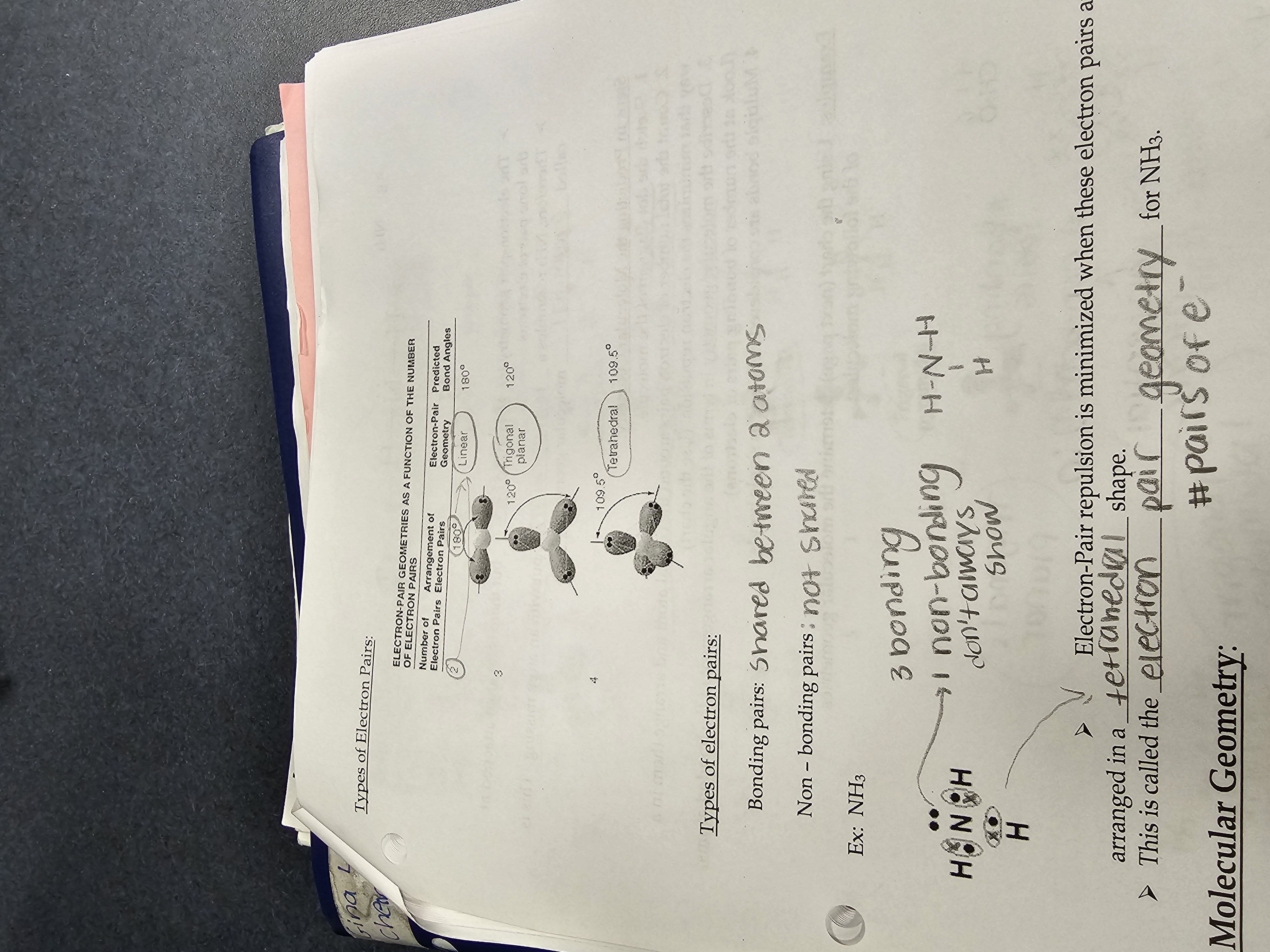
Bonding pairs e-
Shared between 2 atoms
70
New cards
Non-bonding e-
Not shared
71
New cards
Electron pair geometry
\
72
New cards
Molecular geometry
* Based on shared pairs of e- within a molecule
* When describing the shape of a molecule, we give the molecular geometry rather than the electron pair geometry
* The molecular geometry can be determined from the electron pair geometry
* When describing the shape of a molecule, we give the molecular geometry rather than the electron pair geometry
* The molecular geometry can be determined from the electron pair geometry
73
New cards
Steps in predicting the molecular geometry
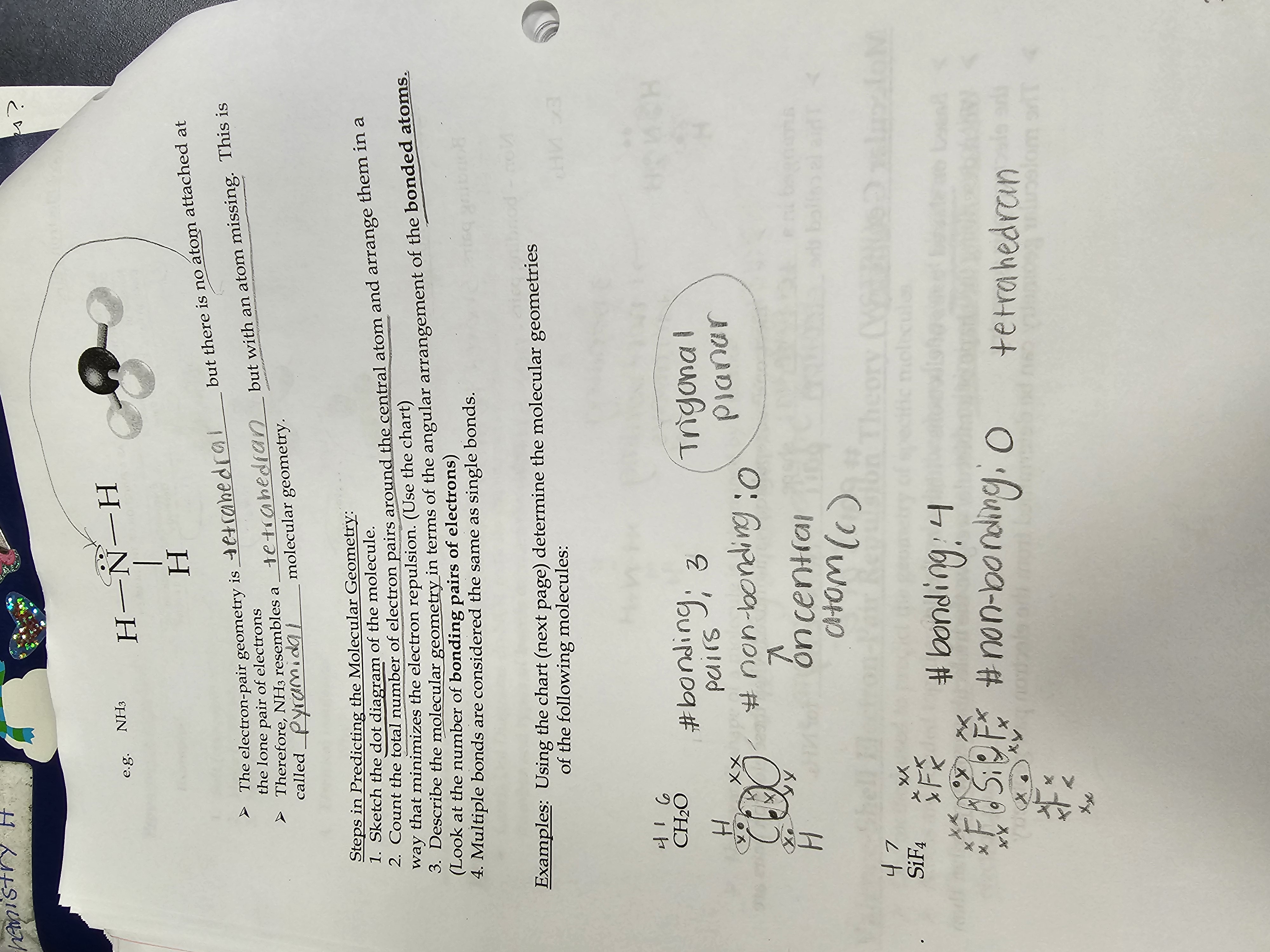
74
New cards
Linear molecular geometry
2 total e- domains, electron-domain geometry = linear, bonding domains = 2, NB domains =0
75
New cards
Trigonal planar molecular geometry
3 pairs e- domains, trigonal planar electron- domain geometry, 3 bonding, 0 NB,
76
New cards
Bent molecular geometry (3 pairs)
3 pairs e- domains, trigonal planar electron- domain geometry, 2 bonding, 1 NB
77
New cards
Tetrahedral molecular geometry
4 pairs e- domains, tetrahedral electron- domain geometry, 4 bonding, 0 NB
78
New cards
Trigonal pyramidal molecular geometry
4 pairs e- domains, tetrahedral electron- domain geometry, 3 bonding, 1 NB
79
New cards
Bent molecular geometry (4 pairs)
4 pairs e- domains, tetrahedral electron- domain geometry, 2 bonding, 2 NB
80
New cards
Shapes chart
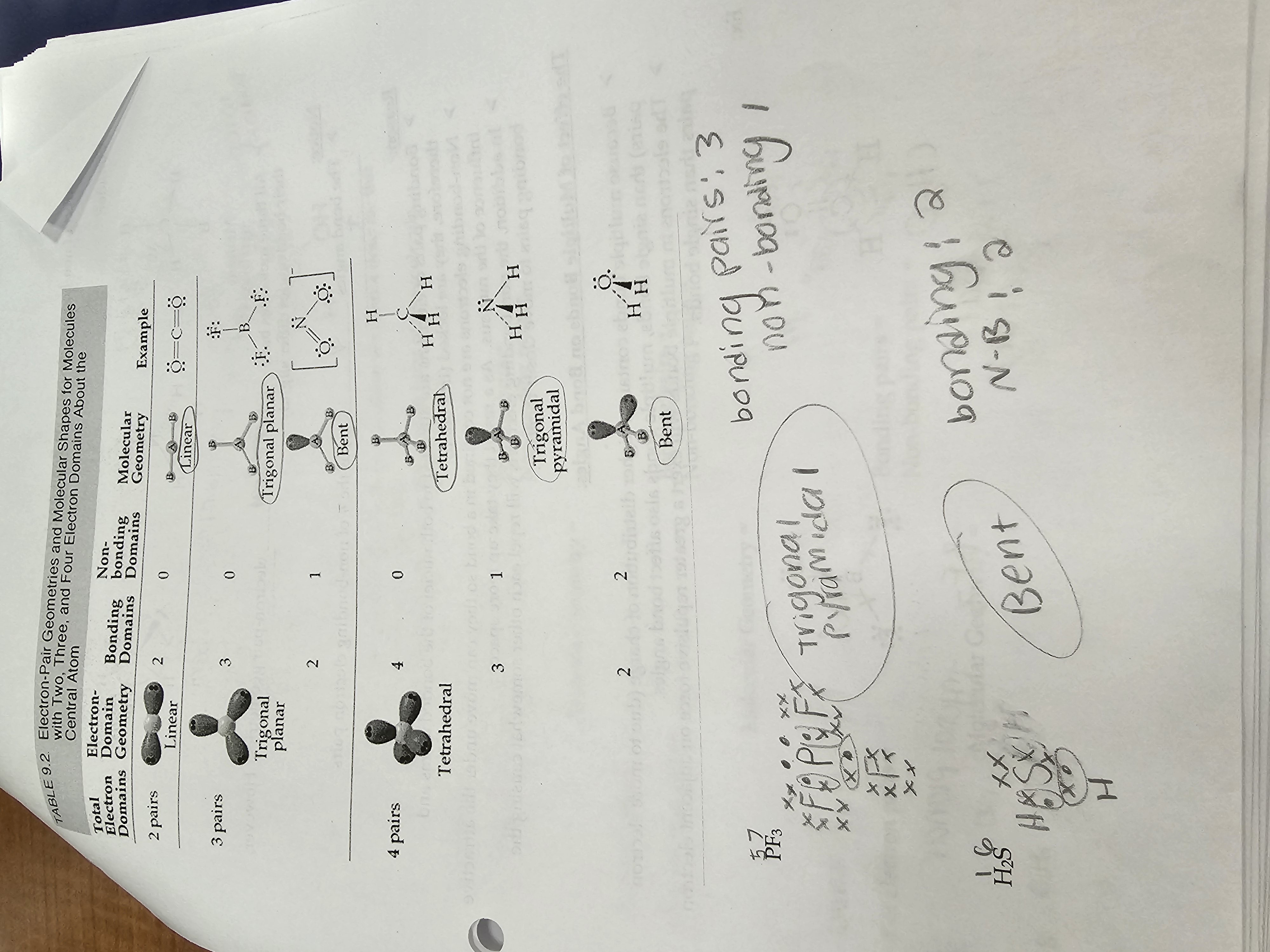
81
New cards
The bond angles decrease as
\# of non-bonding e- pairs increases
82
New cards
Effect of non-bonding on bond angles-reason:
* Bondinding pairs of e- are attached to both nuclei of the bonded atoms (are locked, in a bond)
* Non-bonding e- are not confined in a bond so they can move under the attractive influence of a nucleus → take up more space
* non-bonding e- will repel each other somewhat sausing the bonding pairs to move closer together
* Non-bonding e- are not confined in a bond so they can move under the attractive influence of a nucleus → take up more space
* non-bonding e- will repel each other somewhat sausing the bonding pairs to move closer together
83
New cards
Effect of multiple bonds on bond angles
* Multiple bonds contain higher distribution charge (due to more e- pairs) than single bonds→ multiple bonds affect bond angles
* E- in multiple bonds will exert a greater repulsive force on adjacent e- pair than single bonds
* E- in multiple bonds will exert a greater repulsive force on adjacent e- pair than single bonds
84
New cards
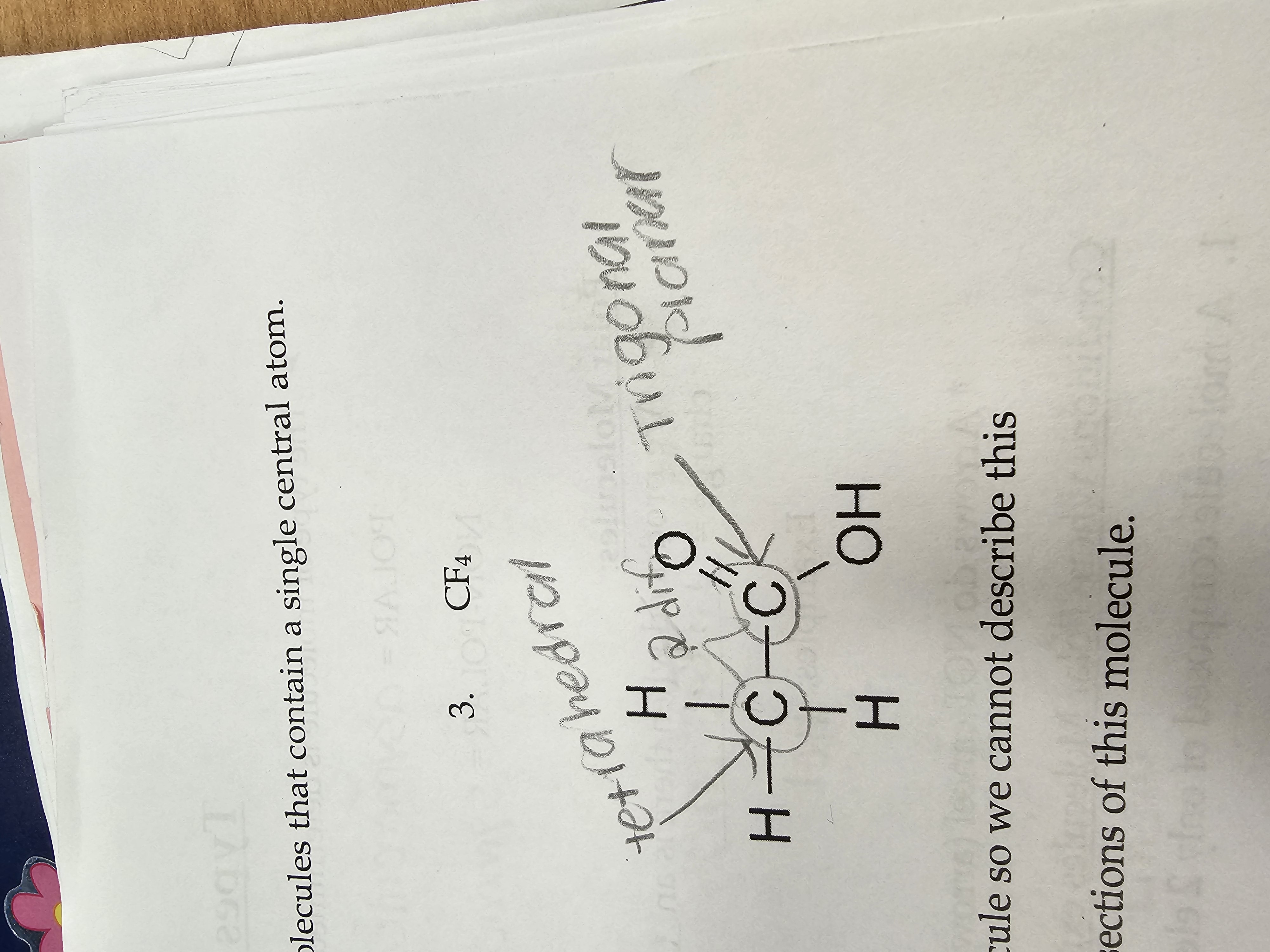
Molecules with no single central atom
* Cannot describe this molecule as 1 type of molecular geometry
85
New cards
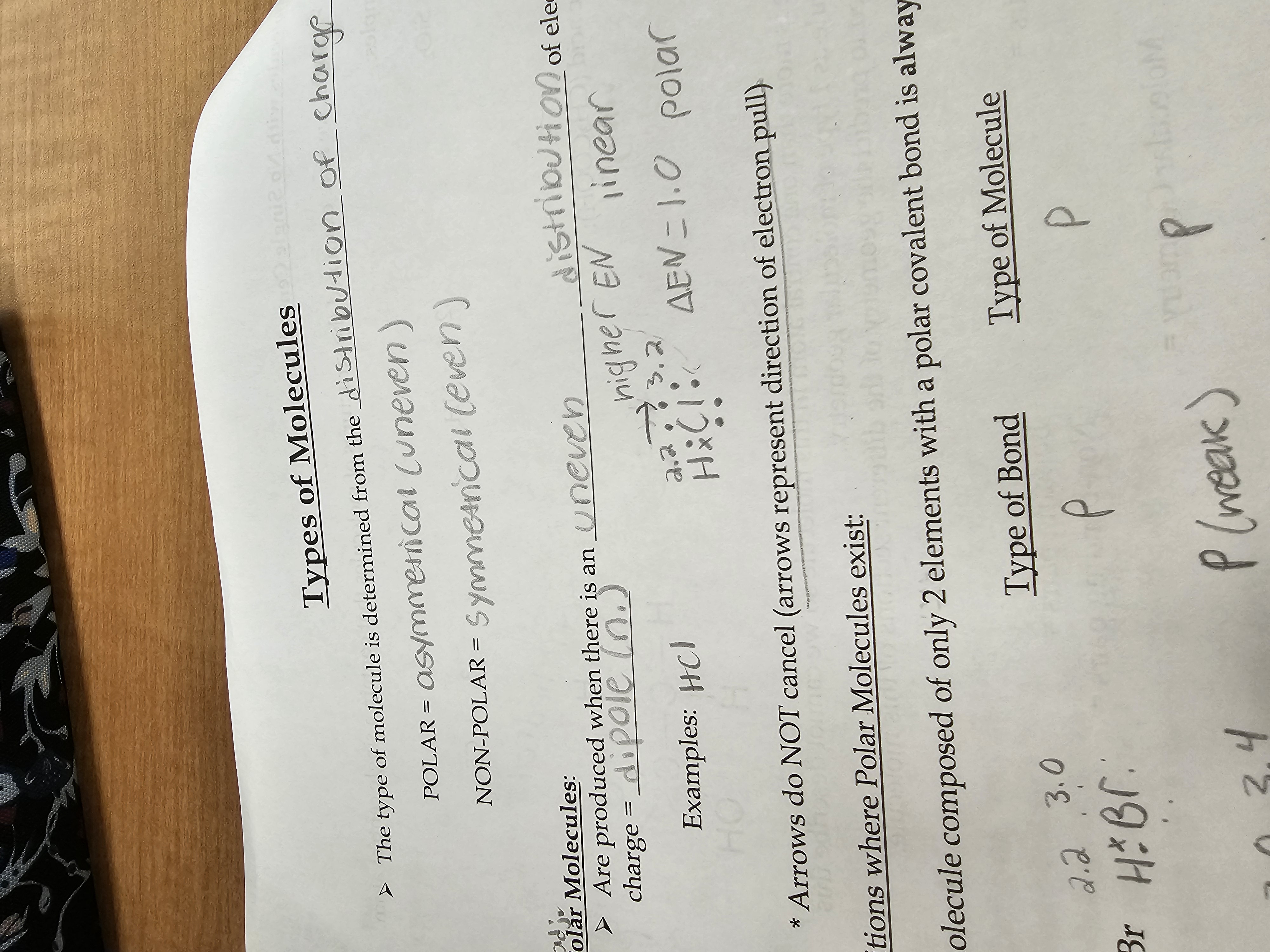
Type of molecule determined from
The distribution of charge
86
New cards
Polar =
Asymmetrical (uneven)
87
New cards
Non-polar =
Symmetrical (even)
88
New cards
Polar molecules produced when
There is an uneven distribution of electrical charge (dipole)
89
New cards
Conditions where Polar molecules exist
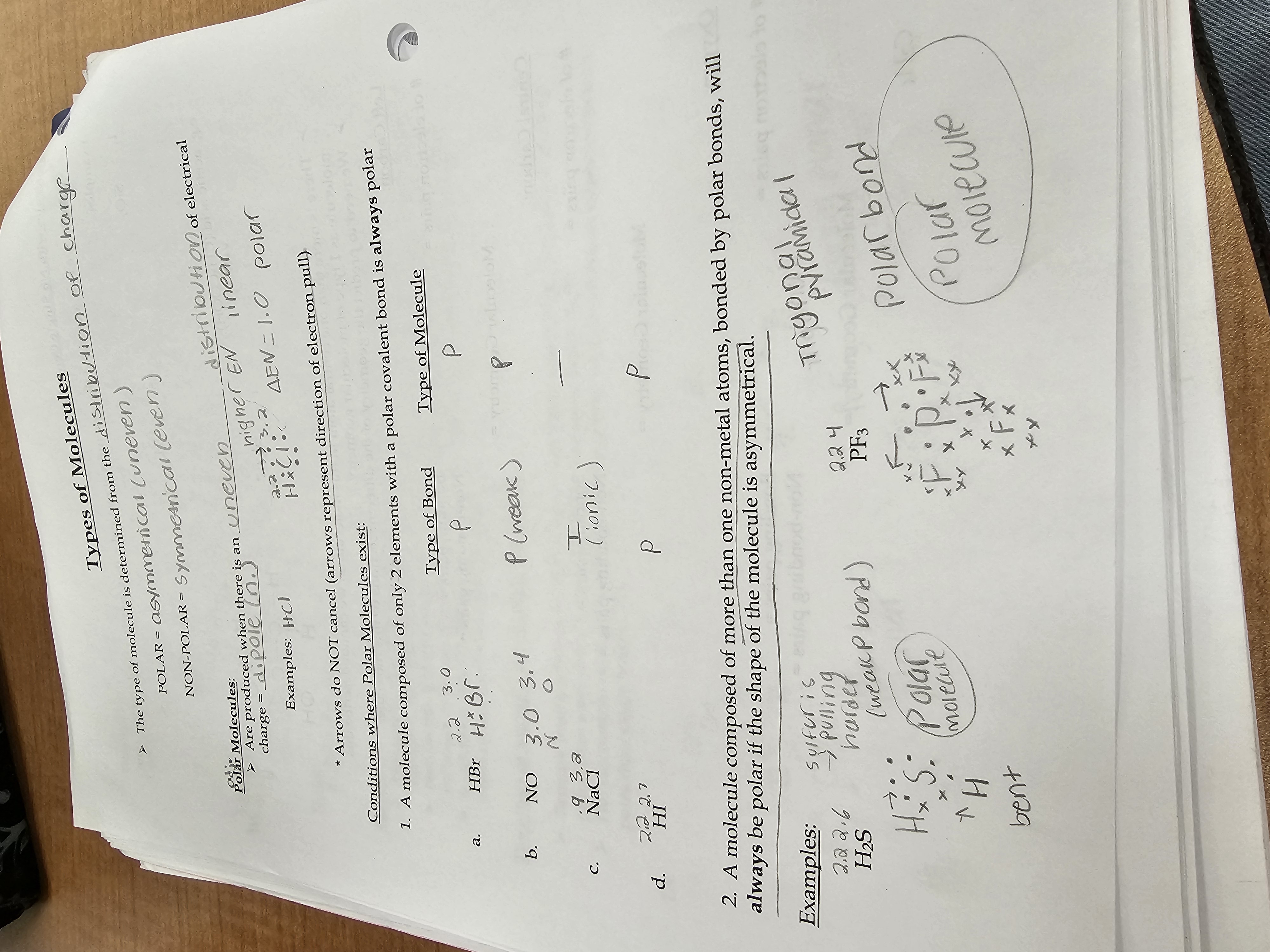
1. A molecule composed of %%only 3 elements with a Polar covalent bond%% is %%always%% polar
2. A molecule composed of morethanonenon−metalatoms, bonded by Polar bonds, will always be Polar if the shape of the moleculeisasymmetrical
90
New cards
Conditions where non-polar exist
Contains even distribution of charge (arrows cancel)
1. @@Diatomic@@ molecules that are bonded by non-polar bonds
2. ==>2 non-metal atoms, bonded by Polar covalent bonds, symmetrical shape==
1. @@Diatomic@@ molecules that are bonded by non-polar bonds
2. ==>2 non-metal atoms, bonded by Polar covalent bonds, symmetrical shape==
91
New cards
Polar substance will dissolve in
Polar molecules
(Partial charge on Polar molecules are attracted to charges on Polar substance)
(Partial charge on Polar molecules are attracted to charges on Polar substance)
92
New cards
Ionic compounds dissolve in
Polar molecules
(Ionic charges (cations, anions) are attracted to Polar molecules)
(Ionic charges (cations, anions) are attracted to Polar molecules)
93
New cards
Non-polar molecules will dissolve in
Non-polar molecules
94
New cards
Bonds between 2 atoms represetn
The force of attraction between atoms
H-Cl
H-Cl
95
New cards
Molecular attraction (IMF's)- physical properties s,l,g largely due to
* Molecular attraction
* Stronger = solid
* Weaker = gas
\
* Stronger = solid
* Weaker = gas
\
96
New cards
Why strength of attraction impact on phase?
Stronger the molecular attraction the higher the temp at which a substance melts ot boils (takes more energy to overcome the force of attraction)
97
New cards
Types of IMF
1. Dipole-Dipole
2. Hydrogen bonding attractions
3. Molecule-ion Attractions
4. VanderWaals Forces (London Dispersion Forces)
98
New cards
Dipole-Dipole attraction
* Exists between Polar molecules (uneven distribution of charge)
* Effective only when Polar molecules are very close together
* Weak attraction
* Effective only when Polar molecules are very close together
* Weak attraction
99
New cards
H bonding attraction
* Special type dipole-dipole bonding that exists between molecules that contain H bonded to a small highly EN atom such as F,O, or N
* H only has a small share of electrons (EN difference is so high that electrons are pulled closer to O,F,N)
* Results in highly polarized bond and molecule (partial charges are stronger)
* Attractions between these highly polarized molecules is like an extra strong dipole-dipole
* H20, HF, NH3
* H only has a small share of electrons (EN difference is so high that electrons are pulled closer to O,F,N)
* Results in highly polarized bond and molecule (partial charges are stronger)
* Attractions between these highly polarized molecules is like an extra strong dipole-dipole
* H20, HF, NH3
100
New cards
Metallic bonds
* Metallic atoms have few valence e-
* Have low IE
* Metallic bond= collection of cations (+) for which free-floating valence e- have an attraction
* “A sea of mobile electrons”
* Have low IE
* Metallic bond= collection of cations (+) for which free-floating valence e- have an attraction
* “A sea of mobile electrons”