BSCI223: Motility, Chemotaxis, and Sporulation
 Call Kai
 Learn
 Practice Test
 Spaced Repetition
 Match
 Flashcards
 Knowt Play
1/53

Earn XP
54 Terms
What are the four types of motility?
Swimming, Swarming, Twitching, and Pushing
What is the flagella?
It provides motility for bacteria where movement is driven by rotary protein engine and powered by proton motive force - it has a motor complex connected to flagellar filament which is also rotated.
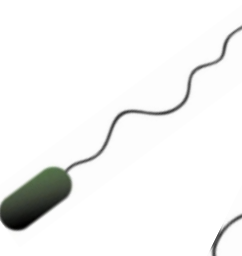
What is this called? Where is the flagella located?
Monotrichous, one flagellum located at one end of cell

What is this called? Where is the flagella located?
Lophotrichous, many flagella co-located on one end of cell
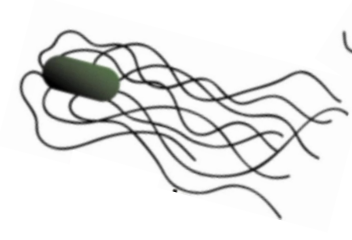
What is this called? Where is the flagella located?
Peritrichous, many flagella distributed all over the cell

What is this called? Where is the flagella located?
Amphitrichous, single flagellum located at each end

What is this called? Where is the flagella located?
Endoflagella; flagella are located in periplasmic space of negative bacteria, they are inserted at both ends of the cell, overlapping in the middle.

What are rigid protein appendages on a cell? There are different types which perform different actions (ie. adhesion, motility, genetic transfer, etc.)
Bacterial pili
In Swimming, what structure is used by the bacteria?
Flagella
Swimming Motility
Movement through liquid, individual movement, and powered by rotating flagella
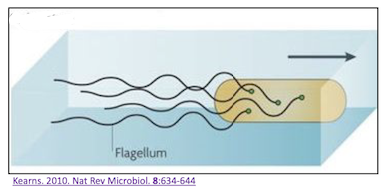
What is used in lab to test for swimming motility?
Motility stab
In direct observation, what is important to consider when trying to determine swimming motility?
Make sure that it is swimming motility and not motion unrelated to bacterial motility such as Brownian motion or streaming.
What is Brownian motion?
Consequence of molecular vibration
In Swarming, what structure is used by the bacteria?
Flagella
Swarming Motility
Cells that become hyperflagellated where they require flagella to perform surface motility with a group; thought to be triggered by surface contact.

Why does swarming motility require surfactant?
To reduce tension
In Twitching, what structure is used by the bacteria?
Type IV Pili
Twitching Motility
Uses type IV pili to perform surface motility where the pilus extends and attaches to surfaces then retracts to pull cell along. It is known to have jerky movement over surfaces.

In Pushing, what structure is used by the bacteria?
Host Cell Actin
Pushing Motility
Where host cell actin polymerization forms actin tail at bacterial pole. The bacterial is then pushed by growing actin tail.

What does taxis mean?
directed movement
What is Chemotaxis?
Direct movement in response to chemical gradients (ie. chemoattractants and chemorepellents) where cell undergoes random swim/tumble movements. In order to determine swim or tumble, one must look at direction of flagellar spinning.
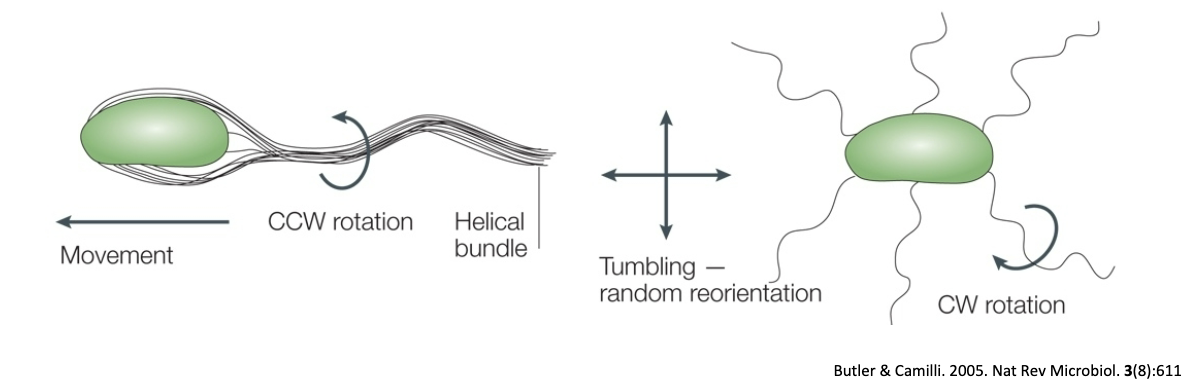
To tumble, what direction does the flagella spin?
Clockwise
To swim (“run”), what direction does the flagella spin?
Counterclockwise
If there is a higher concentration of chemoattractant, is the swimming period longer or shorter?
Longer
If there is a higher concentration of chemorepellents, is the swimming period longer or shorter?
Shorter
How do bacteria know when to swim vs. tumble? Give E. coli example
Protein phosphorylation pathway involves Che proteins. When receptors in the inner membrane (transmembrane proteins) initiate signaling, it can lead to phosphorylation of CheY protein. Then the phosphorylated CheY binds to flagellar motor and favors clockwise rotation which leads to increased tumbling.


What is A?
Swimming

What is B?
Tumbling
What is Aerotaxis?
Direct movement in response to oxygen concentration
What is Phototaxis?
Direct movement in response to light intensity
What is Magnetotaxis?
Direct movement in response to magnetic fields
What is the structure of spores?
Dehydrated, multi-shelled protective structure
When do spores respond to?
Adverse conditions (ie. lack of nutrients, high cell density, etc.)
What are spores resistant to?
Heat, Chemicals, Radiation, Dessication
Do all bacteria produce spores?
No
Do spores have complete chromosome? How about proteins?
They have complete chromosome, but only minimum # of proteins.
What is the main goal of spores?
Survival, not reproduction
T/F: Spores are easy to get rid of using standard disinfectants
False
When there are favorable conditions, how many spores are there in a bacterial cell?
1 spore
What is sporulation a process of?
Cellular differentiation

When a receptor within a spore-forming bacteria senses adverse conditions, it activates sporulation. During this process, what forms within the mother cell?
Endospore
In the early stage of sporulation, a wall forms a compartment within the mother cell which is called?
forespore
What is in the forespore?
Copy of bacterial chromosome, ribosomes, specific proteins
When under a phase contrast microscopy, the forming endospore and fully formed endospore are seen as what?
bright ovals
Endospores are often what?
dormant
What is the conversion of endospore to vegetative cell called?
Germination
Which of the following are true? (Pick all that apply)
A. Bacterial flagella act as rotary motors to propel the cell through liquid.
B. Energy for bacterial motility is generated using cellular mitochondria.
C. Swarming motility is a group behavior.
D. Swimming motility occurs on a surface.
E. I don’t know
A,C
Which of the following terms describes flagella that are distributed all over the surface of a bacterial cell?
A. Monotrichous
B. Lophotrichous
C. Peritrichous
D. Amphitrichous
E. I don’t know
C
Pushing motility requires which cell part?
A. Flagella
B. Pili
C. Peptidoglycan
D. Host cell actin
E. Tiny paws
F. I don’t know
D
Which correctly describe(s) bacterial cell chemotaxis?
A. Cells choosing to swim toward something they like
B. Changes in cell movement in response to external signals
C. Phosphorylation-driven changes to flagellar rotation patterns
D. Bacterial cell movement away from an attractant
E. I don’t know
A,B,C
In the presence of a favorable nutrient, chemotactic bacteria are more likely to show which of the following traits (compared to bacteria without the nutrient)?
A. Longer periods of swimming
B. Longer periods of tumbling
C. Longer periods of sniffing
D. Longer periods of chemotaxis
E. I don’t know
A
In the presence of a repellent, which is (are) true?
A. Flagella form a helical bundle
B. Cells undergo prolonged periods of tumbling
C. Flagella spin in a counterclockwise direction
D. Bacterial cell receptors bind to the repellent chemical
E. I don’t know
B, D
Which of the following is true about bacterial sporulation?
A. It is a reproductive strategy
B. It is a survival strategy
C. It occurs in almost all strains of bacteria
D. It is an irreversible process
E. I don’t know
B