Bio Exam 20-30
 Call Kai
 Learn
 Practice Test
 Spaced Repetition
 Match
 Flashcards
 Knowt Play
1/144

There's no tags or description
Looks like no tags are added yet.
145 Terms
DNA replication
Copying of the cellular information in preparation for cell division. All cells arise from other cells, and all cells need DNA for instructions. This occurs frequently in prokaryotes (Binary fission) and occurs during S phase in eukaryotes (preparation for mitosis)

DNA replication v. Transcription

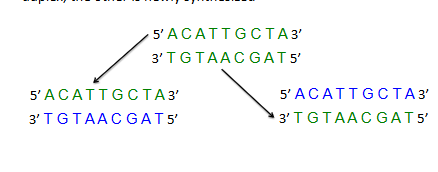
Semiconservative replication
Each new molecule of dsDNA has one strand from the original duplex, and the other is newly synthesized
Replication Fork
Replication occurs along DNA at this point, where the complementary parental strands are pulled apart and copied

Result of semiconservative replication
Each new DNA duplex is identical in sequence to the other, and both are identical to the original duplex.

Origin of Replication
Where replication is initiated

Bacteria replicating in circular chromosome
Results in two daughter DNA molecules

Three steps of DNA replication
Ignition, Elongation, and Termination
Initiation
Proteins at the origin of replication pull apart DNA and help DNA polymerase start DNA synthesis. Needs Topoisomerase, Primase, Helicase, and single strand binding proteins

Topoisomerase
Alleviates torsional strain in the DNA helix by cleaving the DNA and letting it unwind. Relieves the tension building in the duplex

Primase
Sets up a starting point for the DNA polymerase. DNA polymerase extends the primers by adding dNTPs (phosphodiester bonds)

Helicase
Unzips the DNA strands ahead or DNA polymerase

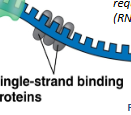
Single-strand binding proteins
Keeps ssDNA from forming any secondary structures
Elongation
DNA polymerase adds dNTPs to the newly synthesized strands using both parental strands as templates
Termination
DNA polymerase reaches special sequences in circular chromosomes, just runs off the ends of linear chromosomes (or into another replication fork)
Synthesis at the replication fork is…
Not continuous on both strands

Leading strand
Continuous replication (unbroken)

Lagging Strand
Discontinuous replication

Okazaki Fragments
The short DNAs synthesized in lagging strand synthesis before being ligated (fused) to the elongated DNA strand

Leading strand synthesis (continuous replication)
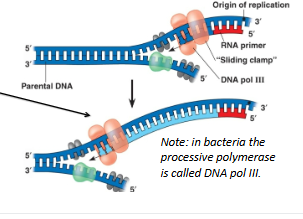
Requires Primase to add an RNA primer at the origin of replication once.

DNA Polymerase
Aided by the “sliding clamp” protein complex to keep it on the DNA: increased processivity
Processivity
How long an enzyme can hang on to substrate and catalyze consecutive reactions


Lagging Strand Synthesis (Discontinuous replication)
Primase adds an RNA primer to get a DNA polymerase started. DNA polymerase (with a sliding clamp) begins DNA synthesis 5’ to 3’. When DNA polymerase hits another RNA primer, it comes off DNA. Next DNA polymerase reaches previous primer

Lagging strand synthesis continued
When DNA is synthesized up to the RNA primer, another polymerase comes in to finish DNA synthesis and remove the RNA.
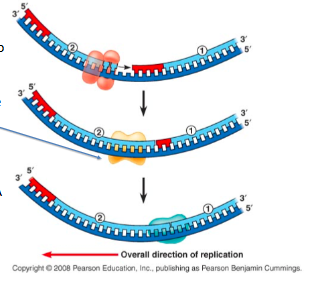
Ligase
an enzyme that joins the DNA strands with a normal phosphodiester bond

Fidelity
The accuracy of the polymerase. When DNA polymerase can correct replication errors

Sexual reproduction
Creating offspring with half the genetic material of two different organisms (within the same species). Genetic diversity each generation: A lot (half of genes from one parent, half from other)

Advantage of sexual reproduction
A mixture of the genetic information of two individual organisms can produce offspring that have greater fitness than either parent (genes have a better chance of surviving to subsequent generations)
Disadvantage of sexual reproduction
Each organism only passes half of its genetic information to its offspring (and you need a mating partner)
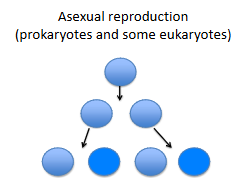
Asexual reproduction
Genetic diversity each generation: Very little (A few replication errors = mutations)
Meiosis
A special type of cell division, in germ cells, to create gametes

Germ Cells
Types of cells in the gonads (reproductive glands) that can divide to become gametes.
Gametes
Haploid cells (with 1n DNA content) combine with gametes of other individuals (fertilization) to make a new diploid cell (2n) (zygote) that is a new organism.

Two stages of meiosis
Meiosis I, and Meiosis II
Meiosis I
Segregates the homologous chromosomes (not the sister chromatids of each chromosome). Like mitosis, EXCEPT 1) homologous chromosomes are paired in Prophase I (for synapsis), and 2) then separated from each other in Anaphase I

Meiosis II
Just like mitosis (but only separating sisters from 23 chromosomes, not 46). Just like mitosis: all chromosomes are lined up in metaphase II; sister chromatids are pulled apart in Anaphase II

Synapsis
Increasing genetic diversity by recombining homologues. The chromosomes in the gametes are a combination of the homologues from mom and dad.

Non-sister chromatids
Can be recombined by synapsis: aligned, cleaved at the same location, regions exchanged
Chiasma
The X shape where synapses occur

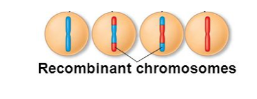
Recombinant chromosomes
Synapsis between non-sister chromatids makes haploid cells with unique chromosomes
Locus
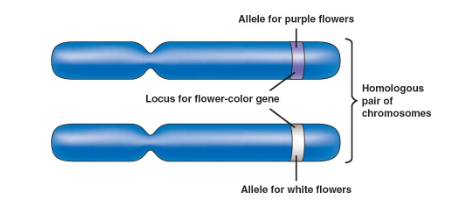
Particular region or gene on a chromosome

Allele
The same gene on each homologous chromosome
Homozygous
Alleles are identical on both chromosomes (RR)
Heterozygous
Alleles are different on the chromosomes (Rr)
Genotype
The alleles an organism has of a particular gene

Phenotype
The characteristics of an organism based on its genotype (its physical traits)
Law of Segregation
During meiosis, the alleles for each gene segregate from each other so that each gamete carries only one allele for each gene. (Each gamete gets ONE of each chromosome. Each gamete gets either the maternal or paternal homologue of each chromosome
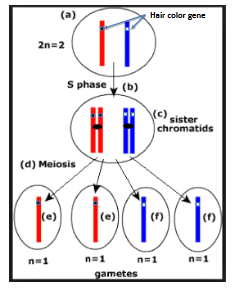
Law of Independent Assortment
Segregation of homologues for a chromosome is not affected by the segregation of any other chromosome. Each of the 23 different chromosomes goes to gametes independently.

Law of Dominance
Some alleles are dominant while others are recessive; an organism with at least one dominant allele will display the effect of the dominant allele. If either allele is dominant then that dominant trait will be expressed
Synapsis
Occurs randomly on any location along a chromosome. Recombination may occur between genes or even within a gene

Linked
Genes on the same chromosome are linked to each other. The further apart two genes are on a chromosome, the more likely recombination could occur between them.

Linkage
How close two genes are to each other on a chromosome. Genes close together have high linkage. The further apart two genes are, the lower their linkage. Genes on different chromosomes have no linkage (law of independent assortment)

Typical genotype notation
The dominant allele is an uppercase letter, and the recessive allele is a lowercase letter
Gregor Mendel
The father of modern genetics. Worked on pea plants to try to understand heredity. Carefully crossed pea plants with different traits with each other and measured the number of offspring with traits similar to each parent. Came up with concepts of alleles and diploid cells. Discovered the three laws of inheritance.

Discovering the law of segregation
Started with true breeding plants (purebred): any two plants crossed produce offspring that are identical to the parents.

Phenotypic ratio
Ratio of observable traits in offspring

Genotypic ratio
Ratio of alleles in offspring

Punnett square
Table used to determine the probability of offspring having a particular genotype (and phenotype)

Punnett square example

Monohybrid cross
Crosses observing only one characteristic

How different alleles impact pea flower color locus

Pedigree
Chart showing relationships among family members expressing some trait

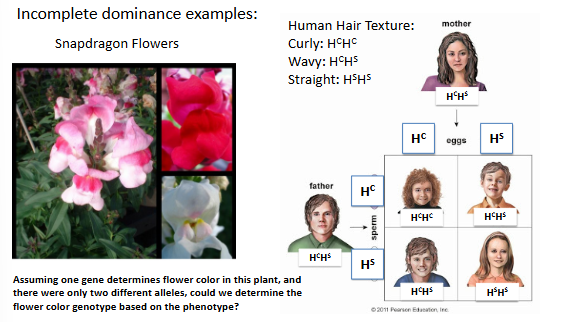
Incomplete dominance
Heterozygous individuals have an intermediate phenotype. Genotype designations for alleles in genes with incomplete dominance are sometimes written little differently. Typical cause: one functional allele does not have the same impact as two functional alleles (gene dosage)

Incomplete dominance examples
Snapdragon flowers: one red parent, one white parent = pink flowers.
Hair: mom and dad with wavy hair = 2 wavy hair, one straight hair, and 1 curly hair child.
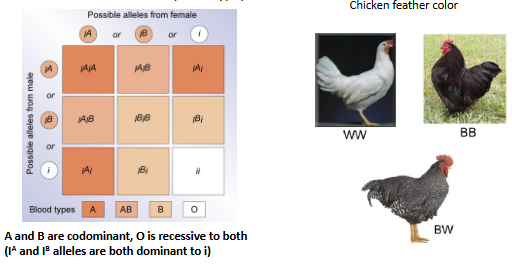
Codominance
Heterozygous individuals show both traits encoded by each allele (Both alleles contribute to the phenotype)
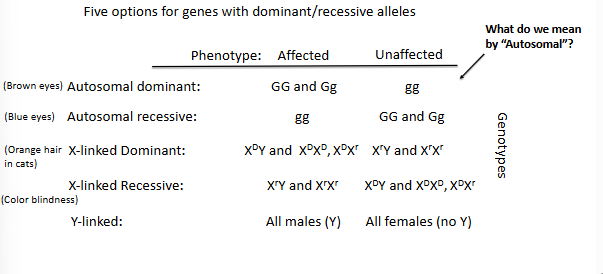
Sex-linked traits
Carried on the X or the Y chromosomes

Sex-linked traits examples
-Daughters get dad’s X chromosome, either one of mom’s
-Sons only get one of Mom’s X chromosomes
-Sons have dad’s Y chromosome

Spotting Y-linked traits in pedigrees
Y-linked is the easiest… only one allele for each gene on the Y chromosome (No dominant/recessive; and only males are affected)

Determining Models of Inheritance from pedigrees
Pedigrees show who in a family has a particular phenotype.
What we can determine from a pedigree
-Is it a dominant or recessive trait
-Is the gene on a sex chromosome (X or Y) or an autosome?
-The genotypes of some or all individuals for that gene (AA, Aa, or aa)

Determining Modes of Inheritance from pedigrees (cont.)
The Cell
The most basic unit of life, all living things are made of cells, and all cells come from other cells (all cells are related)
Microscopy
Use of electromagnetic radiation (light, subatomic particles) and lenses (a device that can focus EM radiation) to see details of small objects. Looking at objects that cannot be seen by eye
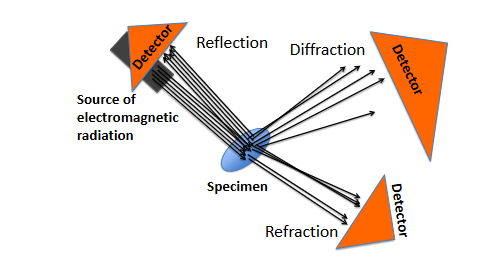
Limitation to microscopy… Resolution
Shortest distance between two points that can be distinguished. The resolution of an object/structure is inversely related to the wavelength used to create the image: Shorter wavelength = high resolution

Two types of microscopy
Light microscopy: Uses photons of light
Electron microscopy: Uses electrons

Two types of electron microscopy
Transmission electron microscopy (TEM), scanning electron microscopy (SEM)

Fractionation
Use of lots of cells and breaking them into pieces to study their parts
Cell fractionation
Separating different compartments of cells to study individually
1) Physically break up cells (homogenization)
2) Separate cell parts by centrifugation (inertia pulls pieces to the bottom of the tube)

Cell fractionation (cont.)

Supernatant
Stuff in suspension (not in pellet)
Prokaryote cell parts
No membrane-bound organelles, the cell contains cytosol (liquid in the cell), DNA (in the nucleoid region), RNA, ribosomes, and proteins. These cells do two things: survive and divide.

Eukaryotic cells
Membrane-bound organelles, DNA in the nucleus, and some have cell walls:
-plants (cellulose)
-Fungi (chitin)

Common features of prokaryotes and eukaryotes
Plasma membrane (separates the inside of the cell from the environment), Chromosomes (DNA stores all the information to make the cell), Ribosomes (translation necessary for protein synthesis), and cytoplasm (liquid in the cell)
Organelles
Specialized structures within the cell, only in eukaryotic cells, and membrane-bound organelles allow cells to compartmentalize and specialize biochemical functions
Nucleus
Organelle housing the DNA (chromatin)
-DNA replication
-Transcription

Nucleolus
Domain within the nucleus where ribosomes are assembled
Nuclear envelope
A double membrane structure isolating the nucleoplasm from the cytoplasm. Has two lipid bilayers (inner membrane and outer membrane). Supported by the nuclear lamina (a protein mesh just inside the inner nuclear membrane)
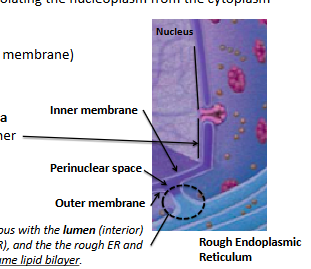
Nuclear pore
A protein gate through the nuclear envelope, anchored to the nuclear lamina inside the inner membrane, and regulates the trafficking of materials and signaling between the cytoplasm and the genome

Endomembrane system
The membrane-bound organelles of the cell

Endomembrane system (cont.)
Connectivity and continuity within the endomembrane system allow for traffic: Shuttling of proteins and other molecules around the cell.

Primary functions of endomembrane system
-Protein synthesis and distribution
-Lipid synthesis and distribution
-Detoxification of poisons
Endoplasmic Reticulum (ER)
Connected to the nuclear envelope. Made up of stacks of cisternae (Flattened disks of membrane) and interconnected by tubules. Reticular = network

Endoplasmic Reticulum (ER) types
Rough ER
Has ribosomes attached to the outside (cytosolic side)
Smooth ER
No ribosomes, more tubular in shape.
Each has distinct functions, but they are actually sub-compartments of the same giant organelle

Rough ER
-Protein production (All secreted proteins and membrane-bound proteins)
- Proteins are shuttled from the rough ER to other locations (Golgi, lysosomes, secretory vesicles, etc.)
- Protein folding and glycosylation (adding sugars) within the ER lumen

Smooth ER
-Lipid manufacturing (and hormone synthesis)
- Drug detoxification (Large in liver cells; can grow in
response to drug exposure)
- Calcium storage (e.g. muscle cells)

Golgi
Cisternae structure (stacks). Receiving face (cis): fuses with transport vesicles from the rough ER. Shipping face (trans): buds off transport vesicles to other destinations (plasma membrane, other organelles)
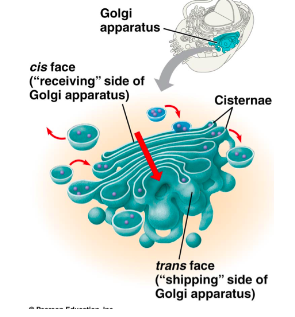
Golgi function
Roles in protein preparation:
-Modifications
-storage
-sorting (protein finishing and final preparations)
Location of much cellular carbohydrate synthesis

Lysosomes
Vesicles of hydrolytic enzymes (break apart bonds). Digestive enzymes are produced in the ER and modified in the Golgi. Acidic environment

Vacuoles
Large vesicles formed in the ER and Golgi. Different functions for different cell types

Central vacuole
Found in plant cells, stores nutrients, keeps cells rigid, breaks down waste materials (like lysosomes in animal cells.)
Other types of vacuoles
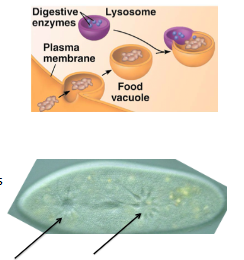
Food vacuoles: Formed by phagocytosis and fused with lysosomes.
Contractile vacuoles: Pump water out of cells (locomotion option for some protozoans)