RBC WBC Lymph Disorders, Infections, Inflammation & Immunity
 Call Kai
 Learn
Learn Practice Test
 Spaced Repetition
 Match
Match Flashcards
 Knowt Play
1/76

There's no tags or description
Looks like no tags are added yet.
Name | Mastery | Learn | Test | Matching | Spaced | Call with Kai | Chat |
|---|
No analytics yet
Send a link to your students to track their progress
77 Terms
Granulocytes
WBC produced in bone marrow and contain small granules that release enzymes to fight infection
Neutrophils
Primary pathogen-fighting cells
Eosinophils
Help control allergic responses; fight parasites
Basophils
Blood cells; release heparin, histamine, and other inflammatory mediators
Mast cells
Tissue cells; release heparin. histamine, and other inflammatory meditators; involved in allergic reactions
Agranulocytes
WBC lacking prominent, visible granules in the cytoplasm
B cells (B lymphocytes)
Produce antibodies
T-helper cells
CD4+ - Activate immune response
Cytotoxic T cells
CD8+ - Cell-mediated immunity
Natural killer cells
kill abnormal or antigenic cells
Monocytes
Circulate in blood and can develop into macrophages
Macrophages
Perform phagocytosis, present antigens, and release inflammatory mediators
Myeloid Stem Cell
Gives rise to granulocytes (neutrophils, eosinophils, and basophils) and monocytes
Lymphoid Stem cell
Gives rise to lymphocytes (T cells, B cells, and NKC
Leukopenia
Decreased number of circulating WBCs
Neutropenia
Decreased neutrophils, increasing infection risk
Agranulocytosis
Severe granulocyte deficiency, particularly neutrophils
Aplastic Anemia
Bone marrow failure, resulting in reduced blood cell production
Infectious mononucleosis
Viral illness commonly affecting lymphocytes
HIV
Viral infection that targets immune cells, particularly CD4+ T cells
Myeloid neoplasm
Group of blood cancers that start in the bone marrow when stem cells grow and divide in an abnormal way
Lymphoid neoplasm
Group of blood cancers that start when B-cells, T-cells, or NKC mutate, multiple out of control, and form tumors or crowd the blood & bone marrow
ALL
Acute lymphoblastic leukemia - acute, lymphoid origin
AML
Acute myeloid leukemia - acute, myeloid origin
CLL
Chronic lymphocytic leukemia - chronic, lymphoid origin
CML
Chronic myeloid leukemia - chronic, myeloid origin
Leukemia
Malignant disorder of blood-forming cells that produce abnormal blood cells
Malignant cells
Proliferate rapidly
Survive longer than normal
Crowd out healthy cells in marrow
Infiltrate widely
Hodgkin lymphoma
Associated with Reed-sternberg cells
Associated with malignant b cells
Forms masses in lymph nodes
EASIER TO TREAT
Non-hodgkin lymphoma
Includes numerous b cells and t cell lymphomas
can involve b cells and t cells
classified into different types and grades - DIFFICULT TO TREAT
Reed Sternberg cells

Myeloma
Malignancy involving abnormal plasma cells derived from B lymphocytes
Findings with Myeloma
abnormal antibody production
immune suppression
increased blood viscosity from abnormal proteins
organ involvement
increased osteoclast activity → breaks down bone
Host
An organism that provides a place for another organism to live
Infection
Invasion and multiplication of microorganisms in the body
Colonization
Microorganisms are present without necessarily causing disease
Microflora
Microorgansims normally living in or on the body
Commensalism
One organism benefits; the other is unaffected
Mutualism
Both organisms benefit
Parasitism
One organism benefits while the host is harmed
Pathogen
A microorganism capable of causing disease
Virulence
The degree of disease-causing ability of a pathogen
Opportunistic Pathogen
Cause disease when defenses are weakened or it enters an unusual location
Saprophyte
Organism that obtains nutrients from dead or decaying matter
Prions
No genome
Small, modified, inspection proteins
Abnormally shaped versions of own proteins
Can bind together and damage other cells
Cause degenerative diseases in CNS
Viruses
Protein coat surrounding nucleic acid core
Some have envelopes
DNA/RNA
Cannot reproduce without a host
Host cell’s normal metabolic activity makes new viruses
Bacteria
Prokaryotic
Contain RNA/DNA
Produce biofilm
Cytoplasmic mem
Use hosts for food and shelter
Live in colonies
Classified by genus & species
Described by: morphological appearance, oxygen dependence, staining
Mycoplasmas
Very small bacteria that lack cell walls
Rickettsiae / Chlamydiae
Bacteria that require living host cells to reproduce
Fungi
Has cell walls, but different from bacteria and requires much cooler temperature than “normal” core body temp
Protozoa
Unicellular, complete cellular components & nucleus
Helminths
Wormlike parasites, depend on and reproduce in host
Arthropods
Includes vectors of infectious disease (ticks, mosquitos, flies, and ectoparasites, infects by direct contact or eggs on host (maggots, mites, lice, fleas)
Adhesion factors
Allow pathogens to attach to host cell
Evasion factors
Help pathogens avoid immune defenses
Invasion factors
Help pathogens enter or spread through tissue
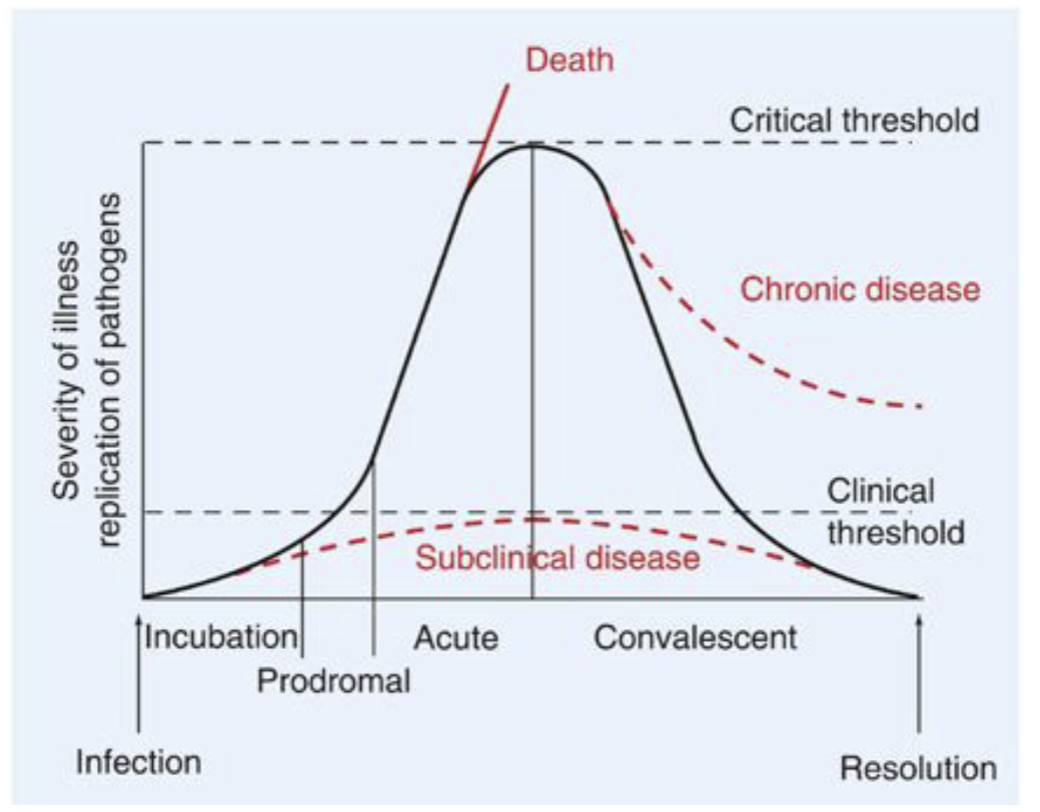
Incubation period
Begins when the pathogen enters the body, pathogen starts multiplying, the patient typically has no symptoms yet

Prodromal period
First signs and symptoms begin, symptoms are mild/unspecific, pathogen continues multiplying (early warning signs)
Acute period
Symptoms become more severe and specific to infection, illness may reach peak, immune system actively fights the pathogen

Convalescent period
Symptoms begin improving, body recovers from the infection, tissue repair and healing occur

Clinical threshold
The point at which illness becomes clinically apparent

Subclinical disease
Infection occurs, but symptoms are absent or not clinically apparent

Critical threshold
A level of severe illness associated with potentially life-threatening complications
Inflammation
Nonspecific protective response to tissue injury or infection (minimize effects of injury/infection, remove damage tissue, generate new tissue, and facilitate healing
What are the signs of inflammation?
Rubor, tumor, calor, dolor
Endothelial cells
Permeability allows for outflow of plasma cells
Vascular stage of acute inflammation
Blood vessels dilate and become more permeable
Mediators of the vasodilation
Histamine & nitric oxide
Mediators of permeability
Histamine,bradykinin, leukotrienes
Cellular stage of acute inflammation
White blood cells move from the blood into injured tissue
What are the plasma derived inflammatory mediators?
Kinis, coagulation & fibrinolysis proteins, complement system
Localized inflammation
Redness, edema, heat, tenderness, loss of function
Systemic inflammation
Fever, increased catabolism, negative nitrogen balance, increased ESR, leukocytosis
Pyrogen
Triggers inflammatory signals that produces elevation in body temperature
Fever in children are usually?
Higher
Fevers in elderly are usually?
Lower
What causes redness in inflammatory process?
Prostaglandins & leukotrienes