Plant Tax Lab 8, 9 and 10
 Call Kai
 Learn
Learn Practice Test
 Spaced Repetition
 Match
Match Flashcards
 Knowt Play
1/95

There's no tags or description
Looks like no tags are added yet.
Name | Mastery | Learn | Test | Matching | Spaced | Call with Kai | Chat |
|---|
No analytics yet
Send a link to your students to track their progress
96 Terms
Family Brassicaceae (habit, leaves, FF, infl, fruit, common name)
habit: herbaceous
leaves: variable, typically alt., lobed → compound
FF: *, 4, 4, 4(taller)+2(shorter), 2 (fused and superior)
infl: raceme
fruit: silique or silicles
common name: mustard family
Genus Raphanus (family, leaves, fruit)
Family Brassicaceae
leaves: (typically) basal, simple (basal) → compound (as the leaves move up/cauline)
fruit: silique (but indehiscent)
Genus Ribes (family, common name of family, habit, leaves, armaments, infl, FF, fruit
Family Grossulariaceae
Family Common Name: currants or goosberries
habit: shrubs
leaves: alt, simple, palmately lobed
armaments: gen. prickles (on stem, leaves, petioles, fruits)
infl: raceme, gen. pendant
FF: *, 5, 5, 5, (hypanthium), 2 (inferior and fused)
fruit: berry
*ribes have no stipules*
Genus Viola (family, common name of family, habit, leaves, FF, nectaries, fruit)
Family Violaceae
common name of family: violets
habit: herbaceous, basal rosette
leaves: often cordate
FF: X, 5, 4(normal)+1(spur), 3(normal+2(produce nectary), 3 (fused and superior)
nectaries: nectaries are produced from filament tissue
fruit: 3-parted capsule, dehiscent
Genus Acer (family, habit, leaves, flowers, fruit, common name)
Family Sapindaceae
habit: woody
leaves: opposite, palmately lobed
flowers: pendant, reduced, catkin
fruit:schizocarp (samaroid)
silique
fruit with two fused carpels with the length being more than three times the width
*unique to Family Brassicaceae
-dehiscent/opens up → septum with fruit/seeds + valves that come apart → leave behind septum = persistent septum

silicles
fruit having two fused carpels with the width being more than the length
-found in Family Brassicaceae

hypanthium
fusion between lowest 3 whorls
-found in Family Grossulariacaea, Genus Ribes

catkin
a slim, cylindrical flower cluster, with inconspicuous or no petals, usually wind-pollinated
-found in Family Sapindaceae, Genus Acer


family? genus? family common name?
Family Violaceae
Genus Viola
(family) common name: Violets

family? genus? family common name?
Family Grossulariacaea
Genus Ribes
Family common name: currant or gooseberries

family? family common name? genus?
Family Brassicaceae
Family Common name: Mustard
Genus: Raphanus

family? family common name? genus?
Family Brassicaceae
Family Common name: Mustard
Genus: Raphanus

family? family common name? genus? fruit type?
Family Brassicaceae
Family Common name: Mustard
Genus: Raphanus
-indehiscent silique

family? family common name? genus?
Family Brassicaceae
Family Common name: Mustard
Genus: Raphanus

family? family common name? genus?
Family Grossulariaceae
Family Common name: currants or gooseberries
Genus: Ribes

family? family common name? genus?
Family Grossulariaceae
Family Common name: currants or gooseberries
Genus: Ribes

family? family common name? genus?
Family Grossulariaceae
Family Common name: currants or gooseberries
Genus: Ribes

family? genus? common name?
Family Sapindaceae
Genus: Acer
common name: maple

family? genus? common name? fruit type?
Family Sapindaceae
Genus: Acer
common name: maple
-schizocarp (samariod)

family? genus? common name?
Family Sapindaceae
Genus: Acer
common name: maple

family? genus? common name?
Family Sapindaceae
Genus: Acer
common name: maple

family? family common name? genus?
Family Violaceae
Family Common name: violets
Genus Viola

family? family common name? genus?
Family Violaceae
Family Common name: violets
Genus Viola

family? family common name? genus?
Family Violaceae
Family Common name: violets
Genus Viola
family? family common name? genus?
Family Violaceae
Family Common name: violets
Genus Viola

family? family common name? genus?
Family Violaceae
Family Common name: violets
Genus Viola

what type of ovary? hypanthium present or absent? if present, what type?
-superior ovary
-no hypanthium
-all parts gen. unfused, at least won’t come off in one piece

what type of ovary? hypanthium present or absent? if present, what type?
-superior ovary
-hypanthium present
=perigynous
(can be syncarpous or apocarpous; Most Rosaeceae)

what type of ovary? hypanthium present or absent? if present, what type?
-inferior ovary
-hypanthium present
=epigynous
*always will be syncarpous (ex: apple)
Family Rosaceae (common name, FF, habit, always have…sometimes have…)
common name: Rose Family
FF: *, 5, 5, infinite (hypanthium between the three), 1-inifnite
habit: herb to tree, vary widely
ALWAYS:
-hypanthium
-serrate or dentate margins
-have stipules
-leaves always alt in arrangement
SOMETIMES:
-armaments = gen. prickles (ex: roses)
-poisonous compounds
-compound leaves
Family Onagraceae (common name, habit, leaves, perianth, ovary, unique __, thread with_)
common name: Primrose Family
leaves: simple for architecture, arrangement is variable (whorl, alt, opp)
perianth: 4 parted (4 sepal, 4 petal)
ovary: inferior (usually really long tube-shaped hypanthium)
*sometimes long threads with pollen
*unique stigma lobes, very pronounced, obvious stigma lobes, sometimes long and curly
Crassulaceae (common name, habit, leaves, FF, fruit)
common name: stone crop family
habit: herbaceous to woody
leaves: simple, succulent (“fleshy”)
FF: *, 5, 5, 5 or 10, 5 (apocarpous, superior)
fruit: agg. of follicles
Genus Fragaria (family? common name? habit? leaves? hypanthium shape? fruit?)
Family Rosaceae
common name: strawberry
habit: herbaceous
leaves: basal rosette, alt., trifolioliate (compound with 3 leaflets)
hypanthium shape: shallow hypanthium
fruit: agg of achens, ecological berry/ecofruit
Genus Prunus (family? common name? habit? leaves? hypanthium shape? fruit?)
Family Rosaceae
common name: cherry, peach, almond, etc.
habit: shrub to tree
leaves: simple, with extrafloral nectary
hypanthium shape: deeply cup-shaped
fruit: drupe
Genus Rosa (family? common name? habit? leaves? hypanthium shape? fruit?)
Family Rosaceae
common name: Rose
habit: shrubs
leaves: pinnately compound, alt.
hypanthium shape: vase/urn-shaped
fruit: agg of achenes
Genus Rubus (family? common name? habit? leaves? hypanthium shape? fruit?)
Family Rosaceae
common name: blackberry, raspberry, thimbleberry, salmonberry, etc.
habit: shrub/herb
leaves: palmately compound leaves
hypanthium shape: shallow/plate shaped, small
fruit: agg of drupes

family? genus? common name?
family Rosaceae
genus Fragaria
Strawberry

family? genus? common name?
family Rosaceae
genus Fragaria
Strawberry

family? genus? common name?
family Rosaceae
genus Fragaria
Strawberry

family? genus? common name(s)?
family Rosaceae
genus Prunus
cherry, peach, almond

family? genus? common name(s)?
family Rosaceae
genus Prunus
cherry, peach, almond

family? genus? common name?
family Rosaceae
genus Rosa
Rose

family? genus? common name?
family Rosaceae
genus Rosa
Rose

family? genus? common name?
family Rosaceae
genus Rosa
Rose

family? genus? common name(s)?
family Rosaceae
genus Rubus
blackberry, raspberry, salmonberry

Family? genus? common name(s)?
family Rosaceae
genus Rubus
blackberry, raspberry, salmonberry

family? genus? common name(s)?
Family Rosaceae
Genus Rubus
blackberry, raspberry, salmonberry

family? family common name? common name of specific flower?
Family Onagraceae
Primrose Family
Fuchsia

family? family common name? common name of specific flower?
Family Onagraceae
Primrose Family
Fuchsia

family? family common name?
Family Onagraceae
Primrose Family

family? family common name?
Family Onagraceae
Primrose Family

family? family common name?
Family Crassulaceae
Stone Crop Family

family? family common name?
Family Crassulaceae
Stone Crop Family

family? family common name?
Family Crassulaceae
Stone Crop Family

family? genus? common name? superior or inferior ovary? what type of hypanthium?
family rosaceae
genus prunus
cherry, peach, almond
superior ovary = perigynous hypanthium

family? genus? common name? superior or inferior ovary? what type of hypanthium?
family rosaceae
genus rosa
rose
inferior ovary = epigynous hypanthium
Family Asteraceae (habit? fruit? infl?)
habit: any
fruit: achene sometimes called cypsela (family specific)
inflor: head
capitulum
another term for “head” inflor type

radiate head
ray flower
disc flower
anthers
pappus
stigmas
palea
peduncle
receptacle
bracts (singular = phyllary, collective = involucre)
Radiate flower
ray flower + disk flower (ONLY)
palea
bract that is sometimes attached at base of ovary where it is attached to receptacle
*no palea = epaleate
pappus
modified calyx (thus makes flower = inferior ovary)
“fluffy stuff” attached to ovary
phyllary and involucre
bracts on receptacles in Family Asteraceae
phyllary = singular
involucre = plural
Ray flowers (petals? bi or unisexual? FF?)
-only 3 fused petals
-pistillate flowers (no stamens, only have gynoecium)
-stigma (partially fused) comes out of small opening at base of ray flower (2 lobed)
FF: X, 0/pappus, 3 (fused), 0, 2 (fused and inferior)

disk flowers (bi or unisexual? stamen fusion? FF?)
-bisexual flower (androecium and gynoecium)
-anthers fused to each other, filaments free, 5 stamens) (part fused, part not hence dotted line over stamen in FF)
-stigma = 2 lobed
-FF: *, 0/pappus, 5 (fused), 5 (dotted line over), 2 (inferior and fused)
discoid head
if you only had disk flowers on whole head
linguliflorous head
only lingulate flowers
lingulate flowers (shape? number of lobes? stamen location/look? bi or unisexual? FF?)
-long and strap shaped
-5* lobed petals
-same stamens as disk flower but in similar opening as ray flower
-bisexual flowers
-use symmetry and how corolla looks to tell apart
FF: X, 0/pappus, 5 (fused), 5 (dotted), 2 (inferior and fused)
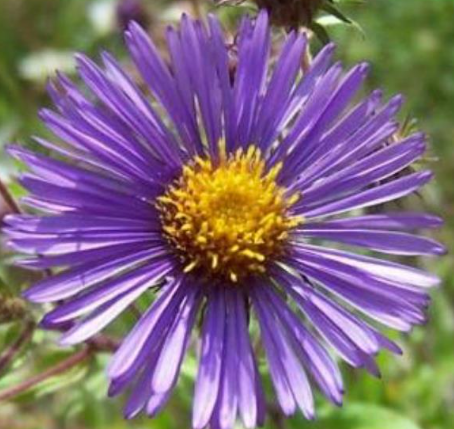
what type of head?
radiate head (ray + disk flowers)
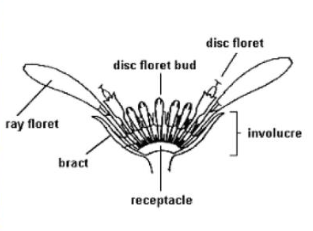
what type of head?
radiate (ray + disk)

what type of head?
discoid (disk flowers only)
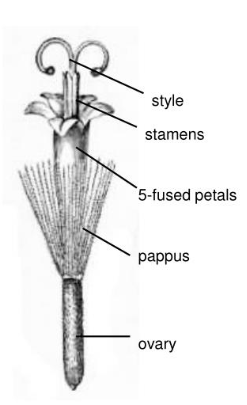
what type of flower?
disk flower

what type of head?
linguliflorous head (lingulate flowers only)

what type of flower?
lingulate flower
pappus types
-absent
-scales
-awns
-bristles (smooth, barbed, or plumose)

what type of pappus?
absent pappus

what type of pappus?
pappus of scales

what type of pappus?
pappus of smooth bristles

what type of pappus?
pappus of barbed bristles

what type of pappus?
pappus of plumose bristles

what type of pappus?
pappus of awns

what type of involucre?
one series, equal
-one one row (series)
-all relatively same height (equal)

what type of involucre?
two series equal

what type of involucre?
two series unequal
-can have 3, 4, 5, etc. series of unequal
-equal in row, but unequal compared to other series/rows

what type of involucre?
graduated
-can’t tell which is coming from what row (tend to be unequal, hard to tell series #)

Family? Genus? common name?
Family Asteraceae
Genus Achillea
Yarrow

Family? Genus? common name?
Family Asteraceae
Genus Achillea
Yarrow

Family? Genus? common name?
Family Asteraeceae
Genus Taraxacum
Dandelion

Family? Genus? common name?
Family Asteraceae
Genus Taraxacum
Dandelion

Family? Genus? common name?
Family Asteraceae
Genus Cirsium
Thistle

Family? Genus? common name?
Family Asteraecea
Genus Cirsium
Thistle

paleae (chaff)
cypselas (achenes)
disk corollas

Genus Cirsium (family, common name, leaves, head type, number of series on receptacle, phyllaries special characteristic, palea present or absent, pappus type)
Family Asteraceae
common name: Thistle
leaves: gen. spiny, toothed, larger leaves deeply lobed
head: discoid (disk flowers only)
receptacle with many series, 5-20 layers of phyllaries
outer and middle phyllaries spine-tipped
palea: absent (epaleate)
pappus: pappus of plumose bristles
Genus Achillea (family, common name, type of capitulum/head, flower types, pappus present or absent, palea present or absent, involucre type)
Family Asteraceae
common name: yarrow
capitulum: radiate head
flowers: disk + ray flowers
pappus: absent (epaleate)
palea: present
involucre: graduated (3-4 series, unequal)
Genus Taraxacum (family, common name, type of capitulum/head, flower types, pappus present or absent, palea present or absent, involucre type)
Family Asteraceae
common name: dandelion
capitulum: linguliflorous head
flowers: lingulate flowers only
pappus: pappus of bristles
palea: absent (epaleate)
involucre: inner - 2 series, equal; outer - reflexed, curved outward/downward