11.2 VSEPR Theory: The Five Basic Shapes
 Call Kai
 Learn
Learn Practice Test
 Spaced Repetition
 Match
Match Flashcards
 Knowt Play
1/10

There's no tags or description
Looks like no tags are added yet.
Name | Mastery | Learn | Test | Matching | Spaced | Call with Kai | Chat |
|---|
No analytics yet
Send a link to your students to track their progress
11 Terms
What does VSEPR stand for?
Valence Shell Electron Pair Repulsion
What are electron groups
as lone pairs, single bonds, multiple bonds, and even single electrons
What is VSEPR theory based on?
the simple idea that electron groups repel one another through coulombic forces. The electron groups are also attracted to the nucleus (otherwise the molecule would fall apart), but VSEPR theory focuses on the repulsions.
What determines the geometry of a molecule?
the repulsions between electron groups on interior
atoms of a molecule determine the geometry of the molecule
The preferred geometry of a molecule is the one in which the electron groups have maximum separation (and therefore minimum repulsion energy).
For molecules having just one interior atom (the central atom), molecular geometry depends on what two factors?
-the number of electron groups around the central atom;
-how many of those electron groups are bonding groups and how many are lone pairs.
What are the five electron geometries?
linear, trigonal planar, tetrahedral, trigonal bipyramidal, octahedral
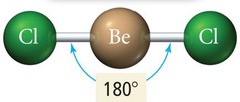
Linear Geometry
Two electron groups around the central atom; Bond angle of 180 degrees
Trigonal Planar Geometry
three electron groups can maximize their separation by assuming 120 degree bond angles in a plane

Tetrahedral Geometry
4 e- pairs, sp3 hybridization
angles 109.5
0 lone pairs: tetrahedral (four bonds) [CH4, NH4+, ClO4-, SO4 2-, PO4 3-]
1 lone pair: trigonal pyramidal (3 bonds) [NH3, PCl3, SO3 2-]
2 lone pairs: bent (2 bonds) [H2O, OF2, NH2-]
Trigonal Bypyramidal Geometry
5 bonding, 0 lone pair; 120 degrees (equatorial), 90 degrees (axial)
Octahedral Geometry
6 e- pairs, sp5 hybridization
0 lone pairs: octahedral (6 bonds) [SF6]
1 lone pair: square pyramidal (5 bonds) [BrF5, IF5]
2 lone pairs: square planar (4 bonds) [XeF4]