BIO1 MIDTERM: TOPIC 2 Scientists and Cells (PROKARYOTIC/EUKARYOTIC)
 Call Kai
 Learn
Learn Practice Test
 Spaced Repetition
 Match
Match Flashcards
 Knowt Play
1/70

There's no tags or description
Looks like no tags are added yet.
Name | Mastery | Learn | Test | Matching | Spaced | Call with Kai | Chat |
|---|
No analytics yet
Send a link to your students to track their progress
71 Terms
Robert Hooke
Devised an early microscope, named porous cork structures "cellulae," and was the first credited with publishing a description of seeing a cell in 1666.
Antonie van Leeuwenhoek
First to observe and study living cells ("animalcules") in pond water, blood, and tartar using a simple one-lens microscope.
Matthias Jacob Schleiden
German botanist who concluded that all plants are composed of cells.
Theodor Schwann
German physiologist who concluded that all animals are composed of cells and helped establish cell theory.
Rudolf Virchow
German physician who proposed that all cells arise from pre-existing cells through cell division.
First Tenet of Cell Theory
All organisms are composed of one or more cells.
Second Tenet of Cell Theory
Cells are the smallest and basic units of structure and function in organisms.
Third Tenet of Cell Theory
Cells arise only from previously existing cells.
Prokaryotic Cell
Simple, smaller cell that lacks a distinct nucleus and membrane-bound organelles, evolved around 3.5 billion years ago.
Eukaryotic Cell
Complex, larger cell containing a distinct membrane-bound nucleus and organized organelles, evolved around 1.8 billion years ago.
Plasma Membrane
Semipermeable outer barrier that controls the movement of molecules, ions, and gases into and out of the cell.
Cell Wall
Rigid outer boundary maintaining shape and structural support, composed of cellulose in plants, chitin in fungi, and peptidoglycan in bacteria.
Capsule
Protective outer polysaccharide layer found lying outside the cell wall in prokaryotes.
Nucleoid Region
Irregularly shaped area in prokaryotes where genetic material in the form of DNA is stored without a nuclear membrane.
Cytoplasm
Internal fluid-filled space between the nucleus and cell membrane containing cytosol and suspended cellular structures.
Ribosomes
Small organelles where amino acids are assembled to synthesize proteins.
Plasmid
Independent circular DNA structure in prokaryotes providing genetic advantages such as antibiotic resistance.
Flagellum
Long, tail-like appendage that rotates or moves in a whiplike motion to propel cells forward.
Fimbriae
Small, bristle-like fibers on prokaryotic surfaces that allow bacteria to attach to objects and tissues.
Conjugation Pili
Tubular structures on bacterial surfaces used for cell-to-cell communication and transferring DNA between cells.
Nucleus
Storehouse of genetic information in the form of DNA in eukaryotic cells that protects DNA from damage.
Nuclear Envelope
Double membrane surrounding the nucleus perforated with nuclear pores to allow passage of large molecules.
Nucleolus
Dense region inside the nucleus where ribosomes are assembled.
Chromatin
Complex structure formed by DNA packaged with specialized proteins called histones.
Endoplasmic Reticulum
Interconnected network of folded membranes forming an internal maze (lumen) for protein and lipid synthesis.
Rough Endoplasmic Reticulum
Membrane network studded with ribosomes that modifies and folds proteins for secretion or membrane insertion.
Smooth Endoplasmic Reticulum
Membrane network lacking ribosomes that synthesizes lipids and detoxifies drugs and alcohol.
Golgi Apparatus
Layered stacks of membrane-bound sacs that modify, sort, package, and ship proteins to various cell destinations.
Vesicles
Small, short-lived membrane-bound sacs that enclose and transport materials between cell organelles.
Vacuoles
Fluid-filled storage sacs for water, food molecules, inorganic ions, and enzymes; large and central in plant cells, small in animal cells.
Lysosomes
Round membrane-bound organelles containing lysozyme enzymes to digest waste, worn-out organelles, and foreign invaders.
Peroxisomes
Single-membrane organelles containing oxidative enzymes and catalase to break down complex molecules and turn toxic hydrogen peroxide into water and oxygen.
Mitochondria
Double-membraned organelles that supply energy (ATP) to the cell and contain their own DNA and ribosomes.
Chloroplasts
Plant organelles containing thylakoids and green chlorophyll that convert solar energy into chemical energy via photosynthesis.
Thylakoids
Sacs organized in stacks called grana inside chloroplasts where light absorption occurs.
Stroma
Fluid portion of the chloroplast surrounding the thylakoids.
Centrosome
Small, dense region of cytoplasm that serves as the main microtubule-organizing center.
Centrioles
Pair of perpendicular barrel-like structures in animal cells aiding in cell division and microtubule organization.
Cilia
Short, hair-like projections that move in a coordinated fashion for cell locomotion or sweeping fluids across tissue surfaces.
Cytoskeleton
Flexible network framework of protein fibers providing sturdy mechanical support, organelle anchorage, and movement direction.
Microtubules
Thickest, stiff hollow protein tubes of the cytoskeleton that give shape, form spindle fibers in division, and act as transport tracks.
Intermediate Filaments
Rope-like cytoskeletal fibers providing tensile strength to resist mechanical stress in skin, hair, and claws.
Microfilaments
Thinnest cytoskeletal fibers (also called actin filaments) forming a protective mesh under the plasma membrane and enabling muscle contraction and movement.
Plasmodesmata
Tiny channels passing through plant cell walls that connect neighboring cytoplasms for direct communication and transport.
rare lysosomes, centrosome is absent in most
Parts of a plant cell lack
cell wall, chloroplast, and plasmodesmata
parts of an animal cell lack
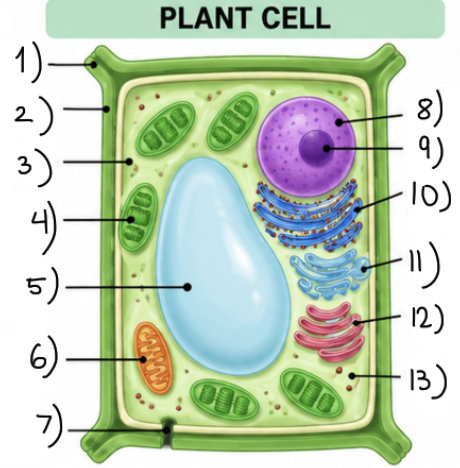
Cell wall
what part is no. 1?
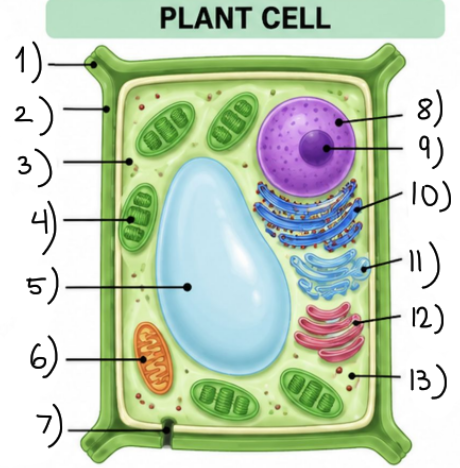
Cell membrane
what part is no. 2?

Cytoplasm
what part is no. 3?
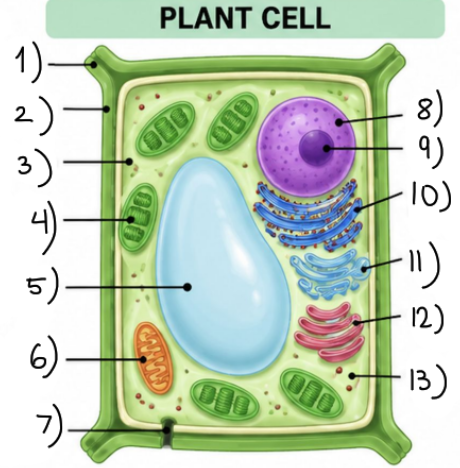
Chloroplast
what part is no. 4?
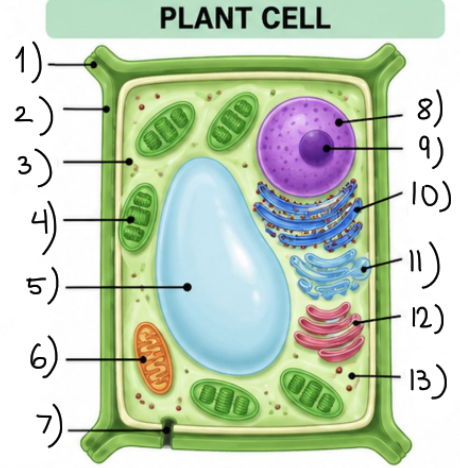
Central vacuole
what part is no. 5?

Mitochondrion
what part is no. 6?

Plasmodesmata
what part is no. 7 located in the cell wall?

Nucleus
what part is no. 8?

Nucleolus
what part is no. 9?

Rough ER
what part is no. 10?

Smooth ER
what part is no. 11?

Golgi apparatus
what part is no. 12?

Ribosomes
what part is no. 13?
Cell membrane
what part is no. 1?

Cytoplasm
what part is no. 2?

Mitochondrion
what part is no. 3?

Lysosome
what part is no. 4?

Ribosomes
what part is no. 5?

Centrioles
what part is no. 6?

Nucleus
what part is no. 7?
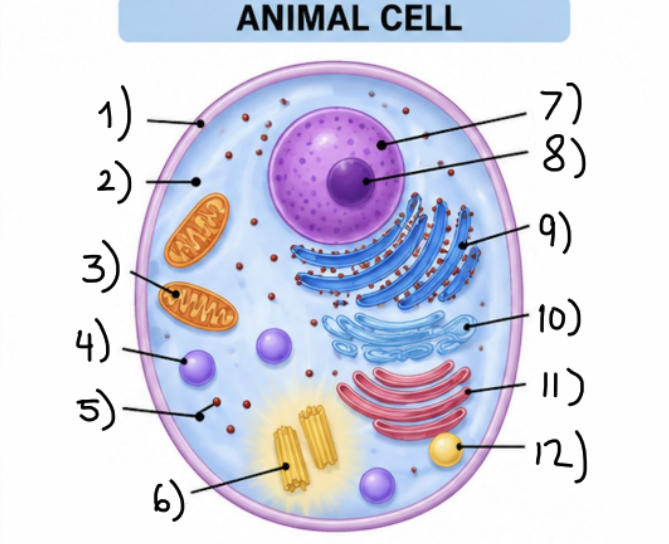
Nucleolus
what part is no. 8?

Rough ER
what part is no. 9?

Smooth ER
what part is no. 10?

Golgi apparatus
what part is no. 11?

Vesicle
what part is no. 12?
