cell functions and structure exam 2
 Call Kai
 Learn
Learn Practice Test
 Spaced Repetition
 Match
Match Flashcards
 Knowt Play
1/120

There's no tags or description
Looks like no tags are added yet.
Name | Mastery | Learn | Test | Matching | Spaced | Call with Kai | Chat |
|---|
No analytics yet
Send a link to your students to track their progress
121 Terms
definition of chemical reaction:
when atoms have enough energy to change bonding partners
Metabolism
All chemical reactions taking place in an organism
main 2 types of metabolism
anabolism, catabolism
anabolism definition
Pathways in which complex molecules are synthesized
thermodynamics definition:
the study of energy and its transformations
Catabolism definition
pathways in which larger molecules are broken down into smaller ones (releases energy)
Energy definition
capacity to do work of the capacity for change
potential energy
stored energy
potential energy example
potential energy in a drawn bow
kinetic energy
energy of motion is used, and work is performed
kinetic energy example
the bowstring pushes the arrow towards its target
energy can be converted from one form to another
energy can be converted from one form to another
Energy transformations occur where?
in organisms
kinetic energy is converted to…
potential energy
potential energy is converted to…
kinetic energy
chemical energy
potential energy is stored in chemical bonds
1st law of thermodynamics
energy cant be created or destroyed, only converted from one form to another
2nd law of thermodynamics
When energy is converted from one form to another, some usable energy (energy available to do work) is converted into heat that disperses into the surroundings (wasted energy)
heat
the kinetic energy of randomly moving particles
entropy (s)
A measure of the disorder, or randomness of energy, Organized, usable energy has a low entropy, Disorganized energy, such as heat, has a high entropy
The total entropy of the universe (organisms plus surroundings) always increases over time
The total entropy of the universe (organisms plus surroundings) always increases over time
Enthalpy (h)
The total potential energy of a system
Essentially equivalent to the total bond energy
Free energy (g)
The amount of energy available to do work under the conditions of a biochemical reaction
Enthalpy (H), free energy (G), entropy (S); and absolute temperature (T) are related
H = G + TS
As entropy increases, the amount of free energy decreases
As entropy increases, the amount of free energy decreases
The rearranged equation can be used to predict whether a particular chemical reaction will release energy or require an input of energy:
Δ G = Δ H − T Δ S
Δ G = what
Free energy
Δ G = G final – G starting
Δ G = G final – G starting

what kind of reaction is this? Negative Δ G = Spontaneous
exergonic reaction: energy released

What kind of reaction is this? Positive Δ G = Energy Required
endergonic reaction: energy required
Exergonic reaction..
releases energy = spontaneous “downhill” reaction from higher to lower free energy
ΔG is negative for exergonic reactions
ΔG is negative for exergonic reactions
When ΔG = 0…
there is no net movement and the reaction is balanced
Endergonic reaction…
reaction in which there is a gain of free energy
ΔG endergonic reactions…
has a positive value (the free energy of the products is greater than the free energy of the reactants)
endergonic reactions require
input of energy from environment
free energy is…
is a measure of a system’s instability, its tendency to change to a more stable state
During a spontaneous change…
free energy decreases and stability of a system increases
Activation Energy is
the energy required to get a reaction going.
Catalysts
increase the speed of a reaction.
Biological catalysts are…
enzymes (proteins)
Enzymes Lower Activation Energy in 3 Ways (way 1)
1. By orienting substrates so they can react
Enzymes Lower Activation Energy in 3 Ways (way 2)
2. By inducing strain through stretching the substrate weakening chemical bonds
Enzymes Lower Activation Energy in 3 Ways (way 3)
3. By temporarily adding charge to substrate
When substrate binds, the enzyme changes shape for catalysis it is
induced fit
Enzyme Activity Can be Regulated in Multiple Ways
1. Gene expression
2. Environmental changes: pH and temperature
3. Chemical modulation
Cyclooxyrgenase is an enzyme that makes
prostaglandins (locally made hormones that induce swelling and heat at site of an injury causing PAIN)
Enzyme Inhibition: 1. Irreversible Inhibition
Some enzyme inhibitions are irreversible
Enzyme Inhibition: 2. Reversible Inhibition
Some enzyme inhibitions are reversible. Competitors don’t bind covalently
Competitive Vs Noncompetitive Inhibition of Enzymes
look at the difference

Un-Competitive inhibitor
binds to the enzyme-substrate complex, preventing the release of products
non-competitive inhibitors
binds at a site other than the active site, changing enzyme structure so that normal substrate binding cannot occur
ATP = energy a cell can use
ATP (adenosine triphosphate)
ATP has
high potential energy and allows cells to do work.
ATP Hydrolysis Is Exergonic and Released Energy can drive Endergonic Reactions
ATP Hydrolysis Is Exergonic and Released Energy can drive Endergonic Reactions
The major process of making ATP is called
Cellular Respiration
As Eukaryotes, our major form of Cellular Respiration is
Aerobic Respiration (Requires Oxygen)
Aerobic respiration is a series of
redox (Oxidation-Reduction) reactions
Organisms convert energy from food molecules into ATP
Organisms convert energy from food molecules into ATP
Two Processes for Making ATP (process 1)
1. Cellular Respiration- can be either: • aerobic (requiring oxygen) • anaerobic (not requiring oxygen) But both use an electron transport chain to transfer energy
Two Processes for Making ATP (process 2)
2. Fermentation- • anaerobic process, Does NOT use an electron transport chain to transfer energy
4 Steps to Cellular Respiration
Step 1: Glycolysis
Step 2: Pyruvate processing
Step 3: The citric acid cycle (TCA)
Step 4: Electron transport, chemiosmosis, and oxidative phosphorylation
During the first three steps, energy is captured which is then used for producing ATP in step 4.
Cellular respiration produces ATP from molecules with high potential energy, such as glucose
C6H12O6 + 6O2 → 6CO2 + 6H2O + ENERGY (DeltaG = -686 kcal/mol
Where does Cellular Respiration take place?
Step 1: Glycolysis (cytoplasm)
Step 2: Pyruvate processing (mitochondrial matrix)
Step 3: The citric acid cycle (mitochondrial matrix)
Step 4: Electron transport, chemiosmosis, and oxidative phosphorylation (inner mitochondrial membrane)
End Goal of Cellular Respiration is……
ATP
90% from Oxidative Phosphorylation (step 4)
10% from substrate-level phosphorylation (steps 1, 2, 3)
The more reduced a molecule is the more energy it has
most reduced state → most oxidized state
highest free energy → lowest free energy

kinase enzyme function
addition of a phosphate group
isomerase enzyme function
rearrangement of binds within a molecule
dehydrogenase enzyme function
Oxidation of a molecule by removing a Hydrogen atom plus electron
mutase enzyme function
Shifting a chemical group from one position to another within a molecule
By the end of the TCA (Kreb’s) Cycle, each glucose molecule that is oxidized, has made:
6 CO2
10 NADH
2 FADH2
4 ATP by substrate-level phosphorylation.
Oxygen is
The most effective electron acceptor because it is highly electronegative.
Fermentation is extremely
Inefficient compared with cellular respiration
Fermentation produces
2 ATP molecules per glucose!!
Photosynthesis
the process that converts solar energy into organic chemical energy
Autotrophs
Organisms that carry out photosynthesis are (“self-feeders”): plants, algae, and cyanobacteria.
Heterotrophs:
(“other-feeders”) must consume other organisms, such as autotrophs or other heterotrophs, to obtain food: animals, fungi, and most other bacteria.
Photosynthesis: 2 parts PHOTO
Light capturing Reactions Generate chemical energy needed to run the chemical synthesis reactions of the Calvin cycle
Photosynthesis: 2 parts Synthesis
Calvin Cycle uses the energy generated in the light capturing reactions to “fix” carbon…what does “fix mean?
Visible light is
A small part continuous range of radiation called the electromagnetic spectrum
All radiation in this spectrum travels as..?
waves
wavelength =
distance from one wave peak to the next
visible spectrum (seen by humans) range
380 nm (violet) to 760 nm (red)
Light is composed of small packets, of energy called…?
photons
When Photons of light approach a molecule they can:
1. Pass through the molecule-transmitted light
2. Bounce off the molecule- reflected or scattered light
3. Be absorbed by atoms of the molecule, adding energy to the molecule- excited state
Chlorophyll does not absorb what color
green - it reflects it
chlorophyll absorbs what colors
blue and red
Red photons raise electrons
1 energy level
Higher-energy blue photons raise electrons
2 energy levels
Green photons are of an intermediate energy level and are
not easily absorbed by chlorophyll
Chlorophyll Structure Two main parts:
1) a porphyrin ring that absorbs light energy,
2) a long hydrocarbon side chain that makes molecule extremely non-polar

chlorophyll a
Main photosynthetic pigment that initiates light-dependent
reactions of photosynthesis
chlorophyll b
Accessory pigment that also participates in photosynthesis
Broadens the spectrum of light used for photosynthesis
carotenoids
Yellow and orange accessory photosynthetic pigments
absorb different wavelengths of light than chlorophyll
can absorb excessive light that would damage chlorophyll
action spectrum
action spectrum
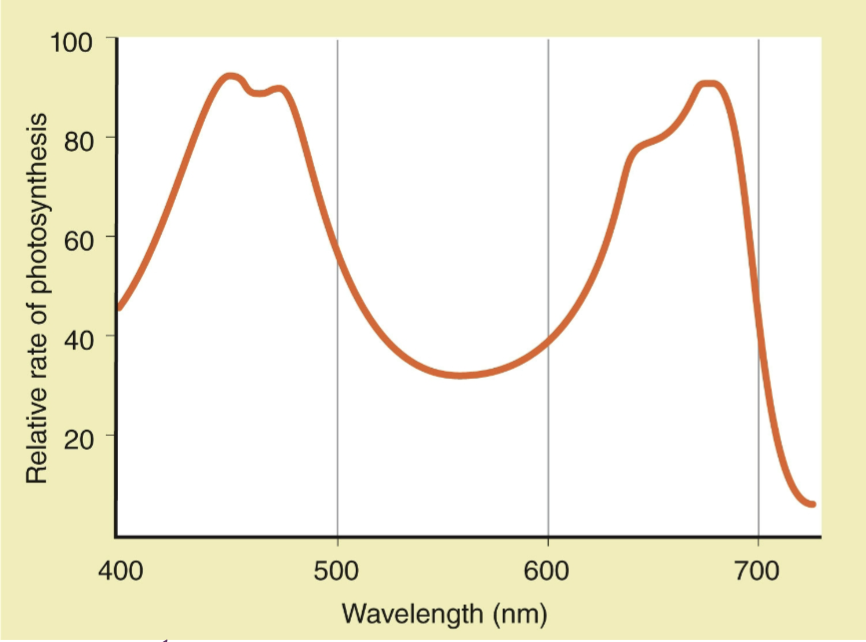
absorption spectrum
The absorption spectrum of a pigment is a plot of its absorption of light at different wavelengths

Light-dependent reactions transform light energy to
a usable temporary chemical form:
Radiant energy from sunlight is captured and used to phosphorylate ADP, producing ATP, and reduces NADP+, forming NADPH
ATP and NADPH are short term usable forms
of ENERGY!!!
Two types of photosystems (II and I) are involved in
photosynthesis
Reaction center of photosystem II (P680) consists of
two
chlorophyll a molecules with an absorption peak of 680 nm