Electron Transport Chain
 Call Kai
 Learn
 Practice Test
 Spaced Repetition
 Match
 Flashcards
 Knowt Play
1/19

There's no tags or description
Looks like no tags are added yet.
20 Terms
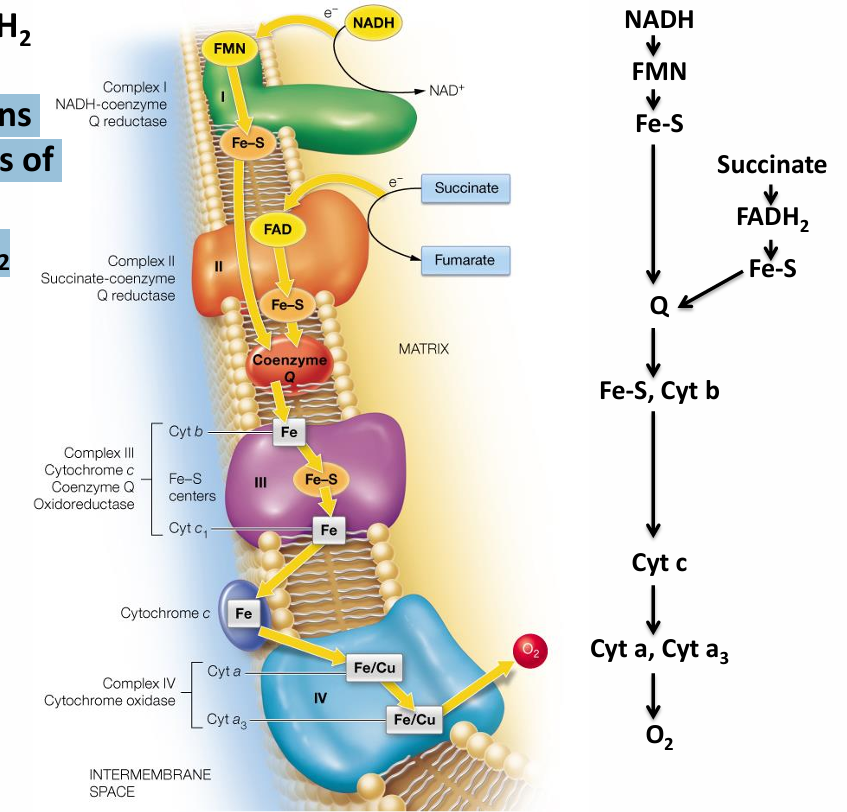
Overview of the electron transport chain
Electrons are passed between 4 protein complexes embedded in the mitochondrial membrane. In the process H+’s are pumped into the intermembrane space creating a proton gradient. Complex V converts this chemiosmotic gradient into ATP
What happens to NADH and FADH2
are oxidized, passing electrons through a series of carriers, and ultimately to O2
Fe4S4
4 Fe’s complexed with the 4 sulfurs of 4 Cys and 4 sulfides (inorganic sulfur)
FADH or FADH2
carries 1 or 2 electrons
Coenzyme Q
very lipophilic so it diffuses in the membrane
Oxidation and reduction of coenzyme Q occurs one electron at a time, like the flavins
heme from cytochrome b c and c1
Is the same as found in hemoglobin and myoglobin.
The heme is attached to 2 Cys residues of the protein.
Found in Complex II and III
The heme from cytochrome a and a3
has 2 modified side chains
Found in Complex IV
Electrons are passed from
high reduction potential carriers to lower reduction potential carriers
Complex I
NADH-Ubiquinone Oxidoreductase
Prosthetic groups: FMN, Fe-S on the enzyme.
2 electrons from NADH are transferred to FMN, which transfers them one at a time to a series of iron-sulfur clusters, and finally to CoQH2.
In the process, 4 protons are pumped from the matrix to the intermembrane space through conformational changes that change the pKa’s of side chains

Complex II
Succinate-Ubiquinone Oxidoreductase
Adds electrons but no H+’s. Prosthetic groups: FAD, Fe-S
In the TCA cycle, 2 electrons are extracted from succinate to FADH2 These electrons are transferred through a series of iron-sulfur clusters to CoQ

Electron Transferring flavoprotein
ETF-Q oxidoreductase receives electrons from over 12 FAD-containing dehydrogenases from fatty acid and amino acid oxidation
Complex III
Ubiquinol-Cytochrome c Oxidoreductase
Transfers electrons from CoQH2to cytochrome c
Prosthetic groups: Fe-S, cytochrome bH, cytochrome bL, cytochrome c1
Dimer with each monomer of the dimer composed of 10-11 polypeptides
4 protons are pumped into intermembrane space (IMS), from QH2

The Q-cycle
Path of electrons through Complex III. Electrons are transferred from the 2-electron donor, CoQH2, to cytochromes which are one electron acceptors

Complex IV
Cytochrome c Oxidase
Cytochrome c transfers electrons to Complex IV
Composed of 13 polypeptides, 28 transmembrane helices
Prosthetic groups: Cytochrome a, Cytochrome a3, CuA, CuB 4 protons pumped into intermembrane space for every O2 reduced

Complex IV net reaction

Cytochrome c mechanism
4 electrons from 4 cytochrome c molecules are used to reduce O2 to H2O
Cytochome c step 1
2 molecules of cyt c sequentially transfer e- to CuB and hemea3
Cytochome c step 2
Reduced CuB and Fe in heme a3 bind O2, forming a peroxide bridge
Cytochome c step 3
2 more molecules of cyt c add 2 more e and 2 H+, cleaving the peroxide bridge
Cytochome c step 4
2 more H+ are added from matrix, generating H2O