BSCI331 Exam 3: L14: Gene Regulation Pt II
 Call Kai
 Learn
 Practice Test
 Spaced Repetition
 Match
 Flashcards
 Knowt Play
1/6

There's no tags or description
Looks like no tags are added yet.
7 Terms
Although much of gene expression is regulated at the level of RNA transcription, additional levels provide rapid and dynamic control of protein level/activity
Although much of gene expression is regulated at the level of RNA transcription, additional levels provide rapid and dynamic control of protein level/activity
This lecture is all about post-transcriptional regulation
Post-transcriptional regulation
Cells can regulate gene expression after transcription begins, including RNA processing
Transcriptional regulation is not the only level at which gene expression is regulated
What are the ways eukaryotic genes are regulated?
Most eukaryotic genes are regulated by alternative splicing (and alternative polyadenylation)
Regulated cytosolic localization
alternative spicing
Eukaryotic mRNA contains exons (protein-coding sequences) and introns (regions usually removed during RNA splicing). normally, the spliceosome removes introns and joins exons together
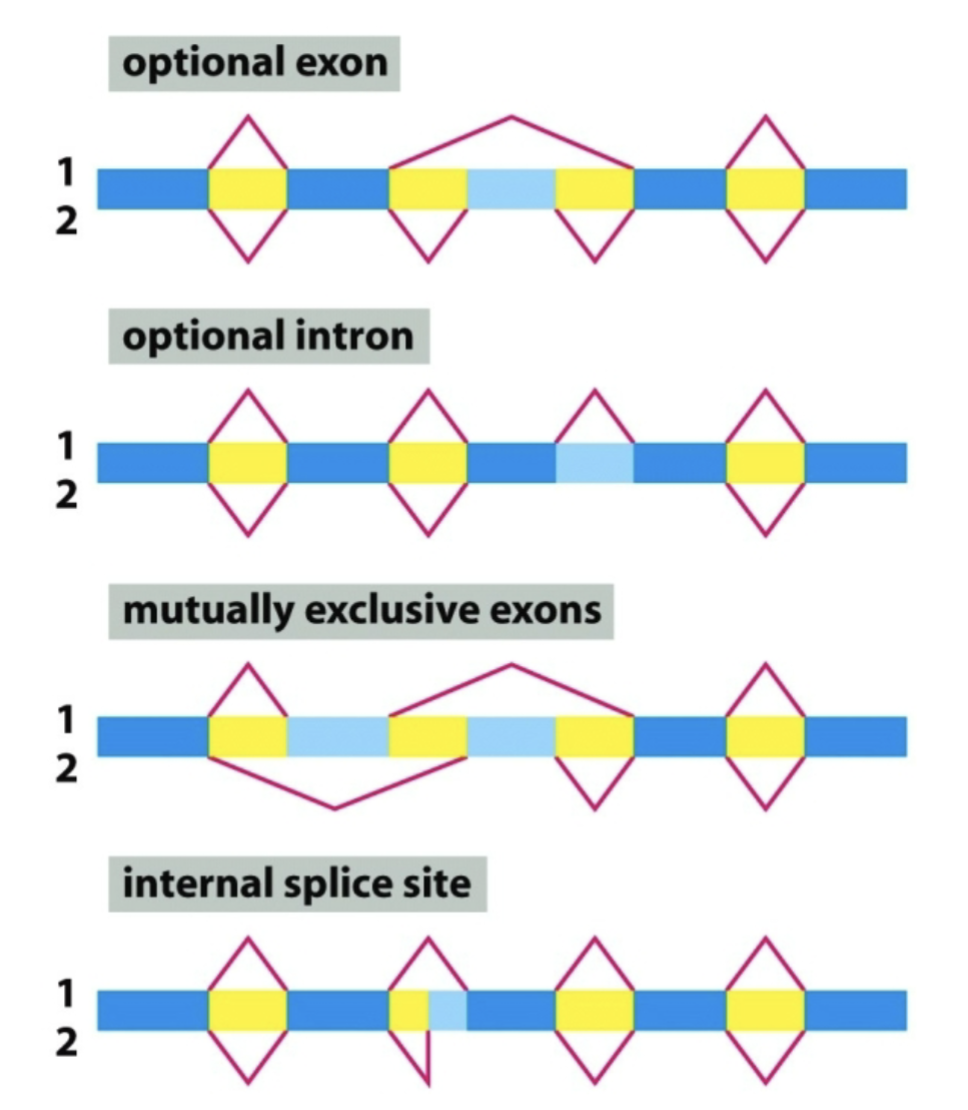
However, in alternative splicing, the same pre-mRNA can be spiced in different ways to produce different mature mRNAs (splice variants)
Because the mature mRNAs are different, they may produce proteins with different structures or functions.
A gene with even just a few exons can produce many different mRNAs via alternative splicing - “splice variants”. How can these variants differ?
Some variants may simply lack one or more exons.
Sometimes, there are mutually exclusive alternative exons (ex. either exon 2 is in the mRNA transcript, or exon 3, but not both)
May be regulated by splicing repressors or splicing activators (splicing repressors inhibit inclusion of certain exons; splicing activators promote recognition or inclusion of certain exons)
Alternative poly-A site addition
Instead of just one poly A site at the end of the transcript, there can be two different poly A sites - the length of the RNA transcript depends on which poly A site you actually use
Normally, a eukaryotic pre-mRNA is cleaved near its 3′ end, and a poly-A tail is added.
However, some genes contain multiple possible polyadenylation sites.
Alternative polyadenylation means that the cell can choose different cleavage and poly-A addition sites, producing mRNAs with different 3′ ends.
Example of alternative poly-A site addition
