Art Module 3 (The Middle Ages)
 Call Kai
 Learn
 Practice Test
 Spaced Repetition
 Match
 Flashcards
 Knowt Play
1/34

There's no tags or description
Looks like no tags are added yet.
Name | Mastery | Learn | Test | Matching | Spaced | Call with Kai | Chat |
|---|
No analytics yet
Send a link to your students to track their progress
35 Terms

Name: Gallery & luculi (funerary niches) of Early Christian Catacombs
Place: Rome
Year: 3rd century CE
Extra: Christians found refuge in these from Roman authorities. Maze-like system of underground funerary sites, excavated from granular tufa; there were galleries connecting to small rooms (cubicula) filled w/ funerary niches (loculi). Conditions unsanitary, but community prevailed & celebrated services here.

Name: Catacomb of Saints Pietro and Marcellinus (the ceiling)
Place: Rome
Year: 4th century CE
Material: Fresco
Extra: Christ as the Good Shepherd (central medallion): figures in “orans” (attitude of prayer with outstretched arms) poses on margins.

Name: Old St. Peter’s (reconstruction)
Place: Rome
Year: 333 CE
Extra: Current one was built on old ones ruins, site where 1st apostle Peter was buried. Blueprint for Christian builders in centuries to come, numerous innovations, derived from Roman basilica design: entrance through propylaea (gateway bldg.), atrium (open colonnaded court), narthex (entrance hall), nave (central aisle), lower side aisles, apse (semi-circular niche), transept (traverse aisle); timber roof.

Name: Santa Constanza (Vault of the Ambulatory of…)
Place: Rome
Year: 350 CE
Extra: Ex. of a building w/ central plan (round or polygonal structure), favored by Byzantine architects (east). Inspiration Pantheon? Domed rotunda; ambulatory = round, barrel-vaulted corridor encircling central space w/ sarcophagus. Mosaic decor: birds (peacock), vegetation, vine harvest scenes; transition between pagan Roman and Christian imagery.

Name: The Good Sheperd Sarcophagus
Place: From catacomb of Praetextatus
Year: late 4th century CE
Extra: Ex. of a Christian adaptation of a pagan theme: Good Sheperd theme appears before Christian times but was appropriated to symbolize Christ (3 x image repeated > allusion Trinity?). Grape vines heavy w/ grapes, putti harvesting, pressing wine; wine sacred to Bacchus in pagan times; now it symbolizes the Eucharist aka transubstantiation of Christs blood. Erotic connection with putti (offspring Venus, goddess of Love) gives way to asexuality of Christian cherubs.

Name: Diplych of Anatastasius 1
Year: 517 CE
Material: Ivory carving
Extra: Diplych = describes an object consisting of 2 hinged panels. Byzantine Emperor sitting on throne about to throw a handkerchief (mappa), sign to let the games begin (amphitheaters in Constantinople). Stark formality of pose, flatness, lack of 3D space, all are characteristics of medieval art & signal of a regression from classical art (Byzantine art is eastern Medieval Art).

Name: Mausoleum of Galla Placidia
Place: Ravenna, Italy
Year: 425-450 CE
Material: W/ mosaic decorations
Extra: Galla Placidia, previous Western Roman Empress, had moved the capital to Ravenna for fear of Gothic invasions (protecting swamps); early Christian period. Latin cross plan, rich mosaic decor inside w/ Good Shepherd motive (star spangled, blue sky), plain outside.


Name: Sant’ Apollinare Nuovo (it’s nave)
Place: Ravenna, Italy
Year: 504 CE
Material: Mosaic decorations
Extra: Top & middle register (clerestory) mosaics are original (detail of the “Miracle of the Loaves and the Fishes” in this pic). Bottom register had Arian content & was replaced by order of Bishop Agnellus w/ a procession of Orthodox saints.


Name: Sant’ Apollinare in Classes (nave & apse mosaic)
Place: Ravenna, Italy
Year: 533-549 CE. Dates from period of Byzantine rule in Ravenna.
Extra: Dedicated to St. Apollinaris, martyred in Classe. Early Christian 3-aisled basilica; has one of most beautiful apse mosaics of Byzantine period. Blue medallion w/ jeweled cross, Hand of God in clouds, figures of Moses and Elijah. Below: patron saint Apollinaris in orans pose flanked by 12 sheep. Face of apse: 12 lambs = 12 apostles, issuing from cities of Bethlehem & Jerusalem; medallion w/ Christ, 2 archangels.


Name: Church of San Vitale
Place: Ravenna, Italy
Year: 526-547 CE
Material: Mosaic decoration
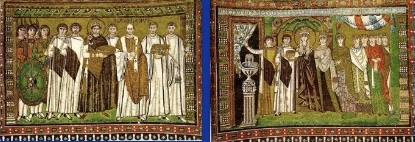
Extra: Plain exterior, central plan of concentric octagons surrounding ambulatory, columned niches. Clerestory, 2nd floor reserved for (priest? jus has a cross idk what that means). Intricate lace patterns for Byz. capitals. Apse: Christ seated on orb of work w/ 4 rivers of Paradise, extends golden wreath of victory to St. Vitalis (center). Emperor Justinian and attendants (side panels, see detail).

Name: Hagia Sophia (or Holy Wisdom) (Anthemius of Tralles & Isidorus of Miletus)
Place: Constantinople (Istanbul)
Year: 532-537 CE
Extra: Monumental church of Hagia epitomizes Byzantine emperor Justinian I (territory expansions, basis civil law). Huge narthex, canopy-like dome, pierced at its base by numerous windows, rests on pendentives (dome rests on a 2nd, larger dome w/ cut off top) supported by huge wall piers in 4 corners. Pendentives make covering an expansive, open, interior space possible (structure again an Islamic mosque).

Name: St. Marks Cathedral
Place: Venice, Italy
Year: Begun 1063 CE
Extra: Located on Venices central square. Built & modified over many centuries; Romanesque & Gothic additions hide Byzantine core. Place: Greek-Cross plan, cluster of 4 domes resting on pendentives. Interior: rich gold-ground (typically Byz) mosaics, telling key stories from Old & ew Testament, in this pic: Book of Genesis.


Name: Mosque at Cordoba (interior)
Place: Spain
Year: 8th & 10th century CE
Extra: Mosque = place of worship for Islamic followers. Cordoba’s mosque is one of largest in Moorish Spain (re-dedicated a Christian Church in 13th century). Unique system of double-tiered arches (one arched stacked on another) to support wooden rood; influences from local Spanish and Moslem architecture combine.

Name: Water Vessel
Place: Persia
Year: 16th century CE
Material: Embossed brass & silver inlays
Extra: Importance of patterns & calligraphy in Islamic art.

Name: Eagle-Shaped Visigoths Fibula
Place: Guadalajara, Spain
Year: 6th century CE
Material: Cloisonné (gold & enamel)
Extra: Fibula = cloth pin. Look at map to see how Goths/Visigoths arrived in Spain during Migration Period.

Name: Purse cover from the Sutton Hoo Ship Burial
Year: 655 CE
Material: Cloisonné (gold & enamel)
Extra: Excavated in 1939, Sutton Hoo became associated w/ the ship burial of the East Anglian king Anna; excavation site yielded many artifacts w/ which the king was buried. Interlace patterns are typical for migration period. Four heraldic groups (eagles attacking ducks & man-beast figures, center), suggest eastern or Oriental influences.

Name: Chi-Rho Monogram (XP), Gospel Matthew, from the Book of Kells
Year: late 8th century CE
Material: Manuscript illumination
Extra: Irish monks created precious manuscript illuminations (book illustrations) of Christian texts, decorated w/ interlace patterns. The Chi-Rho monogram is an abbreviation that stand for the name of Christ/Christianity.

Name: Palatine Chapel of Charlemagne
Place: Aachen (Aix-La-Chapelle), Germany
Year: 792-805 CE
Extra: Charlemagne established his court in Aachen, where he built the Palatine Chapel adjacent to his palace. Robust strength, simplicity of this round structure anticipates Romanesque style of 11th/12th century CE

Name: Taj Mahal
Place: Agra, India
Year: 1632-1654
Extra: Most famous Muslim mausoleums. Built during Mughal Empire that governed most of the Indian subcontinent and Persia (Iran), 1526-19th century, mausoleum build by Muslim ruler Shah Jahan as a memorial to his wife, Mumtaz Mahal (priest at birth). Massive, cubical structure surmounted by a large balloon-shaped dome, surrounded by towers, reflecting pools and gardens, supposed recall paradise as described in Qur’an. Prototype for structure believed to come from Iran.

Name: Monastery at St. Gallen
Place: Switzerland
Year: 819 CE
Extra: Depending on the order (the administrative org of the monastery), monks & nuns had to take an oath of poverty, chastity, obedience, maybe silence & other impositions. Monastic communities were supposed to live ascetic & self-sufficient lives.

Name: Psalm 50 from the Utrecht Psalter
Place: Hautevilliers (near Reims)
Year: 830 CE
Material: Manuscript illumination
Extra: Psalm 150: praise in the name of God, illustrated with timbres, trumpets, and organ. Christ in mandorla (oval shape) in the center; great degree of animation, spontaneity otherwise not typical for medieval art.

Name: Cover of the Codex Aureus of St. Emmeram
Year: 870 CE
Material: Book binding with gold, pearls, and precious stones
Extra: A privileged art form remained illuminated book manuscripts, often with sumptuous bindings. This example has a binding of precious stones and gold repoussé plaques depicting Christ in Majesty (in mandorla), Four Evangelists and Scenes from the Life of Christ.

Name: Map of directions tribes moved toward during the Migration period
Year: 375-568 CE
Extra: Three fall of the West Empire trigged displacement of “barbarians”

Name: Charles the Bald Entbroned from the Codex Aureus (Gold Book (latin) of St. Emmeram (monastery in southern Germany)
Year: 870 CE
Material: Manuscript
Extra: Charles the Bald was one of the three grandsons of Charlemagne involved in dividing up the Carolingian Empire. The depiction exemplifies some key qualities of medieval art: flatness, no spatial depth, no proportions, figures are not life-like; only with the Renaissance will these attributes change.

Name: Otto Mathilden’s Cross
Place: Treasury of Essen Cathedral, Germany
Year: 10th century CE
Material: Gold and precious stones
Extra: This cross would’ve been brought out and carried in procession on certain feast days; otherwise it was kept in the cathedral treasury. Materials, style, subject matter, and crafts skills are basically the same as for the Codex Aureus binding.

Name: Norman Cavalry Charging in the Battle of Hastings
Place: From the Bayeux Tapestry
Year: 1070-1080
Material: Embroidered fabric made of wool on linen, 20in high & 230ft long.
Extra: Commemorates the Norman defeat of the Anglo-Saxons at Hastings in 1066; England and much of France under one rule, the Duke of Normandy (Viking descendants). Commissioned by Bishop Odo, half-brother of conquering Duke William. Unique type of medieval artifact: technique, depiction of a contemporary event shortly after the fact.

Name: St. Sermon
Place: Toulouse, France
Year: 1080-1120
Extra: Growing city culture: age of cathedrals; permanent structures of cut stone (fireproof, not made of wood). Large, simple, massive cathedrals, Latin-Cross plan, vaulted nave, buttresses, ambulatory with radiating chapels are all characteristic of the Romanesque style.

Name: Speyer Cathedral
Place: Speyer, Germany
Year: 1082-1106
Extra: Originally begun as a timber-roofed structure (which burned out), Speyer Cathedral in the German Rhineland, was among the first to have a very innovative architectural feature, a large groin vault (octagonal crossing dome), which will become standard of medieval architecture. Balanced group of 4 towers: Ottonian tradition.

Name: St. Lazare
Place: Ghislebertus, West Tympanum, France
Year: 1130
Extra: Weighing the sounds of Judgements Daym demon & angels dispute souls; condemned souls cast into furnace of hell. Stern reminder to church-goers of the fruits of sin.

Name: Choir w/ Ambukatory & Radiating Chapels of the Abbey Church of St. Denis (royal burial ground)
Place: St. Denis, near Paris
Year: 1140-1144
Extra: Innovators of Gothic architecture: Bernard of Clairvaux & Abbé Suger, Abbot of St. Denis (theologians, politicians, architects) > faith was mystical and intuitive, not rational. Architectural expression of idea: groin vault w/ pointed arches allow for skeletal construction in choir, introduction of stained glass windows.

Name: Chartres Cathedral
Place: Chartres, France
Year: Begun 1194
Extra: Consequences of Sugers innovations can be seen here. Pointed arches allow in combo with groin vault allowed cathedral builders to increase the height of structures and to pierce the walls w/ window space to relieved stained glass windows; galleries. Height of Cathedrals became a point of civic pride of citizens; cities tried to outdo each other with higher and more sumptuous structures. Rosette window at the end of the choir is also characteristic of Gothic style.

Name: Notre Dame Cathedral
Place: Paris
Year: 1182-1250
Extra: Structure combines Romanesque and Gothic features, but facade, outer appearance is quintessentially Gothic. Stained glass, rosette window, flying buttresses. Choir & transept completed in 1182, nave by 1225, facade by 1250. Extended periods of building activity, high-maintenance upkeep. On the balconies, one finds gargoyle sculptures, which seem to epitomize all the stereotypes of medieval art (dark, mysterious, etc).

Name: Sainte Chapelle
Place: Paris
Year: 1243-1248
Extra: End of development w/ Gothic style: walls been taken over completely by long stretches of stained glass windows, finishing in pointed arches, trefoil patterns. Jewel-box-like quality. Adjoining the royal palace on the Ile de la Cité in Paris. Intended as a repository for relics of the Passion of Christ brought back by French king Louis IX after the ill fated 6th Crusade. Structure mimics an intricately carved reliquary (a container of relics).

Name: All from Chartres Cathedral. Upper left = Stained glass windows. Upper goth = Aerial View. Lower left = Royal West Portal. Lower right = Jamb statues.
Year: Begun 1194.
Extra: Flying buttresses, supporting the exterior of the choir, are also typical features of Gothic architecture. Chartres has a rich sculptural program: Second Coming of Christ (central tympanum), Christs Ascension to Heaven, Christ w/ Virgin Mary. Jamb statues: Portraits of Old Testament Kings and Queens; greater degree of naturalism compared to earlier.

Name: Doge’s Palace
Place: Venice, Italy
Year: 1345-1438
Extra: The Doge’s Palace was the seat of government of Venice.