Paget's Disease
 Call Kai
 Learn
 Practice Test
 Spaced Repetition
 Match
 Flashcards
 Knowt Play
1/21

There's no tags or description
Looks like no tags are added yet.
22 Terms
Paget’s Epi
Paget’s Epi:
2 - 6% in affected populations
Found in Neanderthal skulls
Typical Patient: 55 yo European man
Prevalence:
Increased:
Great Britain, France, Germany:
Less:
Asia, Africa, Middle East:
May be decreasing
This disease does not affect children
Describe Paget’s Disease
What is it? (4)
Presentation? (9)
Pain
Imaging (3)
What is it?
Localized bone remodeling disorder
Accelerated rate of bone remodeling BUT impaired bone integrity
Bones =
expanded, less compact, more vascular
Susceptible to deformity and fracture
Affected bones:
Skull, spine, pelvis, long bones
Presentation:
Often Asymptomatic
Incidental Imaging Finding
Increased alkaline phosphatase (from bone)
Bone Pain:
long bones, back
Deformity + Fractures
(traumatic, pathologic)
Nervous System Related:
Impingement
HA
CN Palsies
Hydrocephalus
Mental Apathy
Vascular Steal Syndrome
Gait:
Unsteady/Broad Based gait,
Arthritis:
OA
Gout
Vascular:
“Angioid Streaks”,
Dilated scalp veins
High output CHF
Dental:
Teeth Loss;
Periodontal disease
Malocclusion
Other
Tumor
Bleeding during Ortho surgery
Pain:
Later in Course
Description:
Mild-moderate, deep, aching
All day, at rest, at night,
Worse w/ weight bearing
Possible Causes:
Hyperemia,
Microfractures,
Periosteal changes
Imaging:
Skull:
“Tam O Shanter”
Basilar Invagination
Lumbar spine
Stenosis
compression fracture
Kidney stones (hypercalciuria)
Describe Paget’s
Patho
Histo (8)
Genes?
Pathogenesis
Osteoclasts:
Too Many
Gain of Nuclei
Intranuclear inclusions
Hypersensitivity to Vitamin D
Histo:
Abnormal lamellar bone mixed w/ woven bone
Variably thickened trabeculae,
Increased Osteoblasts
Multinucleated Osteoclasts
Irregular cement lines, “mosaic pattern”
Disorganized bone appearance
Increased Bone Volume
Bone Marrow Replaced by Vascular Stromal tissue
Genetic Association
AD; Variable Penetrance
7 or more genetic loci may increase susceptibility
EX: P 392L mutation of SQSTM1 domain
This affects osteoclast signaling via receptor activator for nuclear factor kB ligand (RANKL)
Describe the Neoplasia Associated w/ Paget’s
Epi
Clinical Clue (3)
Cancer Types (4)
Neoplasia
Epi:
Prevalence: <0.5%
In extensive Paget’s disease
Clinical Clue:
bone pain, swelling, fracture, spinal stenosis
New pain in long standing area of Paget’s disease
Tx Nonresponsive
Get CT or MRI of affected area if suspected
Cancer Types:
Osteosarcoma
Rare but Fatal
Chondrosarcoma,
Fibrosarcoma
Giant cell tumor
Similar symptoms but usually benign
Skull, pelvis
Non bone tissue: “osteoclastoma”
Lab?
Normal? (2)
Most IMP =? (2)
Urine Tests? (2)
Imaging?
Overall Bone Appearance (7)
Skull (3)
Pelvis? (3)
Vertebra? (1)
Other?
Different Modality and usefulness? (4)
Lab:
Normal:
Ca, P
Most Imp: Increased Serum alkaline phosphatase (sAP):
Bone specific alkaline phosphatase (bAP) may be helpful
Relates to Osteoblast function: improves slowly
Very High sAP = skull + other site(s) involved
Urine:
Urine hydroxyproline
Urinary N-telopeptide
From Osteoclast activity: improves in days or weeks
Imaging:
Overall Bone Appearance:
Early osteolysis.
Mixed lytic & sclerotic changes
Thick cortical bone
Coarse trabecular markings
Distorted bone overgrowth
Tunneling:
(linear areas of osteolysis (bone resorption) extending through the cortex or along the shaft of the bone.)
Subchondral progression in one direction
“Flame shaped”
Skull:
early: “osteoporosis circumscripta”
“cotton wool”, “salt and pepper”
Pelvis:
Triangular Shape
Brim Sign
Protrusio of Acetabulum into Pelvis
(Also seen in RA or Ankylosing Spondylitis)
“Ivory vertebra”
Enlarged vertebrae which appear dense
Pseudofracture fissure on surface of bowed bones
Different Modality and Usefullnes’:
Bone scintigraphy (“radionuclide bone scan”):
“Increased uptake” more sensitive but less specific than x-ray for detecting early lesions
Baseline radionuclide bone scan can be used to document multiple locations of involvement
CT
if needed helps detect possible fracture
MRI:
differentiate “lytic” Paget’s from sarcoma
(Paget’s on PET scans may give false + for neoplasm)
Bone Biopsy:
Only for atypical lesions or to diagnose osteosarcoma
Goals of Tx?
When to Treat when there’s no symptoms? (4)
Paget’s: Goals of Treatment
Reduce bone pain, fracture, headache, joint, nerve symptoms, local blood flow
Reduce rate of bone remodeling
Reduce deposition of normal lamellar bone
Reduce bone vascularity
Reduce disease progression
Reduce bone scan isotope uptake
Increase Healing of lytic lesions on x-ray
Paget’s: Treatment without Symptoms
If serum Alk.Phos. > 2-4 x upper limit of normal
If location = complications:
Skull, Spine, Weight bearing bones and bone abutting a joint
If surgery needed at active Paget site
If immobilized patient with Paget’s at multiple sites develops hypercalcemia
r/o hyperparathyroidism
What are the Tx goals of Antiresorbtive treatments?
Target =?
Decrease? (4)
List the Classes of Antiresorbtive treatments
Members? Benefits?
MEMTIP?
Con? (2) Pro? (3)
Usually used for?
Paget’s: Antiresorbtive treatments
Goal:
Target = osteoclasts
Decrease
Resorbtion in days to weeks
Formation in weeks to months
Dec. bone alkaline phosphatase
urine hydroxyproline,
N-telopeptides
Classes of Antiresorbtive treatments;
Nitrogen containing bisphosphonates: best rx.class
Members: MEMTIP: Dronic + Dronate; the teacher DRONED on and on about BISPHOSPHONATES
Zoledronic acid, (Best)
Etidronate Sodium [Didronel]
Alendronate [Fosamax]
Ibandronate [Boniva]
Pamidronate [Aredia]
Tiludronate [Skeliud]
Risedronate [Zolmeta]
Benefit:
Sustained suppression w/o impaired mineralization
Calcitonin:
Con:
Less Potent + Less % of sustained remission ((sAP improves at most 50%))
Pro:
Good if bisphosphonates = CI
(gastroparesis)
Good if remission = nonpriority
Good if renal function marginal
Denosumab (Prolia)
not usually used for Paget treatment but used for osteoporoisis
Why is Zoledronic Acid First Choice? (4)
When to use Zoledronic acid Retreatment (2)
Zoledronic Acid: Why First Choice:
Highly potent
Only one dose needed in most patients
Quick infusion (IV): 15-20 minutes
Best sustained response
Biochemical remission up to 2 years
Effective when other bisphosphonates fail
Zoledronic acid Retreatment
If Active Paget’s lesion, pain or progressive deformity, or planned surgery
5-10 year intervals
Not Rec for elevated alkaline phosphatase alone
But if initial tx not Zoledronic acid; then its ok
Describe Bisphosphanates
MOA (4)
Indications (4)
MOA:
Pyrophosphate analogs
Inhibits osteoclasts
Reduce Resorption
Decrease Formation
Inhibition of Proton Pump
Increases Apoptosis
NOTE:
Very poor oral absorption (1-3 %)
Indications:
Pagets
Osteoporosis (also for prevent.)
Osteolysis associated with tumor
Hypercalcemia
Describe Oral Nitrogen Containing Bisphosphonates
Pt Instruction (4)
AE (6)
CI (2)
Medication Facts (2)
Monitoring? (2)
Pt Instruction:
Taken w/ H2O in early AM; 30 minutes before eating
Don’t Lie Down after
lessens chances for reflux and gi irritation
Don’t use if Gastroparesis present
Monitor calcium/phosphorus
AE:
Flulike syndrome
rapid onset, lasting days, self limited.
Tylenol, NSAIDs OK if needed
Severe Bone + Muscle Pain
Stop Drug
Osteonecrosis of jaw
< 2% but 2- 13% if undergoing tooth extractions
Do extensive dental work before starting bisphosphonates
Esophageal and gastric irritation
GI bleeding
Diarrhea/Nausea
CI:
Compromised Renal
PUD
Medication facts
Dosing = higher than in osteoporosis + malignancy
Zoledronic acid + alendronate not recommended if renal creatinine clearance <30-35 ml/min.
Treatment Monitoring
Alkaline phosphatase
Initial & every 3-6 months
If Stable: 1-2x yearly
GGT
NOTE:
Alkaline phosphatase = Bone/Liver
GGT = Liver
List the pertinent questions to ask about Paget’s at more than one location (6)
List the pertinent questions to ask about Paget’s at more than one location
Worsening hearing loss
Worsening dental problems
Headache
Back pain
Pelvic pain
Forearm and lower leg pain



Paget’s Disease: thickened Tam O’Shanter skull
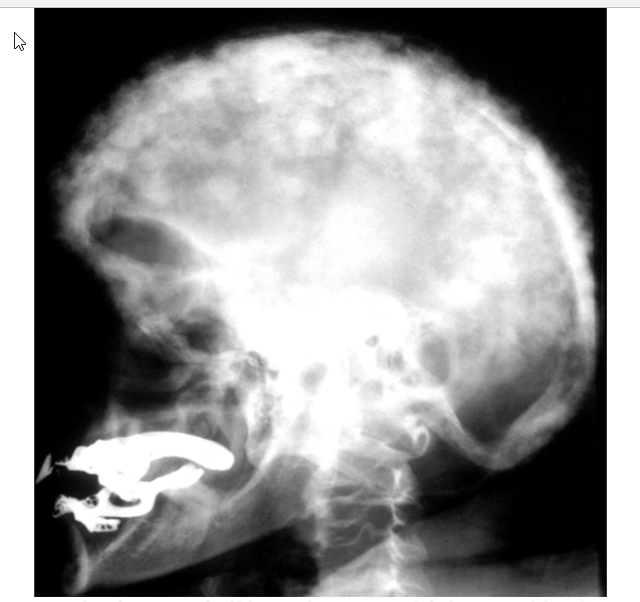
Paget’s Disease: Skull lateral x-ray. Multiple osteoblastic
and lytic lesions. “Salt and Pepper” appearance

Paget’s Disease: Face and Skull. Frontal bossing, increased circulation with prominent temporal artery, deafness with hearing aid

Paget’s Disease: Lower extremity deformity with bowing of tibia

Paget’s Disease. Xray: Pelvis. Lytic and sclerotic lesions. Pelvis is enlarged.

Paget’s Disease: Skull MRI. Thickened, mottled calvarium (skull). Large lateral ventricles with hydrocephalus

Paget’s Disease: Giant Osteoclast reabsorbing bone

Paget’s disease: Histologic changes. Marked irregular thickening of trabeculae. Random arrangement of cement lines and collagen.

Angioid Streaks
Review Case Study Slides
Review Case Study Slides