Chapter 7.4: The Quantum-Mechanical Model of the Atom
 Call Kai
 Learn
 Practice Test
 Spaced Repetition
 Match
 Flashcards
 Knowt Play
1/10

11 Terms
Quantum mechanics
A field that examines the wave nature of objects on the atomic scale
Atomic orbital
An equation that models the electron’s likely position in terms of time and position around the nucleus

Electron density diagram
A representation of an energy sublevel as the probability of finding the electron within a volume as a function of the distance from the nucleus
Principal quantum number (n)
A number that indicates the relative size of the orbital, specifying the atom’s energy level
A ground-state H electron has n = 1
n2 gives the total number of orbitals present
Angular momentum quantum number (l)
A number that ranges from [0, n - 1], giving the atom’s sublevel identifier and shape for a given n and l
l = 0 is designated as s
l = 1 is designated as p
l = 2 is designated as d
l = 3 is designated as f
For example, a sublevel with n = 2, l = 0 is given 2s designation
Magnetic quantum number (ml)
A number that ranges from [-l, l], giving the number, orientation, and identifier of orbitals for a given l
For example, l = 3 gives [-3, -2, -1, 0, 1, 2, 3] for 7 total orbitals
Spin quantum number (ms)
A number describing the spin of an electron going clockwise or counterclockwise, with values of {±1/2}

s orbital
An orbital with l = 0 and a spherical shape and an ml = 0, with highest probabilities increasing farther from the nucleus with greater values of n
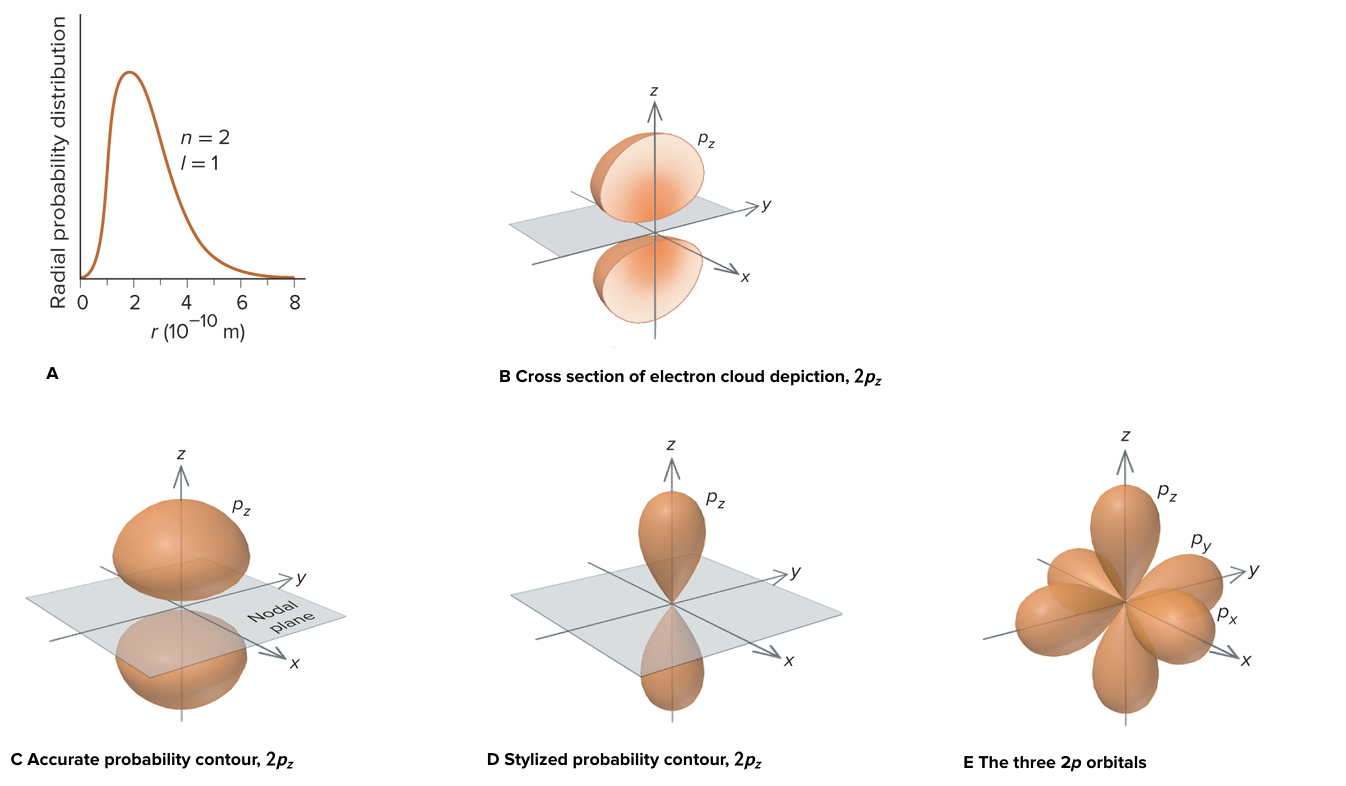
p orbital
An orbital with l = 1 with two regions of high probability on either side of the nucleus, divided by the nodal plane
Electrons spend equal time in both lobes
Differ in orientation across different ml values from ±1

d orbital
An orbital with l = 2 with four regions of high probability and ml values ranging between ±2 for five orientations

f orbital
An orbital with l = 3, n ≥ 4, and ml in the range ±3 for seven orientations