Arr. 2 Midterm Study

0.0(0)
Studied by 0 people
call kaiCall Kai
learnLearn
examPractice Test
spaced repetitionSpaced Repetition
heart puzzleMatch
flashcardsFlashcards
GameKnowt Play
Card Sorting

1/28

encourage image

There's no tags or description

Looks like no tags are added yet.

29 Terms

1
New cards

Abridged Range Trumpet: Concert and Transposed

(Treble) Concert: Bb3 to Bb5 / Transposed: C4 to C6

<p>(Treble) Concert: Bb3 to Bb5 / Transposed: C4 to C6</p>
2
New cards

Abridged Range Alto Sax: Concert and Transposed

(Treble) Concert: F3 to F5 / Transposed: D4 to D6

knowt flashcard image


<p>(Treble) Concert: F3 to F5 / Transposed: D4 to D6</p><img src="https://assets.knowt.com/user-attachments/b66433a4-8bdc-46ca-ac52-2b781f6eeaab.jpg" data-width="50%" data-align="center" alt="knowt flashcard image" style="display: block; width: 50%; margin-left: auto; margin-right: auto;"><p></p>
3
New cards

Abridged Range Tenor Sax: Concert and Transposed

(Bass Clef) Concert: C3 to C5 / (Treble) Transposed: D4 to D6

<p> (Bass Clef) Concert: C3 to C5 / (Treble) Transposed: D4 to D6</p>
4
New cards

Abridged Range Trombone: Concert and Transposed

non-transposing (Bass Clef) Concert: Bb2 to Bb4 / Transposed: Bb2 to Bb4

<p><em>non-transposing</em> (Bass Clef) Concert: Bb2 to Bb4 / Transposed: Bb2 to Bb4</p>
5
New cards

Abridged Range Bari Sax: Concert and Transposed

(Bass Clef) Concert: Db1 to F4 / (Treble) Transposed: Bb3 to D6

<p>(Bass Clef) Concert: Db1 to F4 / (Treble) Transposed: Bb3 to D6</p>
6
New cards

Four Way Close Voicing

A four way close voicing contains four different pitches within an interval smaller than an octave. The four pitches may all be chord tones or a combination of chord tones and tensions.

7
New cards

Four Way Close Voicing: CHORD TONE IN THE LEAD

The arranger may choose a "pure" voicing. This is accomplished by assigning only chord tones to the under voices, just as they occur beneath the melody note.

8
New cards

To avoid creating the interval of a minor 2nd/flat 9 between the top two voices with 1 in the lead.

Substitute 6 for 7 in a major 7th chord with 1 in the lead.

knowt flashcard image


<p>Substitute 6 for 7 in a major 7th chord with 1 in the lead.</p><img src="https://assets.knowt.com/user-attachments/ac350786-45b8-42a4-baaf-200f1f8426dc.png" data-width="50%" data-align="center" alt="knowt flashcard image" style="display: block; width: 50%; margin-left: auto; margin-right: auto;"><p></p>
9
New cards

Four Way Close Voicing: List the chords for which 9 can be substituted for 1 (maj/min/aug/dom)

  1. 9 for 1 or flat 9 for 1
    on dominant 7th chords

  2. 9 for 1 in the following:
    major 7th chords
    minor 7th chords
    major 6th chords
    minor 6th chords
    augmented 7th chords


10
New cards

Four Way Close: Special Case - When 1 is in the lead of a dominant 7th flat 9 chord

7th is skipped

knowt flashcard image


<p><strong>7th is skipped</strong></p><img src="https://assets.knowt.com/user-attachments/f13d4210-c8d0-4ea8-8f06-6fd7871720dd.png" data-width="50%" data-align="center" alt="knowt flashcard image" style="display: block; width: 50%; margin-left: auto; margin-right: auto;"><p></p>
11
New cards

Four Way Close: Special Case - When #11 is in the lead of a dominant 7th chord

Harmonized as though it were 5 of the chord. This is to provide for the inclusion of 3 of the chord in the voicing.

12
New cards

Four Way Close: Melodic Tension in the lead

  1. Skipping the chord tone which occurs immediately below the lead.

  2. Assign the next three chord tones to the remaining instruments.

knowt flashcard image


<ol><li><p><strong>Skipping the chord tone which occurs immediately below the lead. </strong></p></li><li><p><strong>Assign the next three chord tones to the remaining instruments.</strong></p></li></ol><img src="https://assets.knowt.com/user-attachments/751b16c2-05e5-4fd5-9c38-157164a80750.png" data-width="50%" data-align="center" alt="knowt flashcard image" style="display: block; width: 50%; margin-left: auto; margin-right: auto;"><p></p>
13
New cards

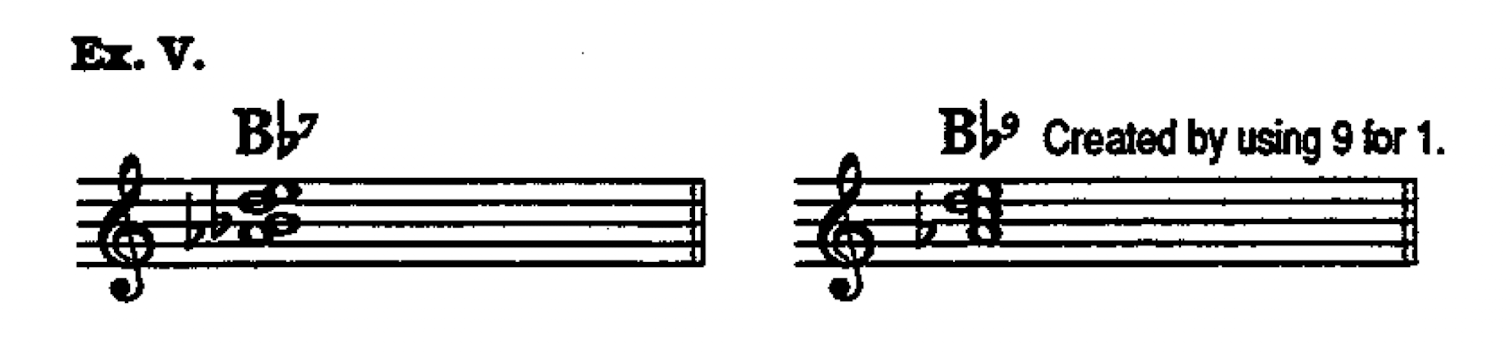
Special Case Voicing: Melodic Tension in the lead - #11 is in the lead of a dominant 7th chord

When #11 is in the lead of a dominant 7th chord, it may be harmonized as though it were 5 of the chord.
knowt flashcard image


<p>When #11 is in the lead of a dominant 7th chord, it may be harmonized as though it were 5 of the chord.</p><img src="https://assets.knowt.com/user-attachments/4cd3ca45-e796-4651-a54c-36ba64fe4cff.png" data-width="50%" data-align="center" alt="knowt flashcard image" style="display: block; width: 50%; margin-left: auto; margin-right: auto;"><p></p>
14
New cards

Drop 2 and Drop 2 & 4 Voicings: Use 9 for 1 in the following chords: (4)

  1. major 6th

  2. major 7th

  3. minor 6th

  4. minor 7th (not always appropriate in III-7)


15
New cards

Avoid creating the flat 9 interval (minor 9th) . . .

Between Any two parts (voices) in a voicing.
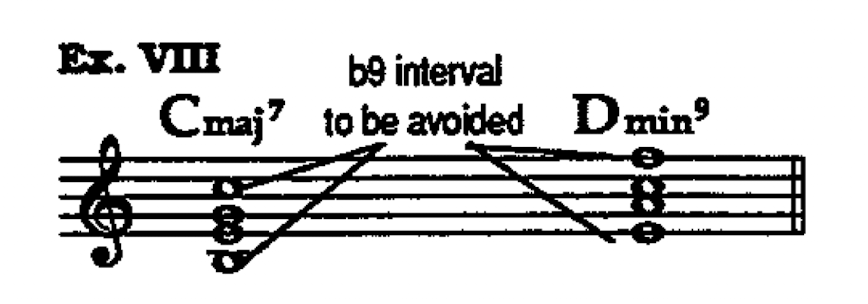
<p>Between Any two parts (voices) in a voicing.</p>
16
New cards

Drop 2 (Open) Voicing:

  1. Take the note that would have been assigned to the second voice in 4 way close.

  2. Then, instead of giving that note to the second voice, drop it an octave and assign it to the fourth voice.

  3. Finally, without making any other octave adjustments, give the remaining two notes to the second and third voices.


*Referred to as open because the interval between the lead and the bottom voice will always be larger than an octave.

<ol><li><p><strong>Take the note that would have been assigned to the second voice in 4 way close.</strong></p></li><li><p>Then, instead of giving that note to the second voice, <strong>drop it an octave and</strong> <strong>assign it to the fourth voice.</strong></p></li><li><p>Finally, without making any other octave adjustments, <strong>give the remaining two notes to the second and third voices.</strong></p></li></ol><p class="p1"></p><p class="p1">*Referred to as open because the interval between the lead and the bottom voice will always be larger than an octave.</p>
17
New cards

Drop 3 (Open) Voicing:

  1. Give the second voice the note it would have in 4 way close.

  2. Take the note that would be assigned to the third voice, drop that pitch an octave and give it to the fourth voice.

  3. Finally, assign the remaining note to the third voice, with no octave adjustment.

knowt flashcard image


<ol><li><p>Give the second voice the note it would have in 4 way close.</p></li><li><p>Take the note that would be assigned to the third voice, drop that pitch an octave and give it to the fourth voice.</p></li><li><p>Finally, assign the remaining note to the third voice, with no octave adjustment.</p></li></ol><img src="https://assets.knowt.com/user-attachments/65f35e9c-4b22-4311-8d5a-e844f05380bf.png" data-width="50%" data-align="center" alt="knowt flashcard image" style="display: block; width: 50%; margin-left: auto; margin-right: auto;"><p></p>
18
New cards

Drop 2 & 4 (Open) Voicing:


  1. Take the note that would go to the second voice in 4 way close, drop it an octave, assign it to the third voice.

  2. Then, assign the next pitch (that would usually go to the third voice) to the second voice — no octave adjustment.

  3. Finally, determine what would have been the bottom note, drop it an octave, and give it to the fourth voice.


<p></p><ol><li><p class="p1">Take the note that would go to the second voice in 4 way close, drop it an octave, assign it to the third voice. </p></li><li><p class="p1"><strong>Then, assign the next pitch</strong> (that would usually go to the third voice) <strong>to the second voice</strong> — <strong>no octave adjustment.</strong> </p></li><li><p class="p1">Finally, determine what would have been the bottom note, <strong>drop it an octave</strong>, and give it to the fourth voice.</p></li></ol><p></p>
19
New cards

Second Voice Substitute Tension Open Voicings: Drop 2 Voicings and Drop 2 & 4 - Dom7 Chords


In dominant 7th chords use one of the following:

a. 9 for 1

b. b9 for 1

c. #9 for 1

d. b5 (#11) for 5

e. 13 for 5

f. b13 (#5) for 5


Note: an added tension normally requires appropriate adjustment of the chord symbol.

knowt flashcard imageknowt flashcard image


<p></p><p>In dominant 7th chords use one of the following:</p><p class="p1">a. 9 for 1</p><p class="p1">b. b9 for 1</p><p class="p1">c. #9 for 1</p><p class="p1">d. b5 (#11) for 5</p><p class="p1">e. 13 for 5</p><p class="p1">f. b13 (#5) for 5</p><p class="p1"></p><p class="p1">Note: an added tension normally requires appropriate adjustment of the chord symbol.</p><img src="https://assets.knowt.com/user-attachments/ea9d6570-98ef-4a60-bdcc-f64ad68a60bf.png" data-width="50%" data-align="center" alt="knowt flashcard image" style="display: block; width: 50%; margin-left: auto; margin-right: auto;"><img src="https://assets.knowt.com/user-attachments/be3df52f-c2ab-49aa-9388-fec40369f8af.png" data-width="50%" data-align="center" alt="knowt flashcard image" style="display: block; width: 50%; margin-left: auto; margin-right: auto;"><p class="p1"></p><p class="p1"></p>
20
New cards

Second Voice Substitute Tension Open Voicings: Drop 3


1. Use 9 for 1 in the following chords:

  1. major 6th

  2. major 7th

  3. augmented 7th

2. In dominant 7th chords use the following:

a. 9 for 1

b. b9 for 1

c. b5 (#11) for 5

d. b13 (#5) for 5


<p><br>1. <strong>Use 9 for 1 </strong>in the following chords:</p><ol><li><p>major 6th</p></li><li><p>major 7th</p></li><li><p>augmented 7th<br></p></li></ol><p>2. In <strong>dominant 7th chords</strong> use the following:</p><p class="p1">a. 9 for 1</p><p class="p1">b. b9 for 1</p><p class="p1">c. b5 (#11) for 5</p><p class="p1">d. b13 (#5) for 5</p><p></p>
21
New cards

Second Voice Substitute Tension Open Voicings: With a Drop 3 Voicing use 9 for 1 in the following chords (3)


  1. major 6th

  2. major 7th

  3. augmented 7th


22
New cards

General Case (All Open Voicings): For (drop 2, drop 3, drop 2 & 4), on dominant 7th chords,

9 for 1 may be used in the bottom voice provided that it does not go below F3

knowt flashcard image


<p>9 for 1 may be used in the bottom voice provided that it does not go below F3</p><img src="https://assets.knowt.com/user-attachments/6a349fa1-1f5c-47cb-914d-3ac513dd051c.png" data-width="50%" data-align="center" alt="knowt flashcard image" style="display: block; width: 50%; margin-left: auto; margin-right: auto;"><p></p>
23
New cards

Transpositions: Bb Trumpet

  • Is a Bb Instrument (Sounds a Major 2nd lower than written) *same as tenor but an octave higher

  • Parts must be written up a Major 2nd from concert (desired) pitch. Ex: To hear a C4, you must write a D4


24
New cards

Transpositions: Alto Sax

  • Is an Eb Instrument (Sounds a Major 6th lower than written) *same as bari but an octave higher

  • Parts must be written up a Major 6th from concert (desired) pitch. Ex: To hear a C4, you must write an A4


25
New cards

Transpositions: Tenor Sax

  • Is a Bb Instrument (Sounds a Major 9th lower than written) *same as trumpet but an octave lower

  • Parts must be written up a Major 9th from concert (desired) pitch. Ex: To hear a C4, you must write an D5


26
New cards

Transposition: Trombone

  • C Instrument (Reads in bass clef)


27
New cards

Transpositions: Bari Sax

  • Is an Eb Instrument (Sounds a Major 13th lower than written)

  • Must be written up a Major 13th from concert (desired) pitch.

  • Ex: To hear a C4, you must write an A5


28
New cards

Transpositions: Bb Trumpet & Tenor Sax Key Signature

Bb Trumpet & Tenor Sax (Add 2 Sharps / Subtract 2 Flats)

29
New cards

Key Signature Transpositions: Eb Alto & Bari Sax

Add 3 Sharps / Subtract 3 Flats



