CHEMISTRY ALKANES
 Call Kai
 Learn
 Practice Test
 Spaced Repetition
 Match
 Flashcards
 Knowt Play
1/48

Earn XP
Description and Tags
Year 1
49 Terms
What is a hydrocarbon?
A compound which only contains atoms of carbon and hydrogen
Alkane general formula
CnH2n+2
Alkane functional group
None
Are alkanes saturated or unsaturated?
Saturated
As the length of chain increases, so does the…
Boiling point of alkanes as the van der Waals are stronger
The more branched the carbon chain...
The lower the boiling point as there are weaker van der Waals forces as the molecules cannot pack as close together
What is crude oil?
A mixture of different hydrocarbons
Crude oil can be separated into fractions using...
Fractional distillation
What is a fraction?
A mixture of compounds with similar boiling points
Fractional distillation of crude oil
Crude oil is heated and vaporised
It enters the fractionating column which has a temperature gradient (hotter at the bottom and cooler at the top)
The Vapour will cool and condense into different fractions at different heights, according to their boiling points,
Longer molecules- bottom and shorter molecules- top.
Properties of shorter chain hydrocarbons
Lower boiling points
Very flammable
Very volatile
Not very viscous (runny)
Burn with clean flames
Properties of longer chain hydrocarbons
Higher boiling points
Not very flammable
Not very volatile
Very viscous (thick)
Burn with smoky flames
What is cracking?
Involves breaking C-C bonds in a longer chain alkane to form a shorter chain alkane and alkene(s). It is a thermal decomposition reaction
Reasons why cracking is done
To produce more useful shorter chain alkanes, which are more flammable and are therefore better fuels
To produce alkenes for making plastics
Thermal cracking conditions
High temperature (700-1200K)
High pressure (7MPa)
Thermal cracking intermediates
Free radials (species with unpaired electrons)
Thermal cracking products
High percentage of alkenes
Catalytic cracking conditions
High temperature (700K)
Slight pressure (1-2atm)
Zeolite catalyst - Aluminosilicates (honeycomb structure, porous and a large surface area)
Catalytic cracking intermediates
Carbocations (species with a positively charged carbon ion)
Catalytic cracking products
Aromatic, cyclic and branched hydrocarbons which are mostly used as motor fuels
Alkanes make good fuels because...
They release a lot of energy when burned
Complete combustion occurs when...
There is a plentiful supply of oxygen
Complete combustion produces...
Carbon dioxide and water
Incomplete combustion occurs when...
There is a limited supply of oxygen
Incomplete combustion produces...
Carbon monoxide/carbon and water
Hydrocarbons react completely with oxygen forming...
Carbon dioxide and water vapour
Hydrocarbons react incompletely with oxygen forming...
Carbon monoxide and/or carbon (soot) and water
Sulphur impurities in hydrocarbon fuels react with oxygen to form...
Sulphur dioxide
Nitrogen and oxygen from the air react with each other at the high temperatures in the engine forming...
Nitrous oxides (NO and NO2)
Some hydrocarbons don't...
React and are just vapourised
Carbon dioxide
Greenhouse gas which may be responsible for global warming.
The C=O bonds in CO2 absorb IR as they are polar, heat it up and re-emit it in all directions, some of which head back towards the Earth's surface, causing its temperature to increase.
Carbon monoxide
Odourless, colourless and highly toxic gas. Binds irreversibly to the haemoglobin in red blood cells
Carbon particles (soot)
Dirty and contributes to global dimming. Can make asthma worse
VOCs (volatile organic compounds / unburnt hydrocarbons)
May contain carcinogenic benzene and can lead to photochemical smog (a type of smog produced when UV from sun reacts with nitrous oxides in atmosphere)
Wastes fuel
Sulphur dioxide
SO2 produced in combustion engine due to impurities in fuel.
SO2 is oxidised and reacts with water in the atmosphere to form acid rain (dilute H2SO4), which causes damage to buildings and lowers the pH of land and water systems
Nitrous oxides
Atmospheric N2 and O2 react in combustion engine due to high temperatures to form NOx.
These then react with water vapour and oxygen to form HNO3. This causes acid rain.
NOx also contributes to photochemical smog.
Catalytic converters
Used in car exhausts to convert harmful products of combustion into less harmful products.
They are honeycombs (to increase the surface area) made of platinum/rhodium plated ceramic (which act as catalysts)
Reactions in a catalytic converter
Nitrous oxides + carbon monoxide to form nitrogen and carbon dioxide
Nitrous oxides + unburnt hydrocarbons to form nitrogen, carbon dioxide and water
Flue gas desulfurisation
Removes sulphur impurities from waste products.
Calcium oxide (CaO) or calcium carbonate/limestone (CaCO3) are used to neutralise the sulphur dioxide and produce gypsum (CaSO4)
Flue gas desulfurisation process
A slurry of calcium carbonate or calcium oxide is fed into the top of the chamber
Flue gases (waste gases from the production of fuel) pass into the chamber
Sulphur dioxide is an acidic gas, so dissolve into the slurry and reacts with the bases
One of the products of this reaction is calcium sulphate (gypsum), which has plenty of uses so can be sold
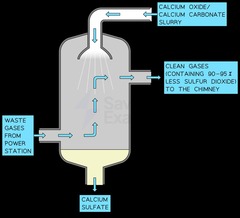
Flue gas desulphurisation - Calcium oxide
CaO + SO2 + 1/2O2 → CaSO4
Flue gas desulphurisation - Calcium carbonate
CaCO2 + 1/2O2 + SO2 → CaSO4 + CO2
Alkanes and halogens will react under...
UV light, undergoing a free radical substitution reaction
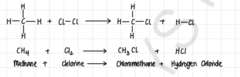
For each H removed from the alkane:
One halogen (X2) molecule is needed
One HX molecule is formed as a by-product
Steps of reaction between alkane and halogen
1. Initiation
2. Propagation
3. Termination
Initiation
Under UV light, chlorine gas molecules break apart homolytically to form chlorine free radicals (chlorine atoms)
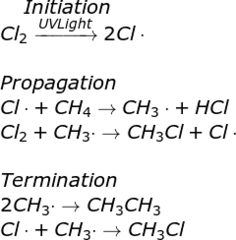
Propagation
Chlorine free radical reacts with a methane molecule, stripping a hydrogen atom and forming HCl and a methyl free radical (the carbon has the unpaired electron)
The methyl radical then reacts with another chlorine molecule to form chloromethane and regenerates another chlorine free radical.
These reactions are self-propagating (will keep going until they run out of reactant).
The chlorine free radical acts as a catalyst
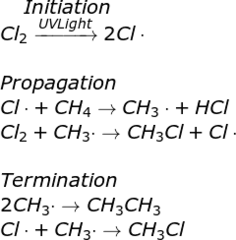
Termination
When any two free radical species react to form a stable product, using up free radicals and slowing/stopping the reaction.
Can form unwanted by-products e.g. chlorine and ethane
Multiple/Further substitutions
When the propagation step continues many times to form CH2Cl2, CHCl3 or CCl4. The formation of these can be reduced by altering the conditions of the reaction to favour the termination step.
This is done by keeping the methane in excess.
The mixture of products can be separated by fractional distillation