science topic 4: cells and classificatoin
 Call Kai
 Learn
 Practice Test
 Spaced Repetition
 Match
 Flashcards
 Knowt Play
1/59

There's no tags or description
Looks like no tags are added yet.
60 Terms
what are some structural traits of a mammal
body covering - hair or fur
4 chambered heart
produces milk through mammary glands
endothermic
what are some of the structural traits of birds
body covering - feathers
lay hard shelled eggs
have beaks
endothermic
what are some of the structural traits of reptiles
body covering - dry scales
lay leathery eggs
ectothermic
what are some of the structural traits of an amphibian
body covering - moist skin
lays eggs without shell
live in/on land or water
2 stage life cycle
what are some of the structural traits of fish
body covering - scales
lay shell-less eggs in water
have gills for breathing
ectothermic
what are the 5 vertebrate groups
fish
reptiles
amphibians
birds
mammals
how can mammals be divided based on the way they reproduce
placental mammals produce live young
marsupials produce very immature young which complete their development in a pouch
monotremes lay eggs
what are the 7 traits that all living organisms share
movement
respiration
stimulus
nutrition
excretion
reproduction
growth
what is the difference between the words living non-living and dead
livings things demonstrate the 7 characteristics of life
living things that have died are called dead
non-living things are things that can’t carry out the 7 functions of live. they are not made of cells
what is a behavioral trail
a behavioral trait refers to what the organism does
what is a physiological trait
a physiological trait refers to the metabolic working of an organism.
what is a structural trait
a structural trait refers to the way in which an organism is buit
what is the difference between a trait and an adaptation
A trait is just a feature of an organism e.g. having fur, having teeth, having legs, having leaves, being green
An adaptation is a trait that helps the organism survive (and ultimately reproduce) in its environment e.g. sharp claws for climbing on a koala, having thick fur to stay warm, having powerful legs to travel further, having small leaves to reduce water loss
what adaptation has helped the Australian bilby
The ears of a Bilby are large, thin and have a rich blood supply. They have a large surface area to volume ratio. This helps it them dissipate heat quickly.
what adaptations have helped the eucalyptus trees
Eucalyptus leaves hang vertically in order to avoid exposure to harsh midday sun. This helpsthem to minimise water loss through transpiration.
They also have a waxy cuticle layer that minimises evaporation from the leaf and thereforereduces water loss.
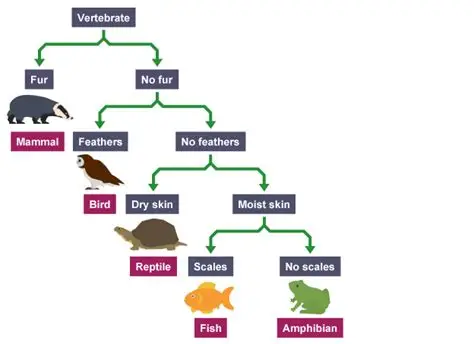
what does dichotomous mean and what is a dichotomous key
Dichotomous means ‘a choice of two’. A dichotomous key presents two options per trait. Whichever option’s true is the one that is followed to the next step. It’s a process of grouping organisms which share the same structural traits

use this dichotomous key to find out which picture is what
1a. Adult leaves broad and sickle-shaped (curved like a scythe) → Southern Blue Gum (Eucalyptus globulus)
1b. Adult leaves narrow and lance-shaped → Go to 2
2a. Leaves very long, narrow, and drooping → River Red Gum (Eucalyptus camaldulensis)
2b. Leaves shorter and less drooping → Go to 3
3a. Leaves thick, bluish-green, and slightly curved → Snow Gum (Eucalyptus pauciflora)
3b. Leaves dark green, narrow, and leathery → Mugga Ironbark (Eucalyptus sideroxylon)
a: southern blue gum
b: river red gum
c: snow gum
d: mugga iron bark
what is a dichotomous key used for
a dichotomous key is used to name organisms with scientific names (genus, species) and not just grouping them with other organisms
what is the kinship system
the kinship system is a system used by aboriginal people, to classify plants and animals based on their uses, forms and functions.
The classification of wood-bearing plants may use the same namesas the function of the finished object:
Spear trees – trees whose wood is suitable for making spears.
Shield trees – trees used to make shields.
Canoe trees – trees whose bark can be used to constructcanoes.
Resin trees – trees that produce resin used as an adhesive orsealant.
what is an organism
a living thing
what is classification
classification is a way of grouping anything with simple characteristics
what is taxonomy
taxonomy is the science of classification
why do we classify
a system of grouping organisms makes communication about them much easier and more efficient.
When previously unknown organisms are discovered, they can be compared to existing known organisms and named.
Evolutionary relationships between living (extant) and extinct (no longer living) organisms can be proposed.
why is latin used in taxonomy
latin is used in taxonomy because its a dead language that no longer changes it makes communication between scientist around the world easier it is a common language
name the 5 kingdoms of broad classification of life on earth
animal, plant, fungus, protista, monera
describe the criteria for animal classification
eukaryotic
multicellular
heterotrophic
describe the criteria for plant classification
eukaryotic, multicellular, autotrophic, cell wall contains cellulose
describe the criteria for fungus classification
eukaryotic, unicellular or multicellular; saprophytic or parasitic; cell wall contains chitin
describe the criteria for Protista classification
eukaryotic, unicellular; can be heterotrophic or autotrophic (e.g. Amoeba vs Euglena)
describe the criteria for Monera classification
prokaryotic, unicellular, can use light or chemicals for nutrition
name the eight groups of the linnaean system of classification in order from largest to smallest. give an example of each group.
domain
kingdom
phylum
class
order
family
genus
species
(the pneumonic to rember: dear kind phillip came over for good soup.)

what is the binomial system
the binomial system is where you give animals scientific names based on their genus followed by their species. The genus always has a capital letter. e.g. Homo sapiens
define species
Organisms in the same species are the most alike.
Two organisms are placed in the same species if they are able to breed together and produce fertile young under natural conditions.
Members of the same species may differ in appearance.
what is fertile
Fertile means able to produce offspring.
what is the modern cell theory
All living things are made of cells.
The cell is the smallest unit of life.
All cells come from pre-existing cells.
Cells contain genetic material (DNA) that is passed on during cell division.
Chemical and metabolic processes happen inside cells.
All cells share a similar basic chemical makeup
what is a compound light microsope
A compound light microscope is commonly used to look at cells. These microscopes use light to pass through the specimen being viewed. The light is passed through two lenses which compounds (intensifies) the magnification.
what is the difference between magnification and resolution
Magnification means making the image of the specimen bigger.
Resolution means making the image of the specimen clearer; being able to distinguish between two lines.
what are the rules for drawing cells
Use a sharp lead pencil.
Draw only the lines you see (no shading, sketching or colouring).
Your diagram should be about 10 lines big.
Only draw two or three representative cells (don’t try and draw every cell)
Record the magnification next to the diagram.
State the name of the specimen in the title of the diagram.
Label any structures and organelles evident.
what does the cell membrane do
controls what substances go in and out of the cell
what does the cell wall do
provides support and protection to the cell, helping it maintain its shape and preventing it from bursting when it takes in water.
what does the cytoplasm do
jelly like substance that fills the cell and holds the organelles in place, where many important chemical reactions happen to keep the cell alive
what does the nucleus do
acts as the control centre of the cell, containing the cell’s DNA and directing all the cells activities like growth and reproduction
what is the nucleolus
found inside the nucleus and is responsible for making ribosomes which are essential for producing proteins the cell needs to survive
what does the mitochondria do
produce energy from food through a process called cellular respiration, which the cell uses, to perform its function.
what does chloroplast do
found in plant cells and use sunlight to make food for the plant through photosynthesis
what does vacuole do
storage organelles that hold water, nutrients and waste products, helping to keep the cell hydrated and store important substances
what dies cytosol do
fluid part of the cytoplasm where many of the cell’s chemicals reactions take place, providing a medium for the organelles to operate.
name some of the important scientist and dates who helped to develop cell theory
1590 - Zacharias Janssen (a Dutch spectacle maker) is credited with developing one of the first microscopes.
1665 - Robert Hooke looked at cork under a microscope and named the tiny compartments "cells".
1674 - Anton van Leeuwenhoek used improved microscopes to observe living cells, including bacteria and tiny organisms.
1838 - Matthias Schleiden concluded that all plants are made of cells.
1839 - Theodor Schwann concluded that all animals are made of cells.
1855 - Rudolf Virchow stated that all cells come from pre-existing cells
define organelle
specialised structures within cells that perform a specific function.
label diagrams showing cell structures and organelles of plant and animal cells

what is a wet mount
a wet mount is when you suspend a specimen in water to make slides
whats the use of biological stains
they stain the specimen a certain colour to make the cells have better resolution and be less see-through
what are parts of a plant cell
cell membrane
cytoplasm
mitochondrion
nucleus
cell wall
chloroplast
vacuole(usually bigger than animal one)
ribosomes
what are the parts of an animal cell
cell membrane
cytoplasm
mitochondrion
nucleus
vacuole
ribosomes
what is photosynthesis and how does it work
it is a way of turning sunlight, carbon and water into sunlight using the chloroplast in a plants. the equation is
sunlight
co2 + h2o ——> c6h12o6 + o2
what is atp
ATP stands for Adenosine Triphosphate.
•cell's energy currency.
•stores and transfers energy to where it is needed in the cell.
•used for activities such as movement, growth, repair, and making new substances.
what is cellular respiration
it is the process in which cells produce energy

what is the difference between a chloroplast and a chlorophyll
chlorophyll is a green pigment and chloroplast is a cell where photosynthesis occurs