Day 20 - refraction and phenomena
 Call Kai
 Learn
 Practice Test
 Spaced Repetition
 Match
 Flashcards
 Knowt Play
1/64

There's no tags or description
Looks like no tags are added yet.
65 Terms
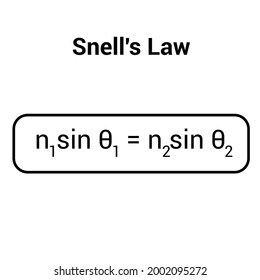
The Law of Refraction is also known as…
Snell’s Law
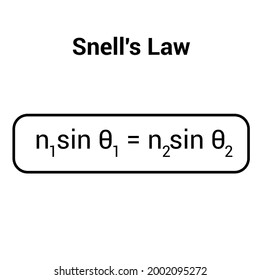
Worked example: Light travels from air into water at an incident angle of 30 degrees. Find the refracted angle.
about 22.1 degrees
Describe the refracted when the angle of incidence is less than critical angle
the refracted ray exists
Describe the refracted when the angle of incidence is equal to the critical angle
the refracted ray found at the boundary; forms 90 degree angle to normal
Describe the refracted when the angle of incidence is more than critical angle
there is no refracted ray because Total Internal Reflection occurs
Worked example: Find the critical angle for water-to-air.
critical angle is about 48.8 degrees
Worked example: Find the critical angle for glass-to-air.
about 41.8 degrees
Worked example: Find the critical angle for glass-to-water.
about 62.5 degrees
Which interface (glass→water, glass→air, or water→air) has the smallest critical angle?
Glass → Air
Index plural?
indices
Why does glass → air have the smallest critical angle?
It is because its two refractive indices differ the most
1.5
1.0003
What is one real-world connection to optics?
Fiber-optic cables guide light through a transparent core. When light strikes the core's boundary at an appropriate angle, total internal reflection keeps it inside, allowing the light to travel along the cable.
___________ is the variation of refractive index with wavelength
Dispersion
Define dispersion
it is the variation of refractive index with wavelength
Memorize the wavelengths of UV and visible light
UV = less than 380nm
Violet = 380-450nm
blue = 450-490nm
green = 490-570nm
yellow = 570-590nm
orange = 590-620nm
red = 620-750nm
NOTE: memorize the first two digits for each visible color: (v, b, g, y, o, r) → 38, 45, 49, 57, 59, 62-75 easy way :)
NOTE: ultraviolet is less than 380 so just say UV < 38
NOTE: red ends at 75
In most materials, shorter-wavelength violet light has a _____ refractive index than longer-wavelength red light
higher
Does red light or violet light have a higher refractive index?
violet light
Does red light or violet light have a lower refractive index?
red light
Because violet has a higher refractive index, violet light generally refracts ________ than red light
more
What happens when a beam of white light shines through a glass prism?
The different visible colors in white light will interact with the material slightly differently. They will refract by different amounts and spread apart resulting in a spectrum of colors
Study this info

Does violet or red light bend more?
Violet light
Does the color change just because the light enters a prism?
NO
A prism ________ white light into various colors
disperses
A color’s identity is associated with what?
its frequency
Is a color’s identity associated with its wavelength?
No, ONLY its frequency
Why do diamonds sparkle colorfully? What phenomena are involved?
Dispersion
Total Internal Reflection
What does dispersion do to a diamond?
dispersion separates the white light into various colors
What does T.I.R. do to a diamond?
It traps light inside the diamond and redirects it before some light exits
Does a diamond sparkle more or less underwater?
It sparkles less
Does increasing the critical angle result in more light being able to escape the material?
YES
Increase critical angle = increase in light escaping
Does water have a higher critical angle than air?
Yes
Why does a diamond sparkle less while underwater?
Because the surrounding water has a higher critical angle than air which means it allows MORE light to escape than air does
light escapes = less sparkle
light trapped = more sparkle
What phenomena allows for rainbows to occur?
Refraction
Reflection
Dispersion
How does refraction help create rainbows?
Sunlight bends as it enters a water droplet
How does reflection help create a rainbow?
light reflects inside the droplet before exiting
How does dispersion help create a rainbow?
the colors spread apart because they refract differently
Where is the sun in relation to you if you can see a rainbow right in front of you?
the sun is behind you
Most of the light that enter a water droplet refracts or reflects, to create a rainbow?
most of the light refracts
a little reflects back into the droplet
How many internal reflections are associated with a Primary rainbow?
one (1)
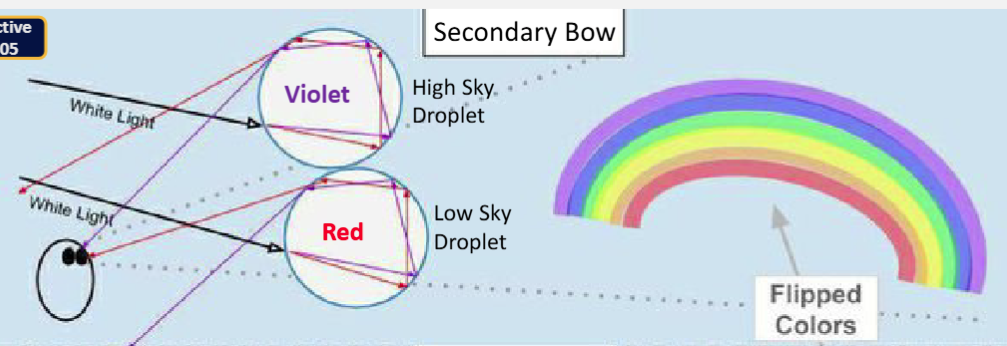
How many internal reflections are associated with a Secondary rainbow?
two (2)
What color order from outside to inside are associated with a Primary rainbow?
red —> violet
What color order from outside to inside are associated with a Secondary rainbow?
Violet —> red
Describe the brightness of a primary rainbow?
Bright
Describe the brightness of a secondary rainbow?
Faint
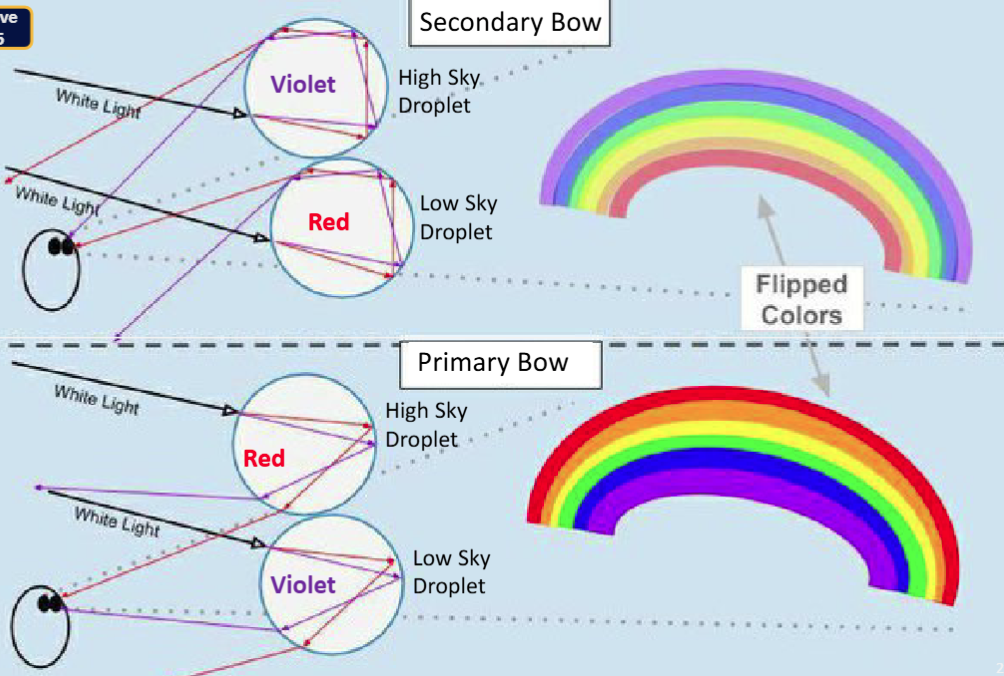
Why does the secondary rainbow have the reverse color order?
because the light undergoes an additional internal reflection
study this image

True or false?
In a primary rainbow, the red light reaching your eye comes from droplets higher in the sky
True

In a primary rainbow, the red light you see at the top of a rainbow came from a droplet ____ in the sky than the violet light you see at the bottom
higher
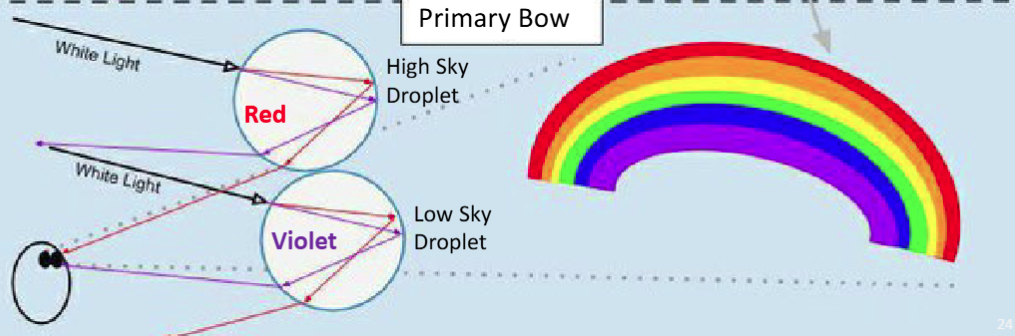
In a primary rainbow, the violet light reaching your eye comes from droplets _____ in the sky
lower

True or false?
In a secondary rainbow, the red light reaching your eye comes from droplets higher in the sky
False, the red light comes from droplets lower in the sky
In a secondary rainbow, the red light you see at the bottom of a rainbow came from a droplet ____ in the sky than the violet light you see at the top
lower

Light travels from water toward air. What is the approximate critical angle measured from the normal?
about 48.8 degrees
A ray travels inside glass toward air. Its incident angle is 50 degrees from the normal. What happens at the boundary?
It undergoes total internal reflection
calculate critical angle to be 41.8 degrees
incidence angle is 50 degrees
incidence angle is larger than the critical angle so T.I.R
Which two conditions are necessary for total internal reflection?
Light begins in the material with the higher refractive index
The incident angle is greater than the critical angle
True or false?
At the critical angle, the refracted ray travels along the boundary between the two materials.
true
when the angle of incidence is at/equal to the critical angle
In most materials, which statement correctly compares red and violet light during dispersion?
Violet has a higher refractive index and bends more than red.
Which sequence best describes how a primary rainbow forms?
Refraction and dispersion on entry, internal reflection, then refraction on exit.
entry: refraction and dispersion
Inside: internal reflection
Exit: refraction
True or false?
Total internal reflection can occur when light travels from air into glass if the incident angle is large enough.
False
Total internal reflection requires light to start in the higher-index material and approach a lower-index material. Traveling from air to glass means traveling from low to high index material which cannot work for T.I.R
A ray makes an angle of 20° with the surface of a glass-to-air boundary. What is its angle from the normal?
70°
Looking at the color order from the outside edge toward the inside edge, how does a secondary rainbow differ from a primary rainbow?
The secondary rainbow has violet outside and red inside.
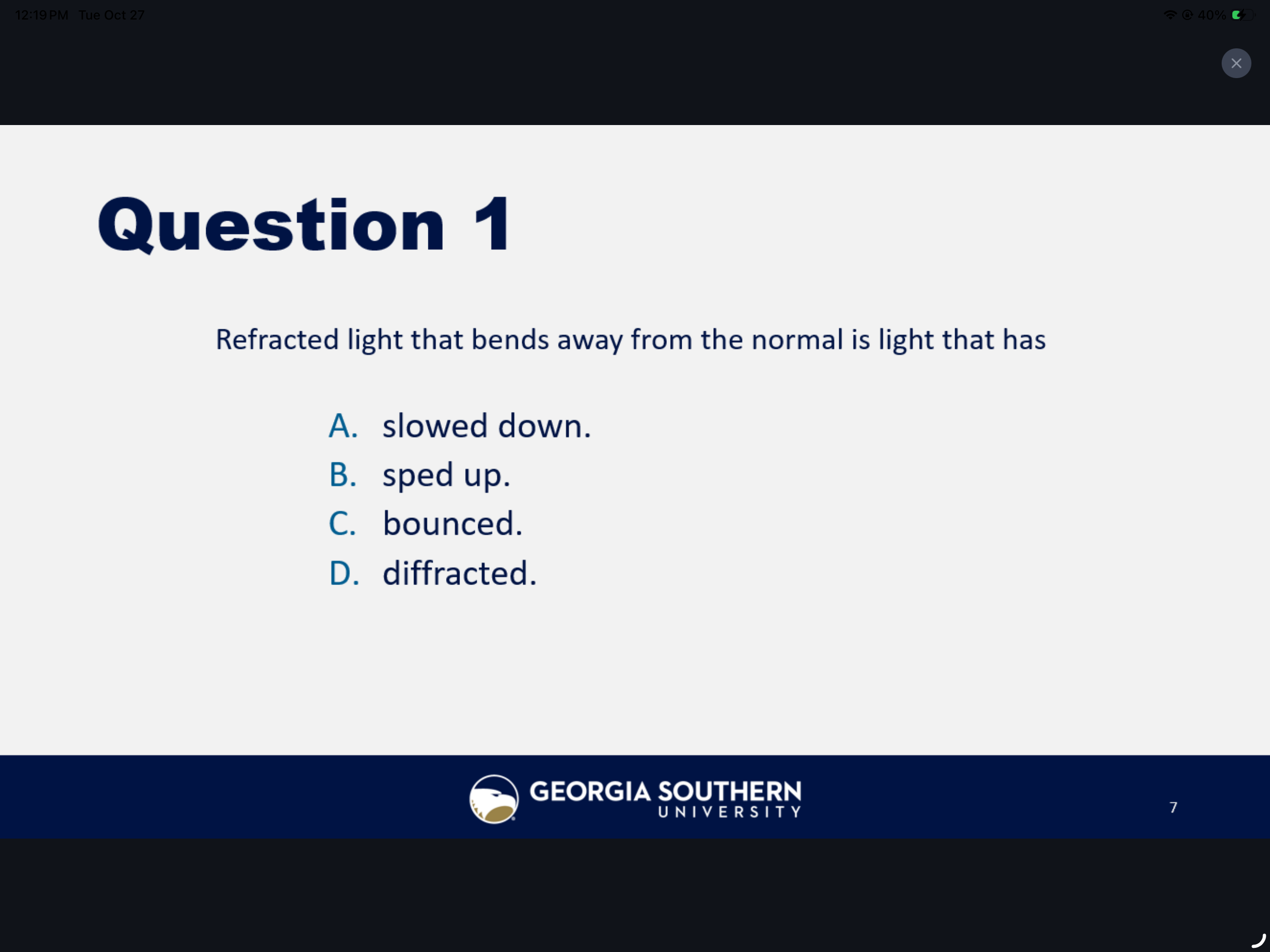
B. Sped up

B. n1 > n2

C. The refracted angle is less than the incident angle


B. It forms a slightly diverging cone with violet rays on top, red rays on the bottom