Perio 10 - Periodontal Examination and Charting (Dr. Valverde)
 Call Kai
 Learn
Learn Practice Test
 Spaced Repetition
 Match
Match Flashcards
 Knowt Play
1/114

There's no tags or description
Looks like no tags are added yet.
Name | Mastery | Learn | Test | Matching | Spaced | Call with Kai | Chat |
|---|
No analytics yet
Send a link to your students to track their progress
115 Terms
- Clinical (visual) observations
- Charting (probing)
- Radiographic evaluation
What three things are used to establish periodontal diagnosis?
D0150
What is an initial exam code at TUSDM?
- D4090
- D4091
What is a gingivitis/periodontitis follow up code at TUSDM?
D0120, 12 months
What is a recare exam code at TUSDM and how often do they occur?
Make sure to review medical and dental histories
What should we do before examining the patient?
every visit (any changes or no change must be recorded)
when should a patient's medical history be updated?
grade
When diagnosing periodontitis, do risk factors, smoking and diabetes, influence the stage or grade of periodontitis?
- Diabetes
- Smoking
What 2 conditions are specifically relevant to periodontal diagnosis?
- Cardiovascular diseases (overall fitness for therapy, anesthesia)
- Bleeding disorders (hemostasis)
- Allergies
What 3 conditions are specifically relevant to periodontal therapy?
e. aspirin
When taking down the patient's medication list, all these drugs require special attention EXCEPT:
a. anticoagulants
b. cardiovascular meds
c. bisphosphonates
d. pain meds
e. aspirin
f. joint replacements
true
t/f: periodontitis is a slow progressing chronic diseases that usually presents without any pain symptoms
- Gingival bleeding
- Bad breath
- Gingiva recession, missing papilla ('black triangle')
- Tooth mobility
- Tooth migration
- Tooth loss
What are potential symptoms of periodontitis?
- Date of last prophylaxis
- Last periodontal diagnosis
- History of periodontal treatment
- Any implants
What are four things to review/update during each appointment regarding periodontal history?
- Extractions due to periodontal disease
- Need for implants
What periodontal concerns are most commonly associated with missing teeth?
- Crowding
- Root proximity
- Difficulty in flossing/cleaning
What periodontal concerns are most commonly associated with supernumerary teeth?
- Pseudopockets
- Difficulty in flossing/cleaning
What periodontal concerns are most commonly associated with crowding?
Is it due to pathologic tooth migration?
Which periodontal concern may arise in the presence of a diastema?
- Pseudopockets
- Is it due to pathologic tooth migration?
Rotated or tilted teeth are most likely associated with which periodontal condition?
- Root exposure
- Furcation exposure
- Appearance of attachment loss
Super-erupted teeth are most commonly associated with which periodontal finding?
- Chronic gingival inflammation
- Recession
What periodontal concerns are most commonly associated with crown margins?
- Difficulty in cleaning
- Inflammation
- Hypertrophy
What periodontal concerns are most commonly associated with pontic designs?
- Ridge resorption
- Gingival recession
- Inflammation
What periodontal concerns are most commonly associated with denture components?
- Deep probings
- Hard-to-clean embrassure spaces
What periodontal concerns are most commonly associated with implant crowns?
- Food impaction
- Gingival inflammation
What periodontal concerns are most commonly associated with interproximal caries?
- Gingival inflammation
- Difficult prophy
What periodontal concerns are most commonly associated with cervical caries?
- Need for crown lengthening
- Prognosis fair/poor/hopeless?
What periodontal concerns are most commonly associated with root caries?
- Normal
- Pink
- Pigmented
How can you describe gingiva color in health?
- Erythematous
- Red
- Purple
- Cyanotic
How can you describe gingiva color if it is potentially a disease?
inflammation or gingival overgrowth
Enlarged gingiva indicates what?
normal gingiva
A scalloped gingiva indicates what?
interproximal periodontal tissue loss (attachment loss!)
Blunted papilla indicates what?
normal gingiva
the gingival margin transitions to the tooth smoothly
A knife-edge gingival margin indicates what?
thick gingival margins, opposite of knife edge
What does a rolled margin gingiva margin mean?
Localized swelling
A bulbous gingiva indicates what?
normal gingiva
A stippled gingiva indicates what?
loss of collagen fibers
loss of papillary stippling indicates what?
left
Which side is healthy?

right
Which side is disease?

P
Plaque that can be seen on the tooth or it sticks to the periodontal probe is entered as ____ in the chart
C
Calculus is entered as ____ in the chart
during prophy/SRP appointment for patient education
When should plaque disclosing solution be used?
supragingival calculus
What type of calculus is white and chalky and commonly at the orifices of salivary glands?
subgingival calculus
What type of calculus is dark and hard and typically in periodontal pockets?
PFS = (number of plaque-free surfaces / total number of surfaces examined) x 100
What is the calculation for plaque free score?
4 (mesial, distal, buccal/labial, lingual/palatal)
How many surfaces per tooth are examined in the free plaque score calculation?
Mobility
__________ is assessed by moving the crown buccolingually with two instruments
no mobility
ID the tooth mobility grade:
-
Grade I
ID the tooth mobility grade:
- 0.1-1mm mobility
Grade II
ID the tooth mobility grade:
- more than 1mm mobility
Grade III
ID the tooth mobility grade:
- Vertical/apico-coronally or twist mobility
UNC-15
ID the type of perio probe:
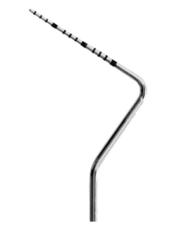
UNC-15
Which perio probe is standard for perio charting?
Marquis (CP-12)
ID the type of perio probe:

Nabers
ID the type of perio probe:

Nabers
Which perio probe is used for detecting furcation involvement?
- Glide the probe tip on the enamel into the sulcus
- 'Feel' the bottom of the sulcus with the probe tip
What is the probing technique?
6
MB, B, DB, ML, L, DL
how many probing sites are there on one tooth?
walking probe
On teeth with potential periodontal problems use the ________ technique
C) Tooth surface
when probing, you should angle your probe so that the tip is always in contact with the _____ to minimize discomfort and maximize tactile sensation
A) CEJ
B) Gingiva
C) Tooth surface
Height of contour
Hold probe parallel to the long axis of the tooth as much as possible. But... teeth are wider at the _________ than at the cervix, thus the probe must be angulated - keep angulation at minimum.
0.25 N (but may vary from pt to pt/tooth to tooth/site to site)
What is the recommended probing force in Newtons?
deeper
The tip of the probe compresses the junctional epithelium, resulting in _________ probing depths than the actual depth of the gingival sulcus
more
In inflamed tissues the probe compresses the junctional epithelium _____ than in healthy tissues
true
T/F: Decrease in probing depth after therapy may result from increased tissue resistance rather than a gain in attachment
B) Junctional epithelium
In a normal/healthy patient probing, the tip of the probe compresses what tissue?
A) Connective tissue attachment
B) Junctional epithelium
C) Gingiva
healthy gingiva
clinically, if the probe tip stops about 1/3 -1/2 into the junctional epithelium, the patients most likely has _________
gingivitis
clinically, if the probe tip stops at the apical end of the junctional epithelium, the patients most likely has _________
periodontitis
clinically, if the probe tip penetrates the most coronal fibers of the connective tissue attachment, the patients most likely has _________
- Pocket shrinkage (gingival recession)
- Decreased inflammation (spongy to firm)
- Attachment gain
A decrease in probing depth after therapy may be due to what three things?
interproximal areas (SSNKE)
Where are the first signs of periodontal attachment loss found?
Periodontitis
Interproximal attachment loss is the definition of _____________
contact point
when probing for interproximal attachment loss, you should angle the perio probe right below the _______
B) Over-angulation leads to exaggerated probing values (too high)
Which of the following will NOT help you get an accurate reading of interproximal probing areas:
A) Probe must be angulated in order to find the area right below the contact point
B) Over-angulate the probe past the contact point
C) Keep probe in touch with the contact area in order to minimize angulation
gingival inflammation (due to atrophy or ulceration of pocket epithelium)
What does BOP indicate?
no BOP
what clinical sign can be used as a good indicator of clinical health from both gingivitis and periodontits?
true
t/f: BOP always indicates gingival inflammation
false
t/f: BOP always indicates periodontitis
Periodontal stability
Absence of BOP is a good predictor of __________
A) Positive bleeding on probing is MAYBE indicative of periodontitis
Which of the following is NOT safe to assume:
A) Positive bleeding on probing is indicative of periodontitis
B) Positive bleeding on probing is indicative of inflammation
C) Negative bleeding on probing is indicative of no inflammation
D) Negative bleeding on probing is indicative of no progression of periodontal disease
- Attachment is hidden under the FGM
- CEJ is most often hidden under the FGM
What is the difficulty in determining attachment level?
probing depth (PD)
in a patient where the CEJ is not visible, the measurement from the gingival margin to the attachment is the ______
free gingival margin (FGM)
in a patient where the CEJ is not visible, the measurement from the gingival margin to the CEJ is the ______
CEJ (cementoenamel junction)
the ______ is the fixed landmark against which most periodontal parameters are measured
CEJ (cementoenamel junction)
On a healthy tooth, where is the attachment at?
ATTACH = PD-FGM
What is the formula used in situations when clinically the CEJ is covered?
exposed
the formula ATTACH = PD+FGM is used in situations when clinically the CEJ is ______
attachment loss (ATTACH)
the distance between the bottom of the pocket and the CEJ is the ________
Find the CEJ with the tip of the probe by feeling the difference between the hard, smooth enamel and the rougher cementum and measure to the gingival margin.
How do you measure the FGM?
By probing around a tooth that has no pathology (no inflammation, no bone loss) where PD=FGM!
How can the FGM be estimated?
FGM was not factored in, so attachment loss was calculated greater that it actually is
what is the problem with this perio charting values?

1mm
at the mid-buccal or mid-lingual location, a healthy free gingival margin should measure about ____ mm
3mm
at the interproximal location, a healthy free gingival margin should measure about ____ mm
Because the papilla is filling in the spaces under the contact points
Why does the height of the free gingival margin varies around the tooth?
if gingiva covers the CEJ
In Axium, when do we record FGM with a (+) prefix?
with a + prefix
if gingiva covers the CEJ, how is FGM recorded?
without a + prefix
if the CEJ is exposed, how is FGM recorded?
PD with a + prefix
if the CEJ cannot be reached with the tip of the probe (no attachment loss), how is FGM recorded?
higher
In a healthy patient, the free gingiva at the interproximal spaces is _____ than it at the mid-buccal area
+1 to +3 mm
What is a normal FGM range?
+4mm and more
What probing number for FGM represents a pseudopocket?