Standardisation
 Call Kai
 Learn
 Practice Test
 Spaced Repetition
 Match
 Flashcards
 Knowt Play
1/64

There's no tags or description
Looks like no tags are added yet.
65 Terms
What are the features of the human genome?
Was publicly funded project that started in 1990 and finished around 2003
Objective was to determine the entire euchromatic human genome
The region that is accessible via sequencing
Has lightly packaged chromatin enriched in genes, and represents 92% of the human genome
How was the HGP funded?
Had major funding from NIH and DOE
Budgeted at 3 billion dollars but cost around 5 billion
Was an international project
What are the features of the draft genome sequence?
In 2001 the draft genome sequence was released
Wasn't complete but allowed analysis and assessment of the genome
Contained 22,300 protein coding genes
25% of the genome with 1% are exonic
There were significantly more segmental duplications than expected
Include nearly identical, repeated sections of DNA, functional gene copies and pseudogenes
There was a large number of short interspersed nuclear elements
Alu which represented 15% of the genome
Who did the human genome represent?
DNA was collected from around 30 donors
Came from blood samples in females and sperm samples in males
Only a few DNA samples were processed into DNA libraries to ensure anonymity
Much of the sequence that went into the draft genome was from 2 females and 1 male
Sequencing was murder harder and due to quality control 70% of the draft sequence came from the single male donor
Possibly from Buffalo, New York – was he an average human?
What are the features of the 2001 genome?
90% of euchromatin genome was covered
There error rate was around 1/1,000
Around 150,000 gaps of regions that hadn't been sequenced
What are the features of the 2003 genome?
2003 First release (hg16)
Coverage had progressed to around 99%
Coverage at 1/10,000 error rate
400 gaps in the euchromatin genome
What were the features of the 2009 genome?
GRCh37 was released in 2009 and contained around 300 gaps
Around 550 genes that contained sequencing errors and couldn't be aligned to the genome reference sequence without opening a small gap
What were the features of the 2013 genome?
GRCh38 was released in 2013
Had 89 unresolved gaps
A few hundred genes still required gap-opening to ensure a perfect alignment between transcript and genome
What were the features of 2022 genome?
In 2022 there was the T2T
Complete human genome sequence with no gaps
Claimed to ave no unresolved gaps or mis-alignments
Which genome sequence is used?
Many labs still use GRCh37 as a reference sequence but increasing number using GRCh38
Not clear if T2T will be used as MANE is based for GRCh38 and migration could cause issues for some genes
What are patches?
Patches are additional genome sequences with their own identifier which add information to the assembly without disrupting the coordinates or sequences in the reference
What are fix patches?
Designed to correct gaps or sequence errors in the genome assembly
Provides additional information about the sequence without altering the numbering of bases
Could be a patch sating that there is an absent base
What are novel patches?
Designed to provide an alternate structure for a chromosomal region
Alternative structures are found for the gene
What happens to the patches with a new genome?
When new releases of the genome reference are made fix patches can be incorporated into the new assembly
Novel patches are still relevant so are retained as alternative loci which represent alternative versions of the assembly at a locus
What is the HG18 patch?
Many genes poorly represented in the reference sequence
Many were clinically relevant
Solution – gene reference sequences
What is the HG19 patch?
300 gaps in the genome reference sequence
550 genes with indel errors where the length of a sequence of a transcript exon is != length of the aligned genomic exon which were clinically relevant genes
What is the HG38 patch?
89 unresolved gaps as of June 2019
A few hundred genes with indel errors – a few are within clinically relevant genes
What is the reference sequence
The HGVSVNC have decided what comprises a reference sequence which is suitable for reporting genetic variation
What are the different reference sequences?
UCSC genome browser is a bioinformatics tool and host data used to build the genome browser
EBI is a genome annotation and reference sequence archive and also a genome browser
NCBI is a reference sequence archive and genome browser
What are the features of RefSeq?
Provides genomic reference sequencing files which is more common for analysis
Files that are unambiguously format and the chromosome IDs are uniquely labelled with an accession and version number
Provides data-files and web tables supporting interconversion of the IDs
Has unambiguous ID to each version of the genomic reference sequence, can identify the build and the reference sequence used
What are the features of transcript reference sequences?
Needs to contain functional information
Exon boundaries, coding sequence start and end positions and location of functional elements
Metadata includes: sequence ID, CDS start and end, translation ID/sequence, publications, features
It also contains the actual reference sequence
RefSeq provides the metadata changes as well
What are genes?
Genes are a collection of transcript reference sequences and sometimes functional reference sequences and how they may onto a chromosomal reference sequence
What are alignment files?
Alignment files – data that describe how transcript sequences align to a genome sequence are provided as GFF
What is the difference between reference sequences?
Different reference sequence providers have different sets of transcripts and different alignment algorithms
Even transcripts with identical sequences may align differently to a given genome build
Alignment data can be viewed using a genome browser
What are the features of RefSeq annotation?
Transcript reference sequences and genomic sequences are independent and the sequence may disagree
Alignment data for a version of a transcript for a gene can align to GRCh37 and 38
In rare cases silent re-annotation occur
Exon boundaries shift without changes to the reference sequence
Why a genomic variant description should always be provided for variants identified by DNA sequencing
What are the features of ensembl annotation?
Transcript and genomic sequences not independent and always match
If the alignment of a transcript changes, a new version is created
Fewer genes have common transcripts between 37/38
Makes it tricker to liftover genome builds but stops silent re-alignment
The major annotation is fixed
Exon boundaries cannot shift without incrementing the version number
What are the features of GFF3?
Plain text file that represents genomic and transcriptomic features
Includes gene annotation, alignments, and other features
Essential in storing information about the genomic elements in their relationships
What is the GFF3 header section?
Provides meta-information about the file
Includes source, version and additional comments
What is the GFF3 feature lines?
Each line represents a genomic or transcriptomic feature
Sequence ID: the identifier of the chromosome or sequence where feature is located
Source: the source of the features annotation
Feature type: type of feature e.g. gene/exon
Start position: the starting position of the feature on the sequence
End position: the ending position of the feature on the sequence
Score: a numerical score or quality score associated with the feature
What are the features of the GFF3 strand?
Strand where the feature is located
+ for forward, - for reverse and . For unknown
What are the features of GFF3 phase?
The phase of the feature, which is used for features with coding sequences
What are the features of GFF3 attributes?
A semicolon-separated list of key-value pairs providing additional information about the feature
ID, Name, Parent and Alias
What are the features of GFF3 attribute tags?
Key-value pairs that provide additional information about the features
ID, name, parent, alias, note, Dbxref, Ontology_term
What can GFF3 files contain?
Can be used to store information about gene structures, including the location of exon, introns, transcripts and other genomic features
Critical role in genome annotation and transcriptome analysis
What is the locus reference genome?
LGRs provide a stable gene sequence and annotations
Contain a minimal set of transcripts that could be used for variant reporting and annotation
Include a minimum set of transcripts for reporting at a locus and manually created by expert scientists
How were LRGs producing gene reference sequences?
Gene reference sequences were produced and the transcripts for each gene were annotated against the reference sequence to be sufficient for clinical reporting
What are the features of stability?
Includes transcript sequences that are stable and independent of changes to transcript models
Establish a coordinate system that is independent from upgrades to the reference genome assembly and provides mappings to present and past assemblies
Use a unique and stable identifier that is not versioned
How has clinical variant changed over time?
Part of the effort to rationalise differences in NCBI and EBI gene sets
Aim to achieve faster convergence between NCBBI and EBI on key high value annotations to provide a common minimal set of transcripts per gene
Facilitate unambiguous multi-directional data exchange between NCBI, EBI and the reference genome assemblies
Define the relationship between legacy and community-requested sequences and the reference assembly
Ensure compatibility with genome reference assembly-based NGS variant reporting systems
How is support important?
Integrated into the Ensembl, NCBI and UCSC genome browsers to allow visualisation in genomic context, with all other existing annotations
Compatible with the HGVS nomenclature and supported by nomenclature checker systems
Generated and maintained by the NCBI and EBI systems
What are the features of 3rd party annotations?
LGRs weren't reference sequences but 3rd party annotations
Any discrepancy between the LTR transcript annotations and the source reference sequence were presented in the metadata
What are the LGRs and GRCh38?
LGRs and gene reference sequences are obsolete
Many are very old based on 37 or earlier so cannot be updated
Some LGRs are refractory to creation of Ensembl reference sequences
3rd party annotations rather than a true reference sequence archive
What is the summary of LGRs?
LGRs were designed as static reference sequences for standardised clinical practice
From a bygone era pre-dating good genome refernece sequence
Static so difficult to incorporate into new knowledge
Cannot be updated without creation of a new LGR
Many transcripts are not aligned to 38 as they are too old
Do not represent all of the gene's clinically relevant transcripts so can't accurately map
LGRs had low coverage and the majority of genes did not have an LGR record
How are MANE and NIH matched?
Matched annotation between NIH and EBI (MANE) built on the LGR product
Designed to ensure each gene in the genome had at least one identical transcript from end to end, including exon-break points H
How does MANE replace LGRs?
LRG was an Ensembl and NIH project
LGRS have poor coverage <15% where MANE is at >98%
LGRs are static don't allow evolution so out of date
Genome 38 is good quality so no longer need independent LRG sequences
LGR was discontinued in early 2022
LGRs are used to inform MANE
How have MANEs evolved?
LGRs have never been independent of reference sequence
MANE ensures the ID is entirely interchangeable between RefSeq and Ensembl
Unlike LRGs MANE intends to include a comprehensive set of clinical transcripts based on the most up to date scientific and clinical evidence
How does MANE 3rd party annotations work?
Could have short hand nomenclature that would be out of context when compared to a MANE transcript or protein
Can lead to opportunities for treatment being missed out
What are the features of stable identifiers?
Variant reporting can lose context if the reference sequence it is being compared to is lost
Stable IDs are used throughout genetics
They don't change over time and not mutable
Only identify a single stable sequence, both ID and sequence won't change over time
If the sequence needs to change the ID also needs to change
Can do the same with the gene ID
What are variants?
Variants refer to sequence-level changes between query sequences in comparison to aligned position within a reference sequence
What does a reference sequence need to have?
Widely available
Well annotated
Where translation is initiated
Where the UTRs are
Where the exon boundaries are
Maintained and updated when necessary
Uniquely identifiable
What does a good reference sequence have?
Have metadata including
Accession numbers and versions, definitions, the organism, related articles, annotations, revision history
What is a mutation?
A mutation is defined as a permeant change in the nucleotide sequence W
What is a polymorphism?
A polymorphism is a variant that has a frequency above 1%
Confusing as they assume pathogenic vs benign affects
What are variants?
Variants are changes between a query sequence and a reference sequence
What are alleles?
Alleles are a set of specific changes within a reference sequence, one or multiple changes
What are haplotypes?
Haplotype is a specific combination of alleles that occur together on single reference sequence in one or more individuals
What is the genotype?
Genotype is a specific combination of haplotypes across multiple reference sequences
What are the features of nomenclature?
The sequence ontology is a set of terms and relationships used to describe the features and attributes of biological sequence
Sequence ontology includes different kinds of features which can be located on the sequence
Biological features are those which are defined by their disposition to be involved in a biological process
How has HUGO changed over time?
1949: variant identified using cellulose acetate electrophoresis
Later shown to be due to abnormal b-globin chain
1956: abnormality located by peptide fingerprinting
Normal and sickle b-globin chains and digested with protease
Fragments were separated by chromatography and electrophoresis
Confirmed by 1959 by protein sequencing prior to the genetic code being worked out
Variant was Glu to Val and A to T transversion

Describe the sequence features?
Reference sequence contain an initiation Met at position 1 where more proteins don't
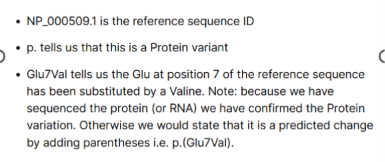

What would the sequence be at different levels?

What are the features of MANE Plus?
MANE plus transcripts are additional clinically relevant reference transcripts for genes that have alternative splice transcript isoforms
What are the features of EDS?
COL5A1 encodes two a1 and an a2 chain for collagen V heterotrimer a1,a1,a2
Has two alternatively spliced transcript variants using two mutually exclusive exons which lead to protein isoforms
A which is 70% retains exon 64a
B which is 30% retains 64b

What does this mean?


What does this mean?
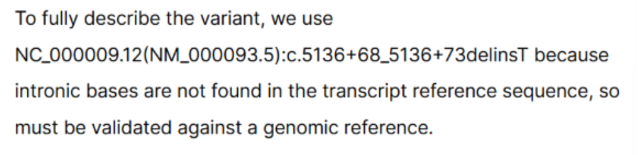
Why might there be no MANE plus transcript?
There is no MANE Plus Clinical transcript because they didn't know which sequence was clinically relevant