Chapter 3.5: The Function of a Protein Is Determined by Its Structure
 Call Kai
 Learn
 Practice Test
 Spaced Repetition
 Match
 Flashcards
 Knowt Play
1/35

36 Terms
Enzymes
Catalytic molecules that increase the rate of biochemical reactions by lowering the activation energy needed
These can bind to reactants to participate in the reaction yet maintain their chemical form
Generally specialized to bind to only one or a few closely related reactants in one reaction
Produced and regulated according to needs of environment and system
Structural and motor proteins
Proteins that provide physical stability and enable movement in the cell
Signal and regulatory proteins
Proteins that control the rates of numerous biological processes
Receptor proteins
Proteins that receive and respond to molecular signals from inside and outside the organism
Protein bonding
This occurs at specific sites on the protein determined by its three-dimensional shape, where side chains bond with molecules or ions

Ligand
A molecule or ion that binds to another molecule, like a protein, through numerous weak bonds that determine binding affinity
Addition of these can cause conformational changes which affect protein functions
Binding affinity
The interaction strength between a ligand and protein molecule
Conformational change
A change in the shape of a protein following the binding of a ligand, affecting its function

Side chain modification (R group modification)
Protein structure modifications through amino acid and chemical group bonds

Cofactor
An additional molecule that some proteins require to function, varying in bond strength either for tight or loose bonds
Seen with ATP as it is converted to and from ADP

Prosthetic groups
Cofactors that are tightly bound to a protein with covalent bonds

Coenzymes
Cofactors that are loosely bound to enzymes

Proteolysis
The breaking apart of a bond in a protein for a change in activation state as needed
Reaction rate
This can be affected by temperature, concentrations, free energy, and activation energy
Activation energy (Ea)
The energy needed to successfully start and complete a reaction
This can be met with higher temperatures or molecular reorganization for higher interaction likelihood
Most common way of meeting this in living systems is lowering it via enzymes

Catalysis
The ability to increase reaction rates without chemical changes; enzymes can do this repeatedly and rapidly up to a 103 to 108 speedup
Substrates
The reactants in an enzyme-catalyzed reaction
Active site
The site on the enzyme where specific substrate molecules bind
Typically only a small part of the protein
Relies on hydrogen bonds, van der Waals interactions, and charged groups for binding

Conformation
The three-dimensional shape of an enzyme
With its chemical properties, one enzyme is made to be highly specific
This may change during a reaction as an example of induced fit
Enzyme-substrate complex (ES)
This is created by the binding of substrates to the active site of an enzyme, held together by chemical bonds, in order to give rise to products

Induced strain
Method of inducing change through an enzyme by stretching bonds in the substrate, making them easier to break with greater potential energy
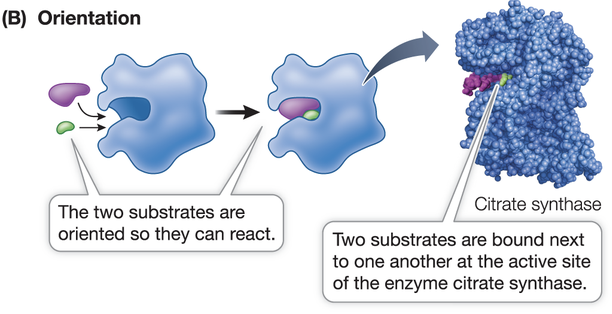
Substrate orientation
Method of inducing change through an enzyme by orienting two substrates to facilitate reactions
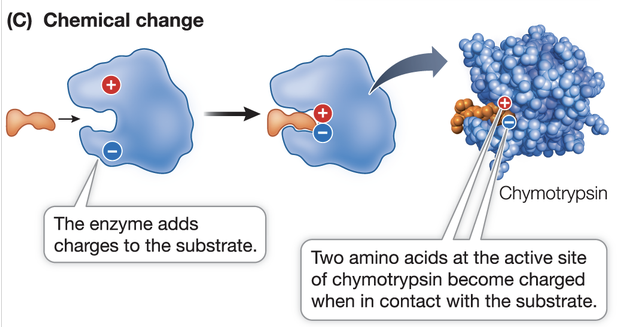
Chemical modification
Method of inducing change via an enzyme via the involvement of the side chains (R groups) in the reaction for manipulation of products

Metabolic pathway
A series of reactions in which the product of one reaction is a substrate for the next for the breakdown or synthesis of molecules
Catabolic pathway
A metabolic pathway that breaks down molecules and releases energy
Anabolic pathway
A metabolic pathway that synthesizes molecules from simpler ones, building up potential energy
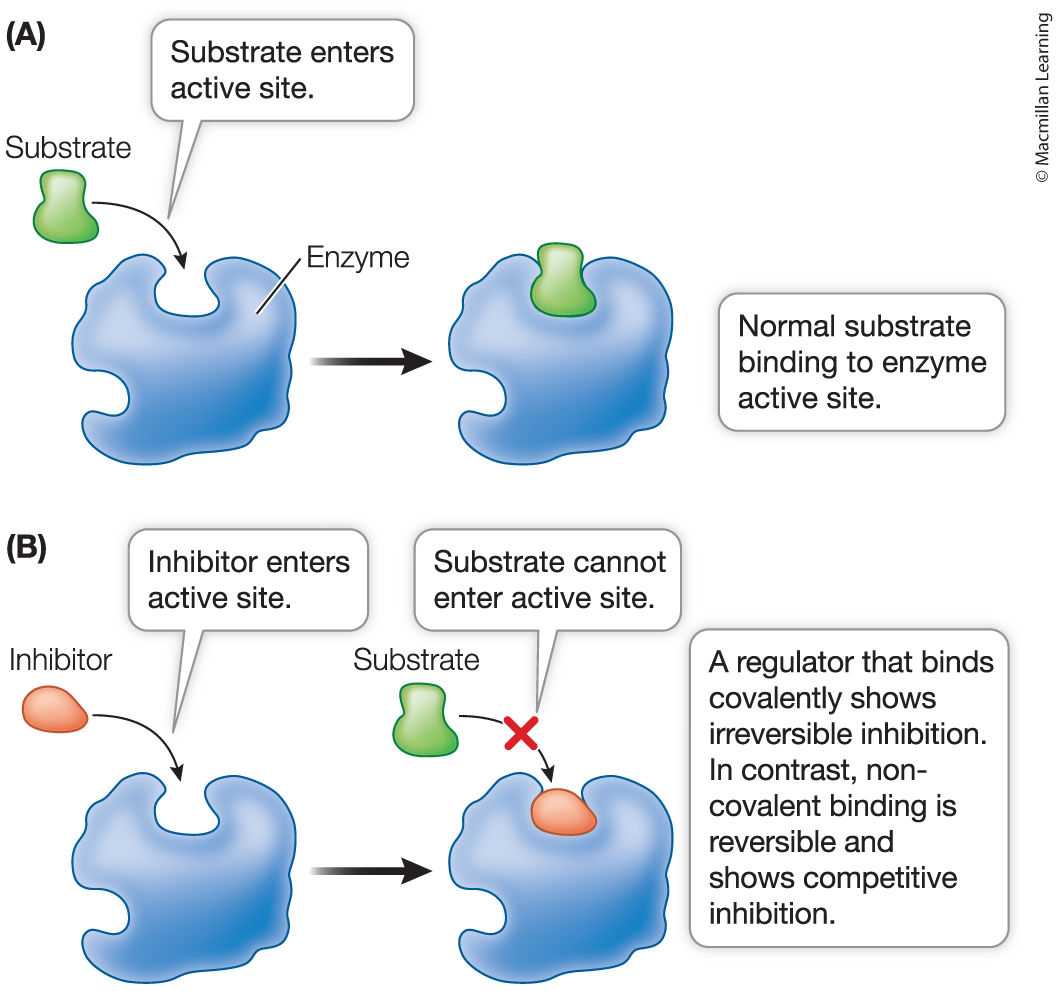
Inhibitor
A molecule that prevents the entry of a molecule into the active site, lowering the rate of reaction
Irreversible inhibition
When an inhibitor covalently binds to an active site of an enzyme and fails to leave, disabling the enzyme
Rare in nature but used in medicines
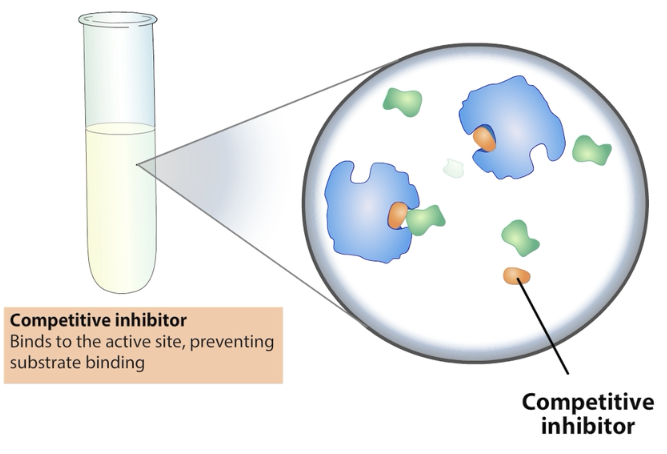
Competitive inhibitor
An inhibitor of an enzyme that binds to the active site and prevents substrate binding normally, decreasing the rate of reaction as none occur
These are reversible and can be countered with greater substrate concentration

Uncompetitive inhibitor
An inhibitor of an enzyme that binds to the complete enzyme-substrate complex, preventing the release of products
Cannot be countered with greater substrate concentration due to attraction to already-bound enzyme
Can be unbound, allowing for occasional formation of products

Noncompetitive inhibitor
An inhibitor of an enzyme that binds outside of the active site, changing the enzyme structure so that normal binding cannot occur
Cannot be countered with greater substrate concentration due to attraction to enzyme itself (requires greater enzyme concentration)
Can be unbound with reversible effects
Is a type of allosteric regulation
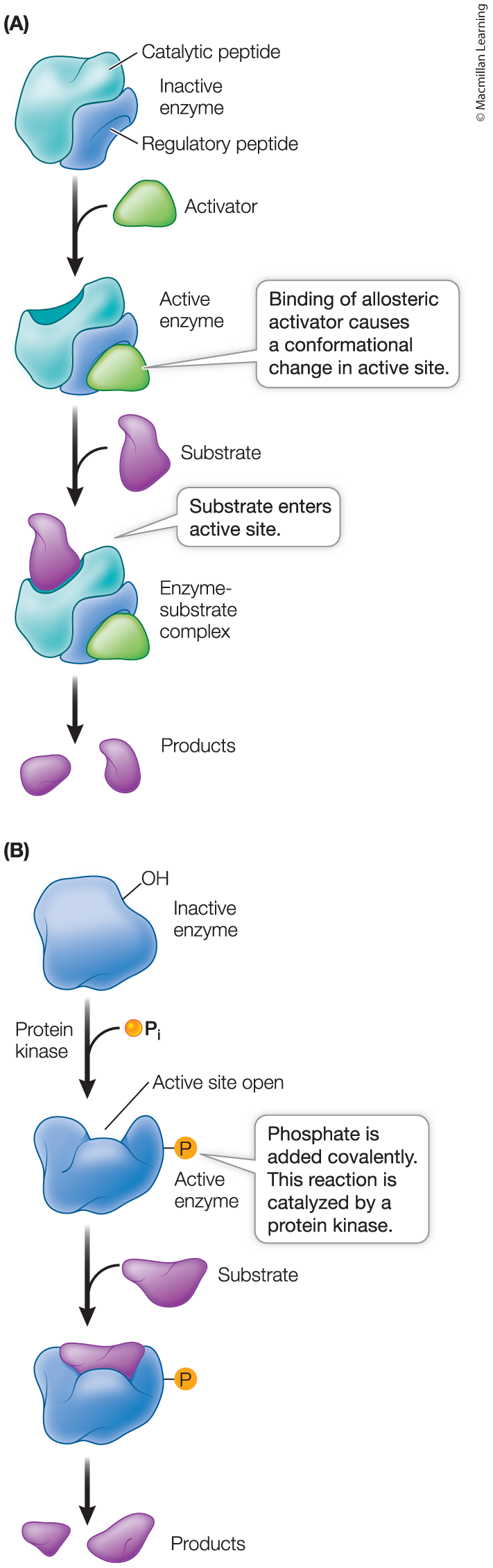
Allosteric regulation
Type of regulation where molecules bind to an enzyme outside of the active site and modify the enzyme’s shape, allowing for a change in activity
This can be done non-covalently and reversibly
Seen with noncompetitive inhibitors
Allosteric site
The binding location of molecules involved in the allosteric regulation of enzymes
These are typically on different peptides of the protein
Phosphorylation
The process of modifying an amino acid by the addition of a phosphate group
Can induce changes like increased hydrophilicity
Is reversible
Kinase
A class of enzymes that catalyzes the addition of phosphate groups to proteins
Phosphatase
A class of enzymes that catalyzes the removal of phosphate groups from proteins