L6 Nervous system structure and resting membrane potential

0.0(0)
Studied by 0 people
call kaiCall Kai
learnLearn
examPractice Test
spaced repetitionSpaced Repetition
heart puzzleMatch
flashcardsFlashcards
GameKnowt Play
Card Sorting

1/35

encourage image

There's no tags or description

Looks like no tags are added yet.

36 Terms

1
New cards

Nervous system

  • Electrical signals, called action potientals in neurons

  • Immediate changes

  • Fast response


2
New cards

Central nervous system (CNS)

  • brain

  • spinal cord


3
New cards

Peripheral nervous system (PNS)

  • Sensory neurons

  • Effector neurons

    • Somatic nervous system

    • Autonomic nervous system


4
New cards

Information flow in the nervous system

knowt flashcard image
5
New cards

Stimulus

perceived by the receptor

6
New cards

Sensory neuron

Carries the sensory information to the CNS

  • Sensory information is carried in the form of an electrical signal, called an action potential


7
New cards

CNS

integrated the infromation and determine if a response is needed

8
New cards

Efferent neuron

stimulates muscles or glands

  • motor neuron: skeletal muscle

  • autonomic neuron: glands, cardiac, and smooth muscle


9
New cards

Effector

organ elicits a response

10
New cards
  1. Neurons


handle information ( functional unit of the nervous system)

11
New cards
  1. Glial cells


supporting cells of the nervous system

  • holds neurons together in specfic ways

  • provide the neurons with an optimal enviroment


12
New cards

Structure of the neuron

knowt flashcard image
13
New cards

Cell body

nucleus and organelles

14
New cards

Dendrites

  • Processes extending from the cell body

  • Receptive part of the neuron


15
New cards

Axon

long process that carries information

16
New cards

Axon hillock or trigger zone

action potential starts

17
New cards

Synaptic terminals

  • swellings of the end of the axon

  • vesicles with neurontransmitters


18
New cards

Neurotransmitters

chemical signal used for cell-to-cell communication


19
New cards

Sensory neuron

  • Carry sensory information

    • body→ CNS

  • Cell body outside the CNS


<ul><li><p>Carry sensory information </p><ul><li><p>body→ CNS </p></li></ul></li><li><p>Cell body outside the CNS</p></li></ul><p></p>
20
New cards

Interneuron

  • communication between neurons

  • Within the CNS


<ul><li><p>communication between neurons </p></li><li><p>Within the CNS</p></li></ul><p></p>
21
New cards

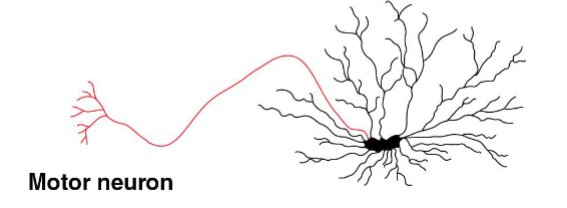
Motor neuron

  • Carry efferent information to an effector

    • CNS→body

  • Cell body located in the CNS


<ul><li><p>Carry efferent information to an effector</p><ul><li><p>CNS→body</p></li></ul></li><li><p>Cell body located in the CNS</p></li></ul><p></p>
22
New cards

Satellite cells (PNS)

Maintain the enviroment of neurons (O2 nutrients)

<p>Maintain the enviroment of neurons (O2 nutrients)</p>
23
New cards

Schwann cells (PNS)

  • Surround axons

  • myelination


<ul><li><p>Surround axons </p></li><li><p>myelination </p></li></ul><p></p>
24
New cards

Ependymal cells (CNS)

monitor and circulates CSF

<p>monitor and circulates CSF</p>
25
New cards

Oligodendrocytes (CNS)

Myelinate CNS axons
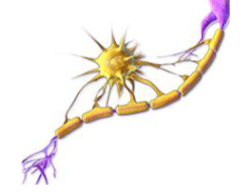
<p>Myelinate CNS axons </p>
26
New cards

Astrocytes (CNS)

Maintain blood-brain barrier

<p>Maintain blood-brain barrier</p>
27
New cards

Microglia ( CNS)

Remove wastes and pathogens

<p>Remove wastes and pathogens</p>
28
New cards

How does a neuron transmit information

  1. Recieve information through dendrites

  2. Transmit the electrical signal or action potential along the axon

  3. Transmit the information to other cells through synapses


<ol><li><p>Recieve information through dendrites </p></li><li><p>Transmit the electrical signal or action potential along the axon</p></li><li><p>Transmit the information to other cells through synapses</p></li></ol><p></p>
29
New cards

How is the electrical signal generated?

Our cells are already electrically charged

  • The resting cell is negative inside, relative to the outside

  • Uneven distribution of ions across the cell membrane ( difference in the electrical potential between the inside and outside of the cell)

  • Na+-K+ ATP pump and different permeabilities of the cell membrane to different ions ( number of the specific ion channels)


<p>Our cells are already electrically charged </p><ul><li><p>The resting cell is negative inside, relative to the outside </p></li><li><p>Uneven distribution of ions across the cell membrane ( difference in the electrical potential between the inside and outside of the cell)</p></li><li><p>Na+-K+ ATP pump and different permeabilities of the cell membrane to different ions ( number of the specific ion channels) </p></li></ul><p></p>
30
New cards

Resting membrane potential

RMP (Vrest)= Vm inside - Vm outside

Vrest~ -70 mV

Vm: membrane potential

31
New cards

Ways ions cross the cell membrane : Channels

  • Selective for certain ions

  • Passive transport, no ATP needed

  • Ions move down a concentration gradient

  • Fast


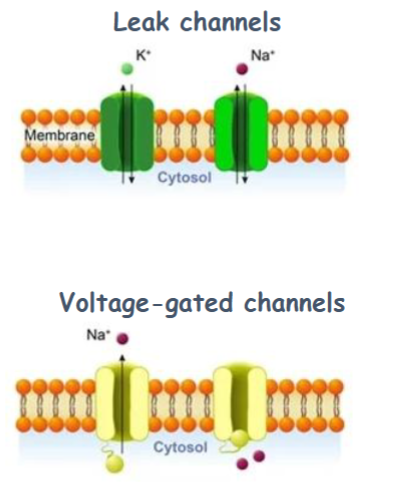
Leak channels: always open

  • K+ leak channels

  • Na+ leak channels


Voltage-gated channel: opens with change in the membrane potential (electrical difference across the membrane)

  • Voltage-gated Na+ channel

  • Voltage-gated K+ channel


<ul><li><p>Selective for certain ions </p></li><li><p>Passive transport, <strong>no ATP needed</strong></p></li><li><p>Ions move down <strong>a concentration gradient </strong></p></li><li><p><strong>Fast</strong></p></li></ul><p></p><p>Leak channels: always open </p><ul><li><p>K+ leak channels </p></li><li><p>Na+ leak channels </p></li></ul><p></p><p>Voltage-gated channel: opens with change in the membrane potential (electrical difference across the membrane) </p><ul><li><p>Voltage-gated Na+ channel </p></li><li><p>Voltage-gated K+ channel</p></li></ul><p></p>
32
New cards

Ways ions cross the cell membrane : Ion pumps

Ion pumps

  • Selective for certain ions

  • Active transport; needs ATP

  • Slow

  • Creates concentration gradients by moving ions against their gradients


Na+-K+ ATP pump

  • Moves 3 Na+ ions out of the cell and 2 K+ ions into the cell


<p>Ion pumps </p><ul><li><p>Selective for certain ions </p></li><li><p>Active transport; needs ATP</p></li><li><p>Slow </p></li><li><p>Creates concentration gradients by moving ions against their gradients </p></li></ul><p></p><p>Na+-K+ ATP pump </p><ul><li><p>Moves 3 Na+ ions out of the cell and 2 K+ ions into the cell</p></li><li><p></p></li></ul><p></p>
33
New cards

Resting membrane potential - cell in equilibruim

Assume a cell

  • Distribution of ions (Na+ and K+) is the same inside and outside of the cell

  • The inside and outside of the cell is electrically neutral

  • Na+ and K+ ions are partnered with negatively charged molecules


Na+-K+ ATP pump creates a concentration gradient ( and a small electrical gradient)

  1. Concentration gradient

  2. Electric gradient


<p>Assume a cell</p><ul><li><p>Distribution of ions (Na+ and K+) is the same inside and outside of the cell </p></li><li><p>The inside and outside of the cell is electrically neutral </p></li><li><p>Na+ and K+ ions are partnered with negatively charged molecules </p></li></ul><p></p><p>Na+-K+ ATP pump creates a concentration gradient ( and a small electrical gradient) </p><ol><li><p>Concentration gradient </p></li><li><p>Electric gradient </p></li></ol><p></p>
34
New cards

Resting membrane potential - insert a pump

  • Na+-K ATP pump on the cell membrane

  • Na+-K ATP pump moves 3 Na+ out of the cell and 2 K+ into the cell ( against a concentration gradient)

  • Creates a concentration ( chemical) gradient

    • More Na+-→ outside

    • More K+→ inside

  • Creates an electric gradient (small)


<ul><li><p>Na+-K ATP pump on the cell membrane</p></li><li><p>Na+-K ATP pump moves 3 Na+ out of the cell and 2 K+ into the cell ( against a concentration gradient) </p></li><li><p>Creates a concentration ( chemical) gradient </p><ul><li><p>More Na+-→ outside </p></li><li><p>More K+→ inside </p></li></ul></li><li><p>Creates an electric gradient (small)</p></li></ul><p></p>
35
New cards

Resting membrane potential- Role of K+

  • The cell membrane has LOTS of K+ leak channels (very permeable)

  • K+ diffuses out of the cell down its concentration gradient

  • As K+ leaves the cell, it leaves its negative partners behind

The cell becomes more negative than the outside


<ul><li><p>The cell membrane has LOTS of K+ leak channels (very permeable) </p></li><li><p>K+ diffuses out of the cell down its concentration gradient </p></li><li><p>As K+ leaves the cell, it leaves its negative partners behind </p></li></ul><p>The cell becomes more negative than the outside</p><p></p><p></p>
36
New cards

Resting membrane potential- Role of Na+

  • The cell membrane has fewer Na+ leak channels (less permeable)

  • Na+ diffuses into cell down its concentration gradient

  • As Na+ enters the cellm its the cell a bit less negative


<ul><li><p>The cell membrane has fewer Na+ leak channels (less permeable)</p></li><li><p>Na+ diffuses into cell down its concentration gradient </p></li><li><p>As Na+ enters the cellm its the cell a bit less negative </p></li></ul><p></p>