A&P Lab 9
 Call Kai
 Learn
 Practice Test
 Spaced Repetition
 Match
 Flashcards
 Knowt Play
1/84

There's no tags or description
Looks like no tags are added yet.
85 Terms
What are the axial and appendicular skeletons?
Axial: central axis (skull, vertebral column, thoracic cage)
Appendicular: limbs and their girdles

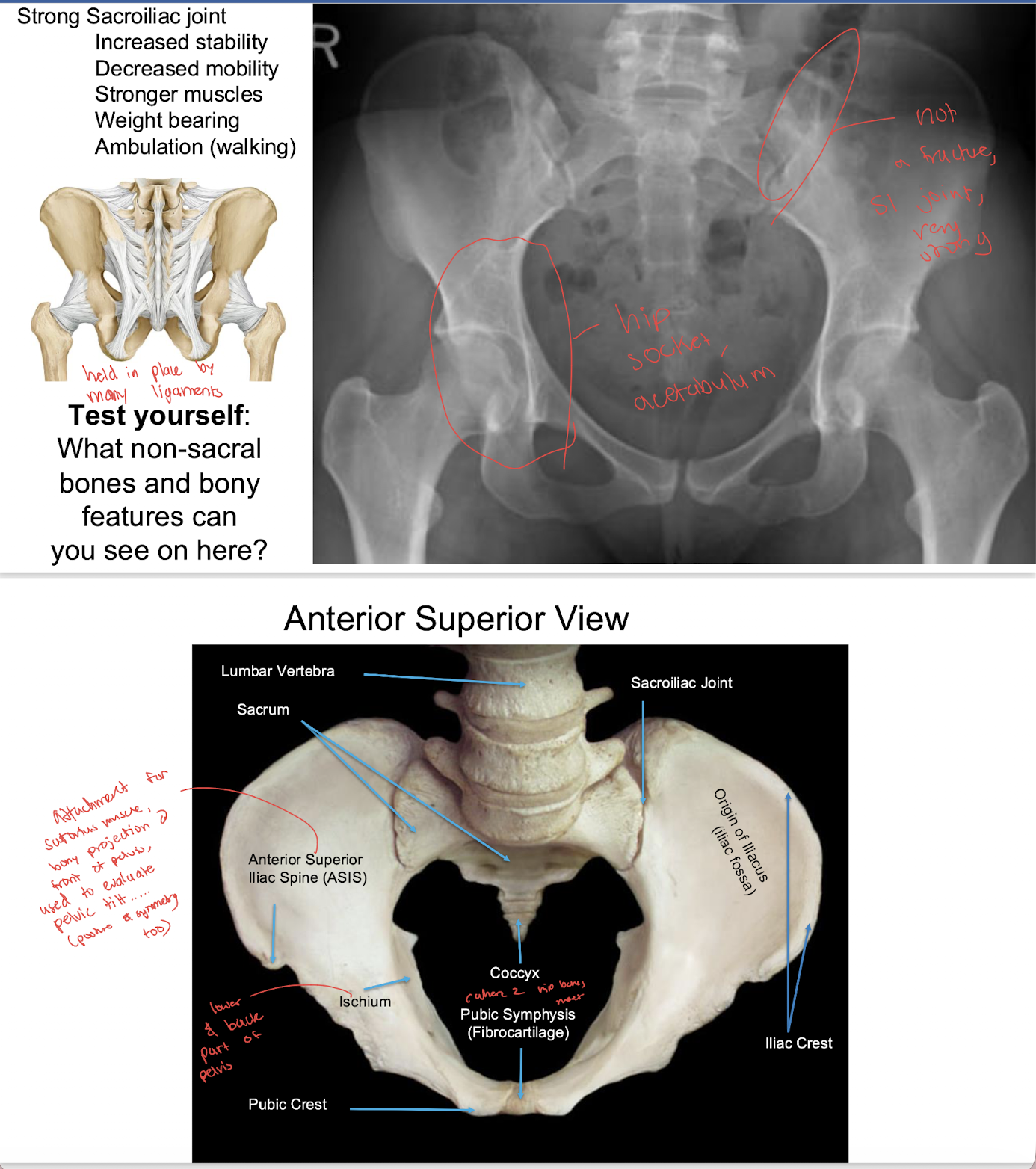
What are the acetabulum and obturator foramen?
Acetabulum: socket for the femoral head
Obturator foramen: large opening formed by the pubis and ischium

What are the pubic symphysis and sacroiliac joint?
Pubic symphysis: fibrocartilaginous joint between pubic bones.
Sacroiliac joint: joint between sacrum and ilium that transfers weight
Condyle
rounded joint projection
Facet
flat joint surface
Fossa
shallow depression
Crest
prominent ridge
Process
bony projection
Trochanter
large femoral projection
Tuberosity
large, often rough projection
Foramen
opening through bone
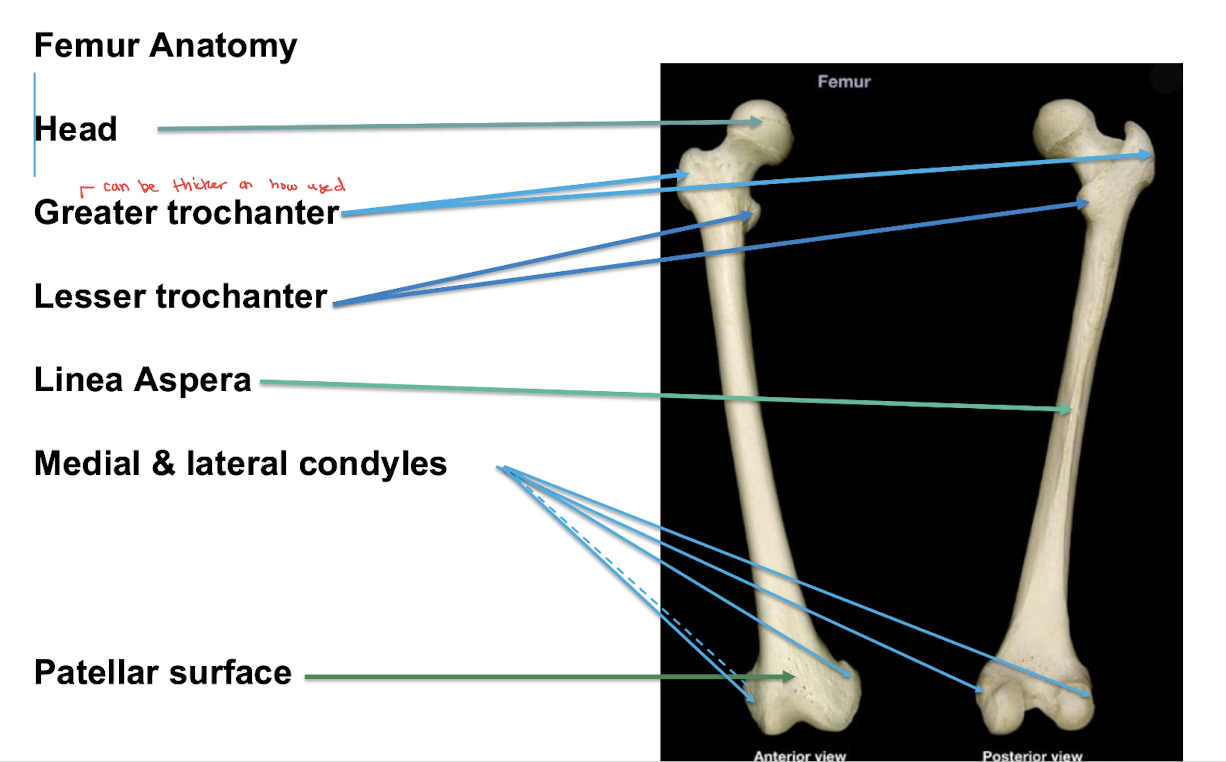
What are the major femoral landmarks, and why is the linea aspera important?
Head, greater and lesser trochanters, linea aspera, medial and lateral condyles, and patellar surface
The linea aspera is a prominent ridge on the posterior femur that serves as an attachment site for multiple muscles, including the vastus medialis and adductor magnus

What are the major tibial landmarks?
Medial and lateral condyles, tibial tuberosity, and medial malleolus

What are the major fibular landmarks?
Head, shaft, and lateral malleolus

How do you identify left versus right os coxae?
acetabulum faces laterally
How do you identify left versus right femur?
head faces medially, patellar surface anteriorly, and linea aspera posteriorly
How do you identify left versus right tibia?
tibial tuberosity faces anteriorly and medial malleolus faces medially

How do you orient the fibula?
Head is proximal; lateral malleolus is distal
fibula lies lateral to the tibia

How many bones are in one foot?
7 tarsals, 5 metatarsals, and 14 phalanges
26 total

What are the talus and calcaneus?
Talus: articulates with tibia and fibula at the ankle
Calcaneus: heel bone and insertion site for the Achilles tendon

What are the three structural joint classifications?
Fibrous, cartilaginous, and synovial
What are tendons?
connect muscle to bone
dense regular connective tissue
What are ligaments?
connect bone to bone
dense regular connective tissue
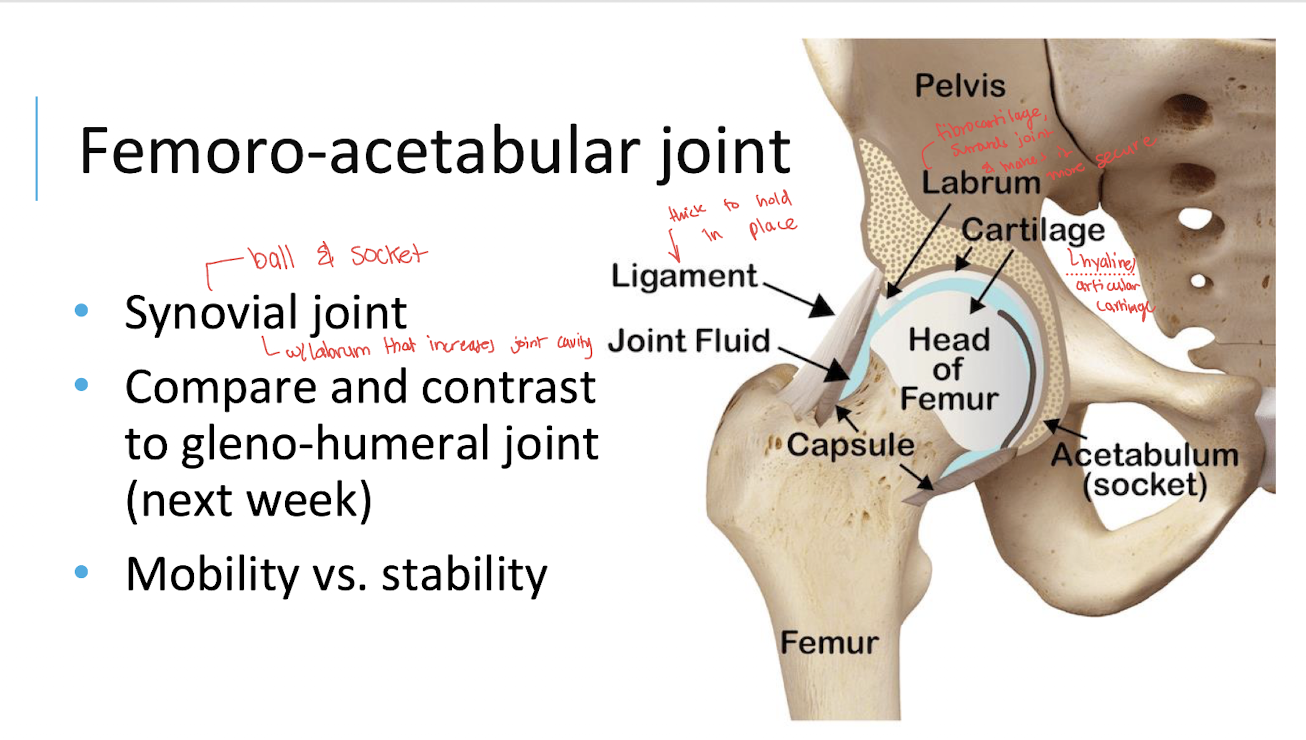
What are the hip joint's articulating bones, subclass?
Femoral head + acetabulum
synovial ball-and-socket
What are the hip joint's actions?
flexion, extension, abduction, adduction, rotation, and circumduction

What are the tibiofemoral joint's articulating bones and subclass?
Femur + tibia
synovial modified hinge

What are the patellofemoral joint's articulating bones and subclass?
Patella + femur
synovial gliding

What are the collective actions of the knee region?
Flexion and extension, with some rotation at the tibiofemoral joint
What are the talocrural joint's bones, subclass?
Tibia, fibula, and talus
synovial true hinge

What are the talocrural joint's actions?
dorsiflexion and plantar flexion

What are the distal tibiofibular joint's classification and functional subclass?
Fibrous syndesmosis; amphiarthrosis (slightly movable).

What is the interosseous membrane, where is it located, and why is it important?
A sheet of fibrous connective tissue connecting the shafts of the tibia and fibula
It helps bind and stabilize the two bones and provides attachment sites for muscles

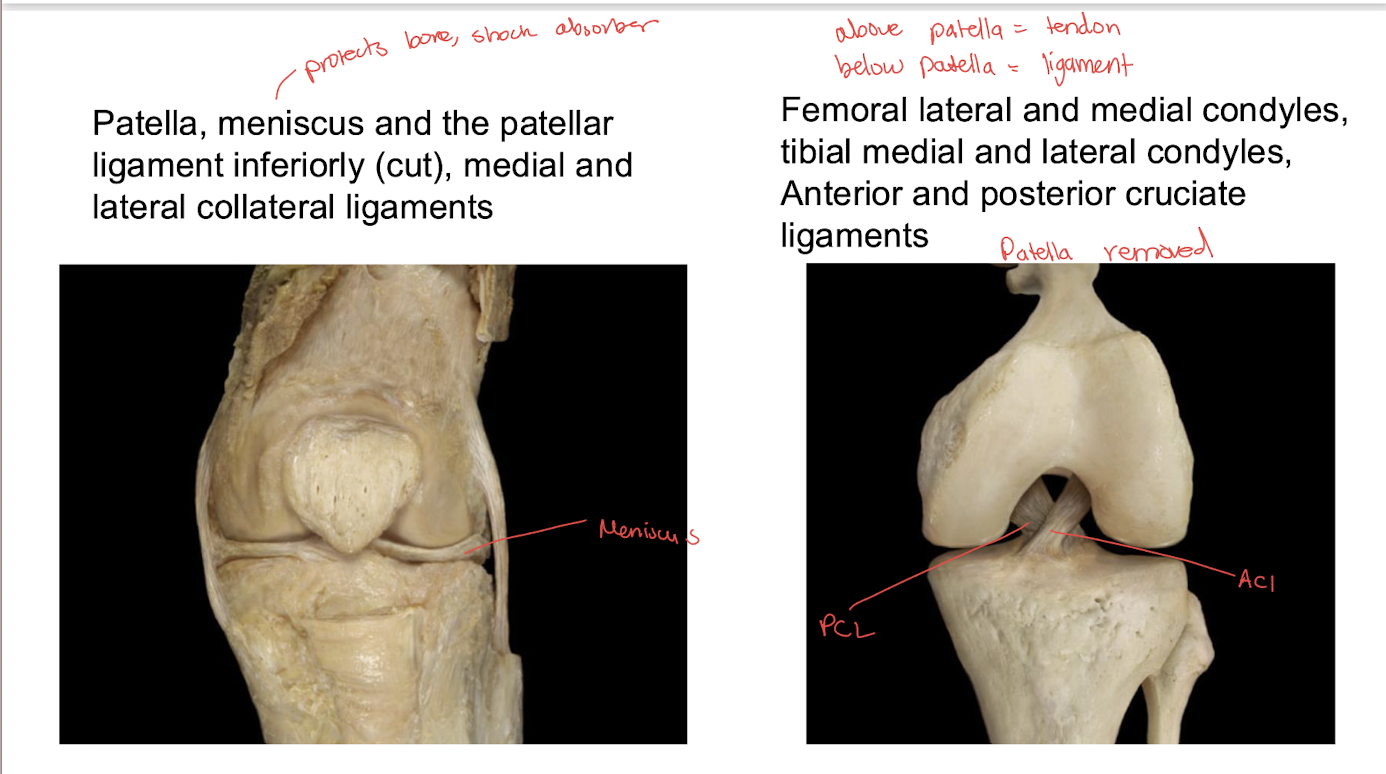
What are the four major knee ligaments?
Tibial (medial) collateral
fibular (lateral) collateral
anterior cruciate (ACL)
posterior cruciate (PCL)
What do the collateral ligaments stabilize?
Tibial collateral: medial knee
Fibular collateral: lateral knee
Both are outside the joint capsule

What do the ACL and PCL stabilize?
ACL limits excessive anterior tibial translation
PCL limits excessive posterior tibial translation
They cross within the joint capsule

What are the menisci and their functions?
Medial and lateral C-shaped fibrocartilage structures between femoral and tibial condyles
they stabilize the joint and absorb some shock

What is the difference between the patellar tendon and ligament?
The quadriceps tendon is proximal to the patella
the patellar ligament extends from the patella to the tibial tuberosity

Define muscle origin and insertion
Origin: proximal attachment
Insertion: distal attachment, generally moving toward the origin during contraction
Anterior to the hip axis
flexion of hip
Posterior to hip axis
extension of hip
Posterior to the knee axis
flexion of knee
Anterior to the knee axis
extension of knee
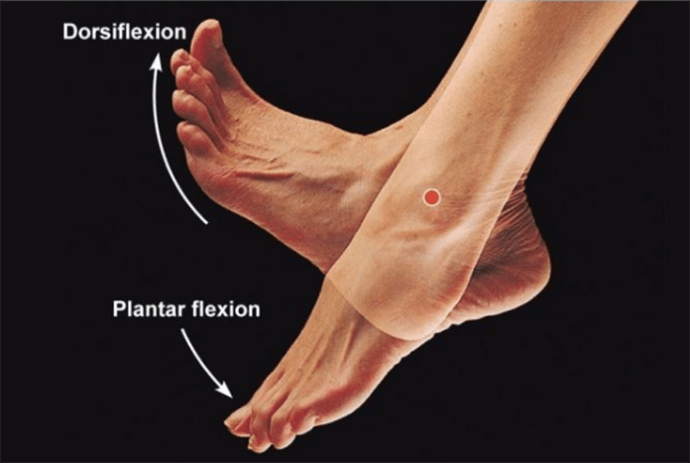
Anterior to ankle axis
dorsiflexion
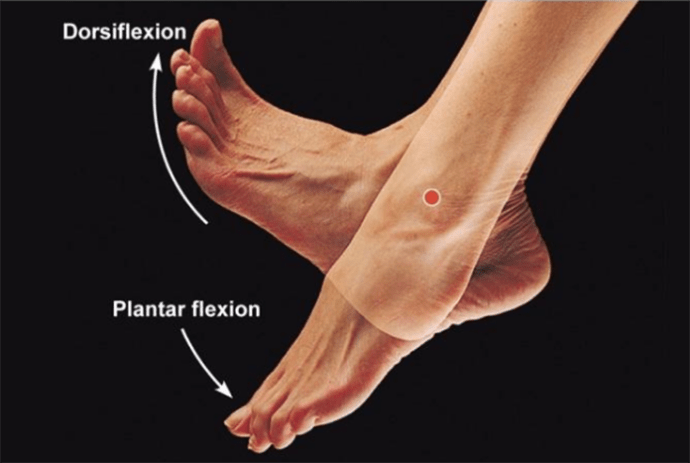
Posterior to ankle axis
plantar flexion
What forms the iliopsoas, and what are its origins?
Iliacus originates on the ilium
psoas major originates on lumbar vertebrae
both insert on lesser trochanter
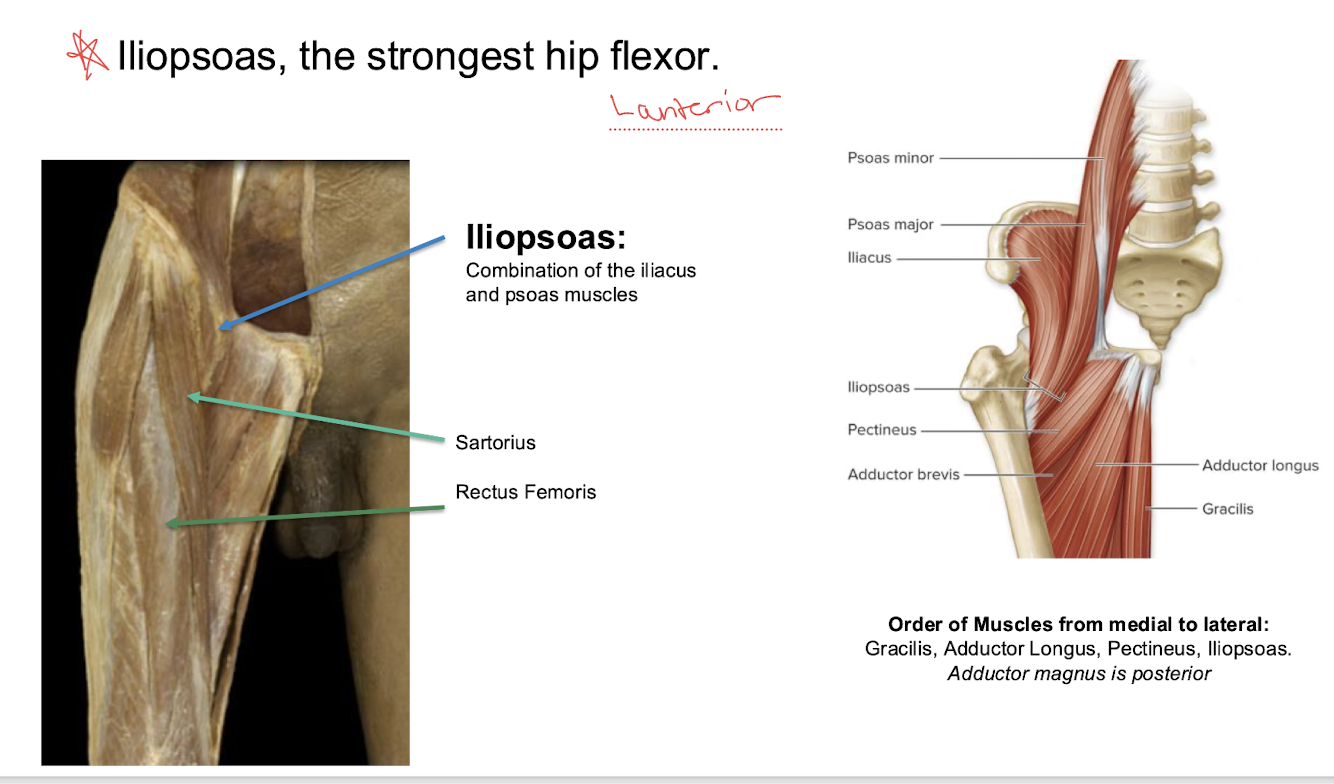
Primary action of iliopsoas?
hip flexion
strongest hip flexor

What are the sartorius's origin, insertion, and actions?
ASIS (Anterior Superior Iliac Spine)
medial proximal tibia
hip flexion and knee flexion


What are the rectus femoris's origin, insertion, and actions?
Pelvis (AIIS) (Anterior Inferior Iliac Spine)
patella/patellar ligament to tibial tuberosity
hip flexion and knee extension
What are the vastus lateralis's origin, insertion, and action?
Femur (origin) → patellar ligament to tibial tuberosity (= insertion)
knee extension

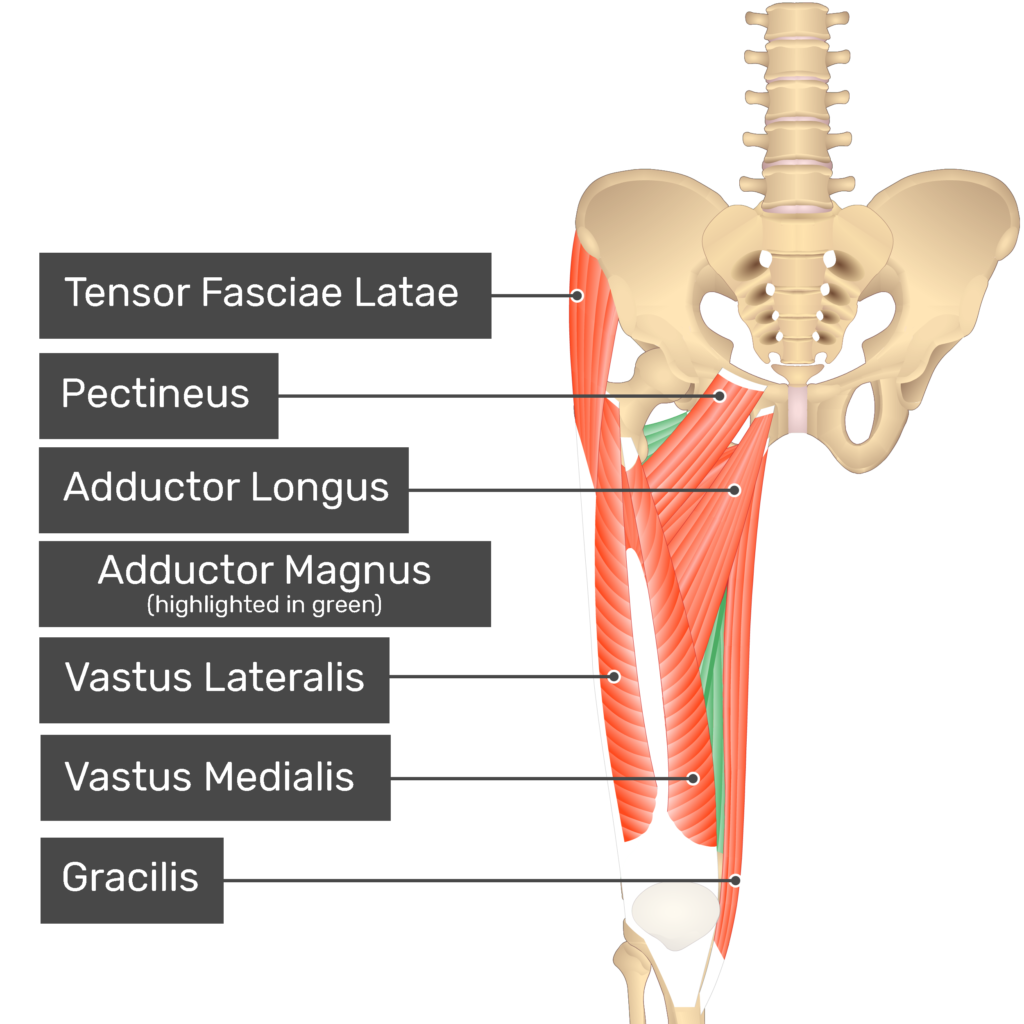
What are the vastus medialis's origin, insertion, and action?
Femur, including linea aspera (origin) → patella/patellar ligament to tibial tuberosity (= insertion)
knee extension

What are the vastus intermedius's origin, insertion, and action?
Femur (origin) → patella/patellar ligament to tibial tuberosity (= insertion)
knee extension

What are the four quadriceps muscles?
Rectus femoris, vastus lateralis, vastus medialis, and vastus intermedius

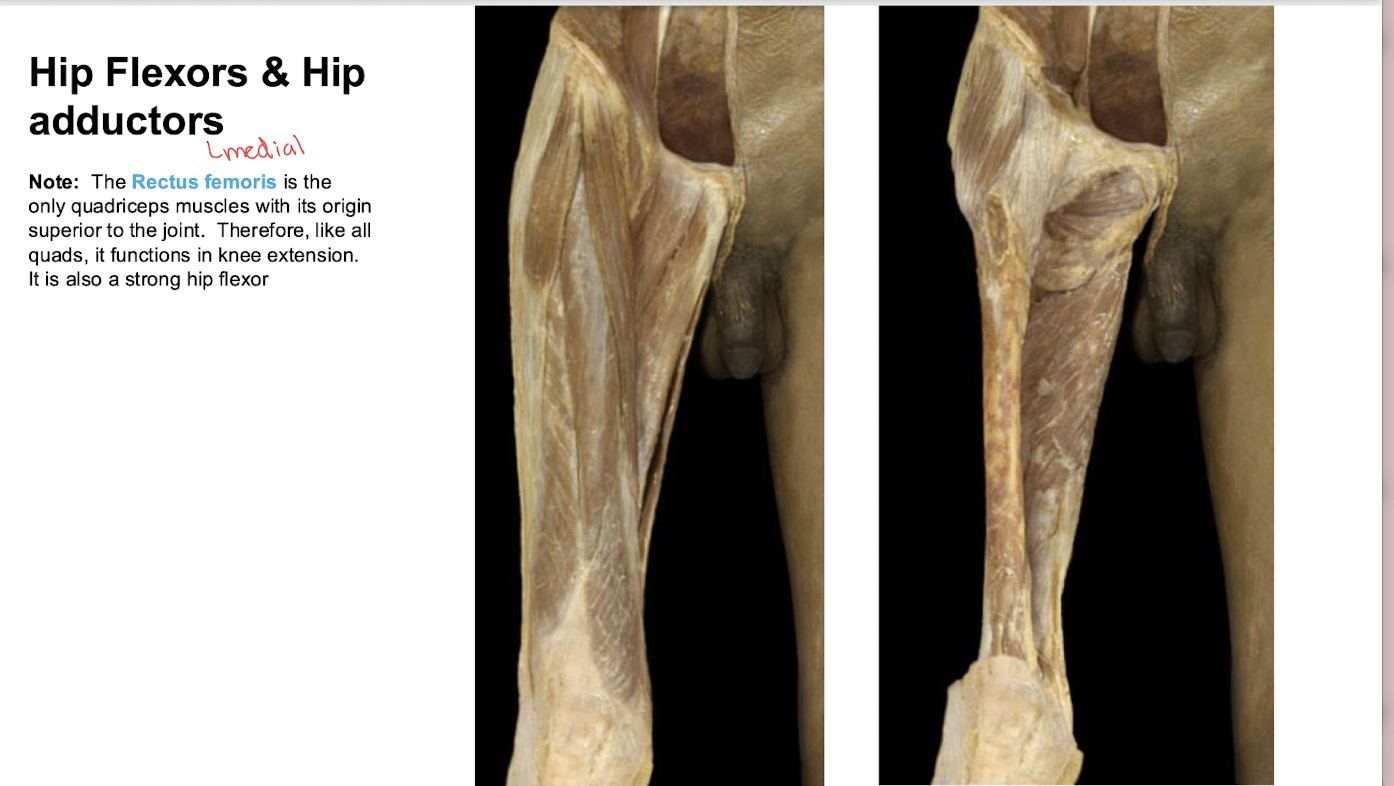
Which quadriceps muscle crosses two joints, and why?
Rectus femoris
it originates on the pelvis and crosses both hip and knee
assisting in hip flexion & lower leg extension
What are the adductor longus's origin, insertion, and action?
Pubis (origin) → femur along linea aspera (insertion)
hip adduction

What are the adductor magnus's origin, insertion, and actions?
Pubis and ischium (origin) → femur, including linea aspera (insertion)
hip adduction and assistance with hip extension

What are the pectineus's origin, insertion, and actions?
Pubis (origin) → proximal femur (insertion)
hip adduction and assistance with flexion

What are the gracilis's origin, insertion, and actions?
Pubis (origin) → medial proximal tibia (insertion)
hip adduction and knee flexion

What is the order of these muscles from medial to lateral in the lecture?
Gracilis, adductor longus (then technically adductor brevis but dont worry abt that one), pectineus, iliopsoas. Adductor magnus is posterior

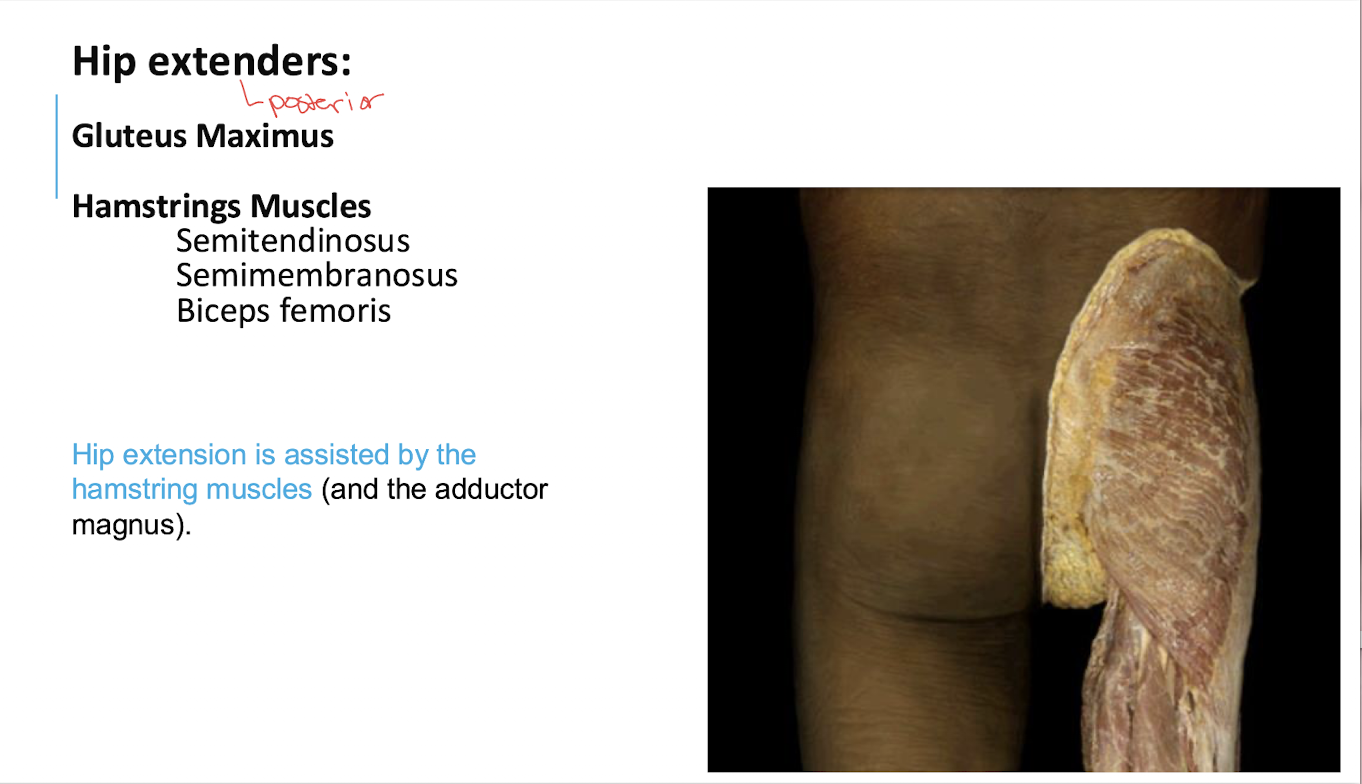
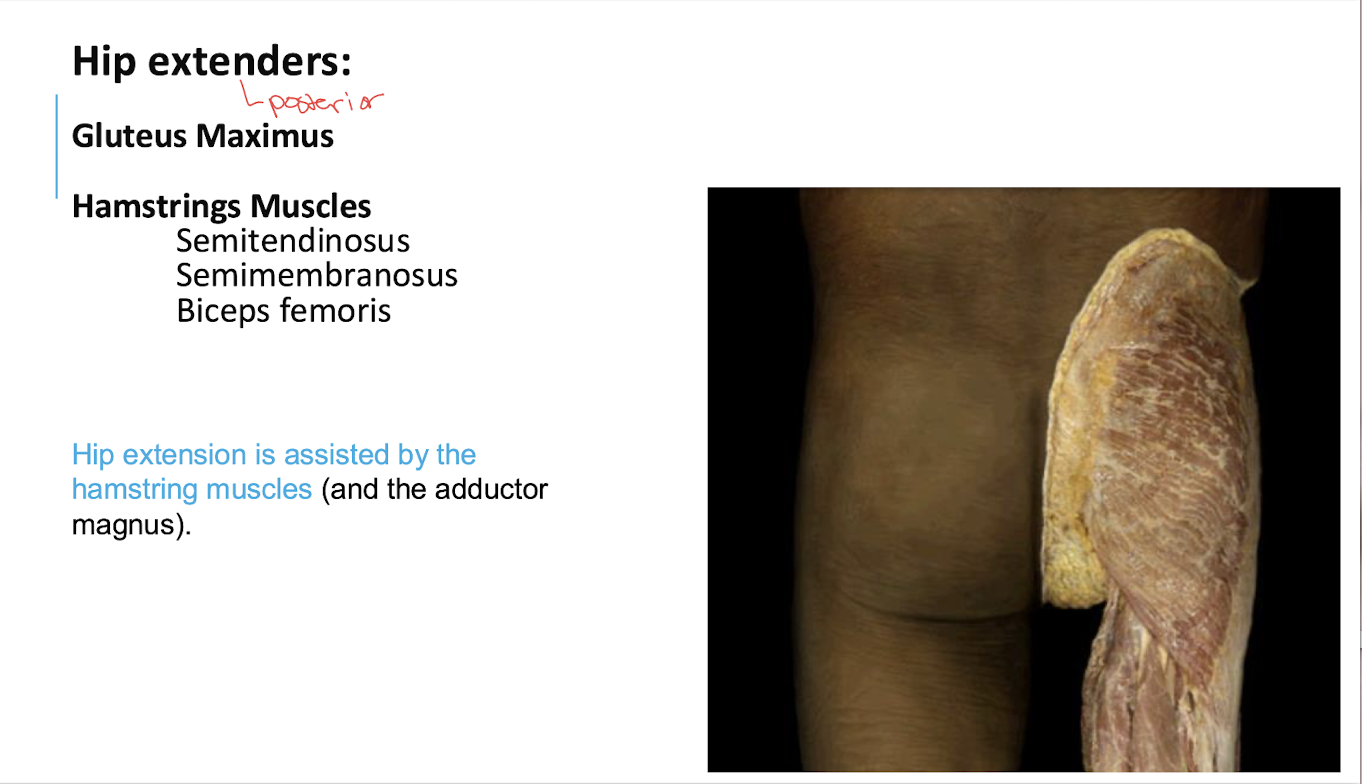
What are the gluteus maximus's origin, insertion, and action?
Posterior pelvis (origin) → femur and iliotibial tract (insertion)
hip extension

What are the gluteus medius's origin, insertion, and action?
Ilium (origin) → greater trochanter (insertion)
hip abduction and pelvic stabilization
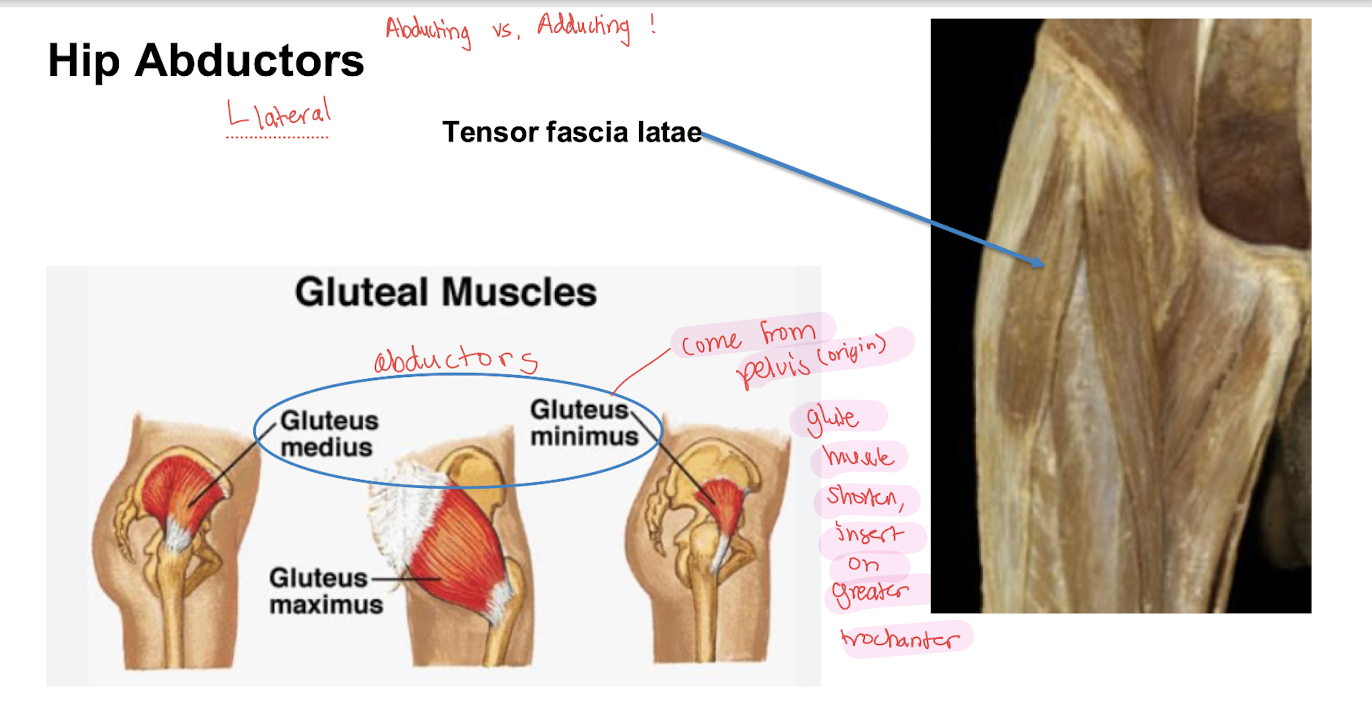
What are the tensor fasciae latae's origin, insertion, and actions?
Ilium near ASIS/iliac crest → iliotibial band; assists hip flexion, abduction, and IT band tension

What is the iliotibial band?
thickened connective tissue band along the lateral thigh receiving fibers from tensor fasciae latae and gluteus maximus

What are the three hamstring muscles?
Biceps femoris
semitendinosus
semimembranosus

What is the common origin and the action of the hamstrings?
origin = Ischial tuberosity
hip extension and knee flexion
What are the biceps femoris's insertion and actions?
insertion = Head of fibula
knee flexion and hip extension

What are the semitendinosus's insertion and actions?
insertion = Medial proximal tibia
knee flexion and hip extension
What are the semimembranosus's insertion and actions?
insertion = Medial condyle of tibia
knee flexion and hip extension

What are the tibialis anterior's origin, insertion, and actions?
Tibia (origin) → medial cuneiform and first metatarsal (insertion)
dorsiflexion and inversion

What are the extensor digitorum longus's origin, insertion, and actions?
Tibia/fibula (origin) → toes 2–5 (insertion)
toe extension and ankle dorsiflexion

What are the fibularis longus's origin, insertion, and actions?
Proximal fibula (origin) → first metatarsal and medial cuneiform (insertion)
eversion and assistance with plantar flexion
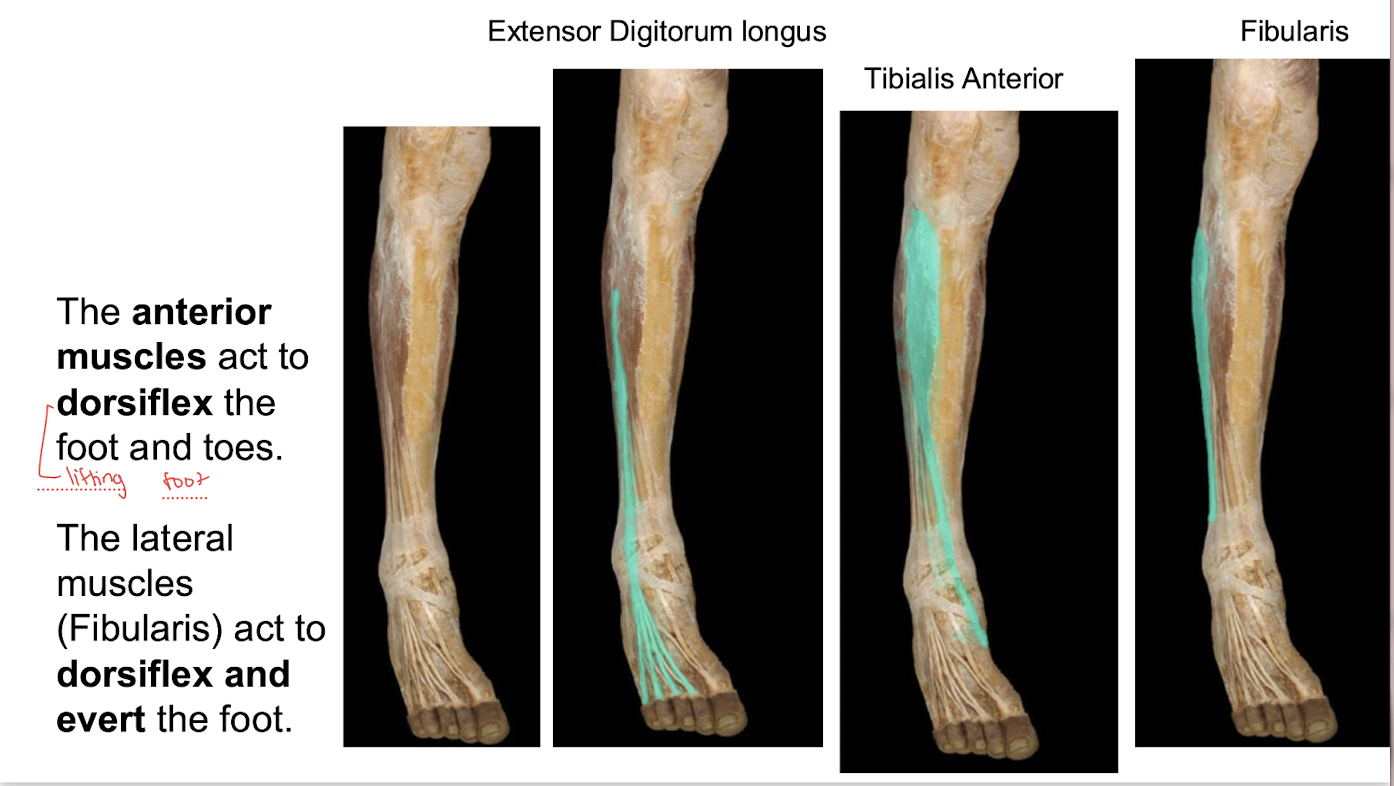
What are the fibularis brevis's origin, insertion, and actions?
Distal fibula (origin) → fifth metatarsal (insertion)
eversion and assistance with plantar flexion

What are the general actions of the anterior leg compartment?
Dorsiflexion of the foot and extension of the toes

What are the general actions of the lateral leg compartment?
Eversion and assistance with plantar flexion; the lecture also lists dorsiflexion for the lateral compartment

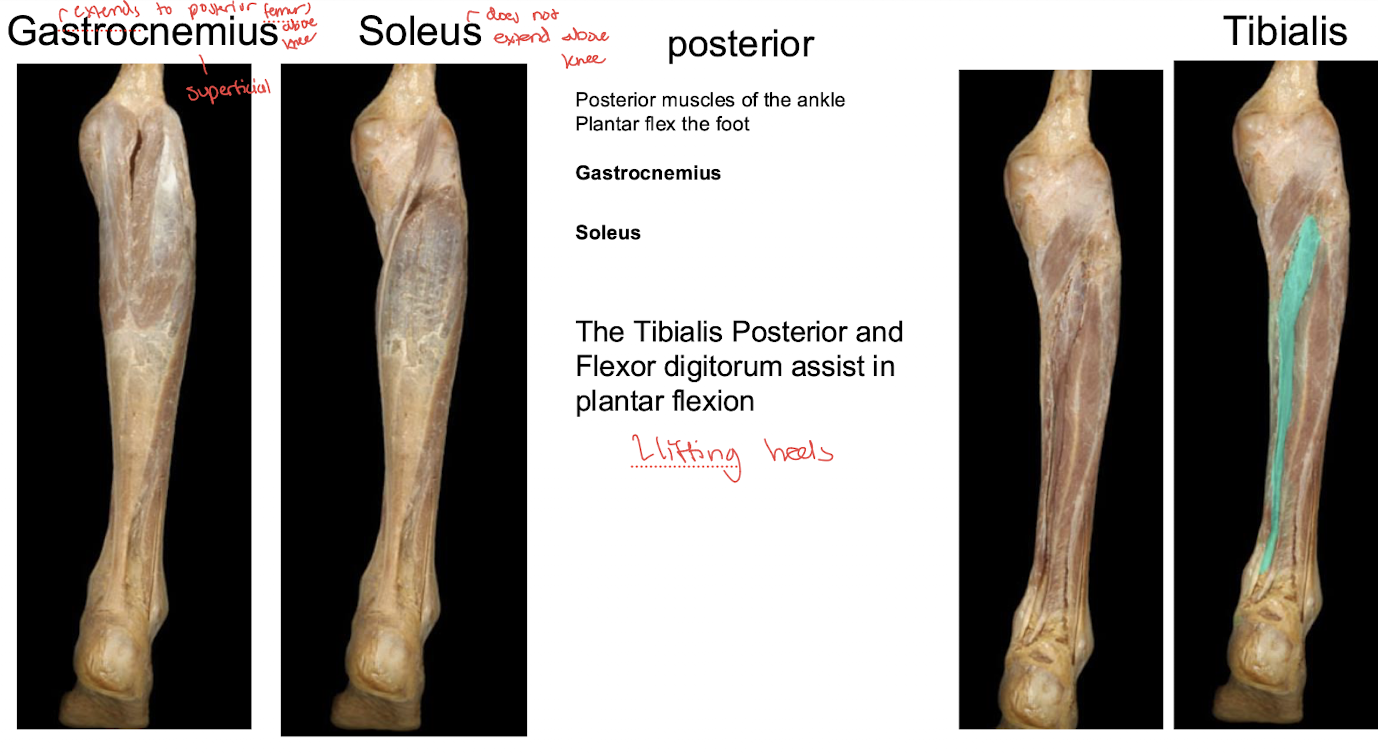
What are the gastrocnemius's origin, insertion, and actions?
Femur (origin) → calcaneus via Achilles tendon (insertion)
plantar flexion and knee flexion

What are the soleus's origin, insertion, and action?
Tibia/fibula (origin) → calcaneus via Achilles tendon (insertion)
plantar flexion

Why does the gastrocnemius act at two joints but the soleus does not?
Gastrocnemius crosses the knee and ankle
soleus crosses only the ankle

What are the flexor digitorum longus's origin, insertion, and actions?
Posterior tibia (origin) → distal phalanges of toes 2–5 (insertion)
toe flexion and assistance with plantar flexion

What are the tibialis posterior's origin, insertion, and actions?
Posterior tibia/fibula (origin) → tarsal and metatarsal bones (insertion) mainly medial foot
inversion and assistance with plantar flexion

Which muscles insert on the calcaneus through the Achilles tendon?
Gastrocnemius and soleus
Which muscles share the ischial tuberosity as their origin?
Semitendinosus, semimembranosus, and biceps femoris (hamstrings)

Name two muscles that attach to the linea aspera.
Vastus medialis (originates there) and adductor magnus (inserts here)
Why can rectus femoris and gastrocnemius each produce actions at two joints?
Each crosses two joints
rectus femoris crosses the hip and knee
gastrocnemius crosses the knee and ankle
If a muscle inserts on the tibia and crosses the knee posteriorly, what action might it produce?
knee flexion
If a muscle inserts on the patella through the quadriceps tendon, what action does it produce?
Knee extension
If a muscle inserts on the calcaneus through the Achilles tendon, what action does it produce at the ankle?
Plantar flexion