Attention
 Call Kai
 Learn
 Practice Test
 Spaced Repetition
 Match
 Flashcards
 Knowt Play
1/27

There's no tags or description
Looks like no tags are added yet.
28 Terms
What is endogenous attention?
Top-down
You decide to attend to a particular source of info
What is exogenous attention?
Something captures your attention without your intention for it to do so
When is over attention used?
When you're looking at something
What is covert attention (shifting)?
Attending to something without making overt indications of that (i.e looking in one direction but attending to something else)
Helmholtz (1866) → developed by James (1890)
Precueing = directing attention without moving the eyes
Posner queueing paradigm
What did Posner (1980) argue about covert attention shifting? What are the weaknesses of this view?
Visual attention = spotlight
Can be directed at portions of the visual field to illuminate targets in its beam
The spotlight of attention could be guided by voluntary internal processes when we want to find something OR reflexively triggered by external events that make us respond
BUT limited analogy → what or who controls the spotlight?
Can’t be a single process in control → evokes the problem of the homunculus
A spotlight suggests that events outside the beam are not detected → selection models show that info isn’t necessarily discarded if it isn’t attended to
BUT this may happen when certain brain regions are damaged → bizarre attentional failures
What is selective attention?
Process whereby we focus mental processing on a limited range of events
Otherwise wouldn't be consciously aware + would be swamped with sensory overload (unable to concentrate)
What is an example of selective attention?
Dichotic listening
One message is presented to the left + another to the right ear
PPT shadows one message to ensure they're attending to that message
What does attention have which causes it to be selective?
Filter → need some sensory info to know whether this stimulus should be attended to or not
No conscious awareness or comprehension of unattended stimuli
Cocktail party effect
Homophone priming
What is the information bottleneck?
The channel of info processing has a limited capacity because the volume of data is too much
How does Donald Broadbent (1958) support the information bottleneck? What is a weakness of this?
Info-processing capacity of our minds is limited → only important messages should be allowed to get through
Selective attention is a filtering mech that operates early in the stream of processing → allowing only crucial info through
Early filter model = advocates an early selection of info in the sequence of processing
BUT info not selected for attention is still processed
What model was invented as a result of the weaknesses of Broadbent’s early filter model?
Attenuation model (Treisman, 1964) = info is still processed in the sequence but unattended messaged were attenuated/dampened relative to the target message
Showed that target detection in a dichotic listening task was very poor for the unattended ear compared to targets presented to the attended ear (Treisman and Geffen, 1967)
What are the weaknesses of early selection models of attention?
Can’t explain how all the information is processed + prioritised without causing a bottleneck
To make a choice on what to attenuate, you must be aware of the alternatives → for selection to occur, there must be some evaluation of all the messages potentially competing for conscious awareness
If all messages are evaluated to some extent, selection must occur late in the stream of processing when there are decisions to be made
What model of attention was invented as a result of the weaknesses of early selection models?
Response selection model (Deutsch + Deutsch, 1963) = there is an info bottleneck but the limited capacity occurred after the signals were processed but before a response could be made
How do Deutsch and Deutsch explain Treisman’s effects on the target detection task? What evidence supports this?
There was competition for responding to 2 potential sources of information → all signals were still getting through the information bottleneck, but not necessarily consciously experienced
Corteen + Dunn (1974) → whenever target words were presented in the unattended ear PPTs failed to consciously report them (as Treisman found) BUT PPTs showed a GSR → suggests the target words were still unconsciously processed
von Wright (1975) → PPTs produced a GSR for unattended synonyms of conditioned words
If you had been conditioned to the word vehicle, you would still show a fear response if the word car was presented in the unattended channel
What did evidence for late and early selection lead to?
Load model (Nilli Lavie, 1995) = task difficulty determines whether selection is early or late
When studies report evidence of early selection, the task is typically difficult in terms of ‘perceptual load’ (e.g. a demanding task with lots of possible targets)
Studies that report late selection are comparatively lighter in terms of load (e.g. a simple task with a single target)
How can the load model be applied to driving expertise?
New drivers need to concentrate → new skills demand attention
Unlikely to listen to the car radio or engage the passenger in conversation
Experienced drivers can easily control the car, monitor traffic, listen out for a favourite record on the radio + hold a conversation at the same time
BUT even experienced drivers can have their attention automatically drawn to something not relevant to driving
E.g. using a mobile phone → less to do with holding a phone + more to do with misallocating attention to the conversation when the driver should be concentrating on the road (Strayer et al., 2003) → drivers using hands-free phones can still cause fatal accidents
What is unilateral visual neglect?
People fail to notice or attend to stimuli that appear on the side of space opposite the site of a hemispheric lesion
Most typically found in people with lesions of the right parietal lobe → loss of attention to events and objects in their left visual field
People with the condition notice objects in the affected side of space if their attention is drawn towards them
When is unilateral visual neglect most pronounced?
When the person is presented simultaneously with 2 visual stimuli, 1 in each field
E.g. presenting one or both index fingers in the left and right visual field of the person with neglect
When only one finger is presented, the person will readily detect it in either field BUT if both fingers are presented simultaneously to a person with left neglect, the finger in the left field is not reported
Seems to be ‘extinguished’ by the finger in the right field (de Renzi, 1982)
Thought to be caused by failure to disengage attention from the target in the ‘good’, right-hand field → people with unilateral neglect cued to the good side on a Posner cueing task also fail to notice the target appearing in the contralesional (opposite side to lesion) field, or take a long time to detect it (Posner et al., 1984)
What does unilateral visual neglect affect?
Mental imagery → fail to report objects on the contralesional side of their mental image
Bisiach + Luzzati (1978)
In the same way that we navigate around mental images as if we are really there (Kosslyn, 1973), people with unilateral neglect fail to navigate into the contralesional side of their imagined world
Produce distorted reps of imagined world
E.g. typically produce a lopsided/incomplete drawing, ignore digits 7-12 in a clock
What is Balint’s syndrome?
Attentional disorder where the person loses the ability to voluntarily shift visual attention to new locations, which is associated with damage to both sides of the brain
Appears to be a generalised, rather than a one-sided disorder of visual neglect
Fail to notice objects outside their attentional spotlight even when they are staring them straight in the face
E.g. difficulty distinguishing overlapping figures
Usually involves damage to both parietal regions -> could be regarded as bilateral neglect disorder
What is blindsight?
Residual vision in the absence of cortical processing (Weiskrantz, 1986)
Humphrey + Wieskrantz (1967) → monkey had entire visual cortex removed BUT learned how to see again (likely unconscious)
BUT human blindsight patients have not shown the same level of recovery → could orientate towards a single target but NOT 2 targets presented in each field
Patient DB → had part of visual cortex removed BUT could accurately detect a target presented in affected region (was unable to describe it and consciously unaware)
Proves that there are multiple visual processing areas in addition to area V1 that could support unconscious vision
What is consciousness?
Brains generate the experience of consciousness to keep track of the outcome of all the unconscious processes by giving us a sense of ownership over them – even if they happen before we are aware of them (Wegner, 2002)
Evolved consciousness as an interface between the parallel world of multiple mental processes + the sequential demands of the world, so that our experience seems to be linear (Bargh, 1997)
What is bias competition theory?
The multitude of inputs compete at all stages of processing
Directed or selective attention is a top-down bias on that competition
There is no attention stage: early + late
Attention is not all-or-none: even “ignored” stimuli cause some neural response
When is divided attention used?
Dual tasks

What are some examples of ‘look but didn’t see’
Change blindness experiments (e.g. gorilla)
Distracted driving
Driver inattention is a causal factor in 25-30% of crashes
5-10% of crashes the driver “looked, but didn’t see”
USA: 10-11 million motor vehicle crashes per year, > 2 million injuries (ER), ~ 40,000 MVC deaths
UK: ~30,000 MVC injuries, almost 2,000 deaths
What factor affects attention?
Task difficulty

Which areas of the brain are used in attention?
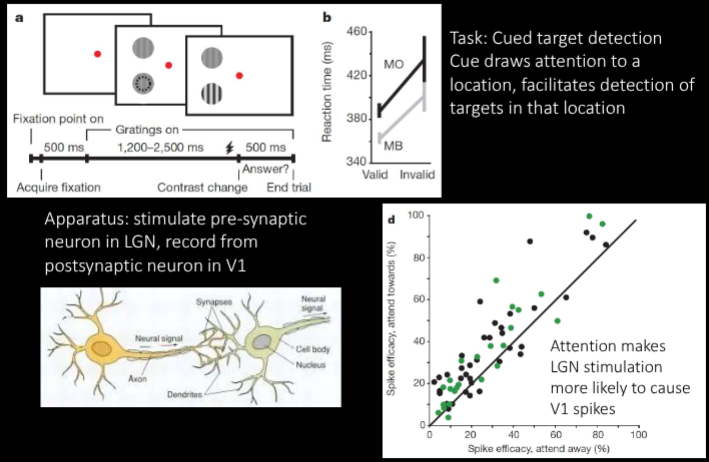
Throughout the brain: V1, MT, V4, FFA + PPA
LGN -> V1 signal attenuation
Bias comes from PFC/frontal lobe
PFC lesion reduces attention effect on V4 response during colour discrimination task
What evidence demonstrates that attention effect modulates the connection between thalamus and the cortex?
When the monkey is attending to that location, visual info has a better chance of getting past the thalamus + actually getting into the cortex