Final 5
 Call Kai
 Learn
 Practice Test
 Spaced Repetition
 Match
 Flashcards
 Knowt Play
1/34

There's no tags or description
Looks like no tags are added yet.
35 Terms
Assessment
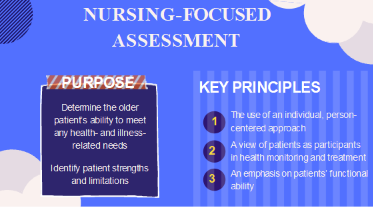
A comprehensive, nursing-focused assessment establishes a database about a patient’s ability to meet the full range of “physical, functional, psychosocial, emotional, cognitive, sexual, cultural, age-related, environmental, spiritual/transpersonal, and economic needs.” (ANA, 2015)
ok
Health History
The first phase of a comprehensive, nursing-focused health assessment and provides a SUBJECTIVE account of the older adult’s current and past health status.
Interview
forms the basis of a therapeutic nurse–patient relationship in which the patient’s well-being is the mutual concern.
ok

ok
Disregard myths and stereotypes
Open ended
Close ended

ok

ok

Visual deficit
Hearing deficit
Anxiety
Pain
Reduced energy
Health Problems
Tendency to Reminisce
PATIENT FACTORS THAT MAY AFFECT INTERVIEW
Biographical Data
Family Profile
Family History
Occupational Profile
Living Environment Profile
Recreation/Leisure Profile
Resource/Support Systems
Description of Typical Days
Present Health Status
Past Health Status
Review of Systems
ELEVEN COMPONENTS OF HEALTH HISTORY
Biographical Data
Basic, factual data about the older adult
Family Profile
- gives a quick overview of who may be living in the patient’s home or who may represent important support systems for the patient
What is included?
Family members’ names and addresses
Year and cause of death of spouse (if deceased)
Number and names of children
Family History
- Provides valuable information about inherited diseases and familial tendencies, whether environmental or genetic, for the purposes of identifying risk and determining the need for preventive services.
What is included?
Health status of immediate and living relatives of the patient
Causes of death of immediate relatives
Survey for risk of specific diseases and disorders
Occupational Profile
- Information about work history and experiences may alert the nurse to possible health risks or exposures, lifestyle or social patterns, activity level, and intellectual performance.
What is included?
Patient's current work or retirement status
Previous jobs
Source(s) of income and perceived adequacy for needs
Living Environment Profile
- The degree of function, safety and security, and feelings of well-being are a few of the areas affected by the patient's home environment.
What is included?
Patient's type of dwelling
What the house is made of
Number of rooms, levels, and people residing
Degree of privacy
Name, address, and telephone number of nearest neighbor
Recreational/leisure profile
Identify what the patient does to relax and have fun, and how the patient uses free time.
Resource/support systems
- Obtain information about the various health care providers and agencies used by the patient to identify patterns of use of health care and related services, perceptions, and attitudes about the importance of health maintenance and promotion.
What is included?
Names of physician(s)
Hospitals and clinics
Other community services used by the patient
Description of a Typical Day
Identify the activities of a patient during a full 24-hour period to gather data about practices that either support or hinder healthy living.
Present Health Status
- The patient's perception of health in both the past year and the past 5 years, coupled with information about health habits, reveals much about his or her physical integrity.
What is included?
Chief complaint
Full symptom analysis
Prescribed and self-prescribed drugs
Health screenings
Immunizations
Allergies
Eating and nutritional patterns
Character
Onset
Location
Duration
Severity
Pattern
Associated Factors
COLD SPA
Character
Q: How does the pain feel like?
A: It feels sore and makes me uncomfortable
Onset
Q: When did the pain begin? Is it better, worse, or the same since it began?
A: It started 2 days ago before I got admitted. It feels a little better now than when it started.
Location
Q: Which body part do you feel the pain coming from? Does it move around and spread to other parts of your body?
Does it radiate? Does it occur in a particular place under certain circumstances? Is it associated with any specific activity?
A: I feel the pain centered on both my knees. My legs and ankles feel a little sore too. I can't move my lower body very well.
Duration
Q: How long does the pain last? Does it come back from time to time?
A: It stays for hours. It goes away for a little while and returns again.
Severity
Q: On a scale of 1-10, with 10 being the worst pain you could have, how would you rate the discomfort you are feeling right now?
A: 6/10
Pattern
Q: What makes the pain worse? What makes the pain better?
A: Moving too much makes it worse.
Associated Factors
Q: Have you noticed other changes or symptoms that occur with your pain? Will you be able to continue your usual activities?
A: I cannot really hear people that well without my hearing aid. I won't be able to
given my condition, my lower body feels so stiff.
COLD SPA
Chief complaint: Use?
Drugs
Ask the patient to bring in all prescription and over-the-counter drugs he takes, as well as regularly and occasionally used home remedies.
Awareness of the use of CAM therapies or complementary and alternative medicine allows nurses to assess for the interaction of these therapies with traditional medications among all cultural groups.
Immunization and Health Screening
The older adult's immunization status for specific diseases and illnesses is particularly important because of the degree of risk for this age group.
Frail and institutionalized older adults are particularly vulnerable and should be screened for exposure or active disease through an annual purified protein derivative (PPD) test. This test is specifically designed to screen for tuberculosis.
Drug
Immunization
Allergy
Nutrition
Chief complaint
PRESENT HEALTH STATUS
Allergies
Determining the older adult's drug, food, and other contact and environmental allergies is essential for planning nursing interventions. It is particularly important to note the patient's reaction to the allergen and usual treatment. Specific contraindications are to be followed upon the presence of allergies to avoid risking the patient's health.
Nutrition
A 24-hour diet recall is a useful screening tool that provides information about the intake of daily requirements by the patient.
It is important to note that the diets of older adults may be nutritionally inadequate because of advanced age, multiple chronic illnesses, lack of financial resources, mobility impairments, dental health problems, and loneliness.
Review of Systems
is generally a head- to-toe screening to ascertain the presence or absence of key symptoms within each of the body systems.
Past Health Status
The patient's history of diseases, common childhood illnesses, serious or chronic illnesses, trauma, hospitalizations, operations, and obstetric history should be obtained to identify potential risk factors for future health problems.
This process can be tedious due to a lengthy, complicated personal history.