Nerve Blocks

0.0(0)
Studied by 0 people
call kaiCall Kai
learnLearn
examPractice Test
spaced repetitionSpaced Repetition
heart puzzleMatch
flashcardsFlashcards
GameKnowt Play
Card Sorting

1/58

encourage image

There's no tags or description

Looks like no tags are added yet.

59 Terms

1
New cards
⭐ Q: What does a nerve block do?
Temporarily reduces sensation in the region supplied by the targeted nerve.
2
New cards
⭐ Q: Why use local nerve blocks during surgery?
To provide regional pain control and reduce anesthetic requirements.
3
New cards
⭐ Q: Why use distal limb nerve blocks during equine lameness evaluation?
To localize the source of painful lameness.
4
New cards
⭐ Q: How is a diagnostic nerve block assessed?
Compare the horse’s gait before and after the block.
5
New cards
⭐ Q: Why are diagnostic distal-limb blocks especially practical in horses?
One weight-bearing digit simplifies distal nerve distribution.
6
New cards
⭐ HIGH-YIELD Q: Why does sequential blocking proceed from distal to proximal?
A proximal block would also desensitize distal structures and reduce localization accuracy.
7
New cards
⭐ Q: What is a Bier block?
Intravenous regional anesthesia of a limb isolated with a tourniquet.
8
New cards
⭐ Q: Where is the Bier block tourniquet placed?
Proximal to the region requiring analgesia.
9
New cards
⭐ Q: How is local anesthetic delivered in a Bier block?
Into a distal limb vein after tourniquet placement.
10
New cards
⭐ Q: Why is the tourniquet important during a Bier block?
It limits systemic spread and retains anesthetic within the isolated limb.
11
New cards
⭐ Q: What is a practical limitation of a Bier block?
The procedure must be completed within a safe tourniquet interval.
12
New cards
⭐ Q: Which proximal nerves contribute to equine distal forelimb innervation?
The median and ulnar nerves.
13
New cards
⭐ Q: Where does the median nerve approach the equine carpus?
From the medial side.
14
New cards
⭐ Q: Where does the ulnar nerve approach the equine carpus?
From the lateral side.
15
New cards
⭐ Q: What does the medial palmar nerve represent?
The distal continuation of the median nerve on the medial palmar limb.
16
New cards
⭐ Q: What contributes to the lateral palmar nerve?
Communicating contributions from the median and ulnar nerves.
17
New cards
⭐ Q: Where do the palmar metacarpal nerves course?
Along the axial sides of the splint bones.
18
New cards
⭐ Q: What do palmar metacarpal nerve branches reach distally?
The dorsal fetlock region.
19
New cards
⭐ Q: What do the medial and lateral palmar nerves become distally?
The corresponding palmar digital nerves near the fetlock.
20
New cards
⭐ Q: What do the dorsal digital branches supply?
Sensation to the dorsal portion of the digit.
21
New cards
⭐ Q: What is a palmar digital nerve block?
A distal block of the medial and lateral palmar digital nerves.
22
New cards
⭐ Q: Where is the palmar digital block performed?
Over the neurovascular bundles just proximal to the collateral cartilages.
23
New cards
⭐ Q: How many sides must be injected for a complete palmar digital block?
Both the medial and lateral sides.
24
New cards
⭐ Q: How many injection sites are used for a standard palmar digital block?
Two.
25
New cards
⭐ Q: Which general region does a palmar digital block desensitize?
The palmar and distal portions of the foot.
26
New cards
⭐ Q: Which deep foot structure is desensitized by a heel block?
The navicular apparatus.
27
New cards
⭐ Q: Which joint is included in the lecturer’s heel-block answer?
The distal interphalangeal (coffin) joint.
28
New cards
⭐ Q: Does a heel block desensitize the entire dorsal hoof wall?
No, not in the lecture’s standard block pattern.
29
New cards
⭐ Q: Does a heel block desensitize the fetlock?
No.
30
New cards
⭐ Q: What is an abaxial sesamoid block?
A bilateral distal-limb block at the abaxial borders of proximal sesamoids.
31
New cards
⭐ Q: What landmark guides abaxial sesamoid block placement?
The neurovascular bundle along each abaxial proximal sesamoid.
32
New cards
⭐ Q: How many sides are injected for an abaxial sesamoid block?
Two: medial and lateral.
33
New cards
⭐ HIGH-YIELD Q: How does the abaxial sesamoid block differ from a heel block?
It additionally desensitizes the dorsal hoof wall and pastern.
34
New cards
⭐ Q: Does an abaxial sesamoid block desensitize the fetlock in this lecture?
No.
35
New cards
⭐ Q: What is a low four-point block?
A bilateral block targeting palmar and palmar metacarpal nerves.
36
New cards
⭐ Q: How many injection sites comprise a low four-point block?
Four: two on each side.
37
New cards
⭐ Q: What landmark is used for the palmar metacarpal injections?
The distal splint-bone buttons.
38
New cards
⭐ Q: Which other nerves are targeted by the low four-point block?
The medial and lateral palmar nerves.
39
New cards
⭐ Q: Which newly desensitized joint distinguishes the low four-point block?
The fetlock (metacarpophalangeal joint).
40
New cards
⭐ HIGH-YIELD Q: Why must low four-point needle placement avoid a distal trajectory?
The palmar fetlock joint pouch extends proximally and may be entered accidentally.
41
New cards
⭐ HIGH-YIELD Q: What could accidental fetlock joint penetration cause during a nerve block?
Joint contamination or a misleading diagnostic response.
42
New cards
⭐ HIGH-YIELD Q: A horse improves after a heel block. What general region is implicated?
Pain within structures desensitized by that distal foot block.
43
New cards
⭐ HIGH-YIELD Q: A horse improves only after a low four-point block. What area becomes suspect?
The fetlock region.
44
New cards
⭐ Q: How is high four-point blocking different from low four-point blocking?
The higher block is performed proximal to the communicating branch.
45
New cards
⭐ Q: What does the instructor advise for more proximal diagnostic blocks?
Consider referral to an equine specialist.
46
New cards
⭐ HIGH-YIELD Q: Why is a correct nerve block not always proof of one exact lesion?
Several anatomical structures can share the same desensitized region.
47
New cards

- ⭐ Q: What is the starting point for sequential diagnostic nerve blocks?

The most distal block

💡 Memory (original): Start at the toe; climb only when needed.

48
New cards

- ⭐ HIGH-YIELD Q: What is the order of the three distal equine blocks taught?

Palmar digital → abaxial sesamoid → low four-point.

💡 Memory (original): Heel → sesamoids → splint buttons.

49
New cards

- ⭐ Q: What procedure illustrates Bier block use in this lecture?

Claw amputation in a standing ruminant.

Example: A tourniquet is applied proximally, and local anesthetic is injected into a distal vein.

<p>Claw amputation in a standing ruminant.</p><p><em>Example:</em> A tourniquet is applied proximally, and local anesthetic is injected into a distal vein.</p>
50
New cards

- ⭐ HIGH-YIELD Q: How do palmar and palmar metacarpal nerves differ in location?

Palmar nerves run more superficially; palmar metacarpal nerves run deeper near the splint bones.


💡 Memory (original): Metacarpal nerves march beside the metacarpals.

51
New cards

- ⭐ HIGH-YIELD Q: How is the equine distal forelimb nerve pathway arranged?

Median/ulnar contributions → palmar nerves → palmar digital and dorsal digital branches.

<p>Median/ulnar contributions → palmar nerves → palmar digital and dorsal digital branches.</p>
52
New cards

- ⭐ HIGH-YIELD Q: What does the heel-block iClicker question identify as desensitized?

Sole, navicular region, and distal interphalangeal (coffin) joint.

Example: The dorsal hoof wall and fetlock are not selected.

<p>Sole, navicular region, and distal interphalangeal (coffin) joint.</p><p><em>Example:</em> The dorsal hoof wall and fetlock are not selected.</p>
53
New cards

- ⭐ Q: Where is the heel-block needle positioned in the lecture diagram?

Superficially above the collateral cartilage on each side.

<p>Superficially above the collateral cartilage on each side.</p>
54
New cards
<p>- <span data-name="star" data-type="emoji">⭐</span><strong> HIGH-YIELD Q: What structures does the abaxial sesamoid block desensitize according to the lecturer?</strong></p>

- ⭐ HIGH-YIELD Q: What structures does the abaxial sesamoid block desensitize according to the lecturer?

Sole, navicular region, coffin joint, dorsal hoof wall, and pastern.

Example: The lecturer verbally excludes the fetlock.


⚠ Source conflict: This slide also highlights “fetlock,” although the instructor verbally says the block does not include it. Confirm which answer your instructor expects.

55
New cards

- ⭐ Q: Where are the abaxial sesamoid block injections illustrated?

At the abaxial borders of both proximal sesamoid bones.
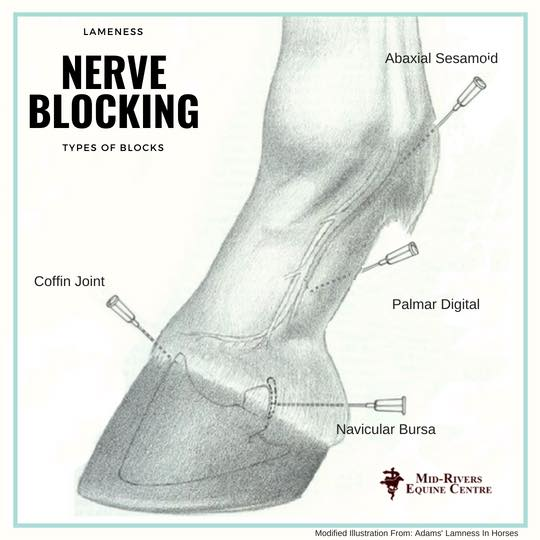
<p>At the abaxial borders of both proximal sesamoid bones.</p>
56
New cards
<p>- <span data-name="star" data-type="emoji">⭐</span><strong> HIGH-YIELD Q: What is newly desensitized by the low four-point block iClicker?</strong></p>

- ⭐ HIGH-YIELD Q: What is newly desensitized by the low four-point block iClicker?

The fetlock.

Example: More distal regions were already covered by the earlier blocks.

57
New cards
<p>- <span data-name="star" data-type="emoji">⭐</span><strong> Q: Where are the low four-point block targets shown?</strong></p>

- ⭐ Q: Where are the low four-point block targets shown?

At the distal splint-bone ends and near the palmar nerves, on both sides.

Between suspensory ligament and DDFT

58
New cards

- ⭐ HIGH-YIELD Q: Why is the fetlock recess important for a low four-point block?

Its palmar pouch extends proximally near the block injection region.

<p>Its palmar pouch extends proximally near the block injection region.</p>
59
New cards

- ⭐ HIGH-YIELD Q: A horse does not improve after a heel block but improves after an abaxial sesamoid block. What area becomes suspect?

Structures newly covered by the abaxial block, such as the dorsal hoof wall or pastern.

💡 Memory (original): Improvement after the next step points to what that step added.



