Ion Concentrations and Potassium Equilibrium
 Call Kai
 Learn
 Practice Test
 Spaced Repetition
 Match
 Flashcards
 Knowt Play
1/22

There's no tags or description
Looks like no tags are added yet.
23 Terms

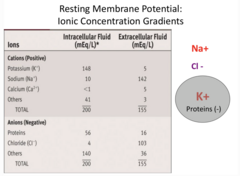
Which ions are found in higher concentrations outside the cell?
Sodium (Na+) and chloride (Cl−).

Which major positive ion is found in a higher concentration inside the cell?
Potassium (K+).

What large negatively charged molecules are found inside the cell?
Negatively charged proteins (protein anions).

Are Na+ and K+ cations or anions?
Cations, because they carry positive charges.
Are Cl− and negatively charged proteins cations or anions?
Anions, because they carry negative charges.

What are the intracellular and extracellular concentrations of potassium (K+)?
Inside: 148 mEq/L. Outside: 5 mEq/L.

What are the intracellular and extracellular concentrations of sodium (Na+)?
Inside: 10 mEq/L. Outside: 142 mEq/L.

What are the intracellular and extracellular concentrations of calcium (Ca²⁺)?
Inside:
What are the intracellular and extracellular concentrations of chloride (Cl−)?
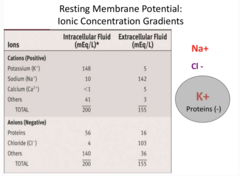
Inside: 4 mEq/L. Outside: 103 mEq/L.

What are the intracellular and extracellular concentrations of negatively charged proteins?
Inside: 56 mEq/L. Outside: 16 mEq/L.

What are the intracellular and extracellular concentrations of other positive ions?
Inside: 41 mEq/L. Outside: 3 mEq/L.

What are the intracellular and extracellular concentrations of other negative ions?
Inside: 140 mEq/L. Outside: 36 mEq/L.

What are the total intracellular and extracellular cation concentrations?
Inside: 200 mEq/L. Outside: 155 mEq/L.

What are the total intracellular and extracellular anion concentrations?
Inside: 200 mEq/L. Outside: 155 mEq/L.

How does potassium initially move through potassium leakage channels?
K+ diffuses out of the cell down its concentration gradient.

Why does potassium move out of the cell?
It is more concentrated inside the cell than outside.

What happens to the electrical charge inside the cell when potassium leaves?
It becomes more negatively charged as positive ions leave.

Why can potassium move back into the cell?
The negative electrical charge inside attracts positive K+ inward.
What two forces control potassium movement?
The outward concentration gradient and the inward electrical gradient.
When does potassium reach electrochemical equilibrium?
When the outward concentration gradient balances the inward electrical gradient.
What is the equilibrium potential for potassium?
Approximately −90 mV.
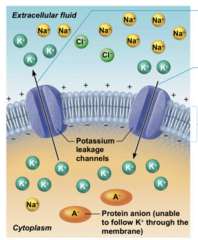
Why do negatively charged proteins remain inside the cell?
They are too large to pass through the membrane.
What are potassium leakage channels?
Membrane channels allowing K+ to diffuse and establish resting membrane potential.