DC Bio: Chapter 3 Test
 Call Kai
 Learn
 Practice Test
 Spaced Repetition
 Match
 Flashcards
 Knowt Play
1/201

There's no tags or description
Looks like no tags are added yet.
202 Terms

The two molecules shown in the figure are best described as
structural isomers
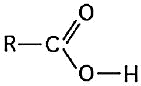
What is the name of the functional group shown in the figure?
carboxyl

Which of the structures illustrated in the figure contains an impossible arrangement of the covalent bonds?
C

Which of the structures illustrated in the figure contain(s) a carbonyl functional group?
D

In which structure(s) illustrated in the figure are all bonds that involve hydrogen atom polar covalent bonds?
A

Which of the structures illustrated in the figure contain(s) only nonpolar single covalent bonds?
B
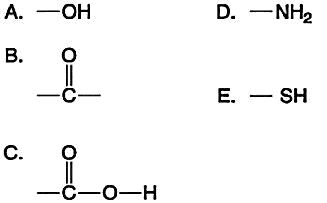
Which functional group shown in the figure is characteristic of alcohols?
A
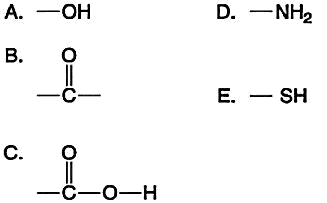
Which two functional groups shown in the figure are present in all amino acids?
C and D

During the synthesis of a polypeptide, the next amino acid in the growing polymer is added to which functional group shown in the figure?
C

Which of the groups in the figure is an acidic functional group that can dissociate and release H+ into a solution?
C

Which of the groups in the figure is a basic functional group that can accept H+ ions and become positively charged?
D

Which molecules shown in the figure contain a carbonyl group?
B and C
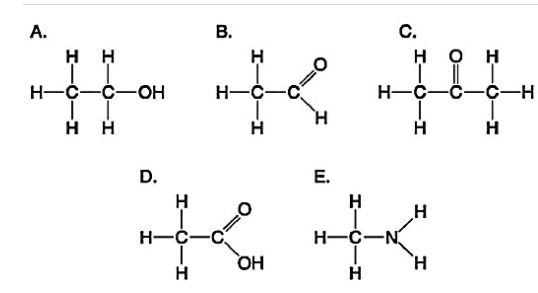
Which molecule shown in the figure contains a carboxyl group?
D
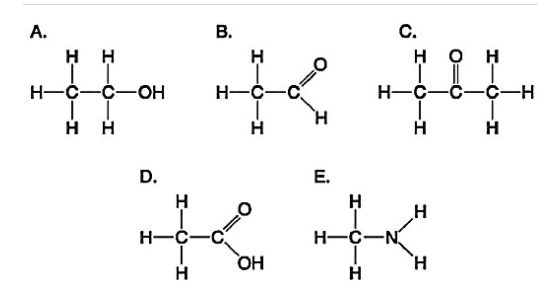
Which molecule shown in the figure can increase the concentration of hydrogen ions in a solution and is therefore an organic acid?
D

Which molecule shown in the figure has a carbonyl functional group in the form of an aldehyde?
B

Which molecule shown in the figure has a carbonyl functional group in the form of a ketone?
C

Which molecule shown in the figure is a thiol?
B

Which molecule shown in the figure can function as a base?
A
How many electron pairs are shared between two carbon atoms when they are joined by a double bond?
2
A carbon atom is most likely to form what bonds with other atoms?
covalent bonds
Ibuprofen is a drug commonly used to relieve inflammation and pain. It is a mixture of two enantiomers, which are molecules that…
are mirror images of one another.
Testosterone and estradiol are male and female sex hormones, respectively, in many vertebrates. How do these molecules differ from each other?
Testosterone and estradiol have different functional groups attached to the same carbon skeleton.
What common chemical group is hydrophobic?
methyl
Which functional groups confer the properties of an acid on amino acids?
carboxyl
To complete its valence shell a nitrogen atom must form covalent bonds with how many hydrogen atoms?
3

Which functional group is NOT present in this molecule?
sulfhydryl
Which chemical group is most likely to be responsible for an organic molecule behaving as an acid?
carboxyl

Choose the term that correctly describes the relationship between these two sugar molecules:
structural isomers
Which hydrocarbons do not have double bonds in their carbon skeleton?
C3H8
The large diversity of shapes of biological molecules is possible because of the extensive presence of _____ in the molecules
carbon
Ex. of a hydrocarbon
C3H8
Variations in the reactive properties of different organic molecules are most closely associated with __________.
the presence or absence of functional groups
What functional group is commonly used in cells to transfer energy from one organic molecule to another?
phosphate
The four main categories of large biological molecules present in living systems are __________.
proteins, nucleic acids, carbohydrates, and lipids
Molecules that have the same chemical formula (same numbers of each type of atom) but different three-dimensional shapes are called __________.
isomers
What best describes cis-trans isomers?
They differ in their spatial arrangement around inflexible double bonds.
Which polymers are composed of amino acids?
Proteins
What is not attached to the central carbon atom in an amino acid?
an oxygen
Which part of an amino acid is always acidic?
Carboxyl functional group
Which monomers make up RNA?
Nucleotides
Describe the formation of polypeptides from amino acids:
A bond forms between the carboxyl functional group of one amino acid and the amino functional group of the other amino acid.
True or false? Enzymes in the digestive tract catalyze hydrolysis reactions.
True
How do isomers differ from one another?
Isomers differ in the arrangement or bonding of atoms.
What is true about enantiomers?
Enantiomers differ in biological activity.
What are amino and carboxyl?
Amino and carboxyl are functional groups.
What does a methyl group consist of?
A methyl group consists of a carbon bonded to three hydrogen atoms.
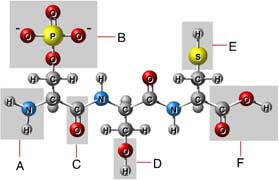
Which one of these is an amino
group?
A

Which of these is a phosphate group?
B

Which of these is a hydroxyl group?
D

Which of these is a carboxyl group?
F

Which of these functional groups is characteristic of alcohol?
D

Which of the functional groups behaves as a base?
A

Which of these groups is characteristic of thiols?
E
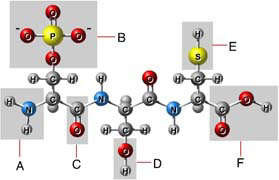
Which of these groups plays a major role in energy transfer?
B

Which of these is a carbonyl group?
C

Which of functional groups listed below behaves as an acid?
F
Biological polymers are commonly formed from monomers by which processes?
dehydration reactions
What chemical equation describes a hydrolysis reaction?
disaccharide + H2O= monosaccharide + monosaccharide
What chemical equation describes a dehydration reaction?
monosaccharide + monosaccharide = disaccharide + H2O
How many molecules of water are needed to completely hydrolyze a polysaccharide that is 10 monomers long?
9
Summarize the relationship between dehydration reactions and hydrolysis:
Dehydration reactions assemble polymers, and hydrolysis reactions break down polymers.
The molecular formula for glucose is C6H12O6. What would be the molecular formula for a molecule made by linking three glucose molecules together by dehydration reactions?
C18H32O16
A dehydration reaction is the process in which __________.
water molecules are produced as a polymer is formed from monomers
What is another name for a condensation reaction that releases a water molecule?
dehydration
What is the name of the process during which a bond between two monomers is broken?
hydrolysis
Protein polymers are made up of _____ ____ monomers.
amino acid
Carbohydrate polymers are made up of ______ _____ monomers.
simple sugar
Nucleic acids polymers are made up of ______ monomers.
nucleotide
Which feature of large biological molecules explains their great diversity?
The many ways that monomers of each class of biological molecule can be combined into polymers.
What are starch and cellulose polymers of?
glucose
Humans can digest starch but not cellulose because…
humans have enzymes that can hydrolyze the alpha glycosidic linkages of starch but not the beta glycosidic linkages of cellulose.
Describe one distinguishing characteristic of cellulose:
It is a primary structural component of plant cell walls.
What polymer is assembled from monomers containing nitrogen?
chitin
The term insoluble fiber on food packaging generally refers to which of the following carbohydrates?
cellulose
Lactose, a sugar in milk, is composed of one glucose molecule joined by a glycosidic linkage to one galactose molecule. What kind of carbohydrate is lactose?
a disaccharide
How many water molecules are produced by the synthesis of a starch molecule that contains 12 glucose monomers?
11
Sucrose is formed when glucose is joined to fructose by a(n) __________.
glycosidic linkage
Plant cell walls consist mainly of _____.
cellulose
Glycogen is _____.
a polysaccharide found in animals
glucose + glucose —-> _____ by _____
maltose + water ... dehydration synthesis
What is a source of lactose?
milk
What is an example of a polysaccharide?
cellulose
_____ is the most abundant organic compound on Earth.
Cellulose
What structural difference accounts for the functional differences between starch and cellulose?
Starch and cellulose differ in the glycosidic linkages between their glucose monomers.
Correct or incorrect statement:
All carbohydrates have the general formula (CH2O)n
incorrect; This formula only applies to simple sugars, which are equal parts carbon and water. Complex sugars, which do not have this general formula, are also carbohydrates.
Lactose, the sugar in milk, is a _________, because it can be split into two monosaccharides
disaccharide
A carbohydrate that yields many monosaccharides when hydrolyzed is a ___________
polysaccharide
A _________ cannot be hydrolyzed any further.
monosaccharide
A simple sugar is composed of equal parts carbon and water, which gave rise to the general name of any sugar as a ___________.
carbohydrate

What is illustrated in the figure?
It is a saturated fatty acid.
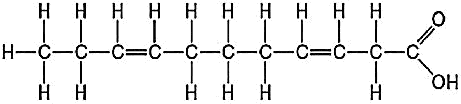
Is the molecule in the image solid or liquid at room temperature?
Molecules of this type are usually liquid at room temperature.

The molecule shown in the figure is a(n)
unsaturated fatty acid.

What is the structure shown in the figure?
steroid molecule
Are saturated fats solid or liquid at room temperature?
solid
What is a characteristic feature of lipids?
they are insoluble in water
A molecule with the chemical formula C6H12O6 is most likely which molecule?
monosaccharide
Which large biological molecules self-assemble into a bilayer when mixed with water?
phospholipids
What is true about saturated fats?
They contain more hydrogen than do unsaturated fats having the same number of carbon atoms.
The characteristic that all lipids have in common is that __________.
none of them dissolves readily in water
Lipids are diverse compounds that are grouped together because they are ________.
hydrophobic