Humanistic approach
 Call Kai
 Learn
 Practice Test
 Spaced Repetition
 Match
 Flashcards
 Knowt Play
1/21

There's no tags or description
Looks like no tags are added yet.
22 Terms
Who were the main founders of the humanistic approach?
Abraham Maslow + Carl Roger’s
What does the humanistic approach focus on?
Understanding what it means to be fully human and achieve personal growth. (believes other approaches are reductionist, deterministic)
Free will: What is free will in the humanistic approach?
Suggests people can consciously control + influence their own destiny despite external influences.
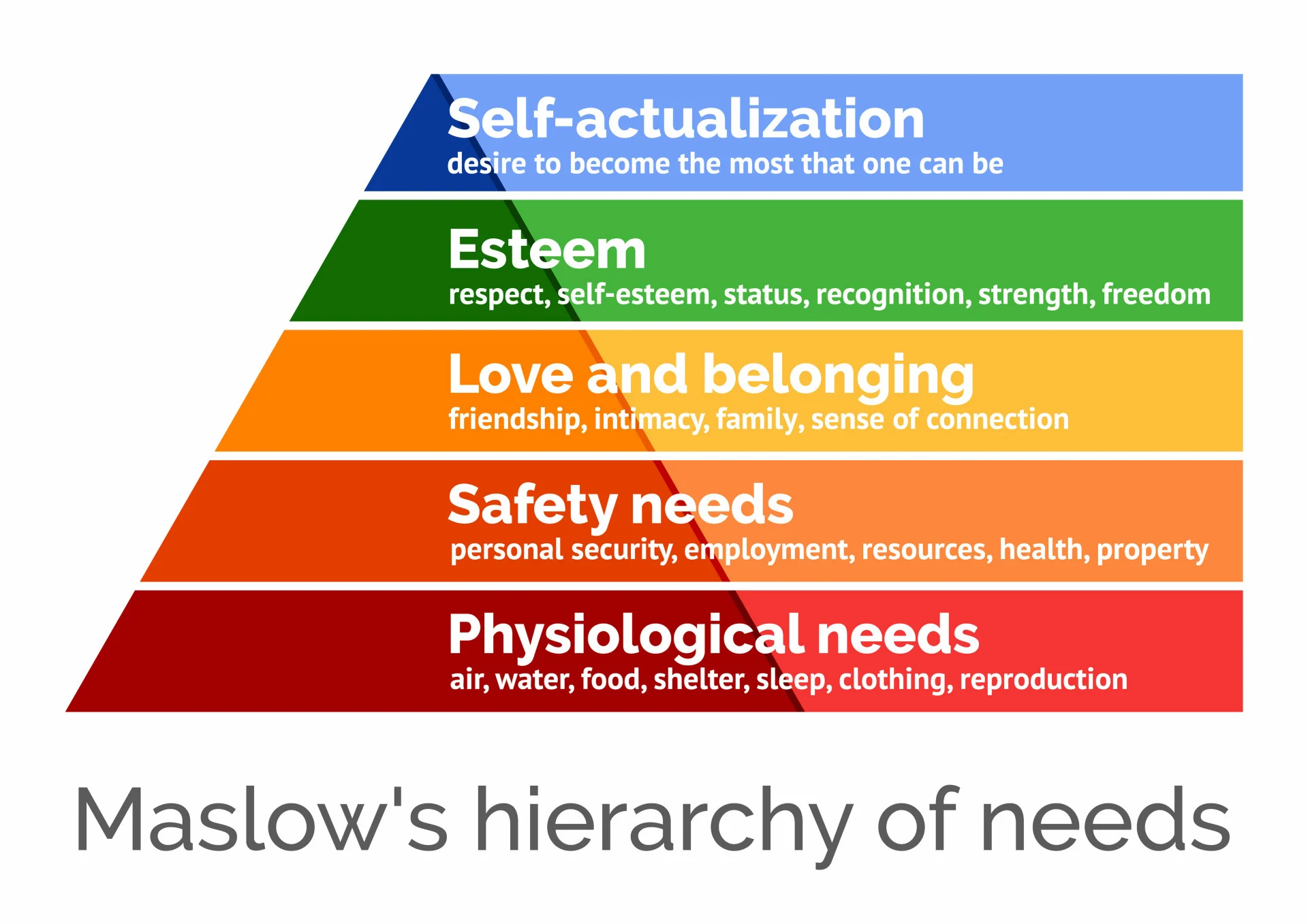
Maslow’s hierarchy of needs: What is Maslow’s hierarchy of needs?
Enduring model of psychological development progressing levels towards self-actualisation.
What is the order (from bottom) of the hierarchy?
Psychological needs (bottom) - basically survival needs like water, shelter and sleep.
Safety needs - needs for security, health, stability, family, employment.
Love + belongingness needs - need for relationships, friendships and affection.
Esteem needs - needs for self-esteem + respect from others. (These are all ‘deficiency needs’ except top)
Self-actualisation (top) - achieving one’s full potential + personal growth, accepting world as it is, spirituality.
What did Maslow say about progression thru the hierarchy?
People usually move step-by-step, but progression is not fixed (e.g; someone may need to address need for self-esteem before finding love).
Self-actualisation: What did Maslow say about self-actualisation?
Takes form of ‘peak experiences’= moments of euphoria, awe, without any fear or inhibitions of the world.
Identified Albert Einstein as self-actualised thru his creativity
Focus on the self: What 2 needs was Roger’s focused on?
Need for:
self-worth (direct impact on psychological well-being)
unconditional +ve regard (acceptance + love without conditions)
Both emerge from good rships with supportive parents in childhood
Conditions of worth: What are conditions of worth?
When individual is recipient of unconditional +ve regard
Some parents impose conditions of worth on their children → expectations must be met to gain approval from others.
How do conditions of worth develop?
When approval from parents or others becomes conditional.
What effect can condition on worth have?
Only feel self-acceptance → create feelings of incongruence.
Congruence: What 2 things did Roger’s say about unhappiness and dissatisfaction?
They were the outcomes of a psychological gap between:
Sef-concept - how a person sees themselves
Ideal self - the person someone wants to become
What is incongruence?
A mismatch between self-concept and ideal self.
What can the incongruence of self-concept and ideal self lead to?
Use of defence mechanisms to provide protection against feeling -ve. (And unhappiness + dissatisfaction)
What is congruence?
Agreement between self-concept and ideal self.
(Uncommon for someone to be congruent all the time, most ppl will experience some degree of incongruence).
Counselling psychology: What is the aim of Rogerian theory?
To reduce gap of incongruence + achieve a balance between them.
What is client-centred therapy?
Therapy focused on helping clients understand themselves + making +ve steps to resolving their issues ultimately to achieve self-actualisation.
What is the role of the therapist in Rogerian therapy?
To provide unconditional +ve regard by expressing acceptance, empathy and understanding.
How does Rogerian therapy reduce incongruence?
Supportive therapy helps remove conditions of worth affecting self-concept, so clients can move towards ideal self.
What are the strengths of the humanistic approach?
Real-wold application - Carl Roger’s CBT using unconditional +ve regard, applied in modern counselling for personal growth → practical value + usefulness.
Holistic + idiographic approach - focuses on whole person +subjective experiences, recognises individual uniqueness not simplifying it, more realistic than reductionist approaches → high ecological validity.
Applications beyond therapy - Maslow’s hierarchy of reds used in education + business to motivate achievement + goal-setting → shows practical value.
What are the weaknesses of the humanistic approach?
Lacks scientific rigour - concepts like self-actualisation difficult to operationalise in controlled conditions, evidence is often subjective → lack reliability + scientific validity.
Cultural bias - Maslow’s hierarchy of needs reflects Western individualistic values, elf-actualisation may not be important in collectivist cultures → limited generalisability.
Too idealistic (unrealistic) - focus on ‘growth-orientated’ behaviour + self-actualisation, ignores self-destruction → may provide unrealistic view of human nature.
Therapy may not work for all clients - unconditional +ve regard may not sufficiently challenge some people.
What are the issues and debates for the humanistic approach?
Free will - behaviour is shaped by personal choice → opposes determinism.
Holism - explains behaviour by considering the whole individual.
Idiographic approach - focuses on individual experience rather then universal laws.