Growth, Nutrition, and Metabolism
 Call Kai
 Learn
Learn Practice Test
 Spaced Repetition
 Match
Match Flashcards
 Knowt Play
1/16

There's no tags or description
Looks like no tags are added yet.
Name | Mastery | Learn | Test | Matching | Spaced | Call with Kai | Chat |
|---|
No analytics yet
Send a link to your students to track their progress
17 Terms
Growth curve
lag, exponential (log), stationary, death

Lag Phase
-cell is synthesizing new components
-replenish spent materials
-adapt to new medium or other conditions
-varies in length (can be very short/absent)
Exponential (log) phase
-growth is constant
-population is most uniform
Stationary phase
-total number of viable cells remains constant
-metabolically active cells stop reproducing
-cell division rate= death rate
increased virulence or pathogenicity of bacteria
-preparing for long-term survival
-production of starvation response: chaperones, DNA protein, etc.
-morphological changes: decreased size, nucleotide condensation
Why do the bacteria enter the stationary phase
nutrient limitation, limited oxygen availability, toxic waste accumulation, critical population density is reached
Death phase
-decline in viable (living) cells
-possibilities: cell death (due to lack of nutrients), apoptosis of some, viable but non-culturable
-bottom line: some of the bacteria are dying, but the population is trying to survive
pH and temperature requirements
-ph=7.2
-tend to grow well in conditions found in the human blood
-bacteria still maintain an internal neutral pH
Siderophores
-release from bacteria to capture iron from the circulation
-our bodies use transferrin to capture free iron
-there is competition between siderophores and transferrin to capture the available iron
-bacteria with effective siderophores are more pathogenic
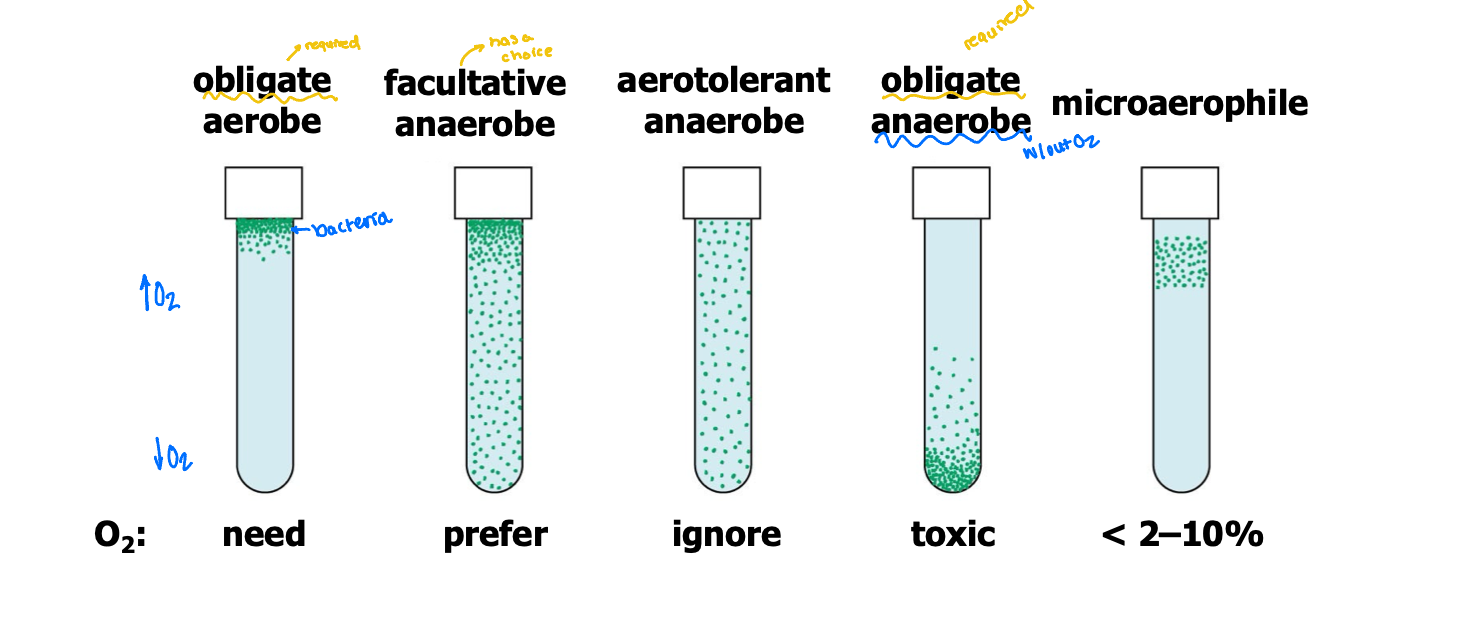
Oxygen requirements
oxygen is easily reduced to toxic byproducts (superoxide radical and hydrogen peroxide)
protective enzymes (Superoxide dismutase and catalase)
Bacteria have 3 common pathways
1.Glycolysis (anaerobic and aerobic)
Pentose phosphate pathway
Entner Doudoroff pathway (pseudomonas)
Aerobic respiration
-glycolysis+ oxidative phosphorylation
-32 ATP can be generated from aerobic respiration
-pyruvate into the TCA (or Kreb’s) cycle
-O2 is terminal electron acceptor
Anaerobic respiration
-Glycolysis +fermentation
-Pyruvate feeds into many different fermentation pathways
-End products are short chain alcohols or fatty acids
-Type of pathway and end product depends on the type of bacteria
-No matter which fermentation pathway is used, less ATP is made than with oxidative phosphorylation
Obligate Aerobes-aerobic and anaerobic effect
-Glycolysis + oxidative phosphorylation
-Produce more ATP
-Grow quickly (24-48h in lab)
Obligate Anaerobes-aerobic and anaerobic
-Glycolysis+ fermentation
-Produce less ATP
-Grow slowly (longer than a week in some cases)
Facultative Anaerobes
-If O2 is present, they will use aerobic respiration so that they can generate more ATP, the faster they grow the more competitive
Rate of DNA polymerases Eukaryotes
50-100 base pairs/second
Rate of DNA polymerases Prokaryotes
750-1000 bp/sec