Genetics
 Call Kai
 Learn
Learn Practice Test
 Spaced Repetition
 Match
Match Flashcards
 Knowt Play
1/102

There's no tags or description
Looks like no tags are added yet.
Name | Mastery | Learn | Test | Matching | Spaced | Call with Kai | Chat |
|---|
No analytics yet
Send a link to your students to track their progress
103 Terms
What are the 2 main types of genetic disease?
hereditary and congenital
What is genetic disease?
a disease caused completely or partly by genetic variation
What is a hereditary disease?
a genetic disease that can be transmitted from parent to offspring
What is a congenital disease?
a disease that is present from/ before birth which can be due to genetic or environmental factors
How do vets use preventative medicine to reduce genetic disease?
By scoring at-risk breeds for certain diseases as they mature, and preventing individuals with the worst cases of the disease from breeding
What are the reasons for selective breeding?
to change the appearance of animals
to reduce hereditary disease
to improve productivity and fitness
to improve the resilience of populations to stresses/diseases
to adapt animals to their current environment/function
What are the different technologies used to control breeding?
artificial insemination
semen sexing
multiple ovulation and embryo transfer
in-vitro fertilisation
juvenile in-vitro embryo transfer
cloning
gene editing
What is a gene?
a DNA segment at a specific position on the genome that encodes a functional product
What is an allele?
a different form of the same gene which combines with another to code for a characteristic
What is genotype?
the genetic makeup of an animal at one or more loci (can be a single gene or multiple)
What does it mean to genotype an animal?
to measure the genetic variants across the genome of an animal, typically using SNPs
What is phenotype?
the physical representation of the genetic makeup of an animal combined with environmental factors
What are the features of qualitative genetic traits?
discrete categories
usually monogenic or oligogenic
What are the features of quantitative genetic traits?
vary on a continuous or ordered scale
usually polygenic
Oligogenic/ monogenic
A genetic trait that is influenced by a small number of genes
Polygenic
A genetic trait that is influenced by many genes and environmental factors
What is complete genetic dominance?
When one allele is always dominant over another, meaning that a heterozygous genotype will produce the dominant phenotype
What is incomplete genetic dominance?
When the dominant allele for a trait is not completely dominant and so the heterozygous phenotype is closer to the homozygous dominant but not completely the same, causing 3 different phenotypes to be possible as an intermediate is formed
What are the different patterns of inheritance?
sex-linked, sex-limited, sex-influenced, genomic imprinting
What is a sex-linked gene?
a gene found on a sex chromosome
What is a sex-limited gene?
a gene which is only expressed in the phenotype of one gender
What is a sex-influenced gene?
a gene which is expressed differently between the different genders
What is genomic imprinting?
when the expression of an allele depends on whether it was inherited from the sire or the dam
How does sex-linked inheritance work?
Certain genes are usually X-linked, because there are more genes on the X chromosome than the Y, which means that recessive X-linked diseases are more readily expressed in males
If the father is the X-linked gene carrier, he cannot pass this onto his sons because they must inherit his Y chromosome
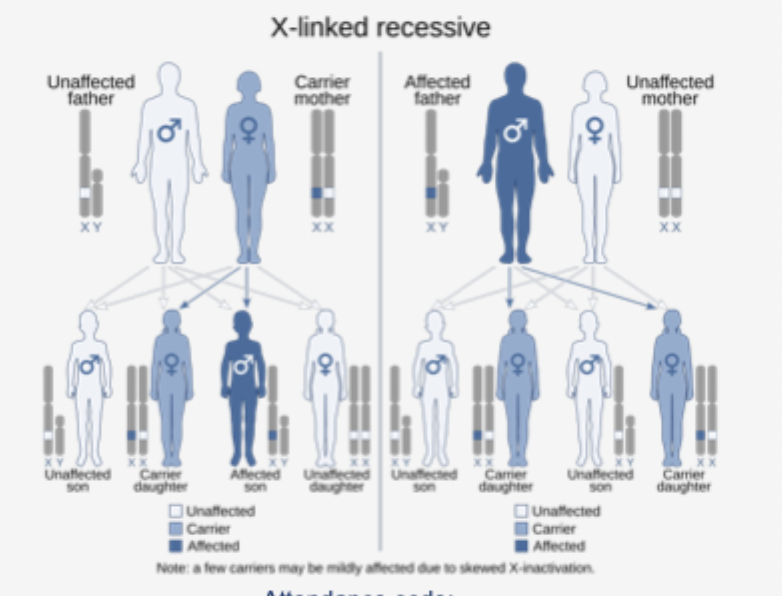
What happens during X-inactivation?
one X chromosome is randomly inactivated in each cell in females, meaning that each allele on one X chromosome in each cell is turned off so one trait is represented e.g. tortoiseshell cats
Can X-inactivation happen in males?
yes, but it causes them to be sterile
What is epistasis?
When the allele at one locus masks or enhances the effect of an allele at another locus
What is pleiotropy?
When variation at one locus influences more than one phenotypic trait
What is incomplete penetrance?
only a proportion of animals with a particular genotype express the associated phenotype
What is variable expressivity?
animals with the same gene can differ in the severity or form of the phenotype caused by that gene
(e.g. polydactyl cats have a range of the number of extra digits)
What is genetic codominance?
When the effects of both alleles are visible in a heterozygous animal
How are mitochondrial genes inherited?
they are passed down from mother to offspring, but they are not sex-linked
What are Mendel’s 3 laws?
law of dominance, law of segregation, law of independent assortment
What does Mendel’s law of segregation say?
each parent passes one of their alleles onto their offspring at random
What does Mendel’s law of dominance say?
some alleles are dominant and others are recessive
What does Mendel’s law of independent assortment say?
genes for different traits are inherited independently
How does gene editing work?
an enzyme (e.g. Cas9) is used to cut open DNA and disrupt, delete or insert DNA at a target location
What phenomenon contradicts Mendel’s law of independent assortment?
genes that are close together on the same chromosome are more likely to be inherited together, meaning that they are not always assorted independently
What is linkage disequilibrium?
when alleles at different loci occur together more often than expected by chance
What is a haplotype?
a group of genetic variants on the same chromosome that tend to be inherited together
What does SNP stand for?
single nucleotide polymorphism
What is an SNP?
a single-base difference in DNA between animals
What do genome-wide association studies test?
the association between SNPs across the genome and a phenotype
What is allele frequency?
the proportion of all copies of a gene that are a particular allele
What is genotype frequency?
the proportion of animals in a population with a particular genotype
What can allele and genotype frequency be used to predict?
carrier frequency for recessive diseases and the genetic profile for the next generation
When must you use the Hardy-Weinberg equilibrium to identify genotype from phenotype?
when complete dominance is occuring so you cannot identify the genotype of individuals just form looking at them
What must occur for the allele frequency of a population to stay the same according to the Hardy-Weinberg equilibrium?
large population
random mating
no selection pressure
no mutations
no movement of genetics in or out of the population via migration
What is the Hardy-Weinberg equation for allele frequency?
p + q = 1
What does p represent in the Hardy-Weinberg equation?
the dominant allele
What does q represent in the Hardy-Weinberg equation?
the recessive allele
What does p2 represent in the Hardy-Weinberg equation?
the frequency of homozygous dominant genotypes in a population
What does 2pq represent in the Hardy-Weinberg equation?
the frequency of heterozygous genotypes in a population
What does q2 represent in the Hardy-Weinberg equation?
the frequency of homozygous recessive genotypes in a population
Which 2 factors affect the phenotype of an animal?
genetics and environment
What is the aim of selective breeding?
to change the average genetic merit of a population over multiple generations via increasing the frequency of desirable alleles and reducing disease-causing recessive alleles
What does selective breeding rely on?
genetic variation in a population
What are the 5 main mechanisms that create genetic variation?
mutation
meiosis
migration
genetic drift
selection
How does genetic mutation create genetic variation?
it is a source of new alleles in a population
How does meiosis create genetic variation?
random alignment and recombination creates new combinations of alleles
How does migration create genetic variation?
it allows alleles to move between populations
How does genetic drift create genetic variation?
it causes random changes in allele frequencies
How does selection create genetic variation?
certain alleles increase the survival of animals and become more common (either naturally or artificially)
In what circumstance can a genetic mutation be inherited by offspring?
when a mutation occurs in the germline
How does the distribution of phenotypic variation of a population appear as a graph?
bell-shaped curve
What is the study of quantitative genetics?
splitting up the phenotypic variation in a population into genetic and non-genetic variation
What are the features of additive genetic effects?
the effects of alleles can be added together and each allele contributes a predictable amount
What are the features of non-additive genetic effects?
the overall effect depends on the combination of alleles which interact differently with each other, making it harder to predict the presentation of offspring
What is narrow-sense heritability?
the additive genetic variation as a proportion of the total phenotypic variation in a population, which shows how much of a population’s characteristics are due to additive genetic variation
How do you calculate heritability?
additive genetic variation (±non-additive genetic variation)/ phenotypic variation
How do you interpret the results for the calculated heritability of a population?
the value calculated shows the percentage amount that the variation in a specific characteristic is attributable to genetic variation in the population
What are the common reasons for low heritability estimates?
errors in pedigree recording
misclassification of phenotype
large environmental variation
low additive genetic variation
What is a correlation?
an association between two variables
What is the correlation coefficient?
a mathematical measure of the strength and direction of the association between 2 quantities (-1 to +1)
What is phenotypic correlation?
when animals with one phenotype tend to also have another phenotype
What is genetic correlation?
when the genetic merit for one trait is associated with genetic merit for another trait, meaning that selection for one trait can also change another trait
What are the 2 main causes of genetic correlation?
one gene affects 2 traits
variants affecting the two traits are inherited together because of linkage disequilibrium
What does indentical by descent mean?
when a randomly selected allele from two individuals are inherited from the same ancestral copy and so are identical
What is the inbreeding coefficient?
the probability that a randomly selected allele from two individuals are inherited from the same ancestral copy and so are identical, therefore giving a measure of how genetically related two individuals are
How do you calculate the inbreeding coefficient of an individual?
identify the common ancestors between the individual’s parents
find all loops from the individual’s parents to the common ancestor(s) and back to the other parents
count the number of individuals in each loop
the number(s) you have calculated is n, subsitute this into the inbreeding coefficient equation
What are some problems caused by inbreeding?
decline in performance
increased homozygous individuals expose harmful recessive alleles
reduced genetic variation in a population
genetic selection increases relatedness and inbreeding
What is the current advice to manage inbreeding?
aim to limit the increase in inbreeding between generations to less than 1%
What is the difference between broad-sense and narrow-sense heritability?
broad-sense includes both additive an non-additive genetic variation, whereas narrow-sense only includes additive genetic variation
would typically always use narrow-sense
What is the estimated breeding value of an animal?
an estimate of the genetic merit of that animal calculated using the animal’s performance, relations’ performance, genomic information and systematic environmental effects
How is the predicted transmitting ability of an individual calculated?
the expected deviation of the offspring’s performance from the population mean is doubled, because each parent passes on half of their genetics
What is the predicted transmitting ability of an animal?
the expected deviation of the offspring’s performance from the population mean
How is the estimated breeding value of an animal calculated?
heritability x (
How do you calculate the estimated breeding value of an animal at birth?
(0.5 x EBV of sire) + (0.5 x EBV of dam)
What is the reliability of EBV?
how confident you are that the EBV measures the true genetic merit of an animal, sometimes given as accuracy
What is the average reliability of parental-average EBV?
30-35%
How much weight is progeny performance given when calculating EBV?
when there are many progeny, it provides much stronger evidence but when few progeny or low heritability the estimate is pulled more towards the population average
Which factors affect reliability?
number of records
genomic information
pedigree
number of offspring
What is phenotypic selection?
assessing an animal’s characteristics to decide whether it has good genetics for breeding or not
Why is phenotypic selection not always very accurate?
does not account for heritability of a trait
doesn’t actually measure the genetics of an animal
only tests for traits that have already been presented (doesn’t include genes for degenerative disease that might develop later in life)
How should you implement genetic selection?
set breeding goals
aim to improve the average genetic merit of a population to improve the average phenotype
have a breeding strategy
maximise genetic gain
control inbreeding
What is a selection index?
a measure of a variety of different important traits in a population which contribute to herd productivity, this promotes balanced selection when breeding
What are the advantages of crossbreeding?
combines the strengths of different breeds
introduces genetic variation
reduces inbreeding/ relatedness
heterosis
What is heterosis/hybrid vigor?
an extra boost in performance above the mid-parent mean due to increased heterozygosity which leads to more non-additive genetic effects in the offspring
What is genetic gain?
the increase in genetic merit over time for a given trait or a group of traits in a breeding objective
What causes faster genetic gain?
better animals selected
increased accuracy of selection
maintaining genetic variation
reducing intervals between generations