Chemistry 11 Unit 1: Laboratory Safety & Lab Techniques
 Call Kai
 Learn
Learn Practice Test
 Spaced Repetition
 Match
Match Flashcards
 Knowt Play
1/45

Earn XP
Description and Tags
Vocabulary flashcards covering lab safety rules, WHMIS hazard symbols, basic chemical equipment, and physical separation techniques for Chemistry 11 Unit 1.
Name | Mastery | Learn | Test | Matching | Spaced | Call with Kai | Chat |
|---|
No analytics yet
Send a link to your students to track their progress
46 Terms
WHMIS
Workplace Hazardous Materials Information System; a standardized system using symbols to identify dangerous materials on common household items and chemical containers.

Gas Under Pressure Symbol
WHMIS hazard symbol indicating gases held under pressure, which may explode if heated, dropped, or impacted.

Flammable Symbol
WHMIS hazard symbol indicating materials that may burn at low temperatures and can be ignited by sparks, flames, or friction.

Oxidizing Material Symbol
WHMIS hazard symbol indicating substances that speed up fire development, increase fire intensity, or cause non-combustible materials to burn in air.

Acute Toxicity Symbol
WHMIS hazard symbol indicating substances that may cause death or severe toxicity after short exposure to small amounts.

Health Hazard Symbol
WHMIS hazard symbol indicating substances suspected of causing serious long-term health effects such as cancer, organ damage, or genetic defects after repeated exposure.

Exclamation Mark Symbol
WHMIS hazard symbol indicating materials that may cause skin and eye irritation or allergic responses.

Corrosive Material Symbol
WHMIS hazard symbol indicating substances that cause corrosive damage to metals, skin, and eyes.

Explosive Material Symbol
WHMIS hazard symbol indicating self-reactive or explosive materials whose detonation can damage surroundings.

Biohazardous Infectious Materials Symbol
Hazard symbol indicating organisms or toxins capable of causing disease in humans or animals.

Environmental Hazard Symbol
Hazard symbol indicating materials that cause toxicity and damage to aquatic ecosystems, including fish, crustaceans, and aquatic plants.

Beaker
A cylindrical flat-bottomed glass vessel with a pouring lip used to hold, mix, and heat liquids.

Hot Plate
An electrical heating device used in laboratories to heat solutions safely without an open flame.

Erlenmeyer Flask
A cone-shaped laboratory flask with a narrow neck and flat bottom used for mixing liquids without splashing.

Bunsen Burner
A gas burner equipment producing a open flame used for heating, combustion, and sterilizing in the lab.

Eyedropper
A small glass or plastic tube fitted with a rubber bulb used for transferring liquids drop by drop.

Graduated Cylinder
A narrow cylindrical container marked with volume gradations used to measure liquid volumes precisely.

Funnel
A conical vessel with a narrow tube used to channel liquids or fine powders into small openings or to hold filter paper during filtration.

Scoopula
A curved metallic scoop utensil used to transfer solid reagents in laboratory work.

Weigh Boat
An open plastic dish used on balances to weigh chemical powders and solids accurately.

Thermometer
A laboratory device used to measure temperature.

Striker
A handheld flint-based tool used to generate sparks to light Bunsen burners.

Test Tube Rack
A specialized stand used to hold multiple test tubes upright concurrently.

Digital Scale
An electronic measuring balance used to determine mass precisely.

Safety Glasses
Protective eyewear required during all lab activities to protect eyes from hazardous splashes and airborne debris.

Test Tube Brush
A long brush with wire handle used to scrub inside test tubes and narrow glass equipment.

Test Tube
A small clear cylindrical glass tube with a rounded U-shaped bottom used to hold, mix, or heat chemical samples.

Solution
A homogeneous liquid mixture created when a solute dissolves uniformly in a solvent.
Solvent
The component of a solution that dissolves the solute; present in the larger quantity (e.g., water).
Solute
The component of a solution that is dissolved in the solvent; present in the smaller quantity.

Hand Separation
A physical separation process for heterogeneous mixtures with visibly distinct components using sieves, magnets, or manual picking.

Settling and Decanting
A technique for separating suspensions where dense particles settle by gravity, allowing the upper liquid layer to be poured off gently.

Centrifuge
A high-speed spinning machine used to accelerate the settling and separation of liquid components based on density.
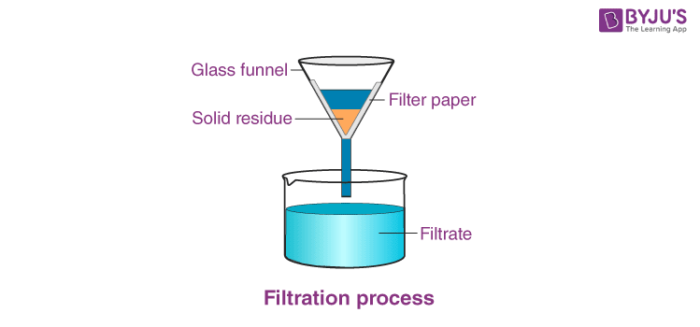
Filtration
A physical separation technique used to separate undissolved solids from liquids or gases by passing the mixture through a filter medium.
Residue
The solid material trapped on the filter paper after filtration.
Filtrate
The liquid or gas that passes through the filter medium during filtration.
Evaporation
A separation technique used to recover dissolved solids from liquids by boiling or vaporizing the liquid component.

Distillation
A method used to separate miscible liquids with different boiling points by boiling the mixture and condensing the distinct vapors.
Extraction
A laboratory technique used to separate two immiscible liquids that do not dissolve in one another.
Chromatography
A technique used to separate and identify individual dissolved components in a liquid mixture.
Wafting
The technique of using your hand to wave vapors toward your nose to smell a substance safely without direct inhalation.
Acid to Water Rule
The required procedure to always add acid to water (never water to acid) to avoid rapid heat release and explosive splashing.
Safety Shower
Emergency lab equipment used to rinse major chemical spills over large body areas for 5 to 10 minutes.
Eyewash Station
Emergency equipment used to flush chemical splashes out of eyes for 10 to 15 minutes continuously.
Heat Proof Pad
A protective pad placed under hot glass equipment to prevent damage to laboratory benchtops.
Glass Waste Container
A designated container specifically meant for disposing broken glass safely, separate from regular garbage bins.