Lecture 2 - Respondent & Operant Conditioning
 Call Kai
 Learn
Learn Practice Test
 Spaced Repetition
 Match
Match Flashcards
 Knowt Play
1/74

There's no tags or description
Looks like no tags are added yet.
Name | Mastery | Learn | Test | Matching | Spaced | Call with Kai | Chat |
|---|
No analytics yet
Send a link to your students to track their progress
75 Terms
Reinforcement:
• Is a basic principle of behavior
• Was established by B.F. Skinner in laboratory research and over 40 years of human research
• Is a component of many (most) Behavior Modification procedures
Defining Reinforcement
1. The occurrence of a behavior
2. Results immediately in a consequence
3. The behavior is strengthened (more likely to occur again in the future in similar circumstances)
** Functional definition of reinforcement
• Present: Behavior is followed by a consequence
• Future: Behavior is more likely to occur
Effects of Reinforcement on Behavior
• Increase in frequency
• Increase in duration
• Increase in intensity
• Increase in quickness (decrease in latency)
• You get more of whatever the reinforcer is contingent on
example of reinforcement in your everyday life
Reinforcement or not: 1. Guy taunts girl and get slapped, guy keeps taunting girl in future.
Reinforcement or not: 2. Kid answers question correctly and gets praise
Reinforcement or not: 3. Mom asks kid nicely to make bed, kid makes bed, mom continues to ask kid nicely to make bed
Reinforcement or not: 4. Mom nags kid to make bed, kid complies, mom less likely to nag
Reinforcement or not: 5. Man chooses lottery ticket from a specific gas station, wins lottery, continues to buy lottery tickets from same gas station
Reinforcement or not: 6. Boy sticks fork in toaster and gets shock, and is more likely to stick fork in toaster
Reinforcement or not: 7. Teenager plays music loud, mom comes into his room and sits by him and asks him how his day was, kid less likely to play music loud
Reinforcement or not: 8. Alarm goes off, you slap the off button, and aversive alarm sound is terminated
What is Operant Behavior?
• Behavior that is strengthened through the process of reinforcement - behavior that is controlled by its consequences
What is a Reinforcer in the context of operant behaviour?
• The consequence (stimulus or event) that follows operant behavior and strengthens operant behavior
• Reward vs. reinforcers
Two types of reinforcement
Positive reinforcement
Negative reinforcement
Both positive reinforcement and negative reinforcement strengthen behavior - they make the behavior more likely to occur in the future
What is Positive Reinforcement?
(addition of a stimulus or consequence)
Behavior is followed by the presentation of a stimulus (a reinforcer) and the behavior is strengthened
Positive Reinforcement example
What is Negative Reinforcement?
Behavior is followed by the removal of a stimulus (a punisher / aversive stimulus) and the behavior is strengthened
(removal of a stimulus or consequence)
Negative Reinforcement example
Escape/avoidance behaviours are involved in _______
negative reinforcement
Escape
the behavior results in the termination of (escape from) the aversive stimulus and the behavior is strengthened.
Aversive stimulus starts → behaviour stops it

Avoidance
the behavior results in the prevention of (avoidance of) the aversive stimulus and the behavior is strengthened.
Aversive stimulus hasn't started → behaviour prevents i

Negative or Positive Reinforcement: Push the power button on the TV remote to turn on the TV
Negative or Positive Reinforcement: Put on a coat on a cold day
Negative or Positive Reinforcement: Use an umbrella
Negative or Positive Reinforcement: Slap a mosquito
Negative or Positive Reinforcement: Turn up the volume on your i-pod
Negative or Positive Reinforcement: Close the window when it rains
Negative or Positive Reinforcement: Wear earplugs on a noisy job
Negative or Positive Reinforcement: Click on the “Explorer” icon and get to the internet
Negative or Positive Reinforcement: Turn off the alarm buzzer
Negative or Positive Reinforcement: Give in to a screaming kid
Negative or Positive Reinforcement: Screaming kid gets an treat in a store
Negative or Positive Reinforcement: Tell someone to be quiet in a movie
Positive and Negative Reinforcement in the Same Situation
Tantrum in a grocery store
• Child’s tantrum behavior is strengthened by getting candy from a parent (positive reinforcement)
• Parent’s behavior of giving candy to child is strengthened by termination of the tantrum (negative reinforcement)
Unconditioned Reinforcers
• Biologically determined - survival value for the individual
• Food, water, human contact (warmth), oxygen, sexual contact, escape from cold, heat, pain, etc.
Conditioned Reinforcers
• A previously neutral stimulus
• repeatedly paired with an established reinforcer (an unconditioned or conditioned reinforcer)
• will function as a reinforcer
Examples of Conditioned Reinforcers
• Sight, sound, and scent of parents
• Parents’ smile, tone of voice, attention, praise
• Types of toys, TV shows, music, clothes, activities
• Grades, positive evaluations
• Accomplishments (social, physical)
• Money
• Others
Conditioned Generalized Reinforcers
• Paired with a wide variety of other reinforcers
• Ex: Money, praise, tokens
Factors that Influence Reinforcement
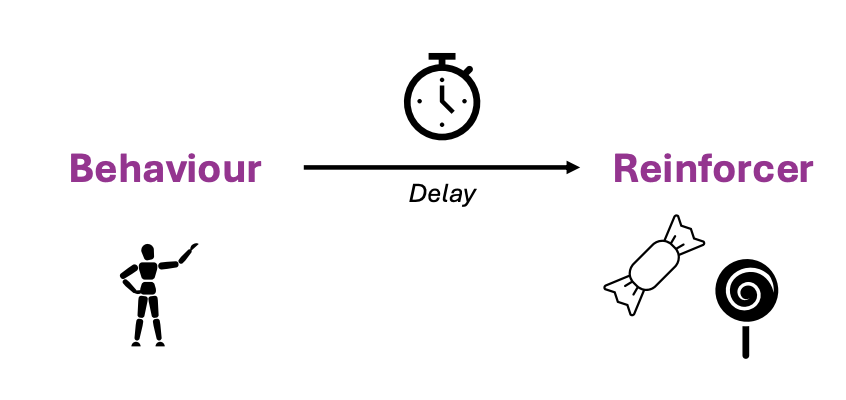
• Immediacy
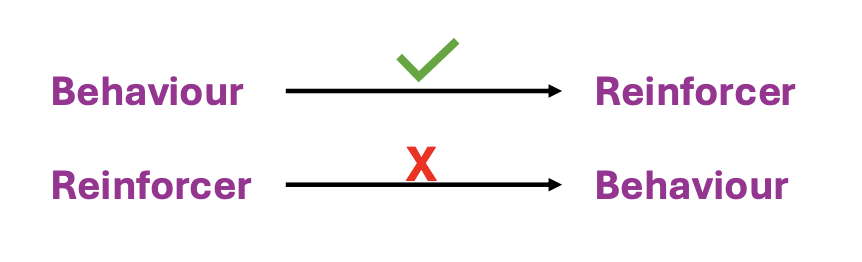
• Consistency (contingency)
• Motivating operations (EO and AO)
• Individual differences
• Intensity/magnitude of the stimulus
• Concurrent schedule of reinforcement or punishment
Immediacy
Consistency (contingency)
Motivating operations (EO and AO)

Individual differences
Intensity/magnitude of the stimulus
Concurrent schedule of reinforcement or punishment
Respondent Conditioning aka
(also known as: Classical Conditioning or Pavlovian Conditioning)
Unconditioned Reflexes
• US → UR
• Unconditioned stimulus elicits an unconditioned response
Respondent Conditioning
• Initially:
US → UR
• Process:
NS → US → UR
*neutral stimulus (NS) paired with US
• Outcome:
CS →CR
After pairing with the US, the NS becomes a conditioned stimulus (CS) that now elicits a conditioned response (CR)
Examples of Respondent Conditioning
• Pavlov’s dog
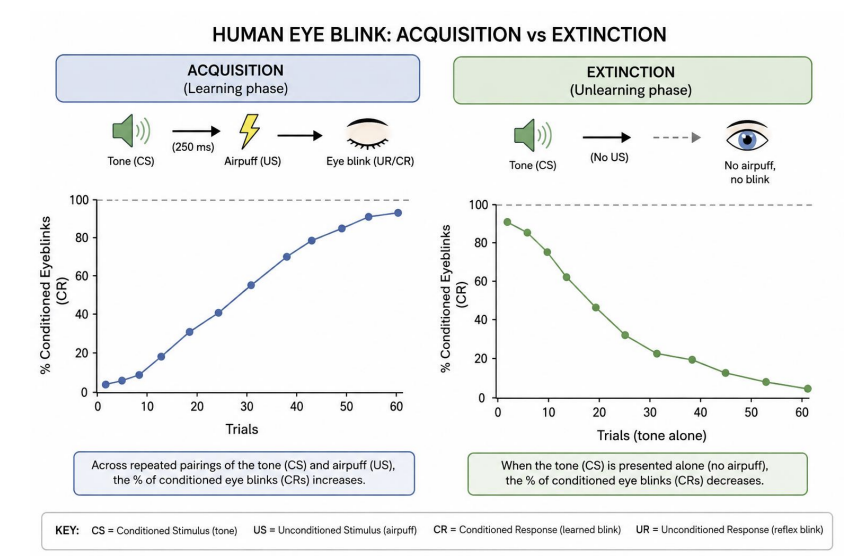
• Eye blink example
• Tone (NS) + Blowing air (US) in eye and eliciting eye blink response (UR)
• Fear/phobia
Respondent Extinction
• Present the CS repeatedly without the US
• The CS will no longer elicit a CR
Respondent Extinction examples
Spontaneous Recovery
• After respondent extinction has occurred
• The CS may once again elicit a CR
Spontaneous Recovery example

Higher Order Conditioning
• Intially:
CS1→ CR
• Process:
NS (soon to be CS2) paired with CS1
• Outcome:
CS2 → CR
Factors Influencing Respondent Conditioning
• The nature of the NS and US
• Timing of the NS and the US
- Trace conditioning
- Delay conditioning
- Simultaneous conditioning
- Backward conditioning
• Consistent pairing of the NS and US
• The number of pairings
> more pairings = stronger learning
• Previous exposure to the NS can diminish learning
Trace conditioning

Delay conditioning

Simultaneous conditioning

Backward conditioning

Conditioned Emotional Responses (CER)
• Negative (unpleasant) CERs (Involves autonomic nervous system arousal)→ Fear, Anxiety, Anger
• Positive (pleasant) CERs → Love, Happiness, Pleasure
Discrimination and Respondent Behavior
• A single CS or narrow range of CSs elicit a CR
• Example: Fear of one specific dog
Generalization of Respondent Behavior
• A number of similar CSs elicit the same CR
• Example: Fear of all dogs
Contrasting Respondent and Operant Conditioning

Operant and Respondent Behavior Together
Example:
Running from the crow (operant)
Autonomic arousal elicited by the crow (respondent)
Operant or respondent behavior: 1. Worker dog gets up when audience applauds
Operant or respondent behavior: 2. Woman experiences shortness of breath when seeing a spider
Operant or respondent behavior: 3. Dad gags when he smells his kid’s vomit
Operant or respondent behavior: 4. Dad holds his breath when he sees vomit
Operant or respondent behavior: 5. Kid is startled when urine alarm sounds at night
Operant or respondent behavior: 6. Kid gets out of bed when urine alarm sounds
Operant or respondent behavior: 7. Kid screams for dad when startled by a snake
Respondent Conditioning and Behavior Modification
• Relaxation training
• Exposure therapy
• Treatment for fears/phobias
• Aversion therapy