BIO325 Midterm 3 Terms
 Call Kai
 Learn
 Practice Test
 Spaced Repetition
 Match
 Flashcards
 Knowt Play
1/103

There's no tags or description
Looks like no tags are added yet.
104 Terms
Genome
Complete set of genetic material (DNA) in an organism
Restriction enzyme
An enzyme that cuts DNA at specific sequences called recognition sites that are 4-6 bp long.
Process is called digestion
Compatible ends
DNA ends that can join together because their sequences can base pair
Partial DNA digestion
Incomplete digestion that cuts only some recognition sites
Done by: reducing amount of restriction enzyme used, reducing time of digestion
Gel electrophoresis
Technique that separates DNA, RNA, or proteins based on size and charge using an electric field
Molecular cloning
Process of making many copies of DNA fragment by inserting it into a host organism
isolate DNA fragment of interest
Cut and insert into a plasmid
Transform bacteria
Cloning vector/ plasmid
Self replicating DNA molecule used to carry foreign DNA into a host cell
Polylinker
Short DNA sequence in a vector containing multiple unique restriction enzyme sites.
is the primary insertion site for foreign DNA b/c it provides so many restriction sites
Artificial chromosome
Engineered chromosome used to carry large DNA fragments in cloning experiments.
Can carry much larger pieces of DNA than ordinary plasmids. Good for cloning large genes, multiple genes, large sections of a chromosome, entire genomic regions
Genomic library
A collection of cloned DNA fragments that together represent an organism’s entire genome
dNTPs (Deoxyribonucleotide triphosphate)
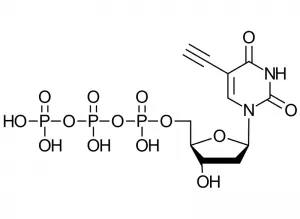
Building block of DNA
-Base
-deoxyribose sugar (only one OH on the 3’)
-Phosphate group
Anneal
Allows complementary nucleic acid strands to bind together during base pairing
Hybridization
Pairing of complementary DNA or RNA strands from different sources
ddNTP (dideoxyribonucleotide triphosphate)
Modified nucleotide without the 3’ OH, causing DNA chain termination during sequencing
Whole genome shotgun sequencing (WGSS)
Entire genome is randomly fragmented, sequenced, and computationally assembled
Sanger Sequencing
Sequencing random unknown fragments of DNA by using ddNTPs with fluorescent tags to terminate synthesis at specific bases
Contig
continuous DNA sequences assembled from overlapping sequencing fragments
DNA polymorphisms
Naturally occuring variations in DNA sequence among individuals that can be used to study inheritance, identity, and disease
-Non-Anonymous: have an effect of gene function
Anonymous: no effect on gene function
-Watson, Venter, YH: comparisons of their genomes shows millions of DNA polymorphisms
DNA marker
A known DNA sequence or variation used to identify individuals, track inheritance, or locate genes
SNP— Single nucleotide polymorphism
DNA variation involving a single nt change at a specific position in the genome
-Most common (1/ every 10kb)
-USES: genome-wide studies, disease association studies
DIP— Deletion-Insertion polymorphism
DNA variations caused by the insertion or deletion of one or more nucleotides
SSR— Simple sequence repeats
Short DNA seuqences repeated in tandem multiple times. Highly variable among individuals
-Highly polymorphic, has more info per marker
-USES: paternity testing, forensics, linkage analysis
Slipped mispairing/ stuttering
Replication error where DNA pol slips on repetitive seuqences and changes the number of repeats
eg. Huntington’s disease
Polymerase Chain Reaction (PCR)
Method used to isolate and amplify a specific DNA fragment and producing millions of copies
Denature
Anneal
Hybridization
PCR primers
Short DNA sequences that bind to target DNA and provide a starting point for DNA synthesis during PCR
-Primers attached such that amplified sequence is within primer regions
-Can also help identify chromosomal rearrangements (eg. inversions, deletions, duplications)
Whole Exome Sequencing
Sequencing of all protein-coding regions (exons) in a genome to identify genetic variants
-capture exons with probes that only bind to exons and wash away everything else
-Sequence captured exons
Prenatal Genetic Diagnosis
Testing performed before birth to detect genetic abnormalities in a fetus
-Uses mother’s blood (Non-Invasive prenatal testing (NIPT)) or embryonic fluid (amniocentesis)
-PCR analyzation and sequencing
CODIS— Combined DNA Index System
FBI database that stores DNA profiles for forensic identification and criminal investigations
Allele Specific Oglionucleotides (ASOs)
Short DNA probes designed to detect specific alleles or mutations through hybridization
-USES: Microarray analysis, dot blot analysis, southern blotting
DNA Microarray
Chip containing thousands of DNA probes with specific sequences used to analyze gene expression or genetic variants
Positional cloning
Method used to link a SNP to a disease
Analyzation of pedigrees containing multiple affected individuals
Perform linkage analysis— SNPs or SSRs used as DNA markers and analyzed
Narrow chromosomal region
Identify candidate genes
Sequence candidate genes— compare affected and unaffected
Confirm the disease gene
Allelic Heterogeneity
Different mutations in the SAME gene cause the same disease
eg. cystic fibrosis
Locus Heterogeneity
Same mutation in different genes causing the same disease. Complementation can occur by crossing over
eg. deafness
Compound heterozygotes
Individuals who carry two different mutant alles of the same gene, one on each chromosome
High-throughput sequencing
Rapid sequencing tech capable of analyzing milions of DNA fragments simultaneously
Types of chromosomal rearrangements
deletions
duplication
inversion
translocation
reciprocal translocation
Reciprocal translocation
Exchange of chromosomal segments between two non homologous chromosomes. Each chromosome recieves genetic info from the other (hence reciprocal)
Mechanisms of chromosomal rearrangements
Illegitimate crossing over— recombination between nonhomologous DNA sequences—> deletions, duplications, or translocation
DNA breakage
Rearrangement breakpoint
sites on chromosomes where breaks occur during structueal rearrangements
Deletion loop
Loop formed during meiotic pairing when one homolog contains a deletion absent from the other
-Appears on the NORMAL WT chromosome

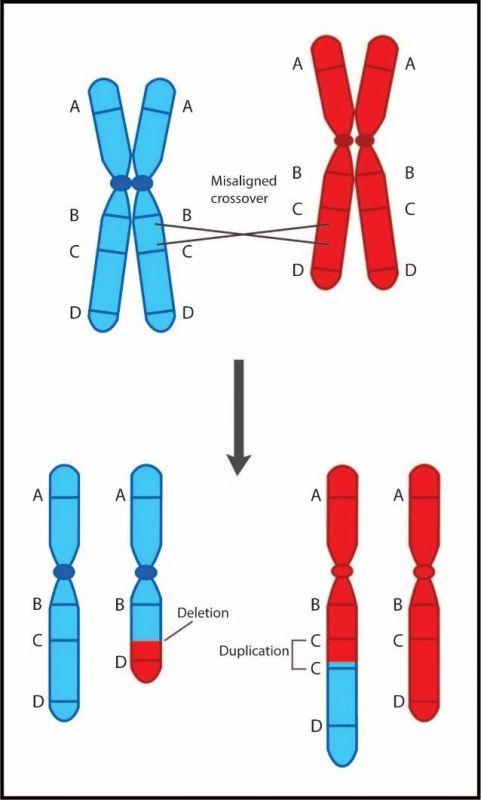
Unequal crossing over
Misaligned homologous chromosomes exchange unequal segments, producing duplications and deletions
Semisterility
Reduced fertility
Causes: seen in translocation heterozygotes b/c they produce unbalanced gametes
Pseudolinkage
Apparent linkage between genes on a different chromosome caused by a translocation
Robertsonian translocation
Translocation such that 2 long arms of acrocentric chromosomes fuse together
Transposition
WITHIN the genome. Movement of a TE
Transposable Element (TE)
Mobile DNA sequences capable of moving within a genome
-Regulate gene function, transcription rate
2 Mechanisms of TE Movement
-Retrotransposons: move thorugh an RNA intermediete using reverse transcription
-DNA transposons: TE moves directly as DNA with a transposase enzyme
Types of retrotransposons
-LINEs (Long interspersed elements): Autonomous retrotransposons that encode proteins needed for their OWN movement
-SINEs (short interspersed elements): Nonautonomous retrotransposons that rely on LINE machinery for movement
HERVs (human endogenous retroviruses): Ancient viral sequences integrated into the human genome and inherited across generations
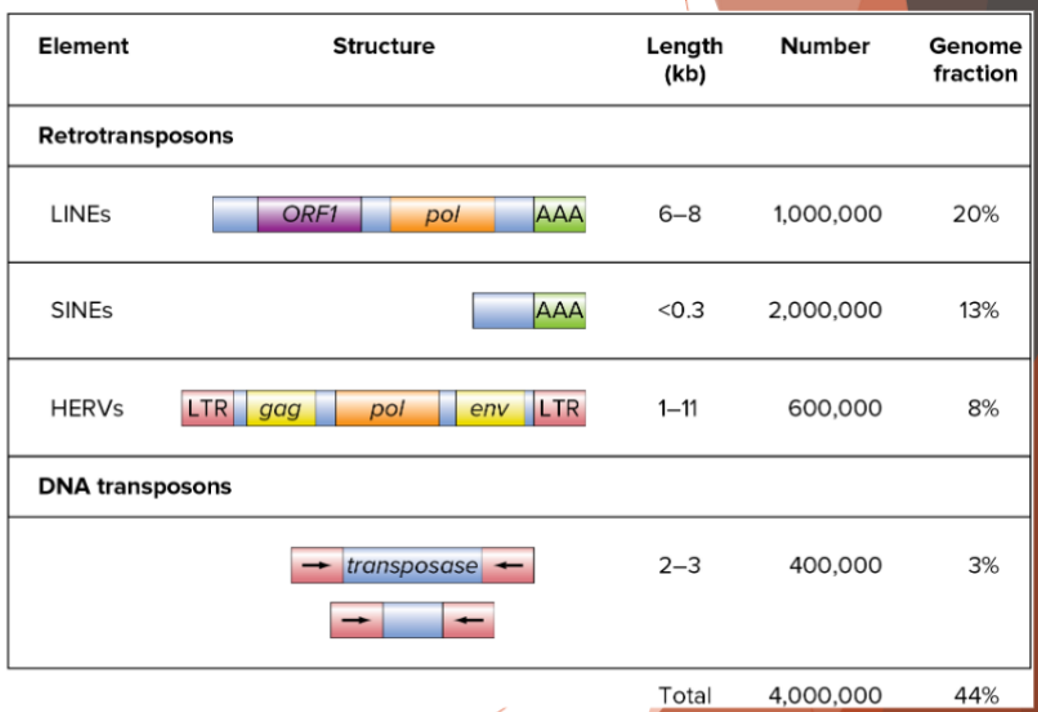
Transposase
Enzyme that catalyzes the movement of DNA transposons
Inverted repeats
Short DNA sequences at opposite ends of many TEs that are recognized by transposase
Mitochondrial Gene Therapy
Oocyte nuclear transfer: nuclear transfer from an oocyte with mutant mitochondria to an oocyte with normal mitochondria. Results in cyrbids (cytoplasmic hybrids)
Transgenic organism
Organism containing DNA from another species introduced through genetic engineering
Transgene
A foreign gene inserted into an organism’s genome
Pronuclei
In a fertilized egg, Haploid nuclei of sperm and egg before they fuse after fertilization.
Involved in making transgentic mice: Transgene inserted into the male pronuclei, DNA integrated into chromosome, embryo implanted into surrogate mother
Methods to make transgenic organisms
-pronuclei injection: A method of creating transgenic animals by injecting DNA into a fertilized egg's pronucleus.
-P element transformation: A method used in Drosophila that employs P transposons to insert foreign DNA into the genome.
-Agrobacterium-mediated T-DNA transfer: Uses Agrobacterium to insert genes into plant genomes
T-DNA
Transfer DNA from the Ti plasmid that integrates into the plant genome
Pharming
Production of pharmaceutical proteins using genetically engineered plants or animals
Reproductive cloning
Creation of a genetically identical organism through nuclear transfer
Genetically modified crops
crop plants whose genomes have been altered to express desired traits
eg. glycosphate resistant soybeans, insecticide corn
Targeted mutagenesis
Intentional creation of mutations at a specifc DNA location
Chimeras
Organisms containing cells from two or more genetically distinct sources
Knock-out mice
mice engineered to have a specific gene inactivated
gene “knocked out”, usually have essential genes knocked out
-Conditional knockout mice: gene is only inactivated in specific tissues and at specific times
Knock-in mice
Mice engineered to contain a specific inserted or modified gene
Cre/loxP recombination system
A site-specific recombination system used to delete, invert, or modify DNA
Floxed
A DNA sequence flanked by loxP sites.
CRISPR-Cas-9
A genome-editing tool that uses guide RNA and Cas9 to cut specific DNA sequences.
Cas Protein: CRISPR-associated enzymes that cut or modify nucleic acids.
sngRNA: recognizes and binds to the DNA
Gene Therapy
Treatment of disease by introducing, replacing, or editing genes
In vivo gene therapy
Can access the tissues directly, delivery directly into cells
Ex vivo gene therapy
Cells removed, genetically modified, and returned to patient
Retroviral vectors
Gene delivery systems derived from retroviruses that integrate into the host genome.
Permanant fix, but can spread to other cells and may cause cancer
Adeno-associated viral vectors (AAV vectors)
Viral vectors commonly used in gene therapy that generally produce long-term gene expression with low pathogenicity.
-don’t integrate into host genome
Homolog
A gene or protein that shares a common evolutionary ancestor with another gene or protein
Conserved DNA
DNA, RNA, or protein sequence that’s similar in terms of sequence and function between two organisms
-Likely means that that DNA encodes something essential
Retroviruses
Viruses that use RNA as their genetic material and replicate through a DNA intermediate
RNA-dependent DNA polymerase
-Used by retrotransposons for movement
-Enzyme that synthesizes DNA with an RNA template
-Make single stranded cDNA from RNA transcript of the retrotransposon
DNA-dependent DNA polymerase
-Used by retrotransposons for movement
-Turn 1x stranded cDNA to 2x stranded cDNA
Centromere
Chromosome region where sister chromatids are joined and where spindle fibers attach during cell division
Orthologous Genes
Homologous genes in different species that evolved from a common ancestral gene through speciation and often retain similar function
Paralogous Genes
Homologous genes within the same genome that arose by gene duplication and may evolve different functions
Psuedogenes
Nonfunctional DNA sequences derived from once-functional genes that have accumulated disabling mutation
De Novo Genes
“Young genes” that developed recently. Originated from previously non-coding DNA—> young
Causes:
-Intergenic regions already being transcribed gain an ATG/coding region
•-Intergenic regions that already contain an ATG/coding region gain
transcriptional control elements
RefSeq
Database providing reference sequences for genomes, genes, transcripts, and protein
BLAST
Tool used to compare nt or protein sequences against databases to identify similarity and possible evolutionary relationships
OMIM
Medical database catalogue of human genetic disorders, their associated genes, inheritance pattern, molecular mechanisms, known disease causing variants

UCSC
Visual representation of genome and sequences

Basic chromosome number
X
The number of chromosomes that make up a single complete chromosome set
Haploid number
N
Euploidy
Humans have 2 sets of chromosomes 2n
Aneuploidy
Certain chromosome out of the entire collection is unbalanced
Polyploidy
-More than 2 complete sets of chromosomes
-3x, 4x, 5x
-In humans: always LETHAL
-In plants: usually infertile (many fruits are polyploid)
Monosomy
2n-1
Trisomy
2n+1
Mitotic Non-Disjunction
Mosaic organisms
Expression depends on the tissue type that contains the aneuploidy
Meiotic nondisjunction
Meiosis I- homologous chromosomes fail to separate
Meiosis II- Sister chromatids “ “
Monoploid (haploid)
X
Autopolyploid
Polyploid where all chromosome sets are from the same species
cause: defective mitosis, where 2 cells don’t form but chromosomes separate
eg. polyploid fruits, usually bigger and seedless
Allopolyploids
Hybrid polyploid. Chromosomes from 2+ different species
Eg. Broccolini, tangelo (tangerine + pomelo)
Bivalent
2 by 2 pairs that are aligned together during meiosis I