ANCIENT MED. ART STUDY GUIDE
 Call Kai
 Learn
 Practice Test
 Spaced Repetition
 Match
 Flashcards
 Knowt Play
1/39

There's no tags or description
Looks like no tags are added yet.
40 Terms
Pebble with natural wear that resembles a human face, Makapansgat, South Africa, 3,000,000 BCE. Reddish brown jasperite [approx. 2 ½ in wide]
PALEOLITHIC
- NOT created or carved in
- opens up the idea of what art can be, and whether it has to be crafted or not

Nude woman (nickname: Venus of Willendorf), from Willendorf, Austria, 28,000-25,000 BCE. Limestone [4 ¼ in high]
PALEOLITHIC
- suggested meaning is fertility and childbirth
- exaggerated form, carved in the round, head is non-representational

Swimming reindeer, from Montastruc, France, 11,000 BCE. Mammoth ivory [approx. 8 in long]
PALEOLITHIC
- observational art
- indicates the importance of close looking for object production

Rhinoceros, wounded man, and disemboweled bison, painting in the cave at Lascaux, France, 16,000 - 14,000 BCE. Bison [3 ft 4 ½ in long]
PALEOLITHIC
- elements of Art present: line, shape, form, space
- elements of composition present: proportion, movement, pattern, etc
- may be representing narrative
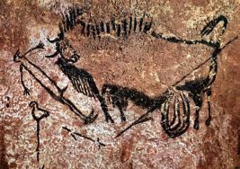
Aurochs, horses, and rhinoceroses, wall painting in the Chauvet Cave, France, 30,000-28,000 or ca. 15,000-13,000 BCE. [Right rhinoceros: 3 ft 4 in long]
PALEOLITHIC
- Aurochs: extinct species of ox
- impression of movement (legs in an angle seeming to move forward)
- large painting, entire ceiling of the cave section was used

Deer hunt, detail of a wall painting, Çatalhöyük, Turkey, ca. 5750 BCE.
NEOLITHIC
- shows momentum in static image
- view in profile, torso frontal(composite view)
- represents humans in groups, organized social activity

Nude seated woman, Çatalhöyük, Turkey, ca. 6000 BCE. Terracotta [approx.. 4 ¾ in]
NEOLITHIC
- focus on pregnancy, childbirth and bearing
- mother goddess perhaps
- art such as this suggests Catalhoyuk was an egalitarian society
- may represent idealized woman, ancestor, pregnant woman etc.

Göbekli Tepe, Turkey, ca. 9000 BCE.
NEOLITHIC
- world earliest largest acrhi.
- Def a communcal place, purpose? not sure. def NOT for living
- gave rise to the idea that perhaps communal archi. encouraged ppl to settle in communites
- megalith stones w/ relief carvings

Passage grave, Newgrange, Ireland, ca. 3200-2500 BCE.
NEOLITHIC
- Passage tomb: long corridor leading to a burial chamber
- archi. controls movement of the body through space
- INTO structure rather than up to.
- cosmic aspect: a beam of light enters directly thru the chamge during solar solstice

Stonehenge, Salisbury Plain, England, ca. 2550-1600 BCE.
NEOLITHIC
- lit up perfectly w/ summer and winter solstices
- TRILITHONS (type of post and lintel structure)
- shows that builders carefully studied the sky
& incorporated that into archi.

White Temple and ziggurat, Uruk (modern Warka), Iraq, 3200-3000 BCE.
BRONZE AGE MESOPOTAMIA
- dedicated to sun god ANU
- temple elevated towards sky > closer to god
- temple at top with "cella" room w/ podium and altar, deity wld appear only to priests
- color and pattern of building wld be striking against landscape

The 'Warka Vase' from the Inanna temple complex, Uruk (modern Warka), Iraq, 3200-3000 BCE. Alabaster [3 ft ¼ in high]
BRONZE AGE MESOPOTAMIA
- hierarchy of scale in figures!
- earliest known work of narrative relief sculpture, low relief
- animals and crops > procession offering > goddess and priest-king

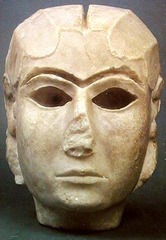
Female head (Inanna?), from the Inanna temple complex, Uruk (modern Warka), Iraq, 3200-3000 BCE. Marble [8 in high]
BRONZE AGE MESOPOTAMIA
- anthropomorphic qualities that perhaps visualize the imaginable or the impossible
- marble suggests elite statues/height = godliness
Early writing tablet recording the allocation of beer, found in southern Iraq, 3100-3000 BCE. Baked clay [3 ½ in long]
BRONZE AGE MESOPOTAMIA
- CUNEIFORM! (invented by Sumerians)
- Writing created to record trade and inventories

Banquet scene, cylinder seal (left) and its modern impression (right), from the tomb of Pu-abi (tomb 800), Royal Cemetery, Ur (modern Tell Muqayyar), Iraq, 2600-2400 BCE. Lapis lazuli [approx. 2 in high, 1 in diameter
BRONZE AGE MESOPOTAMIA
- banquet scene w/ a man sitting enjoying food
- highlights the ability of society that has enough wealth to depict & create items that display leisure!

War side of the Standard of Ur, from Tomb 779, Royal Cemetery, Ur (modern Tell Muqayyar), Iraq, 2600-2400 BCE. Wood, shell, lapis lazuli, and red limestone [8 in x 1 ft 7 in]
BRONZE AGE MESOPOTAMIA
- don't know original use
- symbolizes trade market, lots of rich materials used
- careful order of war represented in registers
- elements of art: color, pattern, form, line etc

Votive disk of Enheduanna, from Ur (modern Tell Muqayyar), Iraq, 2300 - 2275 BCE. Alabaster [diameter 10 in]
BRONZE AGE MESOPOTAMIA
- earliest record of a poet in human history, Enheduanna, daughter of a king & priestess for Inanna of Ur
- single register, all in same ground line
- alabaster in shape of full moon
- hierarchy of scale used (role of women)

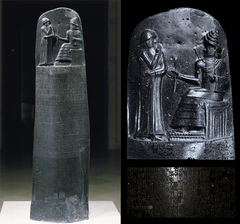
Stele with laws of Hammurabi, set up at Babylon, Iraq, found at Susa, Iran, ca. 1780 BCE. Basalt [7 ft 4 in high]
BRONZE AGE MESOPOTAMIA
- expresses royal authority
-- presence of the god gives further power to king; he's receiving a scepter & ring from Shamash
- horned hat = also sign of given power from the god
Lamassu from the citadel of Sargon II, Dur Sharrukin (modern Khorsabad), Iraq, 721-705 BCE. Limestone [13 ft 10 in high]
BRONZE AGE MESOPOTAMIA
- from side: engaged in movement
- front: strong, protective, legs remain in place and strong
- combination of human intelligence from the head and animal strength from the body
- protectiveness from the wings!

Ashurbanipal hunting lions, relief from the north palace of Ashurbanipal, Nineveh (modern Kuyunjik), Iraq, 645-640 BCE. Gypsum [5ft 4 in high]
BRONZE AGE MESOPOTAMIA
- king showing ability to create order & keeping outside danger
- Kingship order over natural raw nature
-- eventhough lions display immense power of nature, king easily maintains control (he's killed so many alrdy)

Palette of King Narmer from Hierakonpolis, Egypt, Predynastic, 3000-2920 BCE. Slate [2 ft 1in high]
EGYPTIAN ART: LIFE & DEATH
- these palettes were v. common, found in graves
- this one explains narrative of kinship - gives us glance into pre-dynastic Egypt:
-- shows king & enemies but also diff. representations of the king and other gods

King Den's Sandal Label, from Abydos (near Luxor), Egypt, around 2985 BCE. Hippopotamus ivory [1 ¾ in high]
EGYPTIAN ART: LIFE & DEATH

Stepped Pyramid and funerary complex of King Djoser, Saqqara, Egypt, Third Dynasty, 2630-2611 BCE.
EGYPTIAN ART: LIFE & DEATH
- designed by master architect Imhotep (deified after death)
- this complex transforms a royal tomb into entire complex of divine n royal archi.
- walls of complex act as a barrier of who gets in n out
- INNOVATIVE: column shafts w/ papyrus stalk motif, symbolizes permanence of living things after life

Khafre enthroned, from Giza, Egypt, Fourth Dynasty, 2520-2494 BCE. Diorite [5 ft 6 in tall]
EGYPTIAN ART: LIFE & DEATH
- Diorite: v. strong stone= indestructible symbol
- frontal pose shows kings as timeless, mirror symmetry
- idealized body/face = permanence
- serene & still = timeless & eternal

Seated scribe, from Saqqara, Egypt, Fourth Dynasty, 2500 BCE. Painted limestone [1 ft 9 in tall]
EGYPTIAN ART: LIFE & DEATH
- naturalistic but realistic (life-like in appearance but shows aging/flaws)
- shows scribes as soft/plump,
- expressed privilege through intellectual exercise (writing tool) rather than physical

Hatshepsut with offering jars, from the upper court of her mortuary temple, Deir el-Bahri, Egypt, 18th Dynasty, 1473-1458 BCE. Red granite [8 ft 6 in tall]


Temple of Amen-Re, Karnak, Egypt, 19th Dynasty, ca. 129- 1224 BCE.
- Reflects importance of Amun-Re, shows layers of divinity
- AXIAL PLAN = symmetrical off a central axis
- huge complex, sacred lake signified Amen-Re as creator of the world
- Karnak temple NOT built at once, successive pharaohs kept adding to it
-- Pylon gates
**Architecture controlled space and landscape, different experiences bc of access given to diff ppl**

Akhenaton, Nefertiti, and three daughters, from Amarna, Egypt, 18th Dynasty, 1353-1335 BCE. Limestone [1 ft ¼ in high]
- Elevated Aton
- Ruler founded a new capital to celebrate this new god
- Divine blessing given to the world through the royal family
- Hierarchy of scale w/ daughters, proportions are elongated,

Bust of Nefertiti, found in the workshop of Thutmose, from Amarna, Egypt, 18th Dynasty, 1353-1335 BCE. Painted limestone [1ft 8 in high]
- This was a model for other artists to follow in their own artistic reproduction
- blended w/ idealism
-- relaxed smooth face, high cheekbones = ideal royal woman, individual set of yes = individuality represented
- Elegance and representation tells us she held an unusual royal/religious authority

Painted chest with battle and hunt scenes, from the Tomb of Tutankhamen, Thebes, Egypt, 18th Dynasty, 1333-1323 BCE. Wood [1 ft 8 in long]
- Hierarchy of Scale: king and chariot are huge un comparison to crammed figures in chaotic mess
- Represented as active warrior (like lion hunt from Assyrian reliefs!)
- Pharaoh as protector of cosmic order
-- Continuity: previously depicted motifs of order and war in previous art before Tutankhamen

Figurine of a woman, from Cyclades, 2500-2300 BCE. Marble [1 ft 6 in tall]
- Nude women, folded arms, lots have been looted
- Abstract, painted, and perhaps accessorized w/ jewelry
- Feet pointed downward, emphasizes funerary significance: they would be lying down in graves
Palace at Knossos on the island of Crete, 1700-1370 BCE.
-Function: administrative, religious, commercial
-Clusters of rooms arranged around a central rectangular court
-Mostly made of stone; would have been painted, decorated with painted figurines, frescoes, etc


Bull-leaping, from the palace at Knossos, Crete, ca. 1500 BCE. Fresco [2 ft 8 in high]
- Figures have elongated bodies, showing movement and dynamism
- Bull = strong horizontal force, ruptured by elongated bodies
- Bronze Age is uncertain, but bull is of clear importance

Landscape with swallows (Spring Fresco), from Room Delta 2, Akrotiri on the island of Thera, Cyclades, 1650-1625 BCE. Fresco [7 ft 6 in high]
- Reds, Blues, Yellows (not naturalistic, form still conveys naturalism)
- Curved lines = elegance
- Repeated line and form = epmhasizes rythm of nature, renewal of seasons and cycles of life.
Harvester Vase, from Hagia Triada, Crete, ca. 1500 BCE. Steatite, originally with gold leaf [greatest diameter 5 in]
- Central figure seems to be singing, others shown lively
Procession of harvesting
- Crowded with collective movement/labor & communal activity
- Not anatomically correct in modern sense, but in the artist's clear anatomical understanding of the human body

The 'Lion' gate at Mycenae, 1300-1250 BCE.
Megaron in the 'Palace of Nestor', ca. 1300 BCE.
Treasury of Atreus, Mycenae, Greece, 1300-1250 BCE.
Hunter capturing a bull, drinking cup from Vapheio, near Sparta, Greece, 1600-1500 BCE. Gold [3 ½ in high]
Wine-mixing bowl (krater) (nickname the Warriors Vase), from Mycenae, ca. 1200 BCE. Ceramic [1 ft 4 in tall]