SBMS1431 Human Anatomy and Physiology I
 Call Kai
 Learn
 Practice Test
 Spaced Repetition
 Match
 Flashcards
 Knowt Play
1/23

Earn XP
Description and Tags
SESSION C: OXYGEN AND CARBON DIOXIDE TRANSPORT
24 Terms
Atmospheric Pressure
Can be measured using a barometer
The atmospheric pressure at sea level is 760 mmHg
Pascal (Pa) - SI derived unit
Units of pressure or stress
e.g standard atmosphere (atm) 101325 Pa

Dalton’s Law
Partial Pressure: The pressure of an individual gas, which can be measured by multiplying the % of that gas by the total pressure
e.g. CO2 accounts for only 0.03% of the atmosphere:
Thus, the partial pressure of CO2 is 760 × 0.0003 mmHg = 0.23 mmHg
The total pressure of a gas mixture is equal to the sum of the pressured of each gas in it.
Ptotal= P1+ P2+ P3 +… Pn
Total Pressure
Air is composed almost entirely of two gases: nitrogen and oxygen. (Other gases such as CO2 Ar, Ne, He, CH4 are not as abundant)
Nitrogen makes up about 79% of the atmosphere and O2 about 21%, in addition to water vapor:
Pair = PN2 + PO2 + PH2O =760 mmHg
Assuming zero humidity:
PN2 = 0.79 × 760 mmHg= 600 mmHg
PO2 = 0.21 × 760 mmHg= 160 mmHg
Partial Pressure
At 100% humidity and 37 degrees celsius, partial pressure of water is 47 mmHg
With water significantly contributing to the pressure of air that enters the lungs, the partial pressures of other gases decrease
Example: PN2 :563 mmHg
Example: PO2 : 150 mmHg
Example PCO2: 0.21 mmHg
Partial Pressure of Gas in Blood
Partial pressures of oxygen and carbon dioxide in alveolar air and at various sites in the body

Gas Diffusion from Alveoli to blood
As oxygen diffuses from alveoli to blood, it passes several compartments which are known as alveolar-capillary barrier.

Diffusion Capacity
Diffusion capacity of the lung (DL) is the measurement of alveolar-capillary barrier
It measures the transfer of gas from alveolar air to the red blood cells in lung capillaries
Factors affecting rate of diffusion
Partial pressure gradient of gas across alveolar- capillary membrane:
O2: 60 mmHg
CO2: 6 mmHg
Surface area of alveolar capillary membrane (about 70 m2)
Thickness of alveolar capillary membrane (about 0.5 um)
Diffusion coefficient of gas depends on:
-Solubility of gas (CO2 is 24 times more soluble than O2)
Molecular weight of the gas (CO2 is 1.4 times greater than O2)
Solubility/ √MW
Net effect: Diffusion rate of CO2 is 20 times faster than O2
Rate of Diffusion
Diffusion rate of CO2 is 20 times faster than O2 but equilibrium of CO2 occurs at the same rate as O2
In conditions which impair diffusion, diffusion of O2 is more seriously impaired than diffusion of CO2 because of the larger CO2 diffusion coefficient
This effect is more prominent in patients with pulmonary disorders during exercise

Rate of Gas Diffusion vs Diffusion Capacity
Volume of gas transfer across the alveolar- capillary per unit time is:
Directly proportional to:
Difference in partial pressure of gas between alveolar and capillary blood
Surface area of membrane
Inversely proportional to:
Thickness of membrane
Molecular weight of gas

Diffusion Capacity (DL)
Diffusion capacity of respiratory membrane (DL) is defined as volume of gas which diffuses across the alveolar-capillary membrane per minute for pressure difference of 1 mmHg:
O2: 20 mL/ min/ mmHg
CO2: 400 mL/ min / mmHg
Rate of Diffusion = DL x (P1 - P2 )
DL increases during exercise due to opening of pulmonary capillaries, thus increasing surface area.
O2: 80 mL/ min/ mmHg
CO2: 1600 mL/ min / mmHg
DL decreases in conditions which increases alveolar-capillary membrane thickness (e.g. pulmonary fibrosis) or in conditions which decreases effective area of diffusion (e.g. collapse, emphysema)
Transport of Gases in the Blood
Oxygen Transport by Hemoglobin (Hb)
Each RBC has about 280 million hemoglobin molecules, each of which consists of four subunits
Each subunit contains a globin and a heme group (that contains iron)
The heme groups are each capable of binding to one O2 molecule
% of heme groups containing bound oxygen is called hemoglobin saturation

Oxygen Transport
98.5% of oxygen in blood is carried by Hb
1.5% of remaining oxygen is dissolved in plasma
Each Hb molecule can carry 4 oxygen molecules
Iron of heme group: ferrous state (Fe2+) is functional; ferric (Fe3+) is non-functional (met-hemoglobin)
Presence of 2,3-bisphosphoglycerate (2,3-BPG)
Hemoglobin switching is important for the long term health of individuals
Oxygen Transport by Hemoglobin
The reaction of hemoglobin is as follows:
Hb + O2 ⇌ Hb O2
deoxyhemoglobin + dissolved oxygen ⇌ oxyhemoglobin
Carbon dioxide Transport
Transported in blood in three forms:
Dissolved in plasma
As carbaminohemoglobin attached to an amino acid in hemoglobin
As bicarbonate ions
Carbonic Anhydrase
Enzyme that combines water in CO2 to form carbonic acid at high PCO2
Occurs within RBCS in the capillaries of systemic circulation: H2O + CO2 ——— (carbonic anhydrase) ——→ H2CO3
An increase in carbonic acid favors dissociation into bicarbonate and hydrogen ions
H2CO3 ——→ H+ + HCO3-
Chloride Shift
The exchange of bicarbonate ions out of RBCs and CL- ions into RBCs
H+ ions in RBCs attach to Hb and attract Cl-

Hemoglobin-Oxygen Dissociation Curve
At low PO2 , little O2 is bound to Hb
As PO2 increases, binding increases, and then levels off as saturation approaches 100%
Standardized for normal blood with a pH of 7.4 and temperature of 37 degrees celsius

Factors affecting affinity of Hb for oxygen
PO2
pH
PCO2
Temperature
2,3-BPG
Others: e.g. carbon monoxide
Effects of PO2 of blood
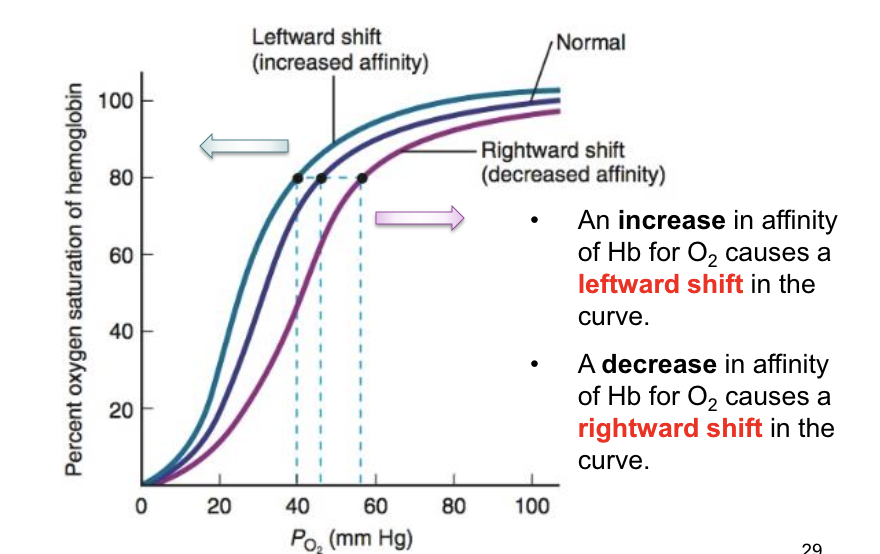
An increase in affinity of Hb for O2 causes a leftward shift in the curve
A decrease in affinity for Hb for O2 causes a rightward shift in the curve
Effect of Blood pH (Bohr Effect)
Bohr Effect
The effect of pH on hemoglobin-oxygen dissociation curve Hb + O2 ⇌ Hb O2 + H+
An increase in [ H+] (i.e a decrease in pH) drrives the reaction to the left, causing some O2 to dissociate from hemoglobin.
When H+ ions bind to Hb, they decrease the affinity of Hb for O2
Significance: In active tissues, [H+] tends to increase, which facilitates O2 unloading
An increases in pH causes an increase in the affinity of Hb for O2 (leftward shift)
A decrease in pH causes a decrease in the affinity of Hb for O2 rightward shift

Effect of PCO2
CO2 reacts reversibly with certain amino groups in hemoglobin to form carbaminohemoglobin
Carbamino effect:
When CO2 is bound to Hb, it changes the conformation of Hb and decreases affinity for O2
Effects of Temperature
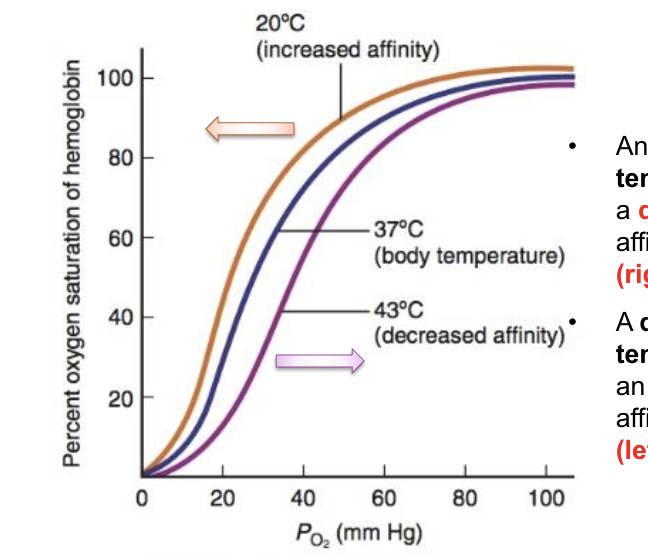
An increase in temperature causes a decrease in the affinity of Hb for O2 (rightward shift)
A decrease in temperature causes an increase in the affinity of Hb for O2 (leftward shift)
Effect of 2,3- BPG/DPG
RBCs have no mitochondria; they generate ATP only by glycolysis, in which lactic acid and 2,3-BPG or 2,3- diphosphoglycerate (2,3-DPG) are formed
2,3-DPG has a direct effect on oxygen binding and release
it decreases the affinity of hemoglobin for O2
The more the 2,3-DPG, the more oxygen is released
If 2,3- DPG levels are low, they have little effect on hemoglobin affinity, and thus hemoglobin will not release oxygen
When oxyhemoglobin levels are low and O2 supply is limited, 2,3- DPG synthesis occurs
An increase in 2,3- DPG synthesis decreases the affinity of hemoglobin for O2, causing an increase in the release of O2 from Hb (rughtward shift)
More unloading of O2 occurs in respiring tissues that need it
