Enzyme Kinetics and Regulation
 Call Kai
 Learn
 Practice Test
 Spaced Repetition
 Match
 Flashcards
 Knowt Play
1/39

There's no tags or description
Looks like no tags are added yet.
40 Terms

Briefly describe the model of binding and catalysis
Binding: enzyme and substrate form an ES complex
Convert: ES forms a product or dissociates back to E + S
Reuse: enzyme is regenerated after product formation
How is enzyme binding a dynamic balance?
The enzyme-substrate complex (ES) is continually forming and breaking down. Its total concentration stays nearly constant because its rate of formation approximately equals its rate of loss
k1[E][S] ≈ (k1 + k2)[ES]
Free enzyme binds substrate at the rate k1[E][S]
ES complex either dissociates at rate k-1[E][S] or forms the product at rate k2[E][S]
How does the Michaelis-Menten connect [S] and V0?
V0 = (Vmax[S])/(Km + [S]). Links an experimental variable to a measurable initial rate.
[S]: the substrate concentration that can vary
Vmax: the limiting rate at a fixed enzyme concentration
Km: the [S] given half the limiting rate
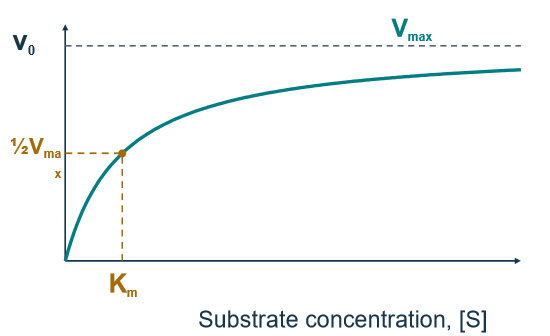
What is the relationship of Km and Vmax on a curve?
x-axis: substrate concentration [S]
y-axis: initial velocity (V0)
When [S] = Km, V = ½ Vmax
When [S] is very high → V0 approaches Vmax
Concentration per-time units
How does enzyme behavior change with substrate concentration?
Low substrate: the rate is approximately proportional to [S]
[S] « Km
Half-maximal: the curve is responsive to [S]
[S] = Km
Near saturation: adding more substrate has minimal effect
[S] » Km
Reaction rate becomes independent of [S] here

What is Km vs Kd?
Km is a kinetic parameter that depends on binding and catalysis
Tells you how tightly an enzyme holds on to its substrate
Lower Km: less S is needed to reach ½ Vmax (higher affinity)
Higher Km: a lot more S is needed to reach ½ Vmax (lower affinity)
Kd is the dissociation constant
Describes the [ ] of S needed to keep ½ the enzyme’s binding sites occupied at equilibrium
Lower Kd → high affinity/tighter binding (small amount of S needed)
Higher Kd →low affinity/weaker binding (large amount of S needed)
What is kcat?
kcat = Vmax/[E]T; represents the turnover per catalytic site
Tells you how many S molecules a single enzyme active site can turn into product in one second when it’s fully functional
Higher kcat: faster, more powerful catalyst
Vmax links total amount of enzyme to max speed of the reaction
[E]T must be the concentration of functional catalytic sites (in matching concentration units)
Units: s-1 or min-1

What is kcat/Km?
Represents the catalytic efficiency (performance) of an enzyme especially when [S] is scarce or limited
The ratio represents how well the enzyme is performing throughout the entire process (finding the substrate and then making a product)
Combines turnover with the low substrate response
Typical units: M-1s-1 or uM-1s-1

How do you make the equation linear?
Via the Lineweaver-Burk method
Takes the reciprocal of the Michaelis-Menten equation
1/V0 = (Km + [S])/(Vmax[S])
Describe how enzymes are efficient, selective, and regulated
Efficient: kcat describes the turnover rate at saturation while kcat/Km describes performance at low [S]
Selective: active-site interactions distinguish among possible substrates
Regulated: effectors and covalent modifications can alter enzyme activity
Catalysis basics
Kinetic measurements
Enzyme inhibition
Regulation within metabolic pathways
ΔG and the equilibrium constant (K) determine how far the reaction proceeds and which direction is thermodynamically favored
Activation energy (Ea) determines how quickly the reaction proceeds
An enzyme lowers the activation energy and therefore increases reaction rate
It does not change ΔG, the equilibrium constant, or the thermodynamically favored direction.

y-axis represents free energy
x-axis represents progress along the reaction coordinate
The height from the reactants to the transition state represents activation energy
The energy difference between reactants and products represents ΔG

What does a negative ΔG indicate vs. a positive ΔG?
Negative ΔG
Exergonic reaction - forward rxn is thermodynamically favored
Products have less free energy than the reactants.
Positive ΔG
Endergonic reaction - reverse rxn is thermodynamically favored
Products have more free energy than the reactants
What does initial velocity (v₀) represent?
The reaction rate measured near the beginning of a reaction
When substrate concentration is nearly constant
Very little product has accumulated
The maximum reaction velocity reached when the enzyme is saturated with substrate
Often depends on the amount of active enzyme present
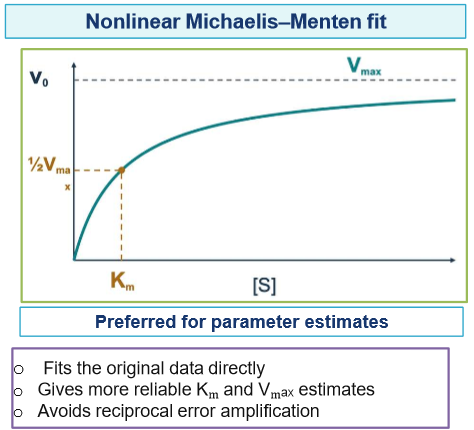
The substrate concentration at which v₀ equals ½Vmax
On the graph, locate ½Vmax on the y-axis and determine the corresponding substrate concentration on the x-axis
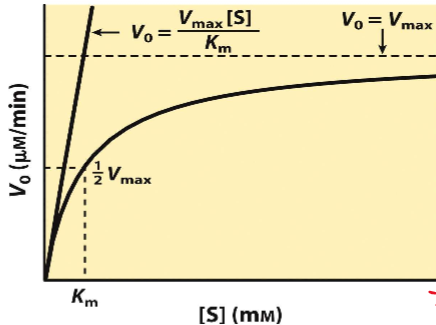
What happens to reaction velocity at different substrate concentrations?
When [S] is much lower than Km, v₀ is approximately proportional to [S]
Increasing substrate concentration causes an approximately linear increase in velocity
At high [S], the enzyme approaches saturation and v₀ approaches Vmax
Adding more substrate then has very little effect on reaction rate.

At low [S], the reaction is approximately first-order in substrate because velocity depends on [S]
At high [S], it approaches zero-order because the enzyme is saturated and velocity becomes nearly independent of [S]

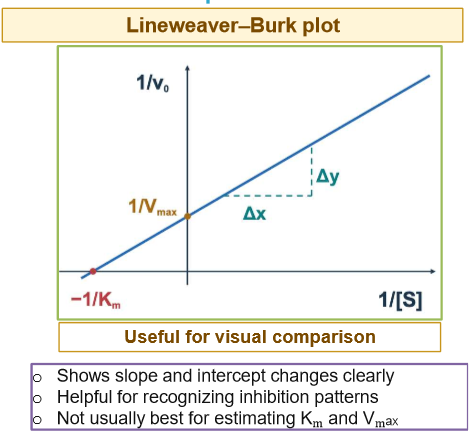
1/v₀ = (Km/Vmax)(1/[S]) + 1/Vmax
y-axis is 1/v₀; y-intercept is 1/Vmax
x-axis is 1/[S]; x-intercept is −1/Km
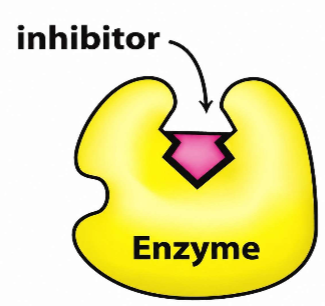
What is an enzyme inhibitor?
A substance that binds to an enzyme and interferes with its catalytic activity.
What is a reversible inhibitor?
Inhibitors that bind through noncovalent interactions and can dissociate from the enzyme. The three types including competitive, uncompetitive, and non-competitive.

Ki = [E][I]/[EI] describes inhibitor dissociation from free enzyme
Ki′ = [ES][I]/[ESI] describes inhibitor dissociation from the enzyme–substrate complex
Smaller values indicate tighter inhibitor binding.

Binds only to free enzyme and prevents substrate from binding
Often acts as a substrate analog with a similar shape, size, and interaction pattern, allowing it to fit into the enzyme’s active site

Increases the apparent Km
More substrate is required to reach ½Vmax
Increasing inhibitor concentration increases the slope and shifts the x-intercept toward zero because apparent Km increases
Vmax remains unchanged because high [S] can overcome the inhibition
On the plot, the lines intersect at the same y-intercept since Vmax is unchanged.
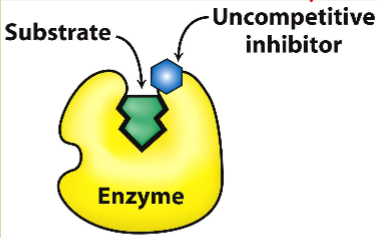
Binds only to the enzyme–substrate complex (not the free enzyme) forming ESI.

Both apparent Km and Vmax decrease by the same factor
On the plot, inhibited and uninhibited lines are parallel since Km/Vmax remains constant
With increasing inhibitor, the y-intercept increases and the x-intercept shifts farther left.
Trapping ES as ESI lowers the amount of product formed and makes the enzyme appear to bind substrate more strongly

It binds at a site separate from the active site. Can bind either the free enzyme or the enzyme–substrate complex, forming EI or ESI.
This type of inhibition occurs when the inhibitor binds free enzyme and the enzyme–substrate complex with equal affinity.
Substrate can still bind, but the inhibited enzyme cannot catalyze the reaction normally

Vmax decreases because some enzyme molecules are rendered catalytically ineffective
Km remains unchanged because substrate-binding affinity is not altered
On the plot, the lines share the same x-intercept since Km is unchanged
Increasing inhibitor concentration raises the y-intercept and increases the slope because Vmax decreases.

What is allosteric inhibition?
An allosteric effector binds at a site distinct form the active site and changes enzyme conformation
This conformation change can increase or decrease enzyme activity by altering how well the substrate binds or how effectively catalysis occurs

Occurs when the end product of a metabolic pathway accumulates and acts as an allosteric inhibitor of an enzyme at an earlier step.
Prevents overproduction and conserves cellular energy and resource
When end-product concentration falls, inhibition is relieved and pathway flux increases to meet cellular demand.

What is a classic example of feedback inhibition?
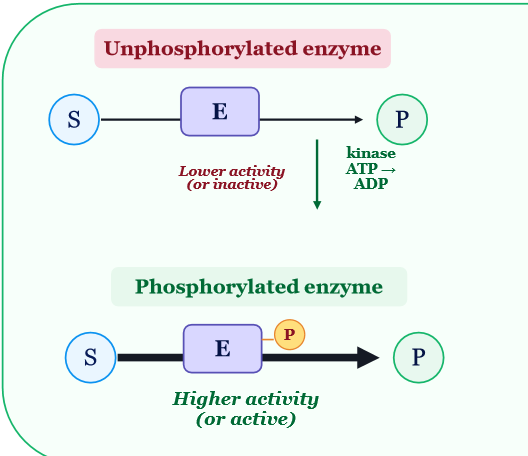
A kinase uses ATP to add a phosphate group, while a phosphatase removes it
Phosphate can change the enzyme’s shape, ionic charge, or both
Phosphorylation may either activate or inhibit the enzyme without changing enzyme abundance

How does changing enzyme abundance regulate pathway flux?
Cells can regulate enzyme expression and degradation to produce more or less enzyme
More enzyme generally increases Vmax and pathway capacity
Less enzyme lowers them
Provides longer-term regulation compared with rapid allosteric or covalent regulation.