White blood cells
 Call Kai
 Learn
 Practice Test
 Spaced Repetition
 Match
 Flashcards
 Knowt Play
1/144

There's no tags or description
Looks like no tags are added yet.
145 Terms
What is haematopoiesis?
The process by which blood cells are produced from haematopoietic stem cells.
What are the two major branches of haematopoietic differentiation?
Myeloid and lymphoid.
What does a pluripotent haematopoietic stem cell give rise to?
Common myeloid progenitors and common lymphoid progenitors, which subsequently differentiate into the different blood-cell lineages.
Which white blood cells are granulocytes?
Neutrophils, eosinophils and basophils.
Why are neutrophils, eosinophils and basophils called granulocytes?
They contain cytoplasmic granules containing agents important for their cellular functions.
Which important white blood cell arises from the myeloid lineage but is not normally grouped with the three granulocytes?
The monocyte, which can migrate into tissues and develop into a macrophage.
What are the important myeloid growth factors mentioned in the lecture?
G-CSF, M-CSF and GM-CSF.
What does G-CSF stand for?
Granulocyte colony-stimulating factor.
What does M-CSF stand for?
Macrophage colony-stimulating factor.
What does GM-CSF stand for?
Granulocyte-macrophage colony-stimulating factor.
What is the role of myeloid growth factors such as G-CSF, M-CSF and GM-CSF?
They provide signalling important for the proliferation and survival of myeloid cells.
What is the maturation sequence leading to a neutrophil?
Myeloblast → promyelocyte → myelocyte → metamyelocyte → band form → mature neutrophil.
Which granulocyte precursors can undergo cell division?
Myeloblasts, promyelocytes and myelocytes.
Which later granulocyte precursors do not undergo cell division?
Metamyelocytes and band forms.
What general changes occur as granulocytes mature?
The cells reduce in size and develop granules important for their function.
Where should myeloblasts normally be found?
In the bone marrow rather than normal peripheral blood.
Why is finding myeloblasts in peripheral blood concerning?
The lecturer emphasised that myeloblasts should not normally appear in peripheral blood and their presence can indicate haematological malignancy.
What is the most abundant circulating leukocyte discussed in the lecture?
The neutrophil.
Approximately how long does a neutrophil survive in the circulation?
About 7–10 hours before migrating into tissues.
What is the characteristic nuclear appearance of a mature neutrophil?
A segmented or lobulated nucleus.
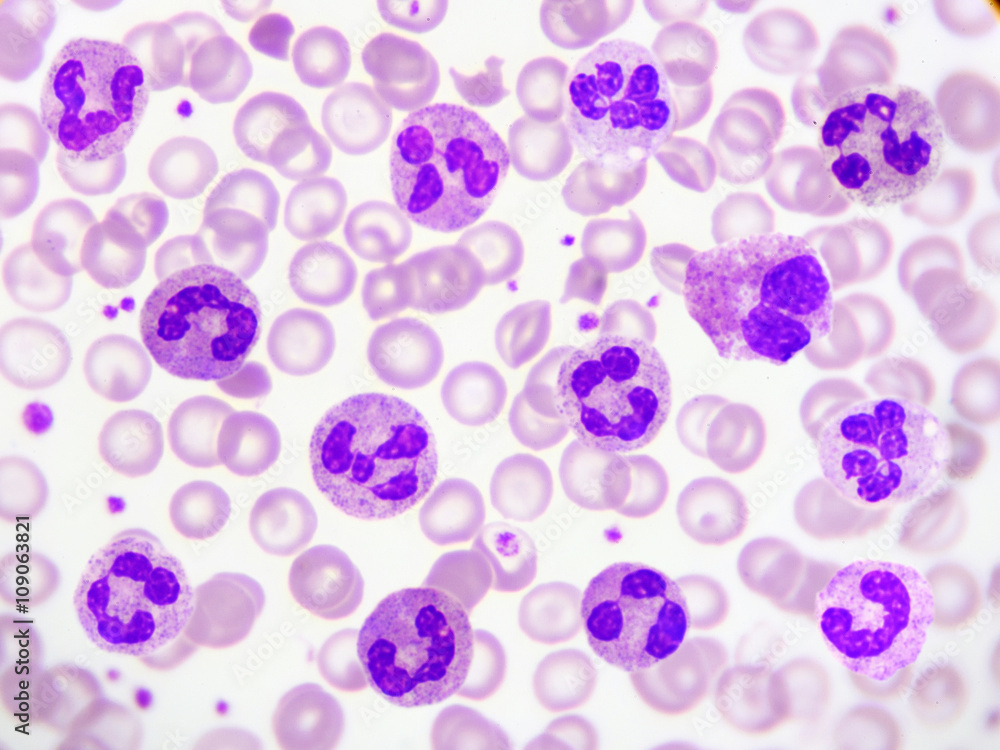
What is the main function of neutrophils?
Defence against infection through phagocytosis and killing of microorganisms, particularly bacteria.
What is chemotaxis?
Directed migration of cells, such as neutrophils, towards chemical signals.
Describe the neutrophil migration process into tissues.
Chemotaxis → margination in the vessel lumen → adhesion to endothelium → migration through the vessel wall into tissues.
What happens after cytokine priming of neutrophils?
They can phagocytose microorganisms.
What can finding bacteria inside a neutrophil on a blood film indicate?
The lecturer explained that visible bacteria within neutrophils can indicate bacteria in the bloodstream and therefore severe infection.
What is the characteristic nuclear appearance of an eosinophil?
It typically has a bilobed nucleus with prominent cytoplasmic granules.

What is the principal function of eosinophils?
Defence against parasitic infection.
What additional immune role do eosinophils have?
They regulate some Type I immediate hypersensitivity reactions by inactivating histamine and leukotrienes released by basophils and mast cells.
What is the characteristic appearance of a basophil?
It has very dense, dark-staining cytoplasmic granules that may obscure the nucleus.
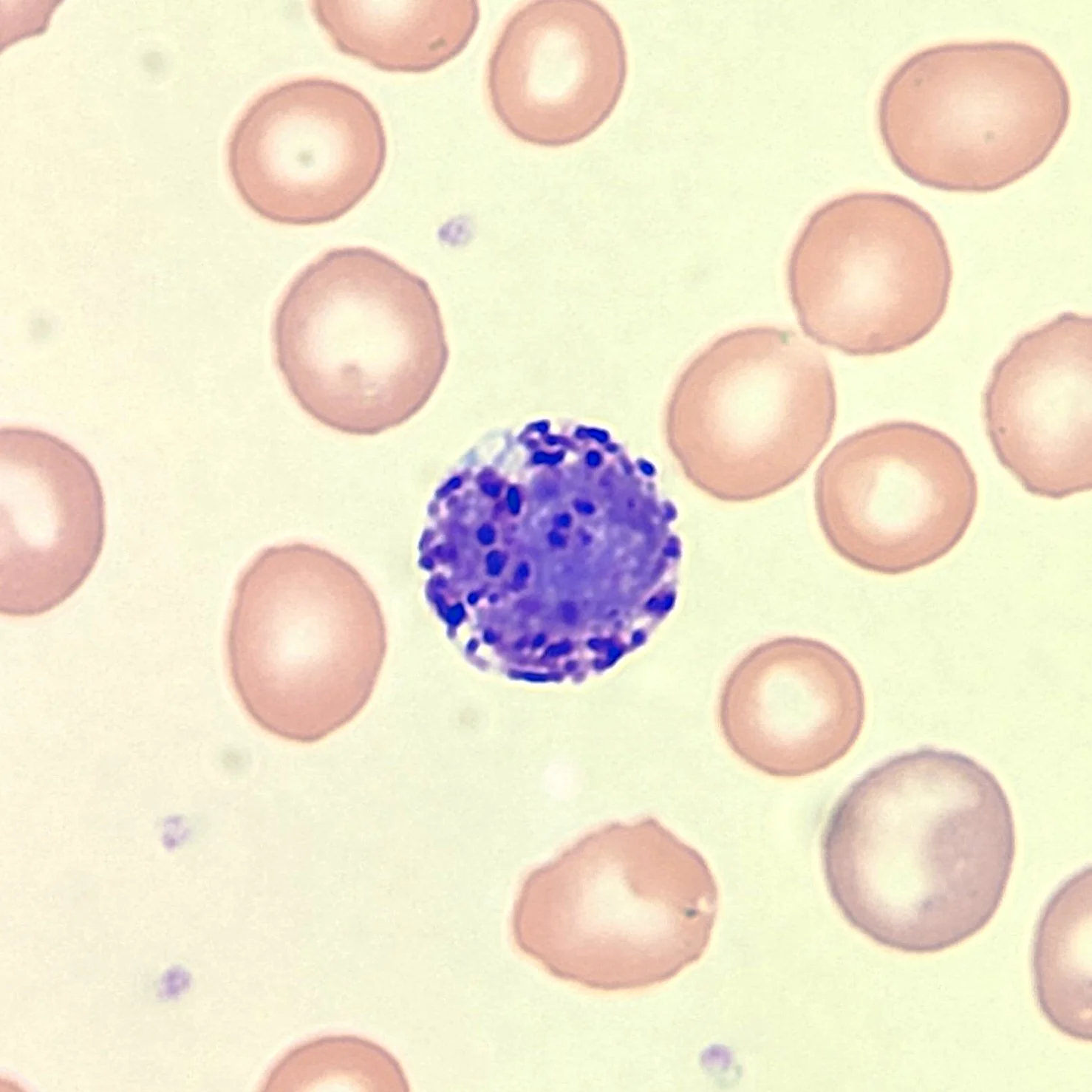
What important substances are stored in basophil granules?
Histamine, heparin and proteolytic enzymes.
What is the major immune function of basophils?
Mediation of immediate-type hypersensitivity reactions and modulation of inflammatory responses.
How do basophils participate in immediate hypersensitivity?
IgE-coated basophils release histamine and leukotrienes.
How can basophils modulate inflammation?
By releasing heparin and proteases.
What is an important difference between basophils and mast cells?
Mast cells are similar to basophils but reside in tissues rather than in the circulation.
What does marked basophilia make you consider clinically?
Chronic myeloid leukaemia (CML), because basophilia is an uncommon finding and is commonly associated with leukaemia or a related condition.
What are the major functions of monocytes?
Phagocytosis of microorganisms, antigen presentation, and development into tissue macrophages with phagocytic and scavenging functions.

How long do monocytes spend in the circulation?
Several days.
What happens to monocytes after they migrate into tissues?
They develop into macrophages, also called histiocytes, and other specialised phagocytic cells.
What is the role of macrophages as scavenger cells?
They phagocytose and remove cellular material and microorganisms.
What important element can macrophages store and release?
Iron.
What additional immune function do monocytes have besides phagocytosis?
Antigen presentation to lymphoid and other immune cells.
What is the simplest way to remember the major granulocyte functions?
Neutrophils = bacteria/phagocytosis; eosinophils = parasites and hypersensitivity regulation; basophils = immediate hypersensitivity/inflammation.
Which cells arise from the lymphoid lineage?
T lymphocytes, B lymphocytes and natural killer (NK) cells.

What happens to lymphocytes after entering the circulation?
They can recirculate through lymph nodes and other tissues and subsequently return to the bloodstream.
Where do B lymphocytes originate?
Fetal liver and bone marrow.
What genetic process occurs during B-cell development?
Immunoglobulin heavy- and light-chain gene rearrangement.
Why is immunoglobulin gene rearrangement important in B-cell development?
It leads to the production of surface immunoglobulins capable of recognising many different antigens.
Which type of immunity is primarily associated with B lymphocytes?
Humoral immunity.
What happens during subsequent B-cell maturation?
Exposure to antigens in lymphoid tissue allows mature B cells to recognise non-self antigens and produce specific immunoglobulins/antibodies.
What can mature activated B cells differentiate into?
Plasma cells.
What is the major function of plasma cells?
Production of antibodies.
Why are plasma cells highly specialised for protein synthesis?
They act as antibody-producing factories.
Where do T-cell progenitors develop?
They migrate to the thymus for T-cell development.
What type of immunity are T lymphocytes principally involved in?
Cell-mediated immunity.
Are NK cells part of the adaptive or innate immune system?
The innate immune system.
What types of cells can NK cells kill?
Tumour cells and virus-infected cells.
What is leukocytosis?
An increased number of circulating white blood cells.
What is leukopenia?
A reduction in the total number of circulating white blood cells.
What is neutrophilia?
An increased neutrophil count.
What is neutropenia?
A reduced neutrophil count.
What is eosinophilia?
An increased eosinophil count.
What is basophilia?
An increased basophil count.
What is lymphocytosis?
An increased lymphocyte count.
What is lymphopenia?
A reduced lymphocyte count.
What is monocytosis?
An increased monocyte count.
Why do changes in neutrophil number have a large effect on the total white-cell count?
Neutrophils are normally the most abundant circulating leukocyte, so leukocytosis and leukopenia commonly reflect changes in neutrophil number.
What does transient leukocytosis generally suggest?
A reactive or secondary response of otherwise healthy bone marrow to an external stimulus.
What stimuli can cause reactive leukocytosis?
Infection, inflammation and infarction are examples.
What white-cell pattern is commonly associated with bacterial infection?
Neutrophilia and/or monocytosis.
What white-cell pattern is commonly associated with viral infection?
Lymphocytosis.
What white-cell pattern is commonly associated with parasitic infection?
Eosinophilia.
What does persistent leukocytosis raise concern about?
A primary blood-cell disorder, including haematological malignancy.
What should you think about when deciding whether leukocytosis is reactive or malignant?
Transient leukocytosis commonly suggests a reactive response, whereas persistent leukocytosis can suggest a primary blood-cell disorder.
What are common causes of neutrophilia?
Bacterial infection, inflammation, infarction, other tissue damage, pregnancy, exercise and corticosteroid administration.
Why can exercise cause neutrophilia?
It can rapidly shift neutrophils from the marginated pool into the circulating pool.
What morphological changes can accompany neutrophilia during infection/inflammation?
Toxic changes, toxic granulation and a left shift.
What is toxic granulation?
Heavy, coarse granulation within neutrophils.
What is a left shift?
An increase in non-segmented neutrophils or the presence of neutrophil precursors in peripheral blood.

Which immature neutrophil forms are particularly associated with a left shift?
Band forms and other early myeloid cells such as metamyelocytes.
What does a left shift suggest physiologically?
Increased demand is causing the marrow to release less mature neutrophil forms into the blood.
What blood-cell pattern is associated with CML in this lecture?
Neutrophilia + basophilia + left shift.
What does CML stand for?
Chronic myeloid leukaemia.
What type of disorder is CML?
A myeloproliferative disorder and primary blood cancer.
What characteristic genetic abnormality is associated with CML?
BCR-ABL1, associated with the Philadelphia chromosome.
What causes of neutropenia were discussed?
Acute leukaemia, chemotherapy, radiotherapy, autoimmune disorders, severe bacterial infections, some viral infections and certain drugs.
Which medications were given as examples of drugs that can cause neutropenia?
Some anticonvulsants, antipsychotics and antimalarials.
Why is chemotherapy an important cause of neutropenia?
Chemotherapy can suppress bone-marrow production of neutrophils.
Why does severe neutropenia cause susceptibility to infection?
Neutrophils are a major defence against microorganisms, particularly bacteria, so severe depletion substantially reduces this defence.
At what neutrophil count does the lecture identify a high risk of serious infection?
Below 0.5 × 10⁹/L.
Why is a neutrophil count below 0.5 × 10⁹/L clinically important?
Patients are at high risk of serious infection and may require urgent treatment with intravenous antibiotics.
What physiological neutropenia was discussed by the lecturer?
Duffy-null associated neutropenia, historically referred to as benign ethnic neutropenia.
Does Duffy-null associated neutropenia itself imply an increased infection risk?
The lecturer described it as a physiological lower circulating neutrophil count without increased infection risk.
What is a hypersegmented neutrophil?
A neutrophil with an abnormally increased number of nuclear lobes/segments.
How many lobes does a normal neutrophil usually have according to the lecture?
3–5 lobes.
What is another name for increased neutrophil segmentation?
A right shift.
What deficiencies classically cause hypersegmented neutrophils?
Vitamin B12 or folic acid deficiency in megaloblastic anaemia.
What is the key difference between a left shift and a right shift?
Left shift = increased immature/non-segmented neutrophil forms; right shift = hypersegmented neutrophils.
What are common causes of eosinophilia?
Allergy and parasitic infection; examples listed include asthma, eczema, drug reactions and parasitic infection.
What parasitic infection was shown as an example of eosinophilia?
Strongyloidiasis.
Can eosinophilia occur in haematological malignancy?
Yes; the lecture gives CML as an example.