BCH4024 Douma Exam 4 - Lecture 5
 Call Kai
 Learn
Learn Practice Test
 Spaced Repetition
 Match
Match Flashcards
 Knowt Play
1/59

There's no tags or description
Looks like no tags are added yet.
Name | Mastery | Learn | Test | Matching | Spaced | Call with Kai | Chat |
|---|
No analytics yet
Send a link to your students to track their progress
60 Terms
What are telomeres?
Repetitive DNA sequences at the ends of linear chromosomes that protect genes from degradation and loss during DNA replication.
What sequence is repeated in human telomeres?
TTAGGG sequence repeated thousands of times.
Why do telomeres have a 3' overhang?
To facilitate formation of a protective T-loop structure and prevent exonuclease degradation.

What is a T-loop?
A three-dimensional structure where the 3' overhang of the telomere invades and base pairs with an internal region of the telomere to protect the chromosome end.
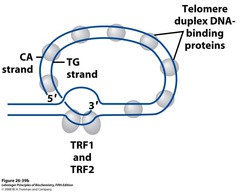
What are shelterin proteins?
Proteins that bind to telomeres and T-loops to protect the chromosome ends from degradation and unwanted DNA repair.
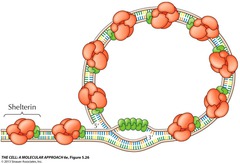
How does the structure of telomeres prevent nuclease degradation?
By hiding the chromosome ends within a T-loop and binding shelterin proteins to mask the DNA ends.
Why do telomeres shorten after each round of DNA replication?
Because the RNA primer at the 5' end cannot be replaced with DNA because DNA polymerase needs a 3' -OH to extend the chain, causing progressive loss of DNA at the chromosome ends.
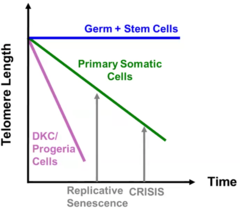
What happens when telomeres become critically short?
The cell activates the senescence pathway to permanently stop cell division.
What is senescence?
A permanent G0 state where a cell no longer divides, used as a safeguard against potential cancerous transformation.
What happens if a cell bypasses senescence and telomeres continue to shorten?
The cell activates the apoptosis pathway, leading to programmed cell death.
Why is telomere shortening considered a protective mechanism?
It prevents old or damaged cells from continuing to divide and becoming cancerous.
How does telomere length relate to aging?
As cells divide over time, telomeres shorten, contributing to cellular aging and organismal aging.
What is progeria and how does it relate to telomeres?
Progeria is a rapid-aging disease where individuals have much shorter telomeres than normal for their age.
Which types of cells maintain long telomeres?
Stem cells and germ cells (eggs and sperm) maintain long telomeres to support development and reproduction.
What is telomerase?
An enzyme that extends the telomeres by synthesizing DNA using an RNA template.
What type of enzyme is telomerase?
A reverse transcriptase that uses an internal RNA template to synthesize DNA at chromosome ends.
In which cells is telomerase active?
Developing cells, stem cells, and germ cells; not active in most adult somatic cells.
Why is telomerase not active in most adult somatic cells?
To allow telomere shortening, which helps cells keep track of their age and limits the risk of cancer.
How does telomerase extend the TG-rich strand of telomeres?
It base pairs its RNA template to the 3' overhang and synthesizes additional TG-rich repeats.
What happens after telomerase extends the 3' end?
Primase-DNA polymerase alpha fills in the complementary CA-rich strand, and shelterin proteins reform the T-loop.
What are the two main types of RNAs that are not translated into protein?
Transfer RNAs (tRNAs) and ribosomal RNAs (rRNAs).
What is mRNA?
mRNA contains the sequence of bases that encodes the primary amino acid sequence for a protein.
What is tRNA?
tRNA carries an amino acid into the catalytic site of a ribosome. tRNA base pairs to mRNA to ensure the selection of the correct amino acid for incorporation into a nascent polypeptide chain.
What is rRNA?
rRNAs are structural copmponents of a ribosome, the enzyme that catalyzes translation.
What are noncoding RNAs?
RNAs that do not encode proteins but have a variety of catalytic, structural, and regulatory functions.
What is a gene?
A segment of DNA that encodes a functional product + the DNA regulatory elements needed for transcription.
What is the primary transcript?
The initial RNA molecule produced directly from transcription.
In prokaryotes, what is the relationship between the primary transcript and mRNA?
They are the same; no processing is required before translation.
What happens to the primary transcript in eukaryotes before translation?
It is first modified into the final mRNA.
What is an open reading frame?
A sequence of bases in DNA or RNA that encodes the primary sequence of a protein.
What are cis-acting elements?
DNA sequences with a fixed position in the genome (are closely tied to the gene) that regulate gene transcription.
What are trans-acting factors?
Diffusible molecules, usually DNA-binding proteins [transcription factors], that regulate transcription by interacting with cis-acting elements at multiple sites in a genome.
What determines which DNA strand is the template strand for transcription?
The promoter sequence at the beginning of the gene.
What is the coding strand?
The DNA strand that has the same sequence as the RNA transcript (except T is replaced with U).
In transcription, what direction is RNA synthesized?
5' to 3' direction.
What is the significance of the +1 site in a gene?
It marks the transcription start site where RNA synthesis begins.
What does "upstream" refer to in transcription terminology?
Sequences located before (in the opposite direction of) the transcription start site.
What does "downstream" refer to in transcription terminology?
Sequences located after (in the direction of) the transcription start site.
What is a promoter?
A DNA sequence that RNA polymerase binds to, signaling where transcription should begin.
What does proximal mean in the context of transcription?
Close to the transcription start site or promoter.
What does distal mean in the context of transcription?
Far from the transcription start site or promoter.
Do RNA polymerases need a primer to begin synthesis?
No, RNA polymerases can initiate synthesis de novo.
What substrates does RNA polymerase use?
Ribonucleoside triphosphates (rNTPs) containing ribose sugars.
What is the difference between T and U in nucleic acids?
T (thymine) is found in DNA, and U (uracil) is found in RNA.
Does RNA polymerase have proofreading ability?
No, RNA polymerase lacks 3' to 5' exonuclease proofreading activity.
Why is a lack of proofreading by RNA polymerase tolerated?
Because RNA is temporary and can be degraded and replaced, unlike the permanent DNA genome.
What defines the template strand for each gene?
The orientation and binding of RNA polymerase at the promoter.
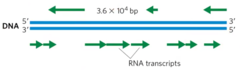
Can different genes on the same DNA molecule use different template strands?
Yes, each gene independently defines its own template strand based on its promoter. The template strand isn't the same (e.g., top strand) across the entire genome.
What is the difference between the core enzyme and holoenzyme of prokaryotic RNA polymerase?
The core enzyme can synthesize RNA but cannot initiate transcription without sigma; the holoenzyme includes sigma for promoter recognition. In other words, the holoenzyme contains the core enzyme and accessory subunits.
What are the alpha subunits essential for in the RNA polymerase core enzyme?
They are esential for enzyme assembly and interact with activators.
What are the beta (B) and beta' (B') subunits essential for in the RNA polymerase core enzyme?
They form the catalytic core.
What is the omega (w) subunit essential for in the RNA polymerase core enzyme?
It provides structural stability.
What is sigma factor?
A protein that associates with the core RNA polymerase to form the holoenzyme and guide it to promoter sequences.
What is the role of sigma factor in transcription?
It directs RNA polymerase to promoters that it recognizes to initiate transcription.
What holoenzyme are more E. coli promoters recognized by?
The sigma-70 holoenzyme
What happens to sigma factor after initiation of transcription?
It dissociates from RNA polymerase after about 10 nucleotides are synthesized.
What are the three major stages of transcription?
Initiation, elongation, and termination.
What happens during initiation of transcription?
The holoenzyme binds the promoter, separates DNA strands, and starts RNA synthesis of the first 10 nucleotides.
What happens during elongation of transcription?
The core enzyme synthesizes RNA in the 5' to 3' direction, extending the RNA transcript.
What signals the end of transcription?
A DNA terminator sequence that causes RNA polymerase to release the RNA and detach from DNA.