Atomic Structure
 Call Kai
 Learn
Learn Practice Test
 Spaced Repetition
 Match
Match Flashcards
 Knowt Play
1/22

There's no tags or description
Looks like no tags are added yet.
Name | Mastery | Learn | Test | Matching | Spaced | Call with Kai | Chat |
|---|
No analytics yet
Send a link to your students to track their progress
23 Terms
Define Atom
basic unit of element
Overall neutrally charged
Made up of subatomic particles:
Nucleons -> protons and neutrons in nucleus
Electrons -> in electron cloud

What is Atomic number
the number of protons in an atom
• If atom is neutral, is also the no. of electrons
What is a mole
6.022x10²³ atoms in a substance
Avogadro's number
What is atomic weight
weight of one mole
• Weight of 6.022x10²³ atoms
• In g/mol
What are properties of Electrons
Have wave and particle properties
Exist in orbitals -> areas where electrons are likely to be found
Orbitals are discrete and properties are described by quantum numbers
Principal -> no. of total orbitals
Angular momentum -> shape or orbital
Magnetic -> orientation of orbital
Spin -> magnetic field of electron
Fill orbitals according to Pauli's exclusion principal
Define Valence electrons
Electrons in the outermost orbital of atom
Determine stability of atom + likeliness to ionise
Determines properties of atom
Bonding strength
Chemical reactions
Atomic charge
Optical parameters
Heat needed to break bonds?
what is Electronegativity
Degree to which an atom attracts electrons to itself
Higher electronegativity = more accepting of electrons
Atom doesn't have enough electrons + is positively charged
Cations
Electropositive = donate electrons
Anions
Too many electrons + negatively charged
Some elements can be electronegative and positive
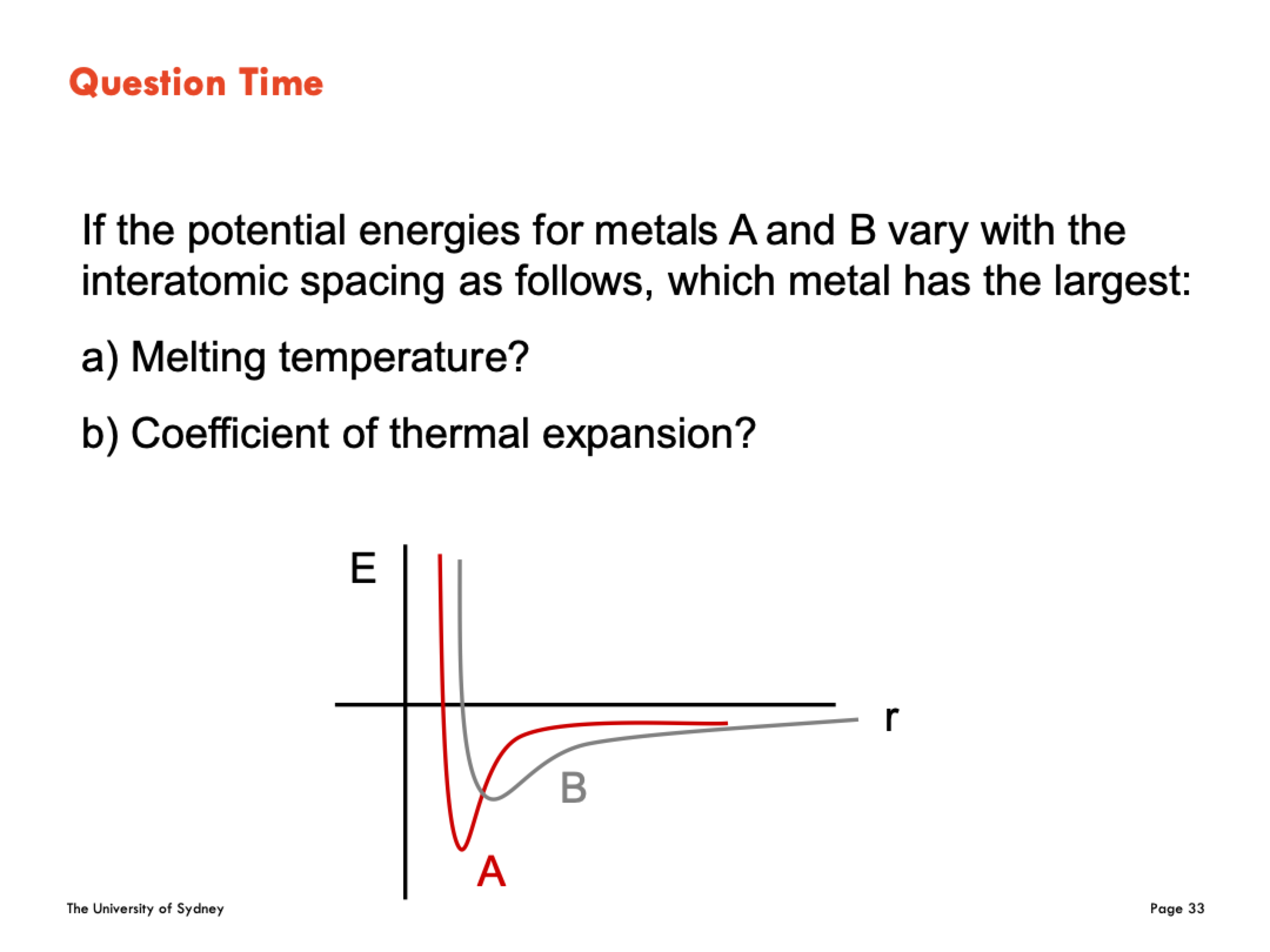
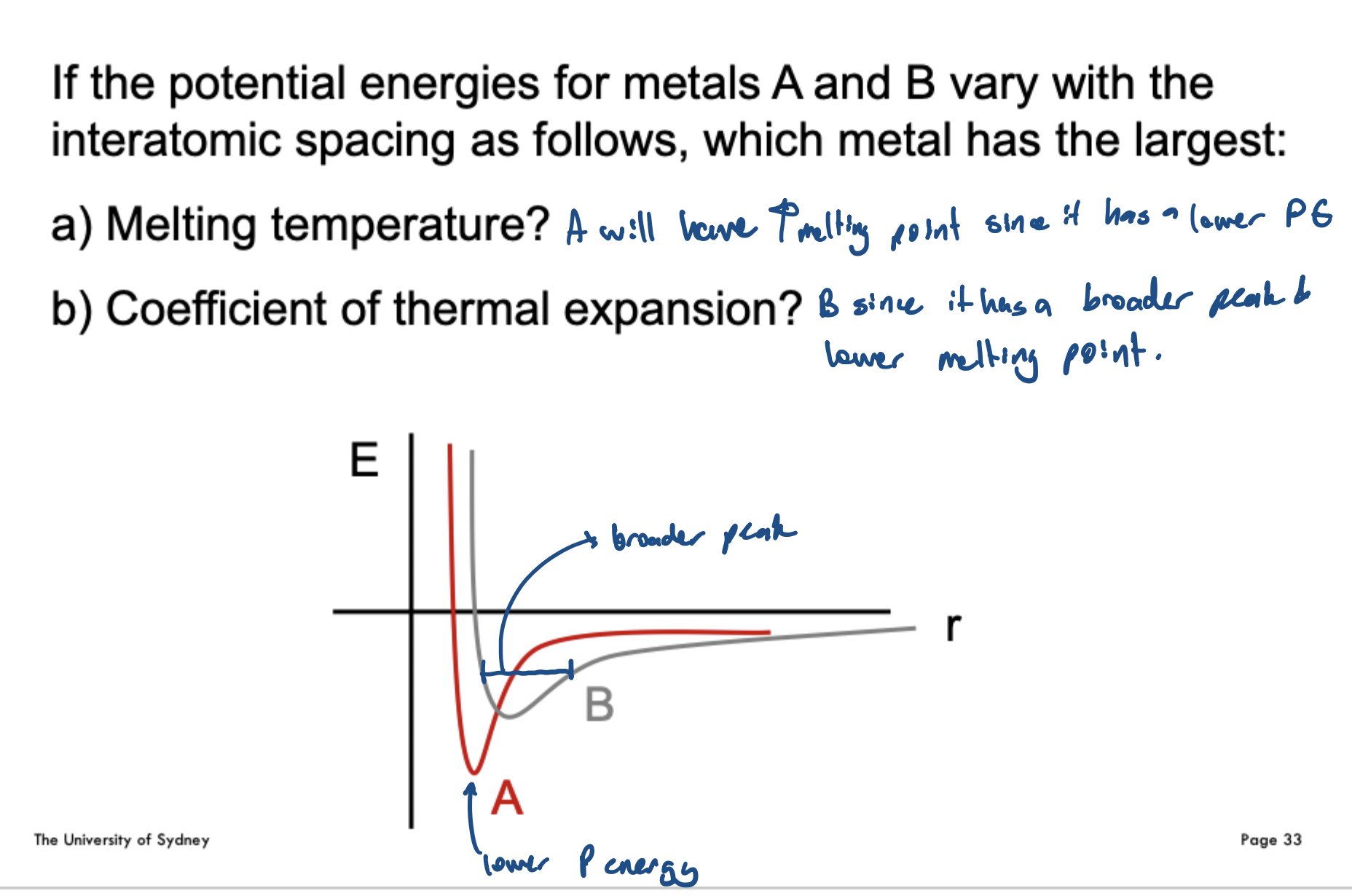
What is r0 and its significance?
minimum/smallest bonding length
Minimum radius for bonding
Equilibrium radius for energetic stability
Fnet = 0
Maximum negative potential energy
Energy required to break bond
More energy required to break bond = stronger bond
r < r0
negative F → repulsive force is stronger
positive GPE → repulsive
r> r0
positive f → attractive force is stronger
negative GPE → attractive
weakens/decays exponentially till zero
what is lattice energy
energy required to break lattice
• Energy is released when broken
• Breaking bonds requires energy
○ Heat
○ Work (force)
• Small lattice energy = smaller melting point
• Large lattice energy = higher melting point
What is a Lattice
structured group of atoms
In crystalline material
Types of bonding
Ionic
Covalent
Metallic
Properties of ionic bonds
Form from the electrostatic attraction between anions (-) and cations (+)
Mostly between metals and non metals
Metal = cation
Non-metal = anion
Increases bonding radius
E.g. magnesium oxide (MgO)
Likely when there is a large difference in electronegativity
Electron from anion is transferred to cation
Further away from each other on periodic table
At minimum energy = most stable
Balance of attractive and repulsive
Very strong but brittle
Properties of Covalent bonding
Sharing of valence electrons between atoms
Both atoms achieve a noble gas configuration
Fill up valence shell
Become most stable
Likely when small differences in electronegativity
Close together on periodic table
Closer atoms are to filling valence orbital = stronger the bond
Common for molecules/materials of one kind of atom
E.g. diamond (carbon)
E.g. fluorine gas
Share one electron to fill valence shell in P orbital
Properties of Metallic bonding
Electrostatic attraction between delocalised electrons and positively charged metal ions in a metal lattice
Metals are ordered in lattices
Atoms are closely packed
Strong bonds
E.g. aluminium
Electrons are free to move between atoms
All electron clouds are connected
Electrons can be anywhere at any time
Bonds are non-directional
Metallic bond lowers atom's individual energy
Min energy still at r0
More valence electrons = higher bonding energy = higher melting temperature
Bonds are strong and ductile
Good for shaping, welding, moulding
Increased strength by introducing alloys
Compare atomic bond types
Ionic - strong but brittle
Covalent - strong but not malleable or ductile
Metal - strong and ductile

How to calculate primary bonding
Calculating how many bonds are ionic or covalent in a substance

Properties of bonding
Melting temperature
Thermal expansion
Elastic / Young's modulus (E)
What is melting temp
temp required to break bonds in a solid
We melt materials to break bonds in them
Adding heat = potential energy required to break bonds is smaller
r0 does not change
we are just shifting to the right of the energy curve, so now: radius of bond length > r0
When increasing temperature, melting temperature also reduces
Thermal expansion
The increase in size of a solid with the increase in temperature
When adding heat into a system
Changes atomic vibrations
Changes thermal coefficient
Changes distance between atoms → increases
Changes bonding energy → decreases
Metallic structures expand when heated + shrink when cooled
Account for change in atomic bonds using coefficient of thermal expansion
What is the thermal expansion coefficient
measures how much a material expands or shrinks when its temperature changes

Elastic / Young's modulus (E)
Gradient of stress strain graph
Higher young's modulus = steeper stress-strain slope = more force required to break bond
E depends on melting temp, bond distance
Since these factors impact stress and strain → thus change E
Stronger the bond = more force required to break it
Compare the … of ceramics, metals and polymers
melting temp
coeff. of thermal expansion
E
