muscles (descriptions)
 Call Kai
 Learn
 Practice Test
 Spaced Repetition
 Match
 Flashcards
 Knowt Play
1/190

There's no tags or description
Looks like no tags are added yet.
191 Terms
what are the 4 major functions of muscle tissue
motion
movement of substance within the body
support of body and organs
thermogenesis
What does movement rely on?
the integration of bones, joints, and skeletal muscles
develop of motion
start with gross motor movement
develops fine motor skills as our neural system matures and strengthens its connection with the muscular system
movements of substances
cardiac muscle
smooth muscle
skeletal muscle
cardiac muscle function
pumps blood to body & back (Involuntary)
smooth muscle function
aids in movement of food through the digestive system via peristalsis (involuntary)
skeletal muscle function
aids in voluntary movement, also aids in the return of blood back to the heart
how does muscle support body and organs
maintains body in stable position (ex. postural muscle keeps body upright (erector spinae))
protection of body and organs (The abdominal muscle enclose the digestive system that lies below the protective covering of the ribcage)
what is thermogenesis
when skeletal muscle contracts, heat is produced (sweat)
muscle contractions can produce up to 85% of body heat
shivering produced heat
arrector pili muscles contract making hairs stand up
where is cardiac muscle found
strictly in the heart
cardiac muscle appearance
branching cells and are striated
how are cardiac muscle cells connected
intercalated disks
is cardiac muscle regeneration possible
NO
how do cardiac muscle contractions work
involuntary by the SA node, no control over heart rate.
where are smooth muscles found
lining hollow organs (lumen) to assist in propelling contents along cavities (ex. digestive system)
traits of smooth muscle cells
long
tapered
non striated
smooth muscle contractions
contracts for longer period of time and are involuntary
why do smooth muscles contract
response to nerves and hormones, a part of the autonomic nervous system
skeletal muscle cell traits
long
striated
multinucleated
what are skeletal muscles responsible for
movement of skeleton (attached to bone via tendons)
skeletal system contraction traits
voluntary, initiated by motor neurons from somatic nervous systen
types of skeletal muscle
red (T1)
white (T2)
intermediate fibers mixed together responsible for different types of contractions
muscular principle 1
skeletal muscles contract if only stimulated to do so
muscular principle 2
skeletal muscles pull on bones
muscular principle 3
bones are levers and joints are fulcrums
muscular principle 4
muscles that move body segments do not usually lie over that part (ex. biceps flex elbow but is in upper arm)
muscular principle 5
skeletal muscle almost always act in groups
5 properties of muscles
irritability (responds to stimulus)
contractability (shortens in length)
elasticity (stretch and return to normal shape)
extensibility (ability to extend in length)
conductivity (ability to transmit nerve impulses)
muscle term: origin
least movable part of the part of muscle that attaches closest to the midline (proximal attachment)
muscle term: Insertion
most moveable part of the muscle that attaches farther away from midline (distal)
muscle term: function
the action the muscle performs when stimulated by nervous system (dictated by muscle fiber direction)
muscle term: Innervate
when a muscle is activated by the nervous system (sliding filament theory
What does the neuromuscular system refer to
A complex link between the nervous and muscular system
How do the nervous and muscular system work together
They receive and respond to external and internal stimuli in a complex feedback system
What detects changes (making our brain respond)
Proprioceptors
What is CNS
Control system to create the response
What is PNS ( parasympathetic nervous system)
Acts out commands from CNS
What is included in the CNS
Brain and spinal column
What is included in PNS
All parts outside the CNS
What are the parts outside the CNS
•Autonomic NS
Somatic NS
Sympathetic NS
Parasympathetic NS
About the autonomic NS
Involuntary control of cardiac and smooth muscle
About the Somatic NS
Allows us the awareness of the internal and external environment
Voluntary
Skeletal muscles only
What are the two kinds of nerves in the somatic NS
Motor/efferent nerve
Sensory/afferent nerve
What is the motor/efferent nerve
It carries a response from the CNS to the body in response to a stimuli
What is sensory/afferent nerve
Carries info from the body or environment and sends it to the CNS
complimentary systems
Sympathetic and parasympathetic NS
About the sympathetic nNS
It’s our fight or flight response
Parts of fight or flight response
increase BP
Increase HR
Slows digestion
Increase sweating
Widens bronchioles
all above leads to chronic inflammation which leads to inflammatory diseases
About the parasympathetic NS
the rest and digest
Decreases BP and HR to normal
hormones released to allow for digestion
(Returns to homeostasis)
What is a neuron
Functional unit
What are the three sections of a neuron
axon
Cell body
Dendrite
What is the axon Cell body And Dendrite function
Transmits info either to the body or brain (CNS)

1
Mitochondrion

2
Cell body

3
Nucleus
4
Dendrite


5
Myelin sheath

6
Node of ranvier

7
Axon

8
Schwann cell

9
Synapse

10
Axon terminal
9
Multiple sclerosis
What do the axon terminals do
Move to another nerve or tissue
How much space between axon and whatever is next
1nm
Where are proprioceptors located
Muscle, tendons, inner ear
Proprioceptors…
Are constantly monitoring changes in the body and reacting or adjusting to maintain homeostasis

1
Endomysium

2
Striations

3
Endomysium

4
Fascicle bundle of muscle fibers

5
Epimysium

6
Perimysium
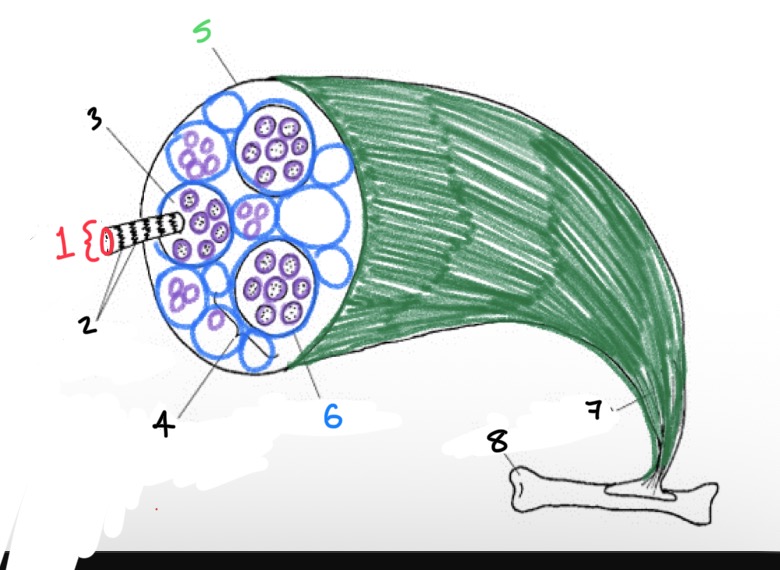
7
Tendon

8
Bone
What is the epimysium
The outer covering of the muscle, extending beyond to create the tendon, which unites with the periosteum of the bone
What is the perimysium
Surrounds or binds a group of muscle fibres together (also referred to as a fascicle)
What is the Endomysium
Surrounds the individual muscle fibres
What is the fascia
Translucent layer on top of muscle
What are myofobrils
They are tubular in structure and extend lengthwise within each muscle fiber
How many myofibrils can a single muscle fiber contain
300-3000
Two types of myofilaments contained by the myofibril
Actin
Myosin
what about actin
The thin filament
Resembles two chains twisted into a helix
Chains contain troponin and tropomyosin
About myosin
The thick filament
Resembles golf clubs twisted together
What are myofibrils divided into
Sarcomeres
What do sarcomeres allow
The filaments to contract individually for. Greater overall contraction
What are sarcomeres defined by
The Z line (also serves as the anchor point for the actin)
Sarcomeres have striations, what are they
dark band (A band) represents the thick filament of myosin and is found in the centre of the sarcomere
Light band (I band) represents the thin filament

1
Endomysium

2
Sarcolemma

3
Mitochondrion

4
Myofibril

5
Nucleus

6
Dark (A) band

7
Light (I) band

8
Sarcomere
9
Z line


10
A band

11
I band