SFL 351 Exam 2: Nelson
 Call Kai
 Learn
 Practice Test
 Spaced Repetition
 Match
 Flashcards
 Knowt Play
1/94

There's no tags or description
Looks like no tags are added yet.
95 Terms
Social Role Theory
a theory that gender differences result from the contrasting roles of men and women
impose opportunities or constraints on behavior
cognitive developmental theory
children actively construct knowledge as they manipulate and explore their world
cognitive developmental theory stages
Gender Labeling: 2 years
Gender identity: 3 years
Understanding Gender Stability:
Understanding gender consistency (permanence): 6 years
Gender Schema Theory
personal gender schema of what it means to be a boy or a girl
Social Cognitive Theory
-observation of male and female models
-enactive experience social reactions prescribe norms and expectations
-direct teaching
-children's gender development becomes self guided
Developmental Intergroup Theory
- identifying with a gender group leads you to maintain and enhance your gender identity
- an ingroup v outgroup dynamic
cross cultural findings regarding the creation of gender neutral societies
scandinavian countries (such as sweden) are pushing for more gender neutrality and gender differences in personality:
professions have been maximized
the gap has widened.
Sex differences of girls
- verbal ability
- fear, timidity, decreased risk taking
- emotional sensitivity/expressivity
- compliance and tactfulness
Sex differences of boys
- visual spacial abilities
- mathematical ability
- developmental vulnerability
- activity level
- physically aggressive/disruptive behaviors
How mothers and fathers differ in how they interact with young children and influence gender role development
mom: affliative; expressive role -- kind, nurturant, cooperative, sensitive to the needs of others
dad: assertive; instrumental role -- dominant, assertive, independent and competitive
why children are resistant to counterstereotypic information in the media they consume
- gender segregation established by age 2-3 so viewing media presents a confirmation bias
- video games, tv shows, books, and other media reinforces gender stereotypes
- media can be used to counteract stereotypes, studies show that egalitarian books have small effects because there are so many stereotypical books and children distort counterstereotypic information at high rates
evidence for existence of gender cultures in early childhood
gender and toy preference, gender segregation reliability established by age 2-3
gender and toy preference
Boys ages 14-22 months already prefer trucks and cars to other objects
18-24 month old toddlers often refuse to play with cross sex toys
gender segregation reliability established by age 2-3
- Maccoby suggests that girls and boys quickly become incompatible in their play styles
- young boys strictly enforce gender boundaries and sex typing; girls have more latitude (boys being called a sissy is a bigger blow than a girl being called a tomboy)
relative distributions of same sex to opposite sex peer interactions across developmental periods
boys act differently in front of other boys than they do in front of girls
longitudinal research on the likely outcomes of child gender dysphoria
- gender dysphoria is actually an early predictor of later LGB identification rather than transgender identity
- frequently comorbid with other struggles (such as ASD)
- quick affirmation approaches can lead to misdiagnosis and create a self fulfilling prophesy
alternative pathways to gender dysphoria or transgender identity
- social contagion -> rapid onset gender dysphoria: may become transgender after a peer did, increase in social media use, conflict with parents after becoming transgender
- telling those with same sex attraction they have that attraction because they are actually transgender
- gender role non conforming v gender non conforming
racial/ethnic differences in prevalence of dating and romantic relationships
asian american youth are less likely than other racial and ethnic groups to engage in teen romance
definitions of aspects of young adult romantic sexual relationships
relationship churning & hook up culture
relationship churning
On again off again
hook up culture
sex without commitments
factors related to more or less engagement in romantic relationships in adolescence
more romantic relationship traits:
- mature physical appearance, physical attractiveness, satisfaction with ones attractiveness, popularity
less romantic relationship traits:
- high maternal sensitivity (affects middle adolescence)
- race may contribute to more or less engagement
predictive power of romantic relationships in middle adolescence for early adult romance
- early romantic experiences forecast subsequent ones. those who have fewer romantic partners and higher quality romantic relationships in middle adolescence are more likely to have higher quality romantic relationships in early adulthood.
- those who are involved in a long term relationship in adolescence are more likely to get married in early adulthood than those who are only casually dating or not dating
- early experiences in romantic relationships have an enduring effect on the nature of romantic relationships in early adulthood
adolescent romance and adjustment
- being involved in a romantic relationship during adolescence is associated with depressive symptoms especially for women
- it is linked to externalizing symptoms and substance use in adolescence
- poorer adjustments in early childhood
- relationships are stressful and can lead to problems with adjustment
- associated with lower levels of internalizing and externalizing symptoms and substance abuse
- can promote adjustment in certain developmental tasks
- high quality relationships are linked with better adjustment in adolescence and early adulthood
- those with delinquent partners tend to be more delinquent themselves
- substance use predicts partner substance use
predictors of dating violence
1 in 4 women and 1 in 5 men experience violence in dating relationships
violence between parents, experience of child abuse, family conflicts, antisocial behavior, substance use problems, associating with aggressive peers, minority group status, acculturation stress and other types of stress
findings of the reconciliation and growth project (gay/single/celibate survey on happiness)
- an online survey of 1782 individuals and different paths they take in light of same sex attraction and personal or religious values
- about an even split between each category (single and celebate, single but not celibate, in a gay marriage or relationship, in mixed-orientation relationship) but the most satisfaction was reported in gay marriage/relationship followed by mixed orientation relationship
- according to pop-culture, it is only acceptable to be either single and not celibate or in a gay marriage/relationship
Social Information Processing Theory
1. encoding of cues
2. interpretation of cues
3. clarification of goals
4. response access or construction
5. response decision
6. behavioral enactment
- peer evaluation and response
- start again

hostile attributional bias of social information processing theory
assuming that others have hostile intentions, even when they may not --> kids laughing when someone walks by -- does that someone assume they were telling a knock knock joke or making fun of them?
proactive agressors
aggression is the best strategy to accomplish my goals
- whether or not provoked, cooly and consciously decide that aggression will best assist in achieving aims (plastics in mean girls)
reactive aggressors
Others are hostile to me
- when provoked attend to the cues consistent with this expectancy
- attribute hostile intent to the provocateur
- hostile attribution bias
- become angry and quickly retaliate aggressively
peers and teachers react negatively, further reinforcing the original expectancy that others are hostile towards them
how aggressive v nonaggressive kids view outcomes of aggressive behavior
compared to their nonaggressive peers, aggressive children are:
- liable to overestimate how much peers like them and underestimate how much peers dislike them (think people love them, and don't dislike them)
- more confident that aggression will yeild tangible rewards (aggression gets me my way)
- more certain that aggression will be easy for them and successful at terminating other's obnoxious behavior (aggression can shut them up)
- more inclined to believe that aggression will enhance their self esteem and will not cause their victims any permanent harm (life me up without really pushing them down)
physical aggression
physical dominance, instrumentality, maintenance of hierarchies
relational aggression
establishing/maintaining close, intimate connections with others, rumors, gossips, exclusion
verbal aggression
sarcasm, mockery, teasing, openly critical comments, name calling, banter
Hostile/Reactive Aggression
"others are hostile to me" will become angry and quickly retaliate
Proactive/instrumental aggression
"aggression is the best strategy to accomplish my goals" (even unprovoked) consciously decide what aggression will best assist in achieving aims
developmental trends in aggressive behavior
not all children who were aggressive in preschool had problems later
- aggression leads to peer rejection and other negative consequences like low academic achievement
sex differences in aggression (boys)
boys (physically aggressive)
- at least 6x more likely to be highly physically aggressive
- physically aggressive behaviors are consistent with the goals important to boys within the peer group context
- physical dominance, instrumentality, maintenance of heirarchies
- boys are socialized in a manner consistent with these behaviors (competitive sports, stick up for yourself, most effective way to inflict harm or get back at someone)
sex differences in aggression (girls)
relationally aggressive behaviors are consistent with the relational goals of girls
- establishing & maintaining close intimate relationships with others
- socialized in a manner consistent with these behaviors (not to be physically aggressive, rumors, gossip, relational exclusion are the most effective ways at getting back at someone or causing harm)
Patterson's model of delinquency (contribution of coercive home environments)
parenting
- coldness and rejection
- power assertive discipline
- erratic or permissive approach to aggression
- an active tempestuous temperament may tire a parent out, fostering permissiveness
- lack of monitoring (single mothers)
- coercive home environments are breeding grounds for aggression
-- constant bickering, threatening, irritating each other
-- negative reinforcement helps maintain coercive interactions
-- mothers of these "out of control" children rarely use social approval - the only way to get attention is to irritate others
Risks related to relational aggression
- relatively aggressive children appear likely to remain relationally aggressive over time (russian GIRL preschooler relational aggression correlates with peer directed romantic relational aggression 10 years later)
- relationally aggressive children are at risk for: peer rejection, loneliness and depression, delinquency, borderline personality disorder
- relational aggression is difficult to deal with and has long lasting negative consequences (need for research and intervension)
peer acceptance categories: popular
high impact, many positive and few negative nominations
- friendly approaches, natural leadership, nurturance, social reinforcement, prosocial interactions, cooperative play and social conversation, appropriate rough and tumble play, asservice without being aggressive
peer acceptance categories
popular, rejected, controversial, neglected, average
popular and rejected status is pretty stable over time
peer acceptance categories: rejected
high impact, many negative and few positive nominations.
- aggressive and disruptive behaviors (including inappropriate rough and tumble play)
- withdrawn, unsociable, submissive behavior
- victimization statues and adult help seeking
- less prosocial behavior then average children
peer acceptance categories: neglected
- low impact
- few positive or negative nominations
peer acceptance categories: controversial
- high impact
- many negative as well as positive nominations
peer acceptance categories: average
- anyone who doesn't fit neatly into "popular, rejected, neglected and controversial"
Peer group entry style and sociometric status
popular children v unpopular children
popular children:
- behave in ways relevant to ongoing peer interactions using a 2 step sequence (wait & hover, mimic the peer group and make group oriented statements)
unpopular children:
- employ self oriented, disruptive entry strategies
- hover nearby rather than directly engage
rates of bullying and victimization
around 8-20% of children get bullied
- boys more often bullied by boys
- girls equally bullied by boys and girls
around 5-12% of children are bullies
- the victims of bullies are 2-6% of children
- boys are more likely to be bully victims or bullies
bullying is mostly verbal attacks
victimization is not equivalent to being bullies this meaning that even though a kid gets picked on once doesn't mean they are being bullied
background and characteristics of passive and provocative victims
- passive victims: quiet, sensitive, studious, shy, isolated (may be tied to physical attractiveness) cower and cry in response to bullying, no attempt at self defense
- provocative victims: react angrily and aggressively to bullying provocation (may be tied to physical attractiveness) some passive victims become provocative victims over time, the group most rejected by peers
characteristics of bullies
- bullies are usually full of themselves (narcissists -> not low in self esteem)
- may have lack of empathy and shame, conduct problems and support aggressive strategies (callous-unemotional traits)
- if want to be more subtle in how they bully, they bring in social intelligence
-- most are bistrategic controllers (see others point of view or situation but use it for their own purposes of gain or control the situation because they understand how the other person is feeling)
-- bully victims however, are usually low in social intelligence
bullying circle
1. bully (initiate the bullying)
2. follower/henchmen (help once the bullying has begun)
3. supporter/passive bullies (fight fight fight!)
4. passive supporter possible bully (no open support but likes it)
5. disengaged onlooker (doesn't stop it, doesn't support it)
6. possible defender (feels bad but doesn't step in)
7. defender of the victim (doesn't like bullying, steps in to help)
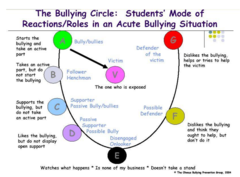
effective and ineffective ways for children to avoid or overcome being bullied
- teach the victim proper attributions
-- the bullying is NOT the victims fault
-- explore more reasons why bullies do what they do
--- something going on at their home
--- doing poorly in school
--- have few friends
--- jealousy
--- they are trying to get attention
- bullies go for the weak and rejected
-- have friendships with accepted children, not other victimized children
-- children with no friends are at greater risk
- bullies want a reaction
-- cower and cry = more bullying
-- having a hot headed reaction = more bullying
-- seeking adult intervention = more bullying
-- nonchalant response = ends or limits bullying DON'T REACT
-- a firm but unemotional confident response may end bullying
forms of bullying behavior
physical bullying
indirect aggression
cyberbullying
majority of bullying consists of verbal attacks
complexity of prosocial behavior
- prosocial behavior: being helpful, sharing, showing consideration, and concern, defending and making restitution after deviation (in children it also includes humor, being friends, inclusion and telling secrets)
- it's a struggle to know what is helpful or not though (those you try to help may not see your behavior as prosocial; assistance may actually lead to unwanted feelings of obligation
nelson & crick (1999) findings
- prosocial children are significantly more likely to hold a "benign attributional bias"
- prosocial children are less likely to report feeling angry or upset by hypothetical altercations with peers
- prosocial children are significantly more likely to favor a relational goal over an instrumental goal
- prosocial children evaluate aggressive responses more negatively and prosocial responses more positively
Grusec + Davidov's five domains of socialization and prosocial development
Protection
Reciprocity
Control
Guided Learning
Group Participation
Grusec + Davidov's: Protection
as you provide for your children, they learn what empathy and prosocial responsiveness looks like
Grusec + Davidov's: reciprocity
a mutual exchange of favors, if mom fields the child's reasonable requests, the child will be more compliant
Grusec + Davidov's: control
the parent pushes prosocial behavior with rewards and punishments, reasoning is best for internalized values but grudging volunteerism still works
Grusec + Davidov's: guided learning
scaffolding the child's learning of how to be prosocial
it must be important if mom is willing to spend so much time teaching it
Grusec + Davidov's: group participation
to be prosocial is to be part of the rituals, routines, and habits of the group. Engaging in tasks that benefit the family welfare
reciprocal altruism
there has to be a mechanism ensuring that the exchange of help is equivalent to the exchange of benefits and sacrifice
multilevel selection theory
suggests that selection for altruism can occur at a group rather than an individual level
costly signaling theory
attempts to account for actions that involve a great deal of self sacrifice that are unlikely to be reciprocated
research on volunteerism
promotes prosocial behavior but is also itself a form of prosocial behavior, volunteerism helps the development of prosocial behavior
Kohlberg's stages of moral development
preconventional, conventional, postconventional

kohlberg theory
right and wrong are defined by a universal morality
preconventional (personal) morality
morality defined by authorities (heteronomous morality) or self serving (exchange)
conventional morality
winning approval (conformity to expectations) or maintaining social order (social systems and conscious)
post conventional (principled) morality
overarching principles of justice (prior rights and social contract, progressing to universal ethical principles)
support for kohlberg's theory
people are consistent in their moral reasoning across contexts
progression of the stages is irreversibly forward with no stage skipping
people do consider later stages to be both psychologically and ethically superior to earlier ones
kohlberg's emphasis on disequilibrium
teach children to rethink their moral stance
- give children opportunities to give their opinions: prose appropriate probing questions, check for understanding. do it in the context of emotional support and attentiveness
failure to teach
- don't have overwhelming opinionated and challenging interactions infused with hostility and criticism
evidence for gilligan's sex based moral orientations
ethic of care = women
ethic of justice = men
saying that these two things (care and justice) cannot exist together (incompatible)
counter evidence for gilligan's sex based moral orientations
- they don't exclusively rely on the same orientation across dilemmas (most mix it up according to the nature of the moral problem)
- boys and girls are no differentially socialized with care or justice oriented reasoning
- natal sex does not differentially predict which moral stage one inhabits
turiel's domain theory: what it says about children's early morality
moral (justice, rights, human welfare, universal & unalterable)
conventional (shared yet arbitrary behavioral norms, context dependent)
personal (matter of individual prerogative, individualized/amoral)
kids moral development is not a linear path but one that is affected by their experiences and concepts of harm, welfare and fairness.
Turiel also distinguished between
moral rules: we follow because they have effects on others
conventions: rules we follow because they make society run more smoothly
kochanska's goodness of fit model
interplay between child temperament and parent socialization
- anxious children: deemphasize power assertion and emphasize induction; work with the child's internal discomfort
- fearless children: focus on secure attachment; discipline is bound to be ineffective (minimal anxiety)
- accurate perception and internalization of parent's message: communicate: attention getting, clarity, redundancy. internalization: warmth and a feeling that the value was self generated rather than externally imposed
LeVines functions of the family
- socialization
- survival
- economic
- self actualization
LeVines functions of the family: socialization
help children acquire desirable and appropriate beliefs values and behaviors deemed significant and appropriate by older members
LeVines functions of the family: survival
promote physical survival and health of children and ensure that children will live long enough to have their own children
LeVines functions of the family: economic
foster skills and behaviors that the child will need to be economically self sufficient as an adult
LeVines functions of the family: self actualization
foster behavioral capabilities for maximizing other cultural values (morality, religion, achievement, wealth etc)
marital conflict and children's social development
- marital conflict is the best familiar predictor of childhood behavioral problems
- children may model inter-parental aggression
- children are more prone to hostile attribution bias
- background anger serves as a family stressor and negatively impacts all relationships
- marital conflict undermines parenting and parent child relationship, which negatively impacts children's behavioral regulation
Marquardt's views on reproductive dontation
young adults conceived from sperm donors are:
- more likely to experience struggles with identity and origin
- more likely to experience confusion, tension & loss in family relationships
- often worry about interacting with unknown blood related family members
- more likely to be delinquent
- more likely to have substance abuse or mental problems
- likely to have concerns about donor conception yet remain open to it as a viable option
Golombok's views on reproductive donation
a child can have as many as 5 parents
- children may want to now about donors
- children may search for them and feel a lack of knowledge about his or her identity
- children may feel like a commodity
- there is variation in child outcomes but they are in a normal range
- limited research yet lots of confidence
essentials of the revisionist views of marriage
- private relationship between 2 consenting adults
- terminable at the will of the other (2 to marry, only 1 to divorce)
- marriage ins an emotional union and is only valuable while the emotion endures
- may justify serial sexual relationships as a search for "the one"
- partners decide the level of familial orientation
- may or may not choose to have children
- may or may not choose to have an exclusive relationship
- all types of love are possible (social justice requires that any union may be called a marriage)
- not up to anyone to tell what is right or wrong
- denying current feelings is living dishonestly
- all about pleasure and self fulfillment
essentials of the traditional conjugal views of marriage
- begun by consent (independent of emotion)
- is a public good
- for better or for worse
- community gathering to recognize the beginning of another family unit
- marriage is tied to procreation
- children benefit from a mother and a father
- marriage must be permanent & exclusive (subjugate and give up personal preferences)
- marriage shapes the rights and obligations of parenthood
- marriage is a license to have children
marriage & divorce trends
- marriage and procreation are no longer "one"
- US divorce rate hit a 50 year low in 2019, but US marriage rate hit an all time low in 2019
- the marriage divide is widening
- college educated, higher SES are more likely to marry and stay married
- amito: increase in divorce in the 20th century is the most dramatic and far reaching in it's implications for family life
- legal divorce does not bring an end to stress
- infidelity is becoming more accepted (polyamory)
- cohabitation and childbearing out of wedlock is rising
- legalization of gay marriage has brought in loose values to heterosexual marriage
- 60% of men and 41% of women would date a married person
- arguments that "committed dyads" should be given the same benefits as marriages; polyamory should be granted the same privileges as dyadic marriages
no fault divorce
- false notion that all marital problems are unsolvable
- marital covenants must be easy to break
- majority of divorces are not the result of serious issues like violence or infidelity
- personal dissatisfaction is the central issue which is an unstable emotion
- divorce deprives children of an intact biological family and often leads to enduring conflict post divorce and new relationship challenges
effects of divorce
- no fault divorce
- lawsuits to determine paternity, visitation rights, child support, alimony
Amato on divorce
- unhappied married adults who divorced/separated were no happier on average than those unhappy people who stayed married
- divorce did not reduce depression or raise self esteem
- unhappy marriages were less common than happy spouses
Ebb and Flow of happiness in marriage
- 67% of unhappily married adults who avoided divorce or separation were happily married 5 years later
- 80% of those who were very unhappy and remained married were happy five years later
- 20% of those who divorced or separated had happily remarried 5 years later
state of the research on gay and lesbian households
- AAP has said no study confirms significant disadvantages between children of hetero parents and homo parents
- 2011: same sex households were increasingly viewed as better than hetero households (no sexual abuse, parents had to do more in order to have children)
- small sample sizes, not culturally/ethically representative, mainly consist of white middle upper class and well educated lesbian parents
- some studies don't include hetero parenting control group
- many studies focus on the parents rather than the children
- many studies that do have hetero control group used single mothers or fathers rather than in tact, biological, married families
- studies that suggest that children of hetero parents do better academically
- many studies neglect questions that other studies ask (incarceration rate, early child bearing rate, drug abuse etc) instead focus on gender related outcomes, gender development, sexual orientation, gender roles etc
- type II error was made in research in many studies
what longitudinal data suggests about same sex v hetero households
- 1990s: common assumption that children raised in gay and lesbian households are more likely to be gay and lesbian, golombok and tasker confirmed this in 1996
- regenerus: there are differences between children of LG parents and children of married biological parents. LG homes had significant household instability, a higher incidence of foster care living with grandparents or on own page by 18
- 25 or 40 variables, the children of women in same sex relationships are quite different than those raised in nuclear households
children of lesbian households v nuclear households
- more likely to be unemployed
- less healthy
- more depressed
- more likely to have cheated on a spouse or partner
- smoke more pot
- more likely to have had trouble with the law
- more male and female sex partners
- more sexual victimization